
Verwandte Artikel zu Mr. Putin: Operative in the Kremlin (Geopolitics in...
Mr. Putin: Operative in the Kremlin (Geopolitics in the 21st Century) - Softcover
Buch 1 von 18: Geopolitics in the 21st Century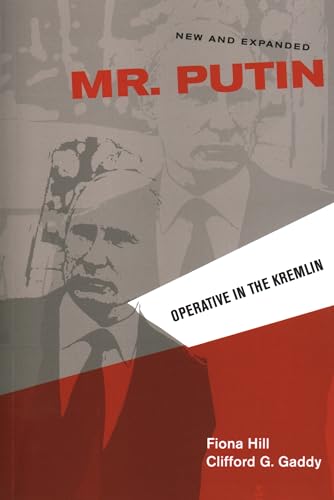
Inhaltsangabe
Fiona Hill and other U.S. public servants have been recognized as Guardians of the Year in TIME's 2019 Person of the Year issue.
From the KGB to the Kremlin: a multidimensional portrait of the man at war with the West.
Where do Vladimir Putin's ideas come from? How does he look at the outside world? What does he want, and how far is he willing to go?
The great lesson of the outbreak of World War I in 1914 was the danger of misreading the statements, actions, and intentions of the adversary. Today, Vladimir Putin has become the greatest challenge to European security and the global world order in decades. Russia's 8,000 nuclear weapons underscore the huge risks of not understanding who Putin is.
Featuring five new chapters, this new edition dispels potentially dangerous misconceptions about Putin and offers a clear-eyed look at his objectives. It presents Putin as a reflection of deeply ingrained Russian ways of thinking as well as his unique personal background and experience.
Praise for the first edition:
“If you want to begin to understand Russia today, read this book.”—Sir John Scarlett, former chief of the British Secret Intelligence Service (MI6)
“For anyone wishing to understand Russia's evolution since the breakup of the Soviet Union and its trajectory since then, the book you hold in your hand is an essential guide.”—John McLaughlin, former deputy director of U.S. Central Intelligence
“Of the many biographies of Vladimir Putin that have appeared in recent years, this one is the most useful.”—Foreign Affairs
“This is not just another Putin biography. It is a psychological portrait.”—The Financial Times
Q: Do you have time to read books? If so, which ones would you recommend? “My goodness, let's see. There's Mr. Putin, by Fiona Hill and Clifford Gaddy. Insightful.”—Vice President Joseph Biden in Joe Biden: The Rolling Stone Interview.
Die Inhaltsangabe kann sich auf eine andere Ausgabe dieses Titels beziehen.
Über die Autorinnen und Autoren
Fiona Hill was director of the Center on the United States and Europe and a senior fellow in Foreign Policy at Brookings.
Clifford G. Gaddy, an economist specializing in Russia, is a senior fellow in the Foreign Policy program's Center on the United States and Europe. He is a co-founder and senior scientific advisor of the joint Russian-American Center for Research on International Financial and Energy Security, based at Penn State University. Gaddy is the co-author of the recently released second edition of Mr. Putin: Operative in the Kremlin (Brookings, 2015).
Auszug. © Genehmigter Nachdruck. Alle Rechte vorbehalten.
Mr. Putin
Operative In The Kremlin
By Fiona Hill, Clifford G. GaddyBrookings Institution Press
Copyright © 2015 The Brookings Institution
All rights reserved.
ISBN: 978-0-8157-2617-3All rights reserved.
Contents
Acknowledgments, vii,
PART I. THE OPERATIVE EMERGES,
1 Who Is Mr. Putin?, 3,
2 Boris Yeltsin and the Time of Troubles, 22,
3 The Statist, 38,
4 The History Man, 63,
5 The Survivalist, 76,
6 The Outsider, 106,
7 The Free Marketeer, 132,
8 The Case Officer, 153,
9 The System, 190,
PART II. THE OPERATIVE ENGAGES,
10 The Stakeholders' Revolt, 227,
11 Putin's World, 260,
12 The American Education of Mr. Putin, 285,
13 Russia Resurgent, 312,
14 The Operative Abroad, 342,
Coda,
The Operative in Action, 385,
Chronology, 399,
Notes on Translation, Transliteration, Nomenclature, Style, and Sources, 407,
Abbreviations and Acronyms, 413,
Notes, 417,
Bibliography, 503,
Index, 519,
CHAPTER 1
WHO IS MR. PUTIN?
ON MARCH 18, 2014, still bathed in the afterglow of the Winter Olympics that he had hosted in the Black Sea resort of Sochi, Russian president Vladimir Putin stepped up to a podium in the Kremlin to address the nation. Before an assembly of Russian officials and parliamentarians, Putin signed the documents officially reuniting the Russian Federation and the peninsular republic of Crimea, the home base of Russia's Black Sea Fleet. Crimea had seceded from Ukraine only two days earlier, on March 16. The Russian president gave what was intended to be a historic speech. The events were fresh, but his address was laden with references to several centuries of Russian history.
Putin invoked the origins of Orthodox Christianity in Russia. He referenced military victories on land and sea that had helped forge the Russian Empire. He noted the grievances that had festered in Russia since the 1990s, when the state was unable to protect its interests after the disintegration of the Soviet Union. At the center of his narrative was Crimea. Crimea "has always been an inseparable part of Russia," Putin declared. Moscow's decision to annex Crimea was rooted in the need to right an "outrageous historical injustice." That injustice began with the Bolsheviks, who put lands that Russia had conquered into their new Soviet republic of Ukraine. Then, Soviet leader Nikita Khrushchev made the fateful decision in 1954 to transfer Crimea from the Russian Federation to Ukraine. When the Soviet state fell apart in 1991, Russian-speaking Crimea was left in Ukraine "like a sack of potatoes," Putin said. The Russian nation was divided by borders.
Vladimir Putin's speech and the ceremony reuniting Russia with its "lost province" came after several months of political upheaval in Ukraine. Demonstrations that had begun in late November 2013 as a protest against Ukrainian president Viktor Yanukovych's decision to back out of the planned signing of an association agreement with the European Union soon turned into a large-scale protest movement against his government. By February 2014, protesters were engaged in clashes with Ukrainian police that left over 100 people dead on both sides. On February 21, 2014, talks between Yanukovych and the opposition were brokered by outside parties, including Russia. A provisional agreement, intended to end the violence and pave the way for new presidential elections at the end of 2014, was upended when Yanukovych abruptly fled the country. After several days of confusion, Yanukovych resurfaced in Russia. Meanwhile, the opposition in Ukraine formed an interim government and set presidential elections for May 25, 2014.
At about the same time that Yanukovych left Ukraine, unidentified armed men began to seize control of strategic infrastructure on the Crimean Peninsula. On March 6, the Crimean parliament voted to hold a snap referendum on independence and the prospect of joining Russia. On March 16, the results of the referendum indicated that 97 percent of those voting had opted to unite with Russia. It was this referendum that Putin used to justify Russia's reincorporation, its annexation, of Crimea. He opened his speech with a reference to the referendum and how more than 82 percent of eligible voters had turned out to make this momentous and overwhelming choice in favor of becoming part of Russia. The people of Crimea had exercised their right—the right of all nations—to self-determination. They had chosen to restore the unity of the Russian world and historical Russia. But by annexing the Crimean Peninsula, immediately after the referendum, Putin had dealt the greatest blow to European security since the end of the Cold War. In the eyes of most external observers, Putin's Russia was now a definitively revisionist power. In a short span of time, between February 21 and March 18, 2014, Russia had moved from brokering peace to taking a piece of Ukraine.
As Western leaders deliberated how to punish Putin for seizing Crimea and deter him from similar actions in the rest of Ukraine and elsewhere, questions arose: Why did Putin do this? What does he want? Many commentators turned back to questions that had been asked nearly 15 years earlier, when Vladimir Putin first emerged from near-obscurity to become the leader of Russia: "Who is Mr. Putin?" For some observers, the answer was easy: Putin was who he had always been—a corrupt, avaricious, and power-hungry authoritarian leader. What Putin did in Ukraine was just a logical next step to what he had been doing in Russia since 2000: trying to tighten his grip on power. Annexing Crimea and the nationalist rhetoric Putin used to justify it were merely ploys to bolster his flagging public support and distract the population from problems at home. Other commentators saw Putin's shift toward nationalist rhetoric and his decision to annex Crimea as evidence of new "imperial" thinking, and as dangerously genuine. Putin's goal, they proposed, was to restore the Soviet Union or the old Russian Empire. But if that was true, where were the patterns and key indicators of neo-imperialist revisionism in Putin's past behavior? Many world leaders and analysts wondered what they had missed. Unable to reconcile their old understanding of Putin with his behavior in Ukraine, some concluded that Putin himself had changed. A "new Putin" must have appeared in the Kremlin.
If, in fact, Putin's behavior in the Ukraine crisis was really different from the past, it could provide an opportunity to understand him better. In his 2014 book, A Sense of the Enemy: The High-Stakes History of Reading Your Rival's Mind, Zachary Shore argues that it is precisely when people break with previous patterns of behavior that we can begin to gain an understanding of their real character. Patterns of past behavior are a poor predictor of how a person will act in the future. Contexts change and alter people's actions. Pattern breaks are key for analyzing individual behavior. They push us to focus on the invariant aspects of the person's self. They help reveal the hidden drivers, the underlying motivations, and what an actor, a leader, values most.
This is the essence of our approach in this book. The book is an effort to figure out who Mr. Putin is in terms of his motivations—what drives him to act as he does? Rather than present a chronicle of events in which Putin played a role, we concentrate on events that shaped him. We look at formative experiences of Putin's past. And where we do examine his actions, we focus on the...
„Über diesen Titel“ kann sich auf eine andere Ausgabe dieses Titels beziehen.
Suchergebnisse für Mr. Putin: Operative in the Kremlin (Geopolitics in...

Beispielbild für diese ISBN
Mr. Putin REV: Operative in the Kremlin
Verlag:
Bloomsbury Publishing Plc, 2015
ISBN 10: 0815726171
ISBN 13: 9780815726173
Gebraucht
Paperback
Anbieter: World of Books (was SecondSale), Montgomery, IL, USA
Verkäuferbewertung 5 von 5 Sternen

Paperback. Zustand: Good. Today Crimea. Tomorrow? Many Putin watchers believe that being able to anticipate the enigmatic Russian president's next move - whether it's hosting another grandiose spectacle, crushing a political rival, or annexing part of a neighboring country - depends on uncovering the "real" Vladimir Putin and his true motives. Artikel-Nr. 00104469332
Gebraucht kaufen
EUR 4,14
Versand gratis
Versand innerhalb von USA
Versand innerhalb von USA
Anzahl: 4 verfügbar
Foto des Verkäufers
Mr. Putin: Operative in the Kremlin (Geopolitics in the 21st Century)
Verlag:
Brookings Institution Press, 2015
ISBN 10: 0815726171
ISBN 13: 9780815726173
Gebraucht
Softcover
Anbieter: Dream Books Co., Denver, CO, USA
Verkäuferbewertung 5 von 5 Sternen
Zustand: acceptable. This copy has clearly been enjoyedâ"expect noticeable shelf wear and some minor creases to the cover. Binding is strong, and all pages are legible. May contain previous library markings or stamps. Artikel-Nr. DBV.0815726171.A
Gebraucht kaufen
EUR 4,15
Versand gratis
Versand innerhalb von USA
Versand innerhalb von USA
Anzahl: 1 verfügbar
Beispielbild für diese ISBN
Mr. Putin REV: Operative in the Kremlin
Verlag:
Brookings Institution Press, 2015
ISBN 10: 0815726171
ISBN 13: 9780815726173
Gebraucht
Paperback
Anbieter: ThriftBooks-Reno, Reno, NV, USA
Verkäuferbewertung 5 von 5 Sternen
Paperback. Zustand: Very Good. No Jacket. May have limited writing in cover pages. Pages are unmarked. ~ ThriftBooks: Read More, Spend Less. Artikel-Nr. G0815726171I4N00
Gebraucht kaufen
EUR 6,20
Versand gratis
Versand innerhalb von USA
Versand innerhalb von USA
Anzahl: 1 verfügbar
Beispielbild für diese ISBN
Mr. Putin REV: Operative in the Kremlin
Verlag:
Brookings Institution Press, 2015
ISBN 10: 0815726171
ISBN 13: 9780815726173
Gebraucht
Paperback
Anbieter: ThriftBooks-Phoenix, Phoenix, AZ, USA
Verkäuferbewertung 5 von 5 Sternen
Paperback. Zustand: Very Good. No Jacket. Former library book; May have limited writing in cover pages. Pages are unmarked. ~ ThriftBooks: Read More, Spend Less. Artikel-Nr. G0815726171I4N10
Gebraucht kaufen
EUR 6,20
Versand gratis
Versand innerhalb von USA
Versand innerhalb von USA
Anzahl: 1 verfügbar
Beispielbild für diese ISBN
Mr. Putin REV: Operative in the Kremlin
Verlag:
Brookings Institution Press, 2015
ISBN 10: 0815726171
ISBN 13: 9780815726173
Gebraucht
Paperback
Anbieter: ThriftBooks-Reno, Reno, NV, USA
Verkäuferbewertung 5 von 5 Sternen
Paperback. Zustand: Good. No Jacket. Pages can have notes/highlighting. Spine may show signs of wear. ~ ThriftBooks: Read More, Spend Less. Artikel-Nr. G0815726171I3N00
Gebraucht kaufen
EUR 6,20
Versand gratis
Versand innerhalb von USA
Versand innerhalb von USA
Anzahl: 1 verfügbar
Beispielbild für diese ISBN
Mr. Putin REV: Operative in the Kremlin
Verlag:
Brookings Institution Press, 2015
ISBN 10: 0815726171
ISBN 13: 9780815726173
Gebraucht
Paperback
Anbieter: ThriftBooks-Atlanta, AUSTELL, GA, USA
Verkäuferbewertung 5 von 5 Sternen
Paperback. Zustand: Good. No Jacket. Pages can have notes/highlighting. Spine may show signs of wear. ~ ThriftBooks: Read More, Spend Less. Artikel-Nr. G0815726171I3N00
Gebraucht kaufen
EUR 6,20
Versand gratis
Versand innerhalb von USA
Versand innerhalb von USA
Anzahl: 2 verfügbar
Beispielbild für diese ISBN
Mr. Putin REV: Operative in the Kremlin
Verlag:
Brookings Institution Press, 2015
ISBN 10: 0815726171
ISBN 13: 9780815726173
Gebraucht
Paperback
Anbieter: ThriftBooks-Atlanta, AUSTELL, GA, USA
Verkäuferbewertung 5 von 5 Sternen
Paperback. Zustand: Good. No Jacket. Former library book; Pages can have notes/highlighting. Spine may show signs of wear. ~ ThriftBooks: Read More, Spend Less. Artikel-Nr. G0815726171I3N10
Gebraucht kaufen
EUR 6,20
Versand gratis
Versand innerhalb von USA
Versand innerhalb von USA
Anzahl: 1 verfügbar
Beispielbild für diese ISBN
Mr. Putin REV: Operative in the Kremlin
Verlag:
Brookings Institution Press, 2015
ISBN 10: 0815726171
ISBN 13: 9780815726173
Gebraucht
Paperback
Anbieter: ThriftBooks-Dallas, Dallas, TX, USA
Verkäuferbewertung 5 von 5 Sternen
Paperback. Zustand: Fair. No Jacket. Readable copy. Pages may have considerable notes/highlighting. ~ ThriftBooks: Read More, Spend Less. Artikel-Nr. G0815726171I5N00
Gebraucht kaufen
EUR 6,20
Versand gratis
Versand innerhalb von USA
Versand innerhalb von USA
Anzahl: 1 verfügbar
Beispielbild für diese ISBN
Mr. Putin REV: Operative in the Kremlin
Verlag:
Brookings Institution Press, 2015
ISBN 10: 0815726171
ISBN 13: 9780815726173
Gebraucht
Paperback
Anbieter: ThriftBooks-Atlanta, AUSTELL, GA, USA
Verkäuferbewertung 5 von 5 Sternen
Paperback. Zustand: Very Good. No Jacket. Former library book; May have limited writing in cover pages. Pages are unmarked. ~ ThriftBooks: Read More, Spend Less. Artikel-Nr. G0815726171I4N10
Gebraucht kaufen
EUR 6,20
Versand gratis
Versand innerhalb von USA
Versand innerhalb von USA
Anzahl: 1 verfügbar
Beispielbild für diese ISBN
Mr. Putin REV: Operative in the Kremlin
Verlag:
Brookings Institution Press, 2015
ISBN 10: 0815726171
ISBN 13: 9780815726173
Gebraucht
Paperback
Anbieter: ThriftBooks-Phoenix, Phoenix, AZ, USA
Verkäuferbewertung 5 von 5 Sternen
Paperback. Zustand: Very Good. No Jacket. May have limited writing in cover pages. Pages are unmarked. ~ ThriftBooks: Read More, Spend Less. Artikel-Nr. G0815726171I4N00
Gebraucht kaufen
EUR 6,20
Versand gratis
Versand innerhalb von USA
Versand innerhalb von USA
Anzahl: 1 verfügbar