
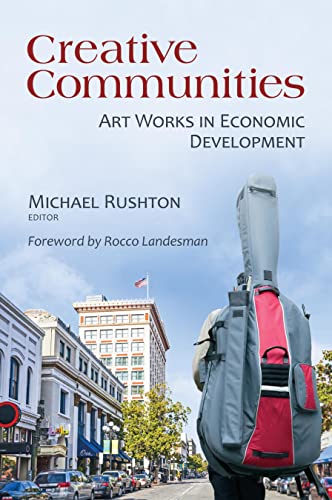
Verwandte Artikel zu Creative Communities: Art Works in Economic Development
Inhaltsangabe
Urban and regional planners, elected officials, and other decisionmakers are increasingly focused on what makes places livable. Access to the arts inevitably appears high on that list, but knowledge about how culture and the arts can act as a tool of economic development is sadly lacking. This important sector must be considered not only as a source of amenities or pleasant diversions, but also as a wholly integrated part of local economies. Employing original data produced through both quantitative and qualitative research, Creative Communities provides a greater understanding of how art works as an engine for transforming communities.
""Without good data and analysis—much of it grounded in economic theory—we cannot hope to strengthen communities through the arts or to achieve any of the other goals we set for the National Endowment for the Arts, the largest nationwide funder of the arts."" —from the Foreword by Rocco Landesman
Contributors: Hasan Bakhshi (Nesta UK), Elisa Barbour (University of California, Berkeley), Shiri M. Breznitz (Georgia Institute of Technology), Roland J. Kushner (Muhlenberg College), Rex LaMore (Michigan State University), James Lawton (Michigan State), Neil Lee (Nesta UK), Richard G. Maloney (Boston University), Ann Markusen (University of Minnesota), Juan Mateos-Garcia (Nesta UK), Anne Gadwa Nicodemus (Metris Arts Consulting), Douglas S. Noonan (Indiana University–Purdue University Indianapolis), Peter Pedroni (Williams College), Amber Peruski (Michigan State), Michele Root-Bernstein (Michigan State), Robert Root-Bernstein (Michigan State), Eileen Roraback (Michigan State), Michael Rushton (Indiana University), Lauren Schmitz (New School for Social Research), Jenny Schuetz (University of Southern California), John Schweitzer (Michigan State), Stephen Sheppard (Williams College), Megan VanDyke (Michigan State), Gregory H. Wassall (Northeastern University)
Die Inhaltsangabe kann sich auf eine andere Ausgabe dieses Titels beziehen.
Über die Autorinnen und Autoren
Michael Rushton is associate professor in the School of Public and Environmental Affairs at Indiana University, where he directs the program in arts administration. He coedited the Journal of Cultural Economics from 2006 to 2012.
Rocco Landesman, chairman of the National Endowment for the Arts from 2009 to 2012, is the Tony Award–winning producer of hit Broadway shows such as Angels in America and The Producers.
Auszug. © Genehmigter Nachdruck. Alle Rechte vorbehalten.
Creative Communities
Art Works in Economic Development
By Michael RushtonBROOKINGS INSTITUTION PRESS
Copyright © 2013 THE BROOKINGS INSTITUTION
All rights reserved.
ISBN: 978-0-8157-2473-5All rights reserved.
Contents
| Foreword Rocco Landesman.................................................. | vii |
| Acknowledgments............................................................ | xi |
| 1 Introduction Michael Rushton............................................ | 1 |
| 2 Causal Agents or Canaries in the Coal Mine? Art Galleries and Neighborhood Change Jenny Schuetz......................................... | 12 |
| 3 The Arts, Consumption, and Innovation in Regional Development Ann Markusen, Anne Gadwa Nicodemus, and Elisa Barbour.......................... | 36 |
| 4 A Case Study in Cultural Economic Development: The Adams Arts Program in Massachusetts Richard G. Maloney and Gregory H. Wassall................... | 60 |
| 5 Do Cultural Tax Districts Buttress Revenue Growth for Arts Organizations? Lauren Schmitz............................................. | 80 |
| 6 Arts, Crafts, and STEM Innovation: A Network Approach to Understanding the Creative Knowledge Economy Robert Root-Bernstein, Rex LaMore, James Lawton, John Schweitzer, Michele Root-Bernstein, Eileen Roraback, Amber Peruski, and Megan VanDyke................................................. | 97 |
| 7 Arts Districts, Universities, and the Rise of Media Arts Douglas S. Noonan and Shiri M. Breznitz............................................... | 118 |
| 8 Cultural Enterprise Formation and Cultural Participation in America's Counties Roland J. Kushner................................................ | 144 |
| 9 The Economic Consequences of Cultural Spending Peter Pedroni and Stephen Sheppard........................................................... | 166 |
| 10 Capital of Culture? An Econometric Analysis of the Relationship between Arts and Cultural Clusters, Wages, and the Creative Economy in English Cities Hasan Bakhshi, Neil Lee, and Juan Mateos-Garcia.................... | 190 |
| Contributors............................................................... | 217 |
| Index...................................................................... | 219 |
Excerpt
CHAPTER 1
Introduction
This volume presents original research findings on the impacts of culturalconsumption and production on local economies. The chapters arebased on papers presented at "The Arts, New Growth Theory, and EconomicDevelopment," a May 2012 Brookings Institution symposium sponsored bythe National Endowment for the Arts. The central theme of the symposiumwas that the arts are not an amenity or a sector that exists in isolation but thatthey are wholly integrated into local economies. Indeed, the complex role ofart in local growth is what has made empirical research in the field so challengingand the new research in this volume so welcome to scholars and policymakerswho seek to advance public knowledge about the dynamicrelationship between art and economic growth.
The following chapters investigate the arts in local economies from a rangeof viewpoints, presenting original data derived from quantitative and qualitativemethods. Topics investigated include location choices by arts entrepreneurs;links between the arts and non-arts sectors; public policies to fosterlocal arts organizations; and the arts' effects on incomes in cities across theUnited States and the United Kingdom. There is no single method of parsingthe complex factors at work, and these chapters should inspire furtherresearch along various lines to advance knowledge about the place of the artsin economic development. A brief review of the evolution of arts policy andof thinking about economic growth is presented below, followed by a surveyof the contributions of these chapters and suggestions for future research.
Public Policy and the Arts
Until around the turn of the twenty-first century, public arts policy in theUnited States received relatively little attention. There was enough of a committedinterest group to keep public funding of the arts alive at the federal,state, and local levels, although budgets were generally small; however, thegreatest public support of the arts came from income tax–deductible charitabledonations to nonprofit arts organizations, not from public funding.Typically, the only time that arts policy was newsworthy was when publiccontroversy arose over specific works of art that had received, usually indirectly,some form of government support.
In the 1960s, the rationales for direct public funding of the arts tended tocenter on the benefits to the public of being able to enjoy fine arts: classicalmusic, opera, ballet and modern dance, some theater, and the visual arts.First, there was the case for equity: the fine arts are part of a fulfilling life thatought to be made available to all, including those who have low incomes orwho live far from major art centers. Public funding of nonprofit arts organizationscould enable those organizations to undertake outreach activities tounderserved populations and to keep ticket prices in check. Second, there wasa rationale based on the potential for market failures in the arts: public subsidiesare a means of encouraging the production and consumption of formsof art that provide public benefits, especially art forms that would be unlikelyto flourish in a purely market-oriented environment. Because the fine artsprovide public as well as private benefits, they do not represent purely privateconsumption. For example, people may benefit from my attending the operaeven if they themselves never attend. They might be pleased that the traditionsof operatic performance are being preserved so that they have the option ofattending one day in the future (or that their children and grandchildren havethat option), they might take special pride in knowing that their communityis considered a center of culture, or they may simply feel good because othersin the community are enjoying art of high quality.
However, even those who enjoy the arts a great deal might find those rationalesfor public funding somewhat weak. If the real concern is about inequalityin the United States, are health, education, and housing not more pressingconcerns than art museums and classical music performances? Are theclaimed external benefits of private arts consumption of any significant magnitude,or do they simply represent wishful thinking by those who themselveshappen to value the arts and their associated public subsidies?
More recently, however, two new kinds of economics-based cases havebeen made for active public support of the arts. One is the so-called "economicimpact" of the arts. In many studies commissioned by arts advocates,impact is calculated by measuring direct consumer spending on the arts (usuallyrestricted to the nonprofit sector), then inflated by a Keynesian-style"multiplier" that generates an estimate of the complete impact on aggregateincome resulting from arts expenditures. Although some arts advocates,impact studies in hand, proclaim that the arts warrant public subsidy becauseof the great amount of total income generated by arts expenditures, the problemswith the analysis are clear: the estimated benefits from increased expenditureson...
„Über diesen Titel“ kann sich auf eine andere Ausgabe dieses Titels beziehen.
Suchergebnisse für Creative Communities: Art Works in Economic Development

Beispielbild für diese ISBN
Creative Communities: Art Works in Economic Development
Verlag:
Brookings Institution Press, 2013
ISBN 10: 081572473X
ISBN 13: 9780815724735
Gebraucht
Softcover
Anbieter: World of Books (was SecondSale), Montgomery, IL, USA
Verkäuferbewertung 5 von 5 Sternen

Zustand: Very Good. Item in very good condition! Textbooks may not include supplemental items i.e. CDs, access codes etc. Artikel-Nr. 00105524172
Gebraucht kaufen
EUR 7,47
Versand gratis
Versand innerhalb von USA
Versand innerhalb von USA
Anzahl: 1 verfügbar
Beispielbild für diese ISBN
Creative Communities: Art Works in Economic Development
Anbieter: Ria Christie Collections, Uxbridge, Vereinigtes Königreich
Verkäuferbewertung 5 von 5 Sternen
Zustand: New. In. Artikel-Nr. ria9780815724735_new
Neu kaufen
EUR 45,12
EUR 14,00 Versand
Versand von Vereinigtes Königreich nach USA
Versand von Vereinigtes Königreich nach USA
Anzahl: Mehr als 20 verfügbar
Beispielbild für diese ISBN
Creative Communities: Art Works in Economic Development
Anbieter: Revaluation Books, Exeter, Vereinigtes Königreich
Verkäuferbewertung 5 von 5 Sternen
Paperback. Zustand: Brand New. 1st edition. 225 pages. 9.00x6.00x0.75 inches. In Stock. Artikel-Nr. x-081572473X
Neu kaufen
EUR 53,35
EUR 11,69 Versand
Versand von Vereinigtes Königreich nach USA
Versand von Vereinigtes Königreich nach USA
Anzahl: 2 verfügbar
Beispielbild für diese ISBN
Creative Communities
Anbieter: Majestic Books, Hounslow, Vereinigtes Königreich
Verkäuferbewertung 4 von 5 Sternen

Zustand: New. pp. 225 Illus. Artikel-Nr. 96208789
Neu kaufen
EUR 78,66
EUR 7,60 Versand
Versand von Vereinigtes Königreich nach USA
Versand von Vereinigtes Königreich nach USA
Anzahl: 1 verfügbar