
Verwandte Artikel zu The Politics of Protection: The Limits of Humanitarian...
Inhaltsangabe
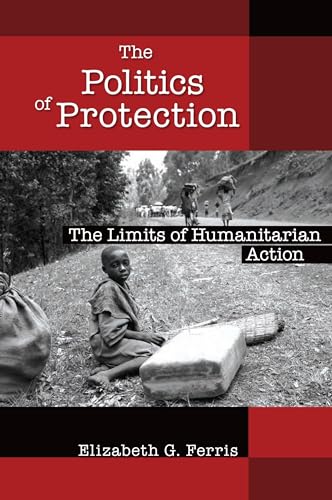
For the past decade, humanitarian actors have increasingly sought not only to assist people affected by conflicts and natural disasters, but also to protect them. At the same time, protection of civilians has become central to UN peacekeeping operations, and the UN General Assembly has endorsed the principle that the international community has the ""responsibility to protect"" people when their governments cannot or will not do so. Elizabeth Ferris explores the evolution of the international community's understandings of protection, with a particular emphasis on the humanitarian community.
""Protection"" is a noble word, with positive connotations, but what does it actually mean in practice? Does providing assistance to vulnerable people protect them, for example? Does monitoring the number of rapes protect women? Does increased engagement in protection activities by humanitarian agencies jeopardize the cornerstone humanitarian principles of neutrality and impartiality?
In The Politics of Protection, Ferris examines inconsistent ways in which protection is defined and applied. For example, why do certain groups receive international protection while other equally needy groups do not? Her case studies, ranging from Iraq to Katrina, illustrate the challenges—and limitations—of protecting vulnerable populations from the ravages of war and natural disasters. Ferris argues that the protection paradigms currently in use are inadequate to meet the challenges of the future, such as climate change, protracted displacement, and the changing nature of warfare.
Die Inhaltsangabe kann sich auf eine andere Ausgabe dieses Titels beziehen.
Über die Autorin bzw. den Autor
Elizabeth G. Ferris is a senior fellow in Foreign Policy at the Brookings Institution, where she is codirector of the Brookings Project on Internal Displacement. Prior to joining Brookings she spent twenty years in the field of humanitarian assistance, most recently with the World Council of Churches in Geneva.
Auszug. © Genehmigter Nachdruck. Alle Rechte vorbehalten.
The Politics of Protection
The Limits of Humanitarian ActionBy Elizabeth G. FerrisBrookings Institution Press
Copyright © 2011 THE BROOKINGS INSTITUTIONAll right reserved.
ISBN: 978-0-8157-2137-6
Contents
Acknowledgments...........................................................................ixIntroduction..............................................................................xi1 Humanitarian Principles and International Law...........................................12 Human Rights and Protection.............................................................403 Protection and Humanitarian Assistance: Communities and Governments.....................624 The UN and NGOs in Humanitarian Operations..............................................915 Global Governance.......................................................................1266 Humanitarian Dilemmas...................................................................1747 Natural Disasters and Protection........................................................2008 Paying for Protection: Humanitarian Financing...........................................2289 Future Challenges for Humanitarian Actors...............................................24510 Concluding Observations and Recommendations............................................270Notes.....................................................................................287Index.....................................................................................345
Chapter One
Humanitarian Principles and International Law
Protect: To defend or guard from danger or injury; to support or assist against hostile or inimical action; to preserve from attack, persecution, harassment, etc.; to keep safe, take care of; to extend patronage to: to shield from attack or damage.
The concept of protection is an ancient one, cited liberally in the Hebrew Scriptures and later in the New Testament, the Koran, and other religious writings. The word "protect" comes from the Latin protegere, meaning to shield, cover, protect, defend. Over the ages in Western civilization, the term has been used in various ways: God's protection, royal protection, diplomatic protection, self-protection, protection under the law, and, more recently, equal protection, trade protection, consumer protection, social protection, environmental protection, copyright protection, and so on. "Protection" is a nice word, a noble word. It is used by historians, political scientists, anthropologists, lawyers, politicians, and even theologians with somewhat different meanings. But it always has a positive connotation.
Since the establishment of the modern international system based on nation-states, usually dated from the Treaty of Westphalia in 1648, it is a recognized responsibility of states to protect their citizens from harm, to defend them from danger, to save them from persecution—in short, to keep them safe. The ability to protect one's citizens is intrinsic to the very definition of a state. If a state cannot protect its people, it has failed as a state.
But there are times when states are not able to protect all of their people and when international law—particularly international humanitarian law, human rights law, and refugee law—provides for protection by others. Most recently the 2005 World Summit adopted the doctrine of "responsibility to protect," which affirms the centrality of the state as the protector of its people but also sets out a series of measures to be taken by the international community when a state is unable or unwilling to protect its citizens.
This book focuses on the understandings and practice of protection in the international humanitarian system, but humanitarians have no monopoly on the term. Protection has become central to UN discussions—and decisions—on on peacekeeping. All but one of the eleven peacekeeping missions initiated in the past decade have included the protection of civilians in their mandate. Protection of civilians has become a UN-wide priority.
Protection in the Humanitarian World
The concept of protection was central to the development of international humanitarian law (IHL), the first component of the concept of protection, which initially stemmed from the need to protect soldiers who were wounded, captured, or otherwise hors de combat. IHL was expanded in 1949 to include measures to protect civilians, and since then the International Committee of the Red Cross (ICRC), the guardian of IHL, has tried to provide guidance on such thorny issues as distinguishing civilians from combatants and the question of the responsibility of nonstate actors to uphold IHL, including protection of civilians. ICRC also has moved to respond to new forms of warfare and has played a leadership role in the campaign to ban antipersonnel land mines. In other words, over the past 150 years or so, IHL has expanded its original remit to protect prisoners of war and wounded soldiers into a broad range of activities designed to protect civilians who are affected by but are not direct participants in conflicts.
The development of a second fundamental component of the concept of protection occurred in the aftermath of the European wars of the twentieth century, when protection of refugees emerged as a response to the plight of individuals who had fled their countries because of those wars or because of persecution. Because their governments were no longer able to protect them, it was the responsibility of host governments and the international community to do so. Just as the International Committee of the Red Cross became the guardian of international humanitarian law, the United Nations High Commissioner for Refugees (UNHCR) became the custodian of international refugee law. Still later in the twentieth century, the growing recognition that people who were displaced from their communities but remained within the borders of their countries also needed protection led to the development of international norms for protecting internally displaced persons.
A third component of the notion of protection comes from international human rights law. The Universal Declaration of Human Rights refers to "protection" ten times: "Human rights should be protected by law, "All are entitled to equal protection under the law," and so on. In fact, much of the modern human rights movement is about expanding the scope of protection: protection of the rights of racial and ethnic minorities, of children, of women, and of gay and lesbian people; protection of the cultures of indigenous people; and so on. The expansion of the groups in need of protection paralleled the expansion of the understanding of human rights from its early, almost exclusive focus on the civil and political rights of individuals to its inclusion of the economic, social, and cultural rights of both individuals and communities. By the end of the 1990s, explicit reference to the protection of civilians emerged in UN Security Council resolutions.
As universal human rights broadened to include more groups, so too the concept of protection expanded in human rights discourse. Protection meant not only physical protection of people from violence and legal protection of refugees from deportation but also protection from hunger, illness, and discrimination. Similarly, one can trace the expansion of protection in the humanitarian field from protection of soldiers (hors de combat) to protection of refugees, to protection of children in armed conflict, to protection of internally displaced persons, to...
„Über diesen Titel“ kann sich auf eine andere Ausgabe dieses Titels beziehen.
Suchergebnisse für The Politics of Protection: The Limits of Humanitarian...

Beispielbild für diese ISBN
The Politics of Protection: The Limits of Humanitarian Action
Verlag:
Brookings Institution Press, 2011
ISBN 10: 0815721374
ISBN 13: 9780815721376
Gebraucht
Softcover
Anbieter: World of Books (was SecondSale), Montgomery, IL, USA
Verkäuferbewertung 5 von 5 Sternen

Zustand: Good. Item in good condition and has highlighting/writing on text. Used texts may not contain supplemental items such as CDs, info-trac etc. Artikel-Nr. 00094624377
Gebraucht kaufen
EUR 6,17
Versand gratis
Versand innerhalb von USA
Versand innerhalb von USA
Anzahl: 1 verfügbar
Beispielbild für diese ISBN
The Politics of Protection: The Limits of Humanitarian Action
Anbieter: Ria Christie Collections, Uxbridge, Vereinigtes Königreich
Verkäuferbewertung 5 von 5 Sternen
Zustand: New. In. Artikel-Nr. ria9780815721376_new
Neu kaufen
EUR 45,05
EUR 13,17 Versand
Versand von Vereinigtes Königreich nach USA
Versand von Vereinigtes Königreich nach USA
Anzahl: Mehr als 20 verfügbar
Beispielbild für diese ISBN
The Politics of Protection: The Limits of Humanitarian Action
Anbieter: Revaluation Books, Exeter, Vereinigtes Königreich
Verkäuferbewertung 5 von 5 Sternen
Paperback. Zustand: Brand New. 359 pages. 8.90x6.00x1.00 inches. In Stock. Artikel-Nr. x-0815721374
Neu kaufen
EUR 59,62
EUR 14,58 Versand
Versand von Vereinigtes Königreich nach USA
Versand von Vereinigtes Königreich nach USA
Anzahl: 2 verfügbar