
Verwandte Artikel zu Delivering Aid Differently: Lessons from the Field
Inhaltsangabe
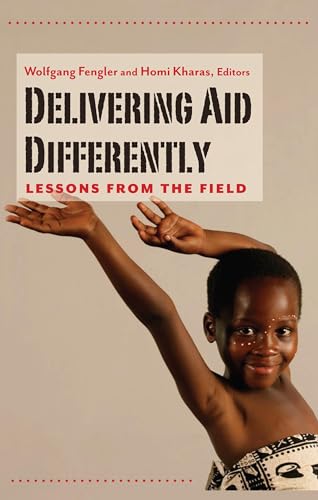
" We live in a new reality of aid. Gone is the traditional bilateral relationship, the old-fashioned mode of delivering aid, and the perception of the third world as a homogenous block of poor countries in the south. Delivering Aid Differently describes the new realities of a $200 billion aid industry that has overtaken this traditional model of development assistance. As the title suggests, aid must now be delivered differently. Here, case study authors consider the results of aid in their own countries, highlighting field-based lessons on how aid works on the ground, while focusing on problems in current aid delivery and on promising approaches to resolving these problems. Contributors include Cut Dian Agustina (World Bank), Getnet Alemu (College of Development Studies, Addis Ababa University), Rustam Aminjanov (NAMO Consulting), Ek Chanboreth and Sok Hach (Economic Institute of Cambodia), Firuz Kataev and Matin Kholmatov (NAMO Consulting), Johannes F. Linn (Wolfensohn Center for Development at Brookings), Abdul Malik (World Bank, South Asia), Harry Masyrafah and Jock M. J. A. McKeon (World Bank, Aceh), Francis M. Mwega (Department of Economics, University of Nairobi), Rebecca Winthrop (Center for Universal Education at Brookings), Ahmad Zaki Fahmi (World Bank)"
Die Inhaltsangabe kann sich auf eine andere Ausgabe dieses Titels beziehen.
Über die Autorin bzw. den Autor
Wolfgang Fengler is a lead economist in the Nairobi office of the World Bank, where he covers Kenya, Rwanda, Eritrea, and Somalia. Previously, he was a senior economist in the Jakarta office and managed the Public Finance and Regional Development team.Homi Kharas is a senior fellow for Global Economy and Development at the Brookings Institution. Before joining Brookings, he was chief economist for the East Asia and Pacific Region at the World Bank.
Auszug. © Genehmigter Nachdruck. Alle Rechte vorbehalten.
Delivering Aid Differently
Lessons from the FieldBy Wolfgang Fengler Homi KharasBrookings Institution Press
Copyright © 2010 Wolfgang Fengler and Homi KharasAll right reserved.
ISBN: 978-0-8157-0480-5
Chapter One
Overview: Delivering Aid Differently WOLFGANG FENGLER and HOMI KHARAS
Since 1960, $3.2 trillion of aid has been delivered from rich countries to poor countries, mainly through a handful of bilateral and multilateral institutions. Recently, this traditional model of development assistance has been overtaken by a more complex reality of aid in response to new circumstances, new international players, and new instruments for delivery. The changed circumstances reflect the fact that developing countries are no longer a homogeneous group of "poor" countries but instead are highly differentiated in their capabilities and needs.
Meanwhile, the new international donors include more bilateral governments, even some, like China, that are still characterized as developing countries. New international donors also include international NGOs, foundations, and private corporations, all of which channel significant volumes of large and small contributions by private individuals from rich to poor countries. Most of these new players operate differently from and parallel to the traditional aid system. New instruments include budget support, debt relief, public-private partnerships, and South-South cooperation.
New players and new modalities have brought fresh energy, resources, and approaches to the delivery of aid. But they have also added to waste, overlap, and uncoordinated efforts that might be individually successful but that do not add up to the systemic transformation needed for a significant impact on development. It is time for development partners to construct an aid architecture for the twenty-first century that broadens the current system to be inclusive of both existing and potential new players and new modalities. Put another way, aid must be delivered differently.
This book highlights field-based lessons on how aid works on the ground, focusing both on problems in current aid delivery and on promising approaches to resolving these problems. It documents the growing fragmentation of aid into ever smaller projects, the planning and implementation difficulties caused by high aid volatility and unpredictability, and the complexities of trying to coordinate the myriad new and different aid donors. It also looks at country experiences with solutions: new information databases for tracking aid, joint country strategies to coordinate approaches, and lessons from the humanitarian community on how to forge a division of labor between official and private aid givers.
There is one other distinguishing feature of the country case studies in this volume. They are all written by scholars born and living in aid recipient countries who interact on a daily basis with government officials on aid issues. These scholars combine a quantitative, analytical discussion with their own personal perceptions on the impact of aid on development in their countries. Surprisingly, given the rhetoric on the importance of recipient country ownership of aid, the current literature on aid effectiveness is dominated by scholars from donor countries. We hope that, by giving voice to those who are at the receiving end, we can expose some hard truths about what works and what does not work.
Country Experiences
In the wake of the 2004 Indian Ocean tsunami, donors worldwide gave billions of dollars in aid to help places like the Indonesian province of Aceh recover from the disaster (see chapter 2, by Harry Masyrafah and Jock McKeon). A brand new coordinating agency within the Indonesian government kept track of the projects being funded by nearly 500 organizations. Its coordination efforts helped identify gaps in funding, and a multiyear trust fund improved predictability of aid flows reaching the people of Aceh.
In Pakistan a small-scale rural support program initiated by a nongovernmental agency has been replicated with financing from the government and international donors. There are now rural support programs in 94 of the country's 138 districts, reaching over 2 million poor households. The program is a notable example of how government can work with private donors to solve the problem of fragmentation by scaling up effective development projects (see chapter 6, by Abdul Malik).
Tajikistan is moving through a joint country assistance process that brings together the largest official aid donors with government officials and even a nongovernmental organization to develop a single strategic plan for development aid in the country. The process will be tied closely to the government's new poverty reduction strategy, promising an aid environment in close alignment with national needs and featuring strong country ownership of the process. Joint country efforts in a dozen other countries have engendered a roundtable mentality among donors and have led to new efforts at collaboration (see chapter 7, by Rustam Aminjanov, Matin Kholmatov, and Firuz Kataev).
Efforts like these, described in the country studies in this volume, show the potential for aid to help development when that aid is coordinated and administered in a way that benefits poor people. These efforts come at a time when the future of foreign aid is being fiercely debated. On the one hand, some observers-including Peter Singer and Jeffrey Sachs-support a huge increase in the size of foreign aid budgets, faulting a lack of donor generosity for the continued existence of severe poverty. Their message: aid works, we just don't do enough of it. On the other hand, there are also scathing critiques of aid. William Easterly derides the "planners" of the world who seek grand strategies that too often end up being supply driven and unimplementable. Dambisa Moyo describes what she sees as the ways that oil wealth, for example, detaches recipient governments from accountability to their citizens and in fact retards Africa's progress. Easterly and Moyo believe official aid should be largely scrapped. In between these camps, aid practitioners argue that foreign aid could work if only it were done right. What should we believe when there is such disagreement among experts?
In this volume we bring to this global debate the realities of how aid works on the ground in a cross section of countries: Aceh (Indonesia), Cambodia, Ethiopia, Kenya, Pakistan, and Tajikistan. In each case aid is important; in some of the countries, it is vital. We chose these countries to reflect some of the diversity of developing countries. In much of the aid literature, developing countries are treated as if they are similar. In reality, they are not. Some countries, like Indonesia and Pakistan, are large, so that aid, while important as a catalyst, is a small fraction of their gross domestic product. These countries also have relatively strong central government administrative structures, with long experience in implementing development projects. Countries like Ethiopia and Cambodia, on the other hand, are more aid dependent. They have had stable governments for some time, governments with a keen interest in managing aid. Tajikistan and Kenya, though, have had volatile political relationships with donors and complicated aid programs. These characteristics, by no means exhaustive, show how difficult it is to generalize about aid when conditions in recipient countries differ so greatly.
A defining feature of all the case studies is the emergence of new players. Bilateral...
„Über diesen Titel“ kann sich auf eine andere Ausgabe dieses Titels beziehen.
Suchergebnisse für Delivering Aid Differently: Lessons from the Field

Foto des Verkäufers
Delivering Aid Differently: Lessons from the Field
Verlag:
Brookings Institution Press, 2010
ISBN 10: 0815704801
ISBN 13: 9780815704805
Gebraucht
paperback
Anbieter: WeBuyBooks, Rossendale, LANCS, Vereinigtes Königreich
Verkäuferbewertung 5 von 5 Sternen

paperback. Zustand: Like New. Most items will be dispatched the same or the next working day. An apparently unread copy in perfect condition. Dust cover is intact with no nicks or tears. Spine has no signs of creasing. Pages are clean and not marred by notes or folds of any kind. Artikel-Nr. rev2599729895
Gebraucht kaufen
EUR 8,85
EUR 7,31 Versand
Versand von Vereinigtes Königreich nach USA
Versand von Vereinigtes Königreich nach USA
Anzahl: 1 verfügbar
Beispielbild für diese ISBN
Delivering Aid Differently
Anbieter: Majestic Books, Hounslow, Vereinigtes Königreich
Verkäuferbewertung 4 von 5 Sternen

Zustand: New. pp. 286. Artikel-Nr. 3427304
Neu kaufen
EUR 29,16
EUR 7,67 Versand
Versand von Vereinigtes Königreich nach USA
Versand von Vereinigtes Königreich nach USA
Anzahl: 1 verfügbar
Foto des Verkäufers
Delivering Aid Differently: Lessons from the Field.
Verlag:
Brookings Institution Press, 2010
ISBN 10: 0815704801
ISBN 13: 9780815704805
Gebraucht
Softcover
Anbieter: Kloof Booksellers & Scientia Verlag, Amsterdam, Niederlande
Verkäuferbewertung 4 von 5 Sternen
Zustand: very good. Washinton, DC: Brookings Institution Press, 2010. Paperback. 286 pp.- We live in a new reality of aid. Gone is the traditional bilateral relationship, the old-fashioned mode of delivering aid, and the perception of the third world as a homogenous block of poor countries in the south. Delivering Aid Differently describes the new realities of a $200 billion aid industry that has overtaken this traditional model of development assistance. As the title suggests, aid must now be delivered differently. Here, case study authors consider the results of aid in their own countries, highlighting field-based lessons on how aid works on the ground, while focusing on problems in current aid delivery and on promising approaches to resolving these problems. Library stamps. English text. Condition : very good. Condition : very good copy. ISBN 9780815704805. Keywords : , Artikel-Nr. 245184
Gebraucht kaufen
EUR 16,95
EUR 30,00 Versand
Versand von Niederlande nach USA
Versand von Niederlande nach USA
Anzahl: 1 verfügbar
Beispielbild für diese ISBN
Delivering Aid Differently: Lessons from the Field
Anbieter: Ria Christie Collections, Uxbridge, Vereinigtes Königreich
Verkäuferbewertung 5 von 5 Sternen
Zustand: New. In English. Artikel-Nr. ria9780815704805_new
Neu kaufen
EUR 50,16
EUR 13,32 Versand
Versand von Vereinigtes Königreich nach USA
Versand von Vereinigtes Königreich nach USA
Anzahl: Mehr als 20 verfügbar
Beispielbild für diese ISBN
Delivering Aid Differently: Lessons from the Field
Anbieter: Revaluation Books, Exeter, Vereinigtes Königreich
Verkäuferbewertung 5 von 5 Sternen
Paperback. Zustand: Brand New. original edition. 286 pages. 9.00x6.00x1.00 inches. In Stock. Artikel-Nr. x-0815704801
Neu kaufen
EUR 54,98
EUR 11,80 Versand
Versand von Vereinigtes Königreich nach USA
Versand von Vereinigtes Königreich nach USA
Anzahl: 2 verfügbar