
Verwandte Artikel zu Budgeting for Hard Power: Defense and Security Spending...
Inhaltsangabe
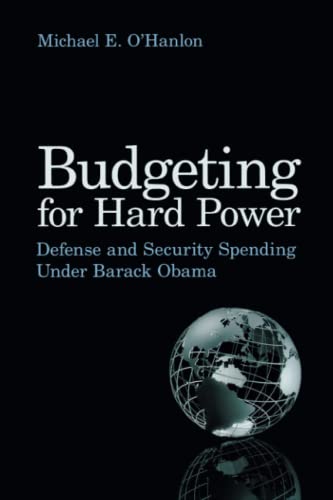
" These are extraordinary times in U.S. national security policy. America remains engaged in both Iraq and Afghanistan while facing a global economic downturn. Homeland security concerns still abound in the wake of the September 11 attacks. Even as the financial crisis places considerable pressure on the U.S. budget, President Obama will have to spend a great deal of time and money on national security, hard power, and war. How should these competing demands be prioritized? How much money will be needed? How much will be available, and how should it be spent? Budgeting for Hard Power continues the long and proud tradition of Brookings analysis on defense spending. As with previous volumes, this book examines the budgets of the Pentagon and the Department of Energy's nuclear weapons programs. But Michael O'Hanlon takes his analysis further, addressing the wide range of activities crucial for American security as a result of 9/11 and the ongoing wars. He considers homeland security resources and selected parts of the State Department and foreign operations budgets—offering a more complete overall look at the elements that make up America's ""hard power"" budget, a concept that he and Kurt Campbell wrote about in Hard Power: The New Politics of National Security (2006). With future federal deficits projected to top $1 trillion, O'Hanlon calls for Defense, State, and Homeland Security budgets to be as frugal as possible. At the same time, he recognizes that resources should be selectively increased in certain areas to compensate for years of systematic underfunding, especially in certain areas of homeland security, diplomacy, and foreign assistance. In his typically clear and concise manner, O'Hanlon shows policymakers how to wrestle with the resource allocation decisions affecting the national security of the United States."
Die Inhaltsangabe kann sich auf eine andere Ausgabe dieses Titels beziehen.
Über die Autorin bzw. den Autor
Michael E. O'Hanlon is a senior fellow in Foreign Policy Studies at the Brookings Institution, where he is research director for the 21st Century Defense Initiative. He is the author or coauthor of numerous books, is the lead author of Brookings's Iraq Index, and is a frequent media commentator on issues of foreign policy and security.
Auszug. © Genehmigter Nachdruck. Alle Rechte vorbehalten.
Budgeting for Hard Power
Defense and Security Spending Under Barack ObamaBy Michael E. O'HanlonBrookings Institution Press
Copyright © 2009 Brookings Institution PressAll right reserved.
ISBN: 978-0-8157-0294-8
Chapter One
Introduction
These are extraordinary times in American national security policy. The nation remains involved in two of the longest conflicts of its history in Iraq and Afghanistan, with more than 4,000 lives lost over six years in Iraq and more than 600 lost over nearly eight years in Afghanistan, as well as cumulative costs approaching, to date, $700 billion in the former case and $200 billion in the latter. Thankfully the prognosis in Iraq appears far improved in recent years; 2009 and 2010 will be momentous times in Afghanistan as the United States doubles combat forces there in hopes of turning around the direction of the conflict. Yet, despite this wartime focus, President Bush's second secretary of defense and President Obama's first, Robert Gates, has seemed almost as interested in helping the Department of State get funding for its units focused on nation building and stabilization missions as in lobbying for Department of Defense (DoD) resources. In his words, "It has become clear that America's civilian institutions of diplomacy and development have been chronically undermanned and underfunded for far too long." He also warns against "next-war-itis" among military planners, many of whom still prefer traditional high-technology modernization programs rather than generating adequate resources for immediate needs in what was called by the Bush administration the war on terror.
The contemporary American national security debate has evolved in other important ways as well. For example, official Pentagon doctrine now formally considers nation building, stabilization, and peacekeeping missions just as central to its portfolio as deterring or defeating traditional enemy combatants. At a more operational level, when coaching his troops, the country's star general in Iraq, David Petraeus, emphasized restraint in the use of force as much as destruction of the enemy. In another domain of national security policy, several former secretaries of state and defense, including Republicans and Democrats, advocate the eventual elimination of all nuclear weapons on the planet. And with the Taiwan issue fairly quiet at present, security discussions about China now focus as much on our common interest in ensuring reliable energy supplies and preventing global warming as on preparing for scenarios that would pit our forces against each other.
But for all this shifting of tectonic plates in the national security debate, those anticipating a radical change in actual American national security policy under President Obama should not leap to conclusions. The Pentagon budget was not a major source of contention in last year's presidential race-because neither candidate had any real interest in proposing that it be cut (despite the fact that, even excluding war costs, it exceeds the cold war average in real-dollar or inflation-adjusted terms; see figures 1-1 and 1-2). President Obama is committed to ending the Iraq war but also, as noted, to beefing up U.S. efforts in Afghanistan, including a promised increase in deployed U.S. troops in that theater. Eventual nuclear weapons abolition may now be the goal, but no one knows how to achieve such a dramatic, absolute goal in the coming years. Slowing nuclear proliferation where possible on a case by case basis, strengthening homeland security measures, gradually deploying missile defenses, and resuming the slog of formal arms control seem a more likely future action agenda for the country's nuclear specialists. And the current state of the Taiwan issue notwithstanding, the rise of China, while welcome in so many ways for the world and the United States, nonetheless inherently constitutes a latent national security issue for this country. War against China is very unlikely, and the magnitude of China's military threat to the United States needs to be kept in perspective. But addressing the strategic implications of China's growing wealth and military power must be a main focus for U.S. strategists nonetheless-in part to ensure that the chances of war remain small in a future where Taiwan may again become a flash point.
The age of the advertised preemption doctrine may be over, and the tools of American soft power may be likely to receive an infusion of resources in the new administration. But the end of preemption policy has greater implications for foreign policy, and for decisions on the use of force, than for defense budgeting or national security resource allocation. That is because rapid response will remain a necessary capability for the United States with or without such a nominal doctrine. President Obama will have to spend a great deal of time and money on national security, hard power, and war as well.
This book is designed to help policymakers wrestle with resource allocation decisions affecting the national security of the United States. Previous Brookings books on U.S. national security budgets have focused almost exclusively on the Pentagon and on Department of Energy (DOE) nuclear weapons programs. This study has a broader purview, one that also considers homeland security resources and selected parts of the State Department and foreign operations budgets. Funds for these latter activities are also crucial for American security, in part as a result of 9/11 and the wars in Iraq and Afghanistan. Rather than being about the defense budget, therefore, this book might be thought of as addressing the nation's hard power budget-the broader set of instruments with direct and near-term bearing on national security, including ongoing military operations and the stability and security of crucial countries around the world.
There are limits on my scope. The book does not generally extend to development aid, trade policy, or energy policy despite their significance for American national security, at least indirectly and over the longer term. But in an age characterized by the terrorist threat, homeland security and State Department instruments for helping stabilize weak states cannot be ignored even in a relatively narrowly construed study.
All of my analyses in this book are influenced by the country's enormously problematic fiscal situation. The United States has real national security needs that require resources. The nation is also (still) rich and can afford what is truly needed. But I take it as a given that the federal deficit is too high and that the country's deficits are relevant to its economic future and thus its long-term national security. There is an argument, as Martin Feldstein and others have emphasized, for including defense spending as part of any short-term stimulus packages-bearing in mind that recruiting troops and buying large-ticket weaponry tends to take many months, if not years, meaning that the short-term effects of some types of military spending are often modest. The greater challenge, however, is in figuring out how national security efforts can remain robust in the future even as the nation ultimately seeks to tighten its fiscal belt after the recession is over. And that belt tightening is likely to be painful; the Obama administration is currently the relative optimist on future deficit projections in relation to the Congressional Budget Office (CBO), and it projects the following annual deficits for 2009 and beyond (sequentially): $1.75 trillion, $1.17 trillion, $912 billion, $581 billion, $533 billion, $570...
„Über diesen Titel“ kann sich auf eine andere Ausgabe dieses Titels beziehen.
Suchergebnisse für Budgeting for Hard Power: Defense and Security Spending...

Beispielbild für diese ISBN
Budgeting for Hard Power: Defense and Security Spending Under Barack Obama
Verlag:
Brookings Institution Press, 2009
ISBN 10: 0815702949
ISBN 13: 9780815702948
Gebraucht
Paperback
Anbieter: ThriftBooks-Atlanta, AUSTELL, GA, USA
Verkäuferbewertung 5 von 5 Sternen

Paperback. Zustand: Very Good. No Jacket. Former library book; May have limited writing in cover pages. Pages are unmarked. ~ ThriftBooks: Read More, Spend Less. Artikel-Nr. G0815702949I4N10
Gebraucht kaufen
EUR 7,81
Versand gratis
Versand innerhalb von USA
Versand innerhalb von USA
Anzahl: 1 verfügbar
Beispielbild für diese ISBN
Budgeting for Hard Power: Defense and Security Spending Under Barack Obama
Verlag:
Brookings Institution Press, Washington, DC, U.S.A., 2009
ISBN 10: 0815702949
ISBN 13: 9780815702948
Gebraucht
paperback
Anbieter: PsychoBabel & Skoob Books, Didcot, Vereinigtes Königreich
Verkäuferbewertung 5 von 5 Sternen
paperback. Zustand: Very Good. Zustand des Schutzumschlags: No Dust Jacket. Paper cover is clean and sound. Contents in very good condition with sound binding, clean pages and clear text throughout. T. Used. Artikel-Nr. 264613
Gebraucht kaufen
EUR 6,91
EUR 14,61 Versand
Versand von Vereinigtes Königreich nach USA
Versand von Vereinigtes Königreich nach USA
Anzahl: 1 verfügbar
Beispielbild für diese ISBN
Budgeting for Hard Power: Defense and Security Spending Under Barack Obama
Anbieter: Ria Christie Collections, Uxbridge, Vereinigtes Königreich
Verkäuferbewertung 5 von 5 Sternen
Zustand: New. In. Artikel-Nr. ria9780815702948_new
Neu kaufen
EUR 31,56
EUR 14,00 Versand
Versand von Vereinigtes Königreich nach USA
Versand von Vereinigtes Königreich nach USA
Anzahl: Mehr als 20 verfügbar
Beispielbild für diese ISBN
Budgeting for Hard Power: Defense and Security Spending Under Barack Obama
Anbieter: Revaluation Books, Exeter, Vereinigtes Königreich
Verkäuferbewertung 5 von 5 Sternen
Paperback. Zustand: Brand New. 191 pages. 9.00x6.00x0.50 inches. In Stock. Artikel-Nr. x-0815702949
Neu kaufen
EUR 40,60
EUR 11,69 Versand
Versand von Vereinigtes Königreich nach USA
Versand von Vereinigtes Königreich nach USA
Anzahl: 2 verfügbar