
Verwandte Artikel zu The Smart Culture: Society, Intelligence, and Law (Critical...
Inhaltsangabe
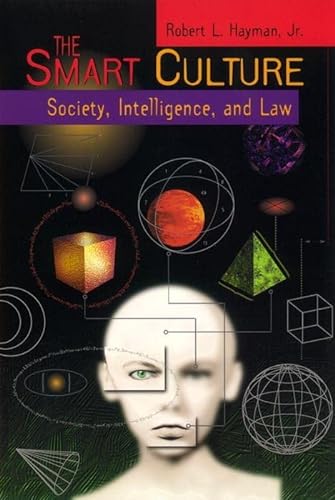
What exactly is intelligence? Is it social achievement? Professional success? Is it common sense? Or the number on an IQ test?
Interweaving engaging narratives with dramatic case studies, Robert L. Hayman, Jr., has written a history of intelligence that will forever change the way we think about who is smart and who is not. To give weight to his assertion that intelligence is not simply an inherent characteristic but rather one which reflects the interests and predispositions of those doing the measuring, Hayman traces numerous campaigns to classify human intelligence. His tour takes us through the early craniometric movement, eugenics, the development of the IQ, Spearman's "general" intelligence, and more recent works claiming a genetic basis for intelligence differences.
What Hayman uncovers is the maddening irony of intelligence: that "scientific" efforts to reduce intelligence to a single, ordinal quantity have persisted--and at times captured our cultural imagination--not because of their scientific legitimacy, but because of their longstanding political appeal. The belief in a natural intellectual order was pervasive in "scientific" and "political" thought both at the founding of the Republic and throughout its nineteenth-century Reconstruction. And while we are today formally committed to the notion of equality under the law, our culture retains its central belief in the natural inequality of its members. Consequently, Hayman argues, the promise of a genuine equality can be realized only when the mythology of "intelligence" is debunked--only, that is, when we recognize the decisive role of culture in defining intelligence and creating intelligence differences. Only culture can give meaning to the statement that one person-- or one group--is smarter than another. And only culture can provide our motivation for saying it.
With a keen wit and a sharp eye, Hayman highlights the inescapable contradictions that arise in a society committed both to liberty and to equality and traces how the resulting tensions manifest themselves in the ways we conceive of identity, community, and merit.
Die Inhaltsangabe kann sich auf eine andere Ausgabe dieses Titels beziehen.
Über die Autorin bzw. den Autor
Robert L. Hayman, Jr. is Professor of Law at Widener University in Deleware and has taught at Georgetown University, Temple University, and the University of Missouri.
„Über diesen Titel“ kann sich auf eine andere Ausgabe dieses Titels beziehen.
Suchergebnisse für The Smart Culture: Society, Intelligence, and Law (Critical...

Beispielbild für diese ISBN
The Smart Culture : Society, Intelligence, and Law
Verlag:
New York University Press, 1997
ISBN 10: 0814735339
ISBN 13: 9780814735336
Gebraucht
Hardcover
Erstausgabe
Anbieter: Better World Books, Mishawaka, IN, USA
Verkäuferbewertung 5 von 5 Sternen

Zustand: Good. First Edition. Former library copy. Pages intact with minimal writing/highlighting. The binding may be loose and creased. Dust jackets/supplements are not included. Includes library markings. Stock photo provided. Product includes identifying sticker. Better World Books: Buy Books. Do Good. Artikel-Nr. 4910640-6
Gebraucht kaufen
EUR 29,80
Versand gratis
Versand innerhalb von USA
Versand innerhalb von USA
Anzahl: 1 verfügbar
Beispielbild für diese ISBN
The Smart Culture : Society, Intelligence, and Law
Verlag:
New York University Press, 1997
ISBN 10: 0814735339
ISBN 13: 9780814735336
Gebraucht
Hardcover
Erstausgabe
Anbieter: Better World Books: West, Reno, NV, USA
Verkäuferbewertung 5 von 5 Sternen
Zustand: Good. First Edition. Former library copy. Pages intact with minimal writing/highlighting. The binding may be loose and creased. Dust jackets/supplements are not included. Includes library markings. Stock photo provided. Product includes identifying sticker. Better World Books: Buy Books. Do Good. Artikel-Nr. 4910640-6
Gebraucht kaufen
EUR 29,80
Versand gratis
Versand innerhalb von USA
Versand innerhalb von USA
Anzahl: 1 verfügbar
Beispielbild für diese ISBN
The smart culture : society, intelligence, and law.
Anbieter: Kloof Booksellers & Scientia Verlag, Amsterdam, Niederlande
Verkäuferbewertung 4 von 5 Sternen

Zustand: very good. New York University Press, 1988. Hardcover. No dustjacket. xv. 398 pp. Index. Condition : very good copy. ISBN 9780814735336. Keywords : RECHT, jurisprudence. Artikel-Nr. 136319
Gebraucht kaufen
EUR 16,95
EUR 30,00 Versand
Versand von Niederlande nach USA
Versand von Niederlande nach USA
Anzahl: 1 verfügbar
Foto des Verkäufers
The Smart Culture: Society, Intelligence, and Law: 3 (Critical America)
Verlag:
New York University Press, 1997
ISBN 10: 0814735339
ISBN 13: 9780814735336
Gebraucht
Hardcover
Anbieter: WeBuyBooks, Rossendale, LANCS, Vereinigtes Königreich
Verkäuferbewertung 5 von 5 Sternen
hardcover. Zustand: Very Good. Most items will be dispatched the same or the next working day. A copy that has been read, but is in excellent condition. Pages are intact and not marred by notes or highlighting. The spine remains undamaged. Artikel-Nr. rev3722807709
Gebraucht kaufen
EUR 37,98
EUR 9,32 Versand
Versand von Vereinigtes Königreich nach USA
Versand von Vereinigtes Königreich nach USA
Anzahl: 1 verfügbar
Beispielbild für diese ISBN
The Smart Culture: Society, Intelligence, and Law (Critical America, 3)
Anbieter: Ria Christie Collections, Uxbridge, Vereinigtes Königreich
Verkäuferbewertung 5 von 5 Sternen
Zustand: New. In English. Artikel-Nr. ria9780814735336_new
Neu kaufen
EUR 128,97
EUR 13,25 Versand
Versand von Vereinigtes Königreich nach USA
Versand von Vereinigtes Königreich nach USA
Anzahl: Mehr als 20 verfügbar
Foto des Verkäufers
SMART CULTURE
Anbieter: moluna, Greven, Deutschland
Verkäuferbewertung 5 von 5 Sternen
Gebunden. Zustand: New. Interweaving narratives and dramatic case studies, the author argues that persistent beliefs in a natural hierarchy of intelligence among humans have affected the way intelligence has been measured since the founding of the American republic. UP.Kl. Artikel-Nr. 595047707
Neu kaufen
EUR 124,98
EUR 48,99 Versand
Versand von Deutschland nach USA
Versand von Deutschland nach USA
Anzahl: Mehr als 20 verfügbar
Beispielbild für diese ISBN
The Smart Culture: Society, Intelligence, and Law: 3 (Critical America)
Anbieter: Kennys Bookstore, Olney, MD, USA
Verkäuferbewertung 5 von 5 Sternen
Zustand: New. 1997. New. hardcover. . . . . . Books ship from the US and Ireland. Artikel-Nr. V9780814735336
Neu kaufen
EUR 171,66
EUR 9,33 Versand
Versand innerhalb von USA
Versand innerhalb von USA
Anzahl: Mehr als 20 verfügbar
Beispielbild für diese ISBN
The Smart Culture Society, Intelligence, and Law
Anbieter: Revaluation Books, Exeter, Vereinigtes Königreich
Verkäuferbewertung 5 von 5 Sternen
Hardcover. Zustand: Brand New. 393 pages. 9.25x6.25x1.25 inches. In Stock. Artikel-Nr. x-0814735339
Neu kaufen
EUR 171,83
EUR 14,67 Versand
Versand von Vereinigtes Königreich nach USA
Versand von Vereinigtes Königreich nach USA
Anzahl: 2 verfügbar
Foto des Verkäufers
The Smart Culture : Society, Intelligence, and Law
Anbieter: AHA-BUCH GmbH, Einbeck, Deutschland
Verkäuferbewertung 5 von 5 Sternen
Buch. Zustand: Neu. Neuware - What exactly is intelligence Is it social achievement Professional success Is it common sense Or the number on an IQ test Interweaving engaging narratives with dramatic case studies, Robert L. Hayman, Jr., has written a history of intelligence that will forever change the way we think about who is smart and who is not. To give weight to his assertion that intelligence is not simply an inherent characteristic but rather one which reflects the interests and predispositions of those doing the measuring, Hayman traces numerous campaigns to classify human intelligence. His tour takes us through the early craniometric movement, eugenics, the development of the IQ, Spearman's 'general' intelligence, and more recent works claiming a genetic basis for intelligence differences. What Hayman uncovers is the maddening irony of intelligence: that 'scientific' efforts to reduce intelligence to a single, ordinal quantity have persisted--and at times captured our cultural imagination--not because of their scientific legitimacy, but because of their longstanding political appeal. The belief in a natural intellectual order was pervasive in 'scientific' and 'political' thought both at the founding of the Republic and throughout its nineteenth-century Reconstruction. And while we are today formally committed to the notion of equality under the law, our culture retains its central belief in the natural inequality of its members. Consequently, Hayman argues, the promise of a genuine equality can be realized only when the mythology of 'intelligence' is debunked--only, that is, when we recognize the decisive role of culture in defining intelligence and creating intelligence differences. Only culture can give meaning to the statement that one person-- or one group--is smarter than another. And only culture can provide our motivation for saying it. With a keen wit and a sharp eye, Hayman highlights the inescapable contradictions that arise in a society committed both to liberty and to equality and traces how the resulting tensions manifest themselves in the ways we conceive of identity, community, and merit. Artikel-Nr. 9780814735336
Neu kaufen
EUR 172,04
EUR 35,00 Versand
Versand von Deutschland nach USA
Versand von Deutschland nach USA
Anzahl: 2 verfügbar