
Verwandte Artikel zu Confronting Capitalism: Real Solutions for a Troubled...
Inhaltsangabe
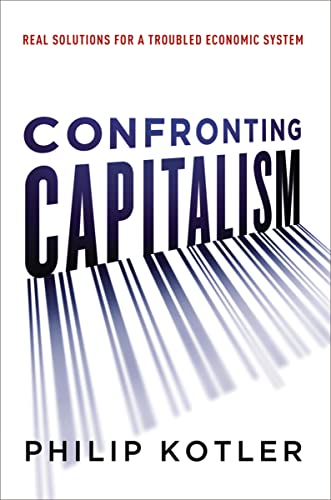
With one side of the political aisle proposing increasingly more socialistic and anti-capitalistic ideas, the other side has been quick to defend our country’s great economic model, with good reason. Capitalism--spanning a spectrum from laissez faire to authoritarian--shapes the market economies of all the wealthiest and fastest-growing nations. But does that mean it is perfect as is, and that we would not all benefit from an honest evaluation and reconstruction of the free market system that has shaped our country’s way of economic growth?The truth is, trouble is cracking capitalism’s shiny veneer. In the US, Europe, and Japan, economic growth has slowed down. Wealth is concentrated in the hands of a few; natural resources are exploited for short-term profit; and good jobs are hard to find. In Confronting Capitalism, business expert Philip Kotler explains 14 major problems undermining capitalism, including:• Persistent and increasing poverty• Automation’s effects on job creation• High debt burdens• Steep environmental costs• Boom-bust economic cycles• And moreBut this landmark book does not stop with merely revealing the problems. It also delivers a heartening message: We can turn things around! Movements toward shared prosperity and a higher purpose are reinvigorating companies large and small, while proposals abound on government policies that offer protections without stagnation. Kotler identifies the best ideas, linking private and public initiatives into a force for positive change, and offers suggestions for returning to a healthier, more sustainable capitalism that works for all.
Die Inhaltsangabe kann sich auf eine andere Ausgabe dieses Titels beziehen.
Über die Autorin bzw. den Autor
Philip Kotler is the S.C. Johnson Son Distinguished Professor of International Marketing at the Kellogg School of Management at Northwestern University. Widely acknowledged as the world's foremost expert on strategic marketing, Professor Kotler is also a classically trained economist. He earned his Master's in Economics at the University of Chicago under the famed Nobel laureate Milton Friedman, who represented free-market thinking. He went on to pursue his Ph.D. at MIT under Paul Samuelson and Robert Solow, two Nobel Prize-winning economists who represented Keynesian thinking. "Many economists are not aware that the field of marketing originated as an economics discipline," Kotler observes. In his latest book, CONFRONTING CAPITALISM: Real Solutions for a Troubled Economic System (AMACOM; April 2015), he draws on his outstanding background in economics, as well as his esteemed knowledge of marketing, to offer unique insights into the inner workings of capitalism. "Capitalism, management, and marketing must be joined in a comprehensive framework to understand marketplace developments and impacts," Kotler contends. "I hope this book achieves that goal." Throughout his career, Dr. Kotler has received numerous honors and awards. He claims 22 Honorary Degrees, including five from Schools of Economics: Athens School of Economics (1995), Cracow School of Economics (1998), Budapest School of Economic Science (2001), Academy of Economic Studies in Bucharest (2005), and Plekhanov Russian Academy of Economics in Moscow (2014). In a Financial Times survey of leading global executives, Philip Kotler ranked fourth among the most Influential Business Writers/Management Gurus, following Peter Drucker, Bill Gates, and Jack Welch. He was also ranked the sixth most influential business thinker, following Gary Hamel, Thomas L. Friedman, Bill Gates, Malcolm Gladwell, and Howard Gardner, by the Wall Street Journal. Voted the first Leader in Marketing Thought by the American Marketing Association and named The Founder of Modern Marketing Management in the Handbook of Management Thinking, he has been recognized with a Distinguished Marketing Educator Award from the American Marketing Association and a Distinguished Educator Award from The Academy of Marketing Science. On his 75th birthday, Professor Kotler was honored with a commemorative postage stamp from Indonesia. Philip Kotler has consulted for IBM, General Electric, ATT, Honeywell, Bank of America, Merck, and other organizations on marketing strategy, planning, and organization. He has advised governments on how to develop and position the skills and resources of their companies for global competition. He has published more than 150 articles in leading journals, including the Harvard Business Review, Sloan Management Review, Journal of Marketing, Management Science, and the Journal of Business Strategy. He has also authored over 50 books on all aspects of marketing, including Marketing Management, the most widely used marketing textbook in graduate business schools worldwide, now in its 15th edition. Professor Kotler did postdoctoral work in mathematics at Harvard University and in behavioral science at the University of Chicago.
Von der hinteren Coverseite
With the fall of the Berlin Wall, one economic model emerged triumphant. Capitalism—spanning a spectrum from laissez faire to authoritarian—shapes the market economies of all the wealthiest and fastest-growing nations.
But trouble is cracking its shiny veneer. Throughout the world, economic growth has slowed. Wealth is concentrated in the hands of a few; natural resources are exploited for short-term profits; and good jobs are hard to find.
With a piercing clarity, Philip Kotler explains 14 major problems undermining capitalism, including persistent poverty, job creation in the face of automation, high debt burdens, the disproportionate influence of the wealthy on public policy, steep environmental costs, boom–bust economic cycles, and more.
Amid its dire assessment of what’s ailing us, Confronting Capitalism delivers a heartening message: We can turn things around. Movements toward shared prosperity and a higher purpose are reinvigorating companies large and small, while proposals abound on government policies that offer protections without stagnation. Kotler identifies the best ideas, linking private and public initiatives into a force for positive change.
Combining economic history, expert insight, business lessons, and recent data, this landmark book elucidates today’s critical dilemmas and suggests solutions for returning to a healthier, more sustainable capitalism—one that works for all.
Auszug. © Genehmigter Nachdruck. Alle Rechte vorbehalten.
Introduction:Creating High-Performance Capitalism
There are scores of books on capitalism, most of them defending it, several criticizing it, and many just trying to explain it. Why would anyone want to write another book on capitalism?
I have five reasons for doing so.
First, I want to understand it myself. My family, friends, and acquaintances around the world live in a market economy run on a system called capitalism. They tell me they want to understand capitalism better.
Second, I believe capitalism is better than any other system. But I also believe that it has fourteen major shortcomings. I wanted to examine these shortcomings and their ramifications.
Third, I want to examine and propose solutions to each of the fourteen shortcomings that would help make capitalism perform better and benefit more people.
Fourth, many readers want a shorter book on capitalism to get their thinking started. Thomas Piketty’s book, Capital in the Twenty-First Century (Belknap Press, 2014), has sold over 200,000 copies, but most book buyers did not read the 500 or so pages beyond the first couple of chapters. In this busy age, we need more concise accounts of social and economic systems that deeply affect our lives. Piketty focused only on income inequality, which is only one of fourteen shortcomings of capitalism that need to be examined.
Fifth, I believe that my background provides an opportunity to develop some special insights into the workings of capitalism. I am a classically trained economist who studied under three great and opposite-thinking Nobel Prize–winning economists, namely, Professor Milton Friedman of the University of Chicago, who represented free market thinking, and Professors Paul Samuelson and Robert Solow of MIT, who represented Keynesian thinking. My goal was to apply macro- and microeconomic theory to understand company decision making aimed at winning market share in highly competitive markets. I feel that economists have neglected the role and power of marketing to shape and influence markets. Marketing is one of the bedrock concepts in a capitalist society. As a behaviorally oriented market economist, I focus my attention on the functioning of the five major players in a market economy: business enterprises, nonprofit organizations, financiers, households, and government. Capitalism, management, and marketing must be joined into a comprehensive framework to understand marketplace developments and impacts. I hope this book achieves that goal.
„Über diesen Titel“ kann sich auf eine andere Ausgabe dieses Titels beziehen.
Suchergebnisse für Confronting Capitalism: Real Solutions for a Troubled...

Beispielbild für diese ISBN
Confronting Capitalism: Real Solutions for a Troubled Economic System
Anbieter: World of Books (was SecondSale), Montgomery, IL, USA
Verkäuferbewertung 5 von 5 Sternen

Hardback. Zustand: Good. With the fall of the Berlin Wall, one economic model emerged triumphant. Capitalism-spanning a spectrum from laissez faire to authoritarian-shapes the market economies of all the wealthiest and fastest-growing nations. But trouble is cracking its shiny veneer. In the U.S., Europe, and Japan, economic growth has slowed down. Wealth is concentrated in the hands of a few; natural resources are exploited for short-term profit; and good jobs are hard to find. With piercing clarity, Philip Kotler explains 14 major problems undermining capitalism, including persistent poverty, job creation in the face of automation, high debt burdens, the disproportionate influence of the wealthy on public policy, steep environmental costs, boom-bust economic cycles, and more. Amidst its dire assessment of what's ailing us, Confronting Capitalism delivers a heartening message: We can turn things around. Movements toward shared prosperity and a higher purpose are reinvigorating companies large and small, while proposals abound on government policies that offer protections without stagnation. Kotler identifies the best ideas, linking private and public initiatives into a force for positive change. Combining economic history, expert insight, business lessons, and recent data, this landmark book elucidates today's critical dilemmas and suggests solutions for returning to a healthier, more sustainable Capitalism-that works for all. Artikel-Nr. 00107229146
Gebraucht kaufen
EUR 4,95
Versand gratis
Versand innerhalb von USA
Versand innerhalb von USA
Anzahl: 2 verfügbar
Beispielbild für diese ISBN
Confronting Capitalism: Real Solutions for a Troubled Economic System
Verlag:
AMACOM (edition First Edition), 2015
ISBN 10: 0814436455
ISBN 13: 9780814436455
Gebraucht
Hardcover
Erstausgabe
Anbieter: BooksRun, Philadelphia, PA, USA
Verkäuferbewertung 5 von 5 Sternen
Hardcover. Zustand: Very Good. First Edition. With dust jacket. It's a well-cared-for item that has seen limited use. The item may show minor signs of wear. All the text is legible, with all pages included. It may have slight markings and/or highlighting. Artikel-Nr. 0814436455-8-1-29
Gebraucht kaufen
EUR 4,96
Versand gratis
Versand innerhalb von USA
Versand innerhalb von USA
Anzahl: 1 verfügbar
Beispielbild für diese ISBN
Confronting Capitalism : Real Solutions for a Troubled Economic System
Anbieter: Better World Books, Mishawaka, IN, USA
Verkäuferbewertung 5 von 5 Sternen
Zustand: Good. Pages intact with minimal writing/highlighting. The binding may be loose and creased. Dust jackets/supplements are not included. Stock photo provided. Product includes identifying sticker. Better World Books: Buy Books. Do Good. Artikel-Nr. 5217553-6
Gebraucht kaufen
EUR 6,35
Versand gratis
Versand innerhalb von USA
Versand innerhalb von USA
Anzahl: 1 verfügbar
Beispielbild für diese ISBN
Confronting Capitalism : Real Solutions for a Troubled Economic System
Anbieter: Better World Books, Mishawaka, IN, USA
Verkäuferbewertung 5 von 5 Sternen
Zustand: Very Good. Former library copy. Pages intact with possible writing/highlighting. Binding strong with minor wear. Dust jackets/supplements may not be included. Includes library markings. Stock photo provided. Product includes identifying sticker. Better World Books: Buy Books. Do Good. Artikel-Nr. 10928166-75
Gebraucht kaufen
EUR 6,35
Versand gratis
Versand innerhalb von USA
Versand innerhalb von USA
Anzahl: 2 verfügbar
Beispielbild für diese ISBN
Confronting Capitalism : Real Solutions for a Troubled Economic System
Anbieter: Better World Books, Mishawaka, IN, USA
Verkäuferbewertung 5 von 5 Sternen
Zustand: Good. Former library copy. Pages intact with minimal writing/highlighting. The binding may be loose and creased. Dust jackets/supplements are not included. Includes library markings. Stock photo provided. Product includes identifying sticker. Better World Books: Buy Books. Do Good. Artikel-Nr. 11368306-75
Gebraucht kaufen
EUR 6,35
Versand gratis
Versand innerhalb von USA
Versand innerhalb von USA
Anzahl: 1 verfügbar
Beispielbild für diese ISBN
Confronting Capitalism: Real Solutions for a Troubled Economic System
Anbieter: ThriftBooks-Dallas, Dallas, TX, USA
Verkäuferbewertung 5 von 5 Sternen
Hardcover. Zustand: Very Good. No Jacket. May have limited writing in cover pages. Pages are unmarked. ~ ThriftBooks: Read More, Spend Less. Artikel-Nr. G0814436455I4N00
Gebraucht kaufen
EUR 6,42
Versand gratis
Versand innerhalb von USA
Versand innerhalb von USA
Anzahl: 1 verfügbar
Beispielbild für diese ISBN
Confronting Capitalism: Real Solutions for a Troubled Economic System
Anbieter: ThriftBooks-Phoenix, Phoenix, AZ, USA
Verkäuferbewertung 5 von 5 Sternen
Hardcover. Zustand: Very Good. No Jacket. May have limited writing in cover pages. Pages are unmarked. ~ ThriftBooks: Read More, Spend Less. Artikel-Nr. G0814436455I4N00
Gebraucht kaufen
EUR 6,42
Versand gratis
Versand innerhalb von USA
Versand innerhalb von USA
Anzahl: 1 verfügbar
Beispielbild für diese ISBN
Confronting Capitalism: Real Solutions for a Troubled Economic System
Anbieter: ThriftBooks-Dallas, Dallas, TX, USA
Verkäuferbewertung 5 von 5 Sternen
Hardcover. Zustand: Very Good. No Jacket. Former library book; May have limited writing in cover pages. Pages are unmarked. ~ ThriftBooks: Read More, Spend Less. Artikel-Nr. G0814436455I4N10
Gebraucht kaufen
EUR 6,42
Versand gratis
Versand innerhalb von USA
Versand innerhalb von USA
Anzahl: 1 verfügbar
Beispielbild für diese ISBN
Confronting Capitalism: Real Solutions for a Troubled Economic System
Anbieter: MusicMagpie, Stockport, Vereinigtes Königreich
Verkäuferbewertung 5 von 5 Sternen
Zustand: Very Good. 1773917317. 3/19/2026 10:48:37 AM. Artikel-Nr. U9780814436455
Gebraucht kaufen
EUR 6,10
EUR 6,49 Versand
Versand von Vereinigtes Königreich nach USA
Versand von Vereinigtes Königreich nach USA
Anzahl: 1 verfügbar
Beispielbild für diese ISBN
Confronting Capitalism: Real Solutions for a Troubled Economic System
Anbieter: WorldofBooks, Goring-By-Sea, WS, Vereinigtes Königreich
Verkäuferbewertung 5 von 5 Sternen
Paperback. Zustand: Very Good. The book has been read, but is in excellent condition. Pages are intact and not marred by notes or highlighting. The spine remains undamaged. Artikel-Nr. GOR007896535
Gebraucht kaufen
EUR 6,96
EUR 6,62 Versand
Versand von Vereinigtes Königreich nach USA
Versand von Vereinigtes Königreich nach USA
Anzahl: 1 verfügbar