
Verwandte Artikel zu The Ten Golden Rules of Leadership: Classical Wisdom...
Inhaltsangabe
How can the contemplations and teachings of a man who lived in ancient Greece help you in your role leading a tech giant or a restaurant chain?
Though skills and experience may have landed you your position, they don’t make you a great leader. Instead, true leaders evolve out of those who learn to look within and question themselves before they try to lead anyone else.
In this book, aspiring leaders will explore ideas from the greatest thinkers of all time--including Aristotle, Heraclitus, Sophocles, Hesiod, and others--and learn how each of these classic teachings applies to the challenges of the modern workplace.
In The Ten Golden Rules of Leadership, teachings discussed and related to the twenty-first-century work environment include:
- Know thyself
- Do not waste energy on things you cannot change
- Nurture community
- Always embrace the truth
- Let competition reveal talent, and more
Whether you have already been entrusted with a leadership position or you aspire to have that responsibility one day, your success in that role begins and ends with you--knowing who you are, what you believe in, and what you are capable of. Within The Ten Golden Rules of Leadership, you will learn the questions you need to reflect on in order to discover what kind of leader you can be.
Die Inhaltsangabe kann sich auf eine andere Ausgabe dieses Titels beziehen.
Über die Autorinnen und Autoren
M. A. SOUPIOS, PH,D., is professor of political philosophy at Long Island University, where he has taught for more than 30 years. He holds eight graduate degrees including four earned doctorates.
PANOS MOURDOUKOUTASS, PH,D., is professor of economics at Long Island University. A regular contributor to Forbes.com, he has been published in Barron's, The New York Times, The Japan Times, Newsday, and other publications. Together, they are authors of The Ten Golden Rules: Ancient Wisdom from the Greek Philosophers on Living the Good Life.
Von der hinteren Coverseite
All great leaders have a personal philosophy: a broad view of the human condition that informs every decision they make and their relationship with the organization and people they lead. Your philosophy is what allows you as a leader to access the kind of deeper, broader insights that result in extraordinary achievements. It is what sets you apart from those who simply "run" companies. To develop and articulate a sound corporate vision--and then follow through on it--you must develop an inner clarity, a ripened personal perspective.
The Ten Golden Rules of Leadership explores thought-provoking ideas from Aristotle, Heraclitus, Sophocles, Hesiod, and other classical thinkers, and introduces essential leadership truths, including:
Live life by a higher code * Do not waste energy on things you cannot change * Understand that character is destiny * Always evaluate information with a critical eye * Never underestimate the power of personal integrity
The book shows you how to apply each idea to the challenges of the modern workplace and combine it with what you discover about yourself as you delve into your own strengths and weaknesses. You'll develop your own ability to see The Big Picture, connect with members of your organization, foster a meaningful and productive work environment, and steer your corporate ship through any challenge.
Skills and experience might land you a leadership position . . . but they don't make you a true leader. This unique and enlightening guide arms you with eye-opening leadership principles that have stood the test of time.
Auszug. © Genehmigter Nachdruck. Alle Rechte vorbehalten.
RULE 2 “Office shows the person.” —PITTACUS
Of all the many problems facing today’s business world
none is more critical than the quality of the work environment.
In the absence of an affable work setting, employee
loyalties quickly dissolve. According to U.S. Department
of Labor statistics, employees typically remain in their position for
only about two years. Surveys designed to explain this remarkable
mobility suggest that the number one reason for employee exit is
a disagreeable workplace. The implications of this rapid turnover
are clear: The organization forfeits the time, energy, and resources
it invested in recruitment and suffers the effects of having employees
who lack meaningful commitment to the organization. How
can organizations motivate staff members who are constantly seek-
ing vocational alternatives?
Negative work settings do not occur spontaneously. Almost
without exception, this potentially lethal failure can be traced to
managerial deficiency and more often than not, to the abusive
misapplication of power on the part of the manager. Nothing will
more rapidly disenchant and alienate workers than a manager who
delights in resorting to the stick as opposed to the carrot.
One of Thales’ colleagues on the list of Seven Sages was the
ruler of Mytilene, a man named Pittacus (circa 600 BC). After
governing his city for a decade, Pittacus voluntarily relinquished
his power and retired. The ancient author Diogenes Laertius
recorded a number of famous sayings traditionally attributed to
Pittacus, the most famous being “office shows the man.” Above
all else, this maxim addresses the critical issue of power and its ef-
fects. Implicitly it contains two premises. First, that the investment
of power—in other words, granting a leader meaningful authority—
is the trigger that will rapidly reveal that person’s inner qualities.
Second, that power not only has a potential to disclose who
a person really is; it also has the capacity to corrupt. We need to
examine both of these ideas.
Anyone who has been involved in hiring a new employee under-
stands that the resume, the reference letters, the interviews,
and so on provide at best only an opaque view of a candidate’s ac-
tual identity. Throughout the various phases of the hiring process,
the real person is easily concealed by a series of highly stylized rit-
uals and procedures. In terms of getting at the core personality, the
procedure remains as superficial as it is cosmetic, with the result
that one never really knows the person behind the mask until the
employee is “up and running.”
These points are particularly noteworthy in the case of senior
personnel, the people who are assigned important leadership roles
in an organization. For these individuals, the investment of power
has an all-important diagnostic potential. Power will invariably
reflect what no resume ever does, namely the psychological and
spiritual disposition of the person. And here, of course, we are
brought back to the points made in the discussion of Rule 1. What
is soon to be revealed in the newly hired “leader” is whether or
not a process of honest self-discovery has taken place. If the battle
to dispel self-induced fraud has been successfully waged, if indeed
the individual has heeded Thales’ “know thyself,” that achievement
will be mirrored by the manner in which power is utilized.
„Über diesen Titel“ kann sich auf eine andere Ausgabe dieses Titels beziehen.
Suchergebnisse für The Ten Golden Rules of Leadership: Classical Wisdom...

Beispielbild für diese ISBN
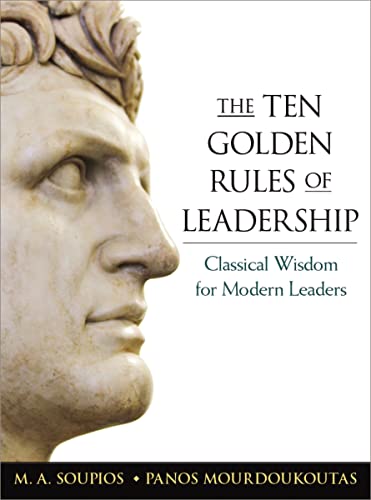
The Ten Golden Rules of Leadership: Classical Wisdom for Modern Leaders
Anbieter: World of Books (was SecondSale), Montgomery, IL, USA
Verkäuferbewertung 5 von 5 Sternen

Hardback. Zustand: Very Good. Leadership comes from inside - and the greatest leaders first question themselves before they tackle the world around them. To aid in this critical interrogation, this book explores ideas from Aristotle, Heraclitus, Sophocles, Hesiod, and other great thinkers, including: know thyself; nurture community; and, always embrace the truth. Artikel-Nr. 00105700407
Gebraucht kaufen
EUR 6,41
Versand gratis
Versand innerhalb von USA
Versand innerhalb von USA
Anzahl: 1 verfügbar
Beispielbild für diese ISBN
The Ten Golden Rules of Leadership: Classical Wisdom for Modern Leaders
Anbieter: World of Books (was SecondSale), Montgomery, IL, USA
Verkäuferbewertung 5 von 5 Sternen
Hardback. Zustand: Good. Leadership comes from inside - and the greatest leaders first question themselves before they tackle the world around them. To aid in this critical interrogation, this book explores ideas from Aristotle, Heraclitus, Sophocles, Hesiod, and other great thinkers, including: know thyself; nurture community; and, always embrace the truth. Artikel-Nr. 00106406920
Gebraucht kaufen
EUR 6,41
Versand gratis
Versand innerhalb von USA
Versand innerhalb von USA
Anzahl: 2 verfügbar
Beispielbild für diese ISBN
The Ten Golden Rules of Leadership: Classical Wisdom for Modern Leaders
Anbieter: ThriftBooks-Dallas, Dallas, TX, USA
Verkäuferbewertung 5 von 5 Sternen
Hardcover. Zustand: Fair. No Jacket. Readable copy. Pages may have considerable notes/highlighting. ~ ThriftBooks: Read More, Spend Less. Artikel-Nr. G0814434673I5N00
Gebraucht kaufen
EUR 6,42
Versand gratis
Versand innerhalb von USA
Versand innerhalb von USA
Anzahl: 1 verfügbar
Beispielbild für diese ISBN
The Ten Golden Rules of Leadership : Classical Wisdom for Modern Leaders
Anbieter: Better World Books: West, Reno, NV, USA
Verkäuferbewertung 5 von 5 Sternen
Zustand: Very Good. Pages intact with possible writing/highlighting. Binding strong with minor wear. Dust jackets/supplements may not be included. Stock photo provided. Product includes identifying sticker. Better World Books: Buy Books. Do Good. Artikel-Nr. 11780311-6
Gebraucht kaufen
EUR 6,55
Versand gratis
Versand innerhalb von USA
Versand innerhalb von USA
Anzahl: 1 verfügbar
Beispielbild für diese ISBN
The Ten Golden Rules of Leadership : Classical Wisdom for Modern Leaders
Anbieter: Better World Books, Mishawaka, IN, USA
Verkäuferbewertung 5 von 5 Sternen
Zustand: Good. Pages intact with minimal writing/highlighting. The binding may be loose and creased. Dust jackets/supplements are not included. Stock photo provided. Product includes identifying sticker. Better World Books: Buy Books. Do Good. Artikel-Nr. 16490849-6
Gebraucht kaufen
EUR 6,55
Versand gratis
Versand innerhalb von USA
Versand innerhalb von USA
Anzahl: 1 verfügbar
Beispielbild für diese ISBN
The Ten Golden Rules of Leadership : Classical Wisdom for Modern Leaders
Anbieter: Better World Books, Mishawaka, IN, USA
Verkäuferbewertung 5 von 5 Sternen
Zustand: Very Good. Pages intact with possible writing/highlighting. Binding strong with minor wear. Dust jackets/supplements may not be included. Stock photo provided. Product includes identifying sticker. Better World Books: Buy Books. Do Good. Artikel-Nr. 11780311-6
Gebraucht kaufen
EUR 6,55
Versand gratis
Versand innerhalb von USA
Versand innerhalb von USA
Anzahl: 1 verfügbar
Beispielbild für diese ISBN
The Ten Golden Rules of Leadership : Classical Wisdom for Modern Leaders
Anbieter: Better World Books, Mishawaka, IN, USA
Verkäuferbewertung 5 von 5 Sternen
Zustand: Good. Former library copy. Pages intact with minimal writing/highlighting. The binding may be loose and creased. Dust jackets/supplements are not included. Includes library markings. Stock photo provided. Product includes identifying sticker. Better World Books: Buy Books. Do Good. Artikel-Nr. 8423293-6
Gebraucht kaufen
EUR 6,55
Versand gratis
Versand innerhalb von USA
Versand innerhalb von USA
Anzahl: 1 verfügbar