
Verwandte Artikel zu Parenting with a Story: Real-Life Lessons in Character...
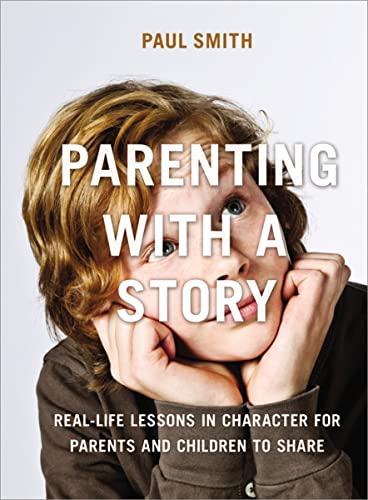
Parenting with a Story: Real-Life Lessons in Character for Parents and Children to Share - Softcover
Inhaltsangabe
“Play nice!” “Be kind!” “Don’t do that!” Every day, it seems half our conversations with young people is made up of commands dealing with character and niceties--all issues that need to be addressed and not ignored. But how is it working? Do you find yourself back at square one the next day, with a child acting as though they had no idea they shouldn’t be lying? In Parenting with a Story, author Paul Smith, one of the world’s leading experts in organizational storytelling, shows that when stories are used to illustrate to children how choices and consequences play out in the real world, with real people, the impact will be far more profound than the relentless commands that are forgotten or ignored as soon as the parent turns away. This collection of 101 narratives from people around the world and from all walks of life includes lessons that illuminate the power of character, integrity, curiosity, creativity, grit, kindness, patience, gratitude, and other essential characteristics every parent should be trying to instill in their children. Sometimes heart-wrenching, sometimes funny, always compelling, these stories impart wisdom and help steer choices about: • Resisting peer pressure• Remaining open-minded• Being humble• Making courageous decisions• Standing by their word• Bouncing back from failure• Showing compassion• Picking friends wisely• And moreThroughout all of history, stories have been used to help shape who we are and who we aspire to come. But effective storytelling doesn’t have to be reserved for teachers, writers, and preachers. As a parent, learn how to share stories, discuss them with your child, and watch your child grow into the adult every parent would be proud of.
Die Inhaltsangabe kann sich auf eine andere Ausgabe dieses Titels beziehen.
Über die Autorin bzw. den Autor
PAUL SMITH is a dedicated father of two and an expert trainer in leadership and storytelling techniques. As the author of the popular Lead with a Story, he has seen his work featured in The Wall Street Journal, Time, Forbes, The Washington Post, Success, and Investor's Business Daily, among others.
Von der hinteren Coverseite
“In Parenting with a Story, Paul Smith offers parents everywhere a powerful way to weave the principles of a meaningful life into the hearts and minds of their children. . . . This is one of the most innovative books on raising children that I know.” — Rachel Naomi Remen, MD, author of Kitchen Table Wisdom and My Grandfather’s Blessings
“Sharing the true stories of real people, Paul Smith brings a wide array of positive character traits to life. Courage, self-confidence, patience, hard work, and more are brought to life through engaging narratives. Any parent interested in building character into their child will benefit from the jump-start this book will provide.” — Emily Rempe, Founder, productiveparenting.com
Tell a young person what to do—play fair, be yourself, stick to the task at hand—and most will tune you out. But show them how choices and consequences play out in the real world, with real people, and the impact will be far more profound.
Parenting with a Story includes 101 narratives from people around the world and from all walks of life, reflecting unexpected moments of clarity about who they are and how they should treat others. The lessons illuminate the power of character—integrity, curiosity, creativity, grit, kindness, patience, gratitude, and more—to prepare us for anything. You’ll meet:
• A young boy from New York whose unfulfilled goal to become an astronaut taught him the value of setting high goals and led him on a lifelong adventure he wouldn’t trade for anything
• A young girl in Ohio whose 1,000 attempts to learn a three-second gymnastics move gave her the patience to practice and excel at anything as an adult
• A young boy in India who learned a lifelong lesson about the value of picking your friends wisely when he saw that choice cost a schoolmate his life
• A high school basketball player in Utah who learned a hard lesson about kindness when his dad forced him to have lunch with the girl everyone made fun of
Sometimes heart-wrenching, sometimes funny, always compelling, these stories help shape who we are and who we aspire to become. Share them, discuss them, and watch your child grow into the adult you’ll be proud of. Also check out the FREE discussion guide that Paul has developed and posted online.
Paul Smith is a dedicated father and speaker on leadership and story-telling techniques. As the author of the popular Lead with a Story, he has been featured in The Wall Street Journal, Time, Forbes, The Washington Post, Success, and Investor’s Business Daily, among others.
Connect with Paul at: www.leadwithastory.com.
Twitter @LeadWithAStory
facebook.com/LeadWithAStory
Auszug. © Genehmigter Nachdruck. Alle Rechte vorbehalten.
INTRODUCTION
The destiny of the world is determined less by the battles that are lost and won than by the stories it loves and believes in. —Howard Goddard
Perhaps the most memorable lesson I ever learned about becoming an
adult occurred at the most unexpected place and time: in a crowded
restaurant on Secretary’s Day, April 1986. Still a teenager and a freshman
in college, I had a part-time job at a local furniture manufacturing company.
My father was an executive there, and he helped me get a job as a
file clerk in the personnel office. I discovered that each year on that day,
all the bosses took their administrators and clerical staff out to lunch.
That meant a free lunch for me.
To make it easy, the company reserved every seat in a local restaurant.
About fifty managers and more than a hundred “secretaries” showed up
that day. In preparation for so many guests, the restaurant prepared only
two meal options: a club sandwich and quiche lorraine. It’s important to
recognize that this event happened shortly after the publication of the
bestselling book Real Men Don’t Eat Quiche by Bruce Feirstein, a tongue-
in-cheek look at the feminization of the American male.
So as the waitress was making her rounds taking orders, it was no
surprise that all the men ordered the club sandwich and most of the
women ordered the quiche. Until they got to my dad, that is, who was
sitting within earshot of me. He looked up from the menu and said,
“Hmm . . . I’ve never had quiche before. I tell you what, why don’t you
bring me half a quiche and half a club sandwich. That way, if I don’t like
the quiche, I’ll still have the sandwich.”
Within seconds, the abuse began. The men at the table called my father’s
masculinity into question in more creative ways than I had imagined
possible at that point in my life. Awkward and embarrassing don’t
begin to describe how it feels for a boy still in his teenage years to watch
his father be ridiculed in such a manner. Needless to say, when it was my
turn to order, I quickly picked the club sandwich.
After ten or fifteen minutes of ribbing, my father seemed to have had
enough and called the waitress back over. “Thank God!” I thought. “Just
pacify these jerks and let’s get on with lunch.” The waitress arrived and
Dad said, as expected, “I’m sorry. I need to change my order. I ordered
half a quiche and half a club sandwich.” Howls of success and a round of
high fives erupted at the table as the other men celebrated their victory.
Their aim had been to break my father’s will with their ridicule, and appar-
ently they had just done it.
What came next, however, shocked me and everyone else. He continued,
“Take back the half a club sandwich and bring me the whole
damn quiche!” A stunned silence fell over the table of now slack-jawed
men.
To this day, I still don’t know if my father likes quiche. But on that
particular day he ate every bite with a smile on his face.
My respect and admiration for my father rose to a whole new level
that day. He showed everyone at that table that he was man enough to eat
anything he liked and didn’t care what they thought about it. He showed
them that he refused to be defined by social norms. And he showed me,
his son, something of what it means to be a real man.
Twenty-eight years later, I have two sons of my own. I’ve shared this story
with both of them on several occasions when I saw them confronting peer
pressure. My goal, of course, is to give them the courage to stand up to
that pressure, but also to give them a successful way to respond.
If a classmate teases my son Matthew that his pants aren’t sagging off
his waist enough, as is unfortunately fashionable these days, now I simply
prompt him, “Eat the quiche, son.” Recalling the story, he’d then follow
the example set by my father. Instead of doing less of what he’s being
teased for, he’d do it more! He’d pull his pants up even higher and say,
“There, is that better?”
You can imagine the confused look on his tormentor’s face and the
retort, “No, you dummy, I said they’re too high!” Another tug and his
pants are now up to mid-torso, followed quickly by “How about now?”
You can see how his adversary would rapidly become exasperated and
give up.
But notice three other things about this story. First, I hope you can see
how simply advising children to “stand up to peer pressure” or to “be
yourself” is less likely to help them navigate this situation. Platitudes that
seem profound in a pithy piece of prose are surprisingly unhelpful to child-
ren in a real-life situation. They’re too vague and abstract. “What exactly
does it mean to ‘be myself’ or to ‘stand up to peer pressure’? Should I walk
away, start a fight, or just ignore them?” At the other end of the spectrum,
telling children exactly what to do in every situation is overly prescriptive
and doesn’t leave them room to think for themselves. But a story like the
one above gives them a concrete idea for how to respond without just
telling them what to do. As keenly observed by Hannah Arendt, “Storytelling
reveals meaning without committing the error of defining it.”
Second, the story does something else platitudes and advice won’t do.
„Über diesen Titel“ kann sich auf eine andere Ausgabe dieses Titels beziehen.
Suchergebnisse für Parenting with a Story: Real-Life Lessons in Character...

Beispielbild für diese ISBN
Parenting with a Story: Real-Life Lessons in Character for Parents and Children to Share
Anbieter: World of Books (was SecondSale), Montgomery, IL, USA
Verkäuferbewertung 5 von 5 Sternen

Paperback. Zustand: Very Good. Your child heard your plea, but did it land? Learn how using a story can make the impact youve been looking for. Artikel-Nr. 00110958162
Gebraucht kaufen
EUR 4,39
Versand gratis
Versand innerhalb von USA
Versand innerhalb von USA
Anzahl: 1 verfügbar
Beispielbild für diese ISBN
Parenting with a Story : Real-Life Lessons in Character for Parents and Children to Share
Anbieter: Better World Books, Mishawaka, IN, USA
Verkäuferbewertung 5 von 5 Sternen
Zustand: Very Good. Former library copy. Pages intact with possible writing/highlighting. Binding strong with minor wear. Dust jackets/supplements may not be included. Includes library markings. Stock photo provided. Product includes identifying sticker. Better World Books: Buy Books. Do Good. Artikel-Nr. 8970123-6
Gebraucht kaufen
EUR 7,87
Versand gratis
Versand innerhalb von USA
Versand innerhalb von USA
Anzahl: 1 verfügbar
Beispielbild für diese ISBN
Parenting with a Story : Real-Life Lessons in Character for Parents and Children to Share
Anbieter: Better World Books, Mishawaka, IN, USA
Verkäuferbewertung 5 von 5 Sternen
Zustand: Good. Pages intact with minimal writing/highlighting. The binding may be loose and creased. Dust jackets/supplements are not included. Stock photo provided. Product includes identifying sticker. Better World Books: Buy Books. Do Good. Artikel-Nr. 11019929-6
Gebraucht kaufen
EUR 7,87
Versand gratis
Versand innerhalb von USA
Versand innerhalb von USA
Anzahl: 1 verfügbar
Beispielbild für diese ISBN
Parenting with a Story: Real-Life Lessons in Character for Parents and Children to Share
Anbieter: ThriftBooks-Dallas, Dallas, TX, USA
Verkäuferbewertung 5 von 5 Sternen
Paperback. Zustand: As New. No Jacket. Pages are clean and are not marred by notes or folds of any kind. ~ ThriftBooks: Read More, Spend Less. Artikel-Nr. G081443357XI2N00
Gebraucht kaufen
EUR 7,98
Versand gratis
Versand innerhalb von USA
Versand innerhalb von USA
Anzahl: 1 verfügbar
Beispielbild für diese ISBN
Parenting with a Story: Real-Life Lessons in Character for Parents and Children to Share
Anbieter: ThriftBooks-Atlanta, AUSTELL, GA, USA
Verkäuferbewertung 5 von 5 Sternen
Paperback. Zustand: Good. No Jacket. Pages can have notes/highlighting. Spine may show signs of wear. ~ ThriftBooks: Read More, Spend Less. Artikel-Nr. G081443357XI3N00
Gebraucht kaufen
EUR 7,98
Versand gratis
Versand innerhalb von USA
Versand innerhalb von USA
Anzahl: 1 verfügbar
Beispielbild für diese ISBN
Parenting With a Story: Real-Life Lessons in Character for Parents and Children to Share
Anbieter: Revaluation Books, Exeter, Vereinigtes Königreich
Verkäuferbewertung 5 von 5 Sternen
Paperback. Zustand: Brand New. 272 pages. 9.00x6.00x1.00 inches. In Stock. Artikel-Nr. 081443357X
Neu kaufen
EUR 20,03
EUR 11,63 Versand
Versand von Vereinigtes Königreich nach USA
Versand von Vereinigtes Königreich nach USA
Anzahl: 1 verfügbar
Beispielbild für diese ISBN
Parenting with a Story Real-Life Lessons in Character for Parents and Children to Share
Anbieter: Mooney's bookstore, Den Helder, Niederlande
Verkäuferbewertung 4 von 5 Sternen

Zustand: Very Good. Artikel-Nr. D6BCF1B3372F1D8
Gebraucht kaufen
EUR 32,02
EUR 14,95 Versand
Versand von Niederlande nach USA
Versand von Niederlande nach USA
Anzahl: 1 verfügbar
Beispielbild für diese ISBN
Parenting with a Story: Real-Life Lessons in Character for Parents and Children to Share
Anbieter: LiLi - La Liberté des Livres, CANEJAN, Frankreich
Verkäuferbewertung 4 von 5 Sternen
Zustand: fine. l'article peut presenter de tres legers signes d'usure. vendeur professionnel; envoi soigne en 24/48h. Artikel-Nr. 2412060003439
Gebraucht kaufen
EUR 8,17
EUR 65,00 Versand
Versand von Frankreich nach USA
Versand von Frankreich nach USA
Anzahl: 1 verfügbar