
Verwandte Artikel zu Going Lean: How the Best Companies Apply Lean Manufacturing...
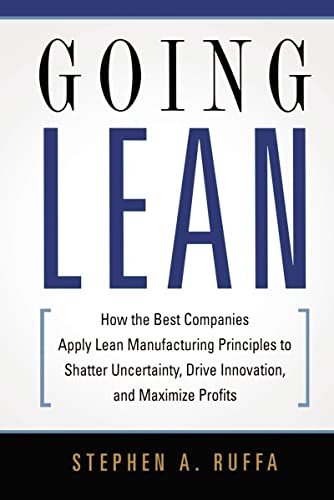
Going Lean: How the Best Companies Apply Lean Manufacturing Principles to Shatter Uncertainty, Drive Innovation, and Maximize Profits - Softcover
Inhaltsangabe
Efficient operations and powerful innovations are not limited to seasons of growth and high demand. Going Lean introduces the powerful yet unexpected mind-set that’s reshaping the rules for business competitiveness: Lean Dynamics ™. This approach, based on the now-famous Toyota Production System--empowers companies to thrive in virtually any environment--even when sudden shifts occur or they experience unpredictable conditions. Through a detailed exploration of this approach, readers will learn how to: become broadly effective in creating and sustaining value; set a critical foundation for achieving sustained excellence; identify sources of lag and create robust value streams that thrive in today’s dynamic conditions; describe the underlying techniques to maintain steady and predictable flow; create a system based on “pull,” or external demand that consistently introduces new innovation; strive for perfection; and deliver industry-leading returns. Led by a new breed of companies--Toyota, Walmart, and Southwest Airlines--this innovative mind-set changes the game for businesses everywhere. Going Lean teaches readers how their companies--big or small--can leverage this revolutionary thinking to measure and achieve real results.
Die Inhaltsangabe kann sich auf eine andere Ausgabe dieses Titels beziehen.
Über die Autorin bzw. den Autor
Stephen A. Ruffa (Oak Hill, VA) is an engineer who worked for the American Defense Department and researched lean manufacturing across seventeen large aerospace producers. His previous book, Breaking the Cost Barrier: A Proven Approach to Managing and Implementing Lean Manufacturing was awarded the 2001 Shingo Prize for Excellence in Manufacturing Research.
Von der hinteren Coverseite
With excellent timing, considering recent events in the global economy, this book demonstrates how companies can use lean principles to help them steer through tough times. Using examples from successful companies that survived crises such as 9/11 and the resulting economic downturn, as well as the oil crisis of 1980s, Ruffa shows how the techniques those companies used can be employed to help weather a crisis."
--Houston Business Journal
“In GOING LEAN, Stephen A. Ruffa spotlights examples from the automotive, airline, and retail industries, offering potent lessons on how companies drive innovation, promote sustainability and create value in the face of uncertainty. The backbone of the book lies in the well-thumbed ideologies of the Toyota Production System.”
---T&D magazine
“Ruffa describes the concept of lean dynamics for use in improving business during uncertain times, which combines lean manufacturing with initiatives that use internal measures to deal with external conditions. He argues that efficient operations and innovation do not have to only occur in times of stability and uses examples from companies like Toyota, Southwest Airlines, and Wal-Mart for illustration. Ruffa is an aerospace engineer and researcher who originated the concept of lean dynamics.”
---Book News
(Annotation ©2008 Book News Inc. Portland, OR)
Book News: http://booknews.com/ref_issues/ref_nov2008/amacom1.html
Auszug. © Genehmigter Nachdruck. Alle Rechte vorbehalten.
Introduction: Solving the Mystery of Success
THIS BOOK IS FOUNDED on one simple but enduring truth: Excellence is best seen in a crisis.
In 1973 when oil shortages compromised the profitability and stability of the global automotive industry, the excellence of one corporation stood apart. Its booming operations fueled continued profit and competitive advantage just as others were clinging to survival. Its sustained success ultimately catapulted this firm—the Toyota Motor Company—to market prominence, and has made its unique approach to management the envy of the business world.
This very same phenomenon can be seen again today.
In the wake of disaster—from September 11th and into war, to economic downturn and then hurricane Katrina—American business throughout this decade has been thrust into crisis. Corporations everywhere have been hard hit from lost sales, disrupted by shifting customer demands, sent reeling from new uncertainties rippling from customers to suppliers. Once-unquestioned leaders found themselves in a terrible struggle, one by one driven into financial turmoil or even bankruptcy. But a few firms—Toyota, Wal-Mart, and Southwest Airlines—remained strong, even thriving amid the chaos that crippled their peers.
What makes these corporations different? How do they seemingly defy gravity, extending their edge in a business environment that should have dragged them down?
The answer is simple. While others insist on managing their businesses just as they had done in the past, these companies took a different path. They saw that the world has dramatically changed, that uncertainty and crisis are no longer the exception but are now the rule. And they adopted a set of principles and practices I call lean dynamics—thus preparing themselves long beforehand to meet this head on.
Those who read this book will learn what years of success followed by decades of struggle should have taught managers everywhere: What marks excellent companies is not how efficiently they operate when demand is stable and conditions are optimal. Rather, those who apply lean dynamics continue to thrive—sustaining strong profitability, growth, and innovation—even when unpredictability is constant and change is normal.
Lean dynamics goes beyond tweaking existing operations and organizational structures—quick fixes that offer uncertain benefit to the bottom line. It goes further than simply finding and removing today’s most visible problems—the focus of so many of today’s improvement efforts. Instead, it is transformational—a new way of managing that corporations of all types and sizes can put in place to create the tangible, sustainable, bottom-line results they need to compete.
Throughout the last century, corporations struggled to refine a system of management that was never originally intended to accommodate the business needs of today. Founded by Henry Ford as an answer to the unsolved problem of bringing his new innovation—the Model T—to the mass markets, America’s management system quickly spread to become the gold standard for much of the world. Its basic premise—that tremendous efficiencies can be derived from managing jobs by their most basic steps—permitted managers to drive out hidden variation and waste, streamlining work and making complex products widely affordable. Yet, their system for keeping such a myriad of independent tasks moving together in lock step brought with it a new problem: Its effectiveness demands stability—a condition that has become increasingly hard to find.
For years, new strategies and techniques arose to hold chaos at bay. As expanding mass markets gave way to fragmented, variable customer demand, managers came to rely on buffers and quick fixes to protect their way of doing business. And with bouts of change increasingly driving disruption and crisis, corporations continued to do what worked so well for them in the past: Struggle harder until conditions once again stabilize.
A few have come to understand the losing proposition of demanding stability from a world that over the last several decades has become increasingly driven by disorder. Advanced technology and heroic effort can no longer overcome the shortfalls of a system that has reached its limits. What was once a manageable gap has grown to a chasm, one that can no longer be bridged through the methods of the past.
The solution is clear. Corporations can no longer thrive on a system that is built on the presumption of stability. Instead, they must prepare for change.
Going Lean challenges how companies have learned to think about the way they do business. It sets aside the notion that efficient operations and innovation are only possible when business is steady and demand is growing; that disruption and loss are the price that must be paid each time change is introduced. Instead, it shows how a new breed of companies has demonstrated a powerful yet unexpected weapon in the battle against uncertainty. Their lessons strike to the core of what is perhaps today’s greatest mystery of success: how one firm’s adversity can become another’s competitive advantage.
This discovery did not come as the result of a single project or event. Rather, it grew from the combined experiences of innovators from diverse industries striving to gain the quality, flexibility, and cost structure they needed to compete.
More than a decade ago I first saw the need to pull these lessons together. Immersed in the furious problem solving that marked the development, production, and fielding of military aircraft, I found that this industry—a beacon of American ingenuity and achievement—was not at all as it seemed. Manufacturing inefficiencies were high, flexibility low, and quality came at a tremendous price. Simply stated, the management of its operations stood in stark contrast to the technological prowess that characterized its products.
How could this be?
This is the question I spent much of the next dozen years exploring. Fortunately, as my passion for gaining this understanding grew, so did my ability to study and report on it.
My first opportunity arrived with my study of seventeen aerospace facilities across a dozen major aerospace firms—from GE to Boeing—who granted me and my team of researchers tremendous access to scrutinize their factories.1 We traced their improvement initiatives from beginning to end, looking to see what had worked and what had not, across practices ranging from lean manufacturing to statistical process control and Six Sigma.
I quickly found that things were not as I had imagined. As an engineer I had been trained to use a straightforward, logical approach to problem solving. I came to believe that finding a solution lies in isolating those steps where problems are most evident and then targeting them for action. What I found to be true was quite the contrary. While most struggled, those who managed to make substantial gains did not do so by giving greater attention to the disruption they could readily see or those problems already at hand. Instead, these companies had reached beneath the surface, taking steps that addressed the underlying conditions that had led to their occurrence in the first place. In doing so, many of the problems they once faced simply went away.
By taking a range of internal actions, these firms had made great strides in overcoming the substantial constraints of their external environments. They had been able to mitigate many of the effects of their variability, overcoming huge amounts of waste that had long been seen...
„Über diesen Titel“ kann sich auf eine andere Ausgabe dieses Titels beziehen.
Suchergebnisse für Going Lean: How the Best Companies Apply Lean Manufacturing...

Beispielbild für diese ISBN
Going Lean : How the Best Companies Apply Lean Manufacturing Principles to Shatter Uncertainty, Drive Innovation, and Maximize Profits
Anbieter: Better World Books, Mishawaka, IN, USA
Verkäuferbewertung 5 von 5 Sternen

Zustand: Good. Former library copy. Pages intact with minimal writing/highlighting. The binding may be loose and creased. Dust jackets/supplements are not included. Includes library markings. Stock photo provided. Product includes identifying sticker. Better World Books: Buy Books. Do Good. Artikel-Nr. 56457276-6
Gebraucht kaufen
EUR 18,04
Versand gratis
Versand innerhalb von USA
Versand innerhalb von USA
Anzahl: 1 verfügbar
Beispielbild für diese ISBN
Going Lean: How the Best Companies Apply Lean Manufacturing Principles to Shatter Uncertainty, Drive Innovation, and Maximize Profits
Anbieter: California Books, Miami, FL, USA
Verkäuferbewertung 5 von 5 Sternen
Zustand: New. Artikel-Nr. I-9780814432853
Neu kaufen
EUR 24,04
EUR 2,69 Versand
Versand innerhalb von USA
Versand innerhalb von USA
Anzahl: Mehr als 20 verfügbar
Foto des Verkäufers
Going Lean
Anbieter: Rarewaves.com USA, London, LONDO, Vereinigtes Königreich
Verkäuferbewertung 5 von 5 Sternen
Paperback. Zustand: New. Efficient operations and powerful innovations are not limited to seasons of growth and high demand. Going Lean introduces the powerful yet unexpected mind-set that's reshaping the rules for business competitiveness: Lean Dynamics T. This approach, based on the now-famous Toyota Production System--empowers companies to thrive in virtually any environment--even when sudden shifts occur or they experience unpredictable conditions. Through a detailed exploration of this approach, readers will learn how to: become broadly effective in creating and sustaining value; set a critical foundation for achieving sustained excellence; identify sources of lag and create robust value streams that thrive in today's dynamic conditions; describe the underlying techniques to maintain steady and predictable flow; create a system based on "pull," or external demand that consistently introduces new innovation; strive for perfection; and deliver industry-leading returns. Led by a new breed of companies--Toyota, Walmart, and Southwest Airlines--this innovative mind-set changes the game for businesses everywhere. Going Lean teaches readers how their companies--big or small--can leverage this revolutionary thinking to measure and achieve real results. Artikel-Nr. LU-9780814432853
Neu kaufen
EUR 30,37
Versand gratis
Versand von Vereinigtes Königreich nach USA
Versand von Vereinigtes Königreich nach USA
Anzahl: Mehr als 20 verfügbar
Beispielbild für diese ISBN
Going Lean: How the Best Companies Apply Lean Manufacturing Principles to Shatter Uncertainty, Drive Innovation, and Maximize Profits
Verlag:
AMACOM/American Management Association, 2008
ISBN 10: 0814432859
ISBN 13: 9780814432853
Neu
Paperback
Anbieter: Revaluation Books, Exeter, Vereinigtes Königreich
Verkäuferbewertung 5 von 5 Sternen
Paperback. Zustand: Brand New. 288 pages. 9.25x6.13x0.63 inches. In Stock. Artikel-Nr. x-0814432859
Neu kaufen
EUR 28,38
EUR 11,99 Versand
Versand von Vereinigtes Königreich nach USA
Versand von Vereinigtes Königreich nach USA
Anzahl: 2 verfügbar
Foto des Verkäufers
Going Lean : How the Best Companies Apply Lean Manufacturing Principles to Shatter Uncertainty, Drive Innovation, and Maximize Profits
Anbieter: GreatBookPricesUK, Woodford Green, Vereinigtes Königreich
Verkäuferbewertung 5 von 5 Sternen
Zustand: As New. Unread book in perfect condition. Artikel-Nr. 18734198
Gebraucht kaufen
EUR 27,53
EUR 17,98 Versand
Versand von Vereinigtes Königreich nach USA
Versand von Vereinigtes Königreich nach USA
Anzahl: Mehr als 20 verfügbar
Beispielbild für diese ISBN
Going Lean : How the Best Companies Apply Lean Manufacturing Principles to Shatter Uncertainty, Drive Innovation, and Maximize Profits
Anbieter: GreatBookPricesUK, Woodford Green, Vereinigtes Königreich
Verkäuferbewertung 5 von 5 Sternen
Zustand: New. Artikel-Nr. 18734198-n
Neu kaufen
EUR 27,71
EUR 17,98 Versand
Versand von Vereinigtes Königreich nach USA
Versand von Vereinigtes Königreich nach USA
Anzahl: Mehr als 20 verfügbar
Foto des Verkäufers
Going Lean
Anbieter: Rarewaves.com UK, London, Vereinigtes Königreich
Verkäuferbewertung 5 von 5 Sternen
Paperback. Zustand: New. Efficient operations and powerful innovations are not limited to seasons of growth and high demand. Going Lean introduces the powerful yet unexpected mind-set that's reshaping the rules for business competitiveness: Lean Dynamics T. This approach, based on the now-famous Toyota Production System--empowers companies to thrive in virtually any environment--even when sudden shifts occur or they experience unpredictable conditions. Through a detailed exploration of this approach, readers will learn how to: become broadly effective in creating and sustaining value; set a critical foundation for achieving sustained excellence; identify sources of lag and create robust value streams that thrive in today's dynamic conditions; describe the underlying techniques to maintain steady and predictable flow; create a system based on "pull," or external demand that consistently introduces new innovation; strive for perfection; and deliver industry-leading returns. Led by a new breed of companies--Toyota, Walmart, and Southwest Airlines--this innovative mind-set changes the game for businesses everywhere. Going Lean teaches readers how their companies--big or small--can leverage this revolutionary thinking to measure and achieve real results. Artikel-Nr. LU-9780814432853
Neu kaufen
EUR 28,41
EUR 77,91 Versand
Versand von Vereinigtes Königreich nach USA
Versand von Vereinigtes Königreich nach USA
Anzahl: Mehr als 20 verfügbar