
Verwandte Artikel zu Emotional Intelligence for Project Managers: The People...
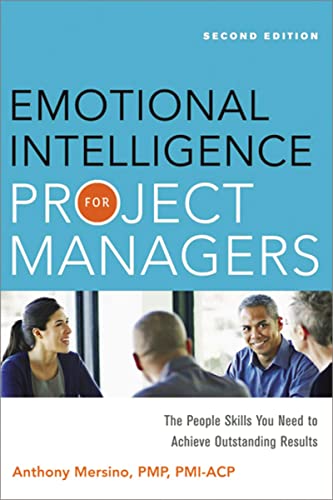
Emotional Intelligence for Project Managers: The People Skills You Need to Achieve Outstanding Results - Softcover
Inhaltsangabe
You’ve spent years gathering the technical intelligence you need for this challenging career--now separate yourself from the pack by increasing your emotional intelligence!
As recent research has indicated that emotional intelligence (EI) now accounts for 70 to 80 percent of management success, there is no doubt that today’s successful project manager needs strong interpersonal skills and the ability to recognize emotional cues to lead their teams to success--the technical expertise the position depended on so greatly in the past simply isn’t enough anymore!
Emotional Intelligence for Project Managers introduces you to all facets of EI and shows how emotions can be leveraged to meet project goals. Project managers strong in technical skills but needing help in the EI department will learn how to:
- Set the tone and direction for the project
- Communicate effectively
- Motivate, inspire, and engage their team
- Encourage flexibility and collaboration
- Deal productively with stress, criticism, and change
- Establish the kind of high morale that attracts top performers
Now in its second edition, Emotional Intelligence for Project Managers includes several expanded sections on self-awareness and self-management, as well as a new chapter on using EI to lead Agile Teams and a close look at Servant Leadership.
Die Inhaltsangabe kann sich auf eine andere Ausgabe dieses Titels beziehen.
Über die Autorin bzw. den Autor
ANTHONY MERSINO, PMP, PMI-ACP has more than 26 years of project management experience. He has trained and consulted on Project Leadership and Agile methods for a wide variety of clients.
Von der hinteren Coverseite
Praise for the first edition of Emotional Intelligence for Project Managers:
“A well-structured, easy read that delivers results . . . a worthy investment, particularly for aspiring or current project management professionals.” — PM World Today magazine
“It’s the book I wished I’d written. If you don’t own a copy, go out and get one.”— Elizabeth Harrin, pm4girls.com
Without good people management skills, even the most carefully planned project can fall apart in a flash. And managing people effectively means more than just keeping them in line: It means using finely tuned interpersonal skills and astutely reading emotional cues to get the job done right and on time.
According to the latest research, an astounding 70 to 80 percent of management success rests on this kind of “emotional intelligence” (EQ). Even if you already recognize the important role of EQ in the workplace, this book will help you take your understanding to the next level. Real-world examples of EQ in action, as well as checklists, self-assessments, and worksheets, will guide you through the process of building real rapport with your team. You’ll learn how to:
Establish the kind of high-energy approach that attracts top performers • Develop empathetic listening skills • Encourage flexibility and collaboration among team members • Deal productively with change, blame, stress, and criticism • Leverage emotional information to make better decisions
The second edition of this indispensable guide provides new tips on using EQ to lead and coach Agile Teams, and explores the concept of Servant Leadership, which enhances productivity by promoting emotional connection with your staff. Also included in this edition are expanded sections on self-awareness, self-management, and self-care, because before you can build and lead a winning team, you need to understand and nurture yourself.
The keen insights and practical tools you’ll find here will help you transform your results from “good enough” to “beyond expectations”—all by improving your ability to read between the emotional lines. Improve your EQ and you’ll soon be getting the best work out of everyone involved—including yourself.
ANTHONY MERSINO, PMP, PMI-ACP is an Agile Transformation Coach and IT Program Manager with more than 27 years of experience. He has delivered large-scale business solutions to clients that include Abbot Labs, IBM, Unisys, ARAMARK, and Wolters Kluwer, and provided Enterprise Agile Coaching for The Carlyle Group, Bank of America, Hayneedle, and Blue Cross Blue Shield of North Dakota.
Auszug. © Genehmigter Nachdruck. Alle Rechte vorbehalten.
Chapter 1 My Growth in Emotional Intelligence A Dangerous Situation "Do you have any idea how dangerous it is not to be in touch with your feelings?" This question was posed to me in the summer of 2001 by Rich, a therapist who has since become my career coach and mentor. His words stopped me in my tracks. Dangerous? That was a curious word choice. What could be dangerous about not being in touch with my feelings? I was thirty-nine years old and had been a successful project manager (PM) for over seventeen years. I had a record of slow but steady career progression. I had been certified as a Project Management Professional (PMP) since 1995. I owned my own project management consulting business and lived, taught, and even breathed project management. No one had ever asked me about feelings before. No one had ever mentioned that there might be danger involved. What could be dangerous? What was so important about feelings? Rich's question resonated with me, but I wasn't sure why. It didn't feel dangerous to be out of touch with my emotions. However, I had a nagging sense that he saw or knew things that I didn't. On some level I recognized that the way I approached work wasn't always effective. Hard work did not always make the difference in the outcomes of the projects I managed. I wondered how others seemed to succeed with less effort. I also felt insecure about the lack of personal and professional relationships I had built, and I suspected that it was hurting me. As much as I wanted to deny that my career and relationship challenges might be related to my emotions, I began to sus-pect that Rich might be right. The truth was that I wasn't aware of my feelings or emotions. I was about as emotionally aware as a small green soap dish. If I could have taken an emotional intelligence test at that time, I would have been considered the village idiot. With Rich's help, I began to see a connection between my lack of emotional awareness and my limited success in project management. Up to that point, my project management career had been a bumpy road. While not quite a dead end street, my career path hadn't exactly taken a superhighway either. Lately that road didn't seem to be taking me anywhere. I had recently been passed over for a key promotion at Unisys. My career ladder had literally run out of rungs. Perhaps I had been promoted to my level of incompetence and was therefore living proof of the Peter Principle. Eventually I found I could no longer ignore Rich's question about the danger, and I decided to do something about it. I knew I needed to make some changes. I was ready to make more of an investment in my emotions and relationships. Initially, it wasn't for personal reasons. It was all about ROI, my return on investment for improving my emotional intelligence. I believed that my career would benefit from it. And after spending most of the last five years working on my emotional intelligence, I am happy to report that my career has benefited significantly. As I grew, I learned how my work relationships reflected my world view. Until then, my relationships with my project teams and other stakeholders were weak or nonexistent. That was largely the result of my project management style as a taskmaster. I was all business. Unfortunately, I placed a higher value on tasks, productivity, and outcomes than on relationships. I lacked empathy. I had a way of driving the people on my project teams that was hostile and irresponsible. My coworkers may have called me driven, but they would never have characterized me as a warm and fuzzy relationship person. At best people warmed up to me over time. My big shift came when I began to recognize the value of emotions and relationships in the workplace. I became aware of feelings and learned to trust them as a source of information. I learned to recognize and acknowledge when I felt angry, scared, or happy. I also began to pay attention to what those around me were feeling and to consider that inf
„Über diesen Titel“ kann sich auf eine andere Ausgabe dieses Titels beziehen.
Suchergebnisse für Emotional Intelligence for Project Managers: The People...

Beispielbild für diese ISBN
Emotional Intelligence for Project Managers: The People Skills You Need to Achieve Outstanding Results
Anbieter: World of Books (was SecondSale), Montgomery, IL, USA
Verkäuferbewertung 5 von 5 Sternen

Paperback. Zustand: Good. The one skill the project manager was never trained on is the one he cant succeed without! Artikel-Nr. 00098847815
Gebraucht kaufen
EUR 3,80
Versand gratis
Versand innerhalb von USA
Versand innerhalb von USA
Anzahl: 4 verfügbar
Foto des Verkäufers
Emotional Intelligence for Project Managers: The People Skills You Need to Achieve Outstanding Results
Anbieter: Dream Books Co., Denver, CO, USA
Verkäuferbewertung 5 von 5 Sternen
Zustand: good. Gently used with minimal wear on the corners and cover. A few pages may contain light highlighting or writing, but the text remains fully legible. Dust jacket may be missing, and supplemental materials like CDs or codes may not be included. May be ex-library with library markings. Ships promptly! Artikel-Nr. DBV.0814432778.G
Gebraucht kaufen
EUR 3,81
Versand gratis
Versand innerhalb von USA
Versand innerhalb von USA
Anzahl: 1 verfügbar
Beispielbild für diese ISBN
Emotional Intelligence for Project Managers: The People Skills You Need to Achieve Outstanding Results
Verlag:
AMACOM (edition Second), 2013
ISBN 10: 0814432778
ISBN 13: 9780814432778
Gebraucht
Paperback
Anbieter: BooksRun, Philadelphia, PA, USA
Verkäuferbewertung 5 von 5 Sternen
Paperback. Zustand: Very Good. Second. It's a well-cared-for item that has seen limited use. The item may show minor signs of wear. All the text is legible, with all pages included. It may have slight markings and/or highlighting. Artikel-Nr. 0814432778-11-1
Gebraucht kaufen
EUR 5,83
Versand gratis
Versand innerhalb von USA
Versand innerhalb von USA
Anzahl: 1 verfügbar
Beispielbild für diese ISBN
The Emotional Intelligence for Project Managers: The People Skills You Need to Achieve Outstanding Results
Anbieter: ThriftBooks-Dallas, Dallas, TX, USA
Verkäuferbewertung 5 von 5 Sternen
Paperback. Zustand: Fair. No Jacket. Readable copy. Pages may have considerable notes/highlighting. ~ ThriftBooks: Read More, Spend Less. Artikel-Nr. G0814432778I5N00
Gebraucht kaufen
EUR 6,64
Versand gratis
Versand innerhalb von USA
Versand innerhalb von USA
Anzahl: 1 verfügbar
Beispielbild für diese ISBN
The Emotional Intelligence for Project Managers: The People Skills You Need to Achieve Outstanding Results
Anbieter: ThriftBooks-Atlanta, AUSTELL, GA, USA
Verkäuferbewertung 5 von 5 Sternen
Paperback. Zustand: Good. No Jacket. Former library book; Pages can have notes/highlighting. Spine may show signs of wear. ~ ThriftBooks: Read More, Spend Less. Artikel-Nr. G0814432778I3N10
Gebraucht kaufen
EUR 6,64
Versand gratis
Versand innerhalb von USA
Versand innerhalb von USA
Anzahl: 1 verfügbar
Beispielbild für diese ISBN
Emotional Intelligence for Project Managers: the People Skills You Need to Achieve Outstanding Results
Anbieter: Better World Books, Mishawaka, IN, USA
Verkäuferbewertung 5 von 5 Sternen
Zustand: Good. Pages intact with minimal writing/highlighting. The binding may be loose and creased. Dust jackets/supplements are not included. Stock photo provided. Product includes identifying sticker. Better World Books: Buy Books. Do Good. Artikel-Nr. 14803738-6
Gebraucht kaufen
EUR 7,02
Versand gratis
Versand innerhalb von USA
Versand innerhalb von USA
Anzahl: 1 verfügbar
Beispielbild für diese ISBN
Emotional Intelligence for Project Managers: the People Skills You Need to Achieve Outstanding Results
Anbieter: Better World Books, Mishawaka, IN, USA
Verkäuferbewertung 5 von 5 Sternen
Zustand: Very Good. Pages intact with possible writing/highlighting. Binding strong with minor wear. Dust jackets/supplements may not be included. Stock photo provided. Product includes identifying sticker. Better World Books: Buy Books. Do Good. Artikel-Nr. 16257580-6
Gebraucht kaufen
EUR 7,02
Versand gratis
Versand innerhalb von USA
Versand innerhalb von USA
Anzahl: 1 verfügbar
Beispielbild für diese ISBN
Emotional Intelligence for Project Managers: The People Skills You Need to Achieve Outstanding Results
Anbieter: WorldofBooks, Goring-By-Sea, WS, Vereinigtes Königreich
Verkäuferbewertung 5 von 5 Sternen
Paperback. Zustand: Very Good. The book has been read, but is in excellent condition. Pages are intact and not marred by notes or highlighting. The spine remains undamaged. Artikel-Nr. GOR008179993
Gebraucht kaufen
EUR 13,32
EUR 6,71 Versand
Versand von Vereinigtes Königreich nach USA
Versand von Vereinigtes Königreich nach USA
Anzahl: 1 verfügbar
Foto des Verkäufers
Emotional Intelligence for Project Managers
Anbieter: Rarewaves USA, HEBRON, KY, USA
Verkäuferbewertung 5 von 5 Sternen
Paperback. Zustand: New. Second Edition. You've spent years gathering the technical intelligence you need for this challenging career--now separate yourself from the pack by increasing your emotional intelligence!As recent research has indicated that emotional intelligence (EI) now accounts for 70 to 80 percent of management success, there is no doubt that today's successful project manager needs strong interpersonal skills and the ability to recognize emotional cues to lead their teams to success--the technical expertise the position depended on so greatly in the past simply isn't enough anymore!Emotional Intelligence for Project Managers introduces you to all facets of EI and shows how emotions can be leveraged to meet project goals. Project managers strong in technical skills but needing help in the EI department will learn how to:Set the tone and direction for the projectCommunicate effectivelyMotivate, inspire, and engage their teamEncourage flexibility and collaborationDeal productively with stress, criticism, and changeEstablish the kind of high morale that attracts top performersNow in its second edition, Emotional Intelligence for Project Managers includes several expanded sections on self-awareness and self-management, as well as a new chapter on using EI to lead Agile Teams and a close look at Servant Leadership. Artikel-Nr. LU-9780814432778
Neu kaufen
EUR 22,40
Versand gratis
Versand innerhalb von USA
Versand innerhalb von USA
Anzahl: Mehr als 20 verfügbar
Beispielbild für diese ISBN
Emotional Intelligence for Project Managers: The People Skills You Need to Achieve Outstanding Results
Verlag:
HarperCollins Leadership, 2018
ISBN 10: 0814432778
ISBN 13: 9780814432778
Gebraucht
Paperback
Anbieter: Brit Books, Milton Keynes, Vereinigtes Königreich
Verkäuferbewertung 4 von 5 Sternen

Paperback. Zustand: Used; Very Good. ***Simply Brit*** Welcome to our online used book store, where affordability meets great quality. Dive into a world of captivating reads without breaking the bank. We take pride in offering a wide selection of used books, from classics to hidden gems, ensuring there is something for every literary palate. All orders are shipped within 24 hours and our lightning fast-delivery within 48 hours coupled with our prompt customer service ensures a smooth journey from ordering to delivery. Discover the joy of reading with us, your trusted source for affordable books that do not compromise on quality. Artikel-Nr. 4468387
Gebraucht kaufen
EUR 14,11
EUR 19,16 Versand
Versand von Vereinigtes Königreich nach USA
Versand von Vereinigtes Königreich nach USA
Anzahl: 1 verfügbar