
Verwandte Artikel zu Generations at Work: Managing the Clash of Boomers,...
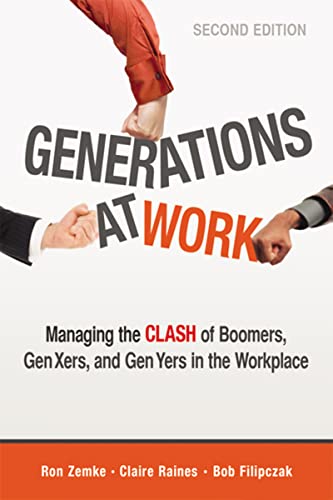
Generations at Work: Managing the Clash of Boomers, Gen Xers, and Gen Yers in the Workplace - Softcover
Inhaltsangabe
Written for those struggling to manage a workforce with incompatible ethics, values, and working styles, this book looks at the root causes of professional conflict and offers practical guidelines for navigating multigenerational differences.
By exploring the most common causes of conflict--including the Me Generation’s frustration with Gen Yers’ constant desire for feedback and the challenges facing Gen Xers sandwiched between these polarities--Generations at Work offers practical, spot-on guidance for managing the differences with consideration to each generation’s unique needs.
Along with the authors’ insights for managing a workforce with different ways of working, communicating, and thinking, this invaluable resources offers:
- in-depth interviews with members of each generation,
- tips on best practices from companies successfully bridging the generation gap,
- and a mentorship field guide to help you support the youngest members of your team.
Generations at Work has the tools that are key to helping your workforce interact more positively with one another and thrive in today’s wildly divergent workplace culture.
Die Inhaltsangabe kann sich auf eine andere Ausgabe dieses Titels beziehen.
Über die Autorinnen und Autoren
CLAIRE RAINES is a nationally recognized expert on generational issues and the author of Connecting Generations.
BOB FILIPCZAK is a social media coordinator and an experienced writer and editor. CLAIRE RAINES is a nationally recognized expert on generational issues and the author of Connecting Generations.
Von der hinteren Coverseite
“Learning about differences may be fun, but learning about cooperation is useful. And it’s here that Generations at Work becomes a valuable tool.”
— Fast Company (review of the first edition)
Annoyed with your workmates and flustered with your staff? Don’t understand how they think, act, and communicate—especially the twentysomethings who ask questions all the time and want confirmation that they’re doing great?
All these difficult people may be nothing more than diverse demographics. Friction among Traditionalists, Boomers, Xers, and Millennials has spiked, as four distinct generations are tossed side by side, cubicle by cubicle—and nobody speaks the same language.
Generations at Work offers a refreshing way to root out the causes of workplace clashes and bridge the generational gaps. Now updated to include the Millennial newcomers to the workplace, the book serves as both a sweeping overview of generational differences and a solutions-based managerial guide to molding each group into loyal employees who work effectively with everyone, from tech-savvy, high-needs young people to conformist, hardworking seniors.
Packed with original research and eye-opening insights, you’ll find explanations of what makes each generation tick, key phrases and tactics for motivating each, best practices from companies with generations-friendly cultures, in-depth interviews highlighting problems and solutions, a field guide for mentoring Millennials—and many more valuable tools for turning today’s multigenerational workforce into an organizational asset.
Ron Zemke was the author of the bestselling Knock Your Socks Off series and founder of Performance Research Associates, a consultancy specializing in organizational effectiveness.
Claire Raines is a nationally recognized expert on generational issues, and the author of Connecting Generations. She lives in Tucson, Arizona.
Bob Filipczak is a social media coordinator and an experienced writer and editor. He lives in Minneapolis.
Auszug. © Genehmigter Nachdruck. Alle Rechte vorbehalten.
Introduction
The New Economic Reality and the
Cross-Generational Workplace
It’s been more than ten years since the first edition of Generations at
Work. The world has changed profoundly and so have our personal
circumstances. In 2004, we lost Ron Zemke, one of our original coauthors.
He was the driving force that led to the first book. Ron was a brilliant
writer, an even more brilliant presenter, and a great mind and mentor.
We still can’t stand in front of an audience without thinking of him
and, every time we get a laugh from the group, it’s because we are channeling
Ron’s spirit. In updating this book, there are phrases and paragraphs
and whole pages of the original that are pure Ron, and it hurts to
revise them. Just the act of deleting the words seems sacrilegious.
Fortunately Ron was nothing if not irreverent, so the idea that we would
attach religious potency to his writing would have him chasing us from
his office with heavy projectiles—as we fled for the elevator on the eighteenth
floor of Minneapolis’ Foshay Tower.
Suffice it to say, the world we live in has changed. In some ways, it
seems as if the earth has shifted on its axis. We find ourselves near the
end—we use that phrase with great hope and determination—of a dramatic
economic decline that has affected the entire world economy.
Recent years have seen a sharp increase in oil and food prices, a precipitous
drop in international trade, and low consumer confidence. The
European Union (EU) is stretched to its limits as it decides whether to
bail out the failing economies of Greece and Spain. Growth has slowed
in the formerly booming economies of China and India. In the United
States, the number of foreclosures and personal bankruptcies has skyrocketed.
Hundreds of millions of people worldwide are unemployed.
The poor economy has even affected birthrates; according to Demographic
Intelligence, a company that produces quarterly birth forecasts,
birthrates in the United States are at their lowest in 25 years, “in large
part because unemployment and economic fear remain high” among
twentysomethings.
The first edition of this book focused on generational issues in the
United States where, in 2000, we were experiencing our ninth year of
economic expansion. For nine years running, the United States had
added more than two million workers a year to its payrolls. The unemployment
rate hovered around four percent. So it makes sense that our
first edition emphasized recruitment and retention, labor shortages, and
meeting the demands of workers who knew they were sorely needed.
Those workers knew that, if their current positions didn’t suit them to a
tee, they could get a job just across the street.
Today, employees from every generation are going back to the basics
and lowering their workplace expectations. Elizabeth Milligan, a recent
college graduate, describes the shift: “I think the current economic crisis
has changed things. I would have said a few years ago, ‘We’re really skilled.
We’re going to get jobs and we’re going to do something interesting.’ But
we recognize that the economy is bad. If we can get a paycheck, we’re
pretty lucky. Today we’re saying, ‘We just need jobs.’”2
The shifting sands of the economy are playing havoc with the generational
mix in virtually every organization. The Boomers—and even
some members of the generation before them—aren’t retiring as soon as
everyone thought. As a result, Generation X is feeling as if it has been
sentenced to an extended parole in middle management without much
room for movement. And some Millennials will spend their early “working
years” underemployed or even unemployed because the organizational
pipes are clogged with more experienced Boomers and Xers.
Even though the current economic climate might make compromise
on the part of employees and job seekers unavoidable, let’s not be
tempted to assume all those nagging differences among us will simply
evaporate. While employees of all ages are surely less confident and emboldened
than they were in 2000, history tells us that our tough economic
times will be temporary. Job seekers might acknowledge that today
they have to settle for less, and current employees might stay in their
jobs a little longer, but that doesn’t mean we will all perform at the highest
levels—unless and until we create a workplace environment that respects
and rewards workers of all ages. The cost to a business of replacing
a disgruntled employee who is fortunate enough to find a greener
pasture is approximately 2.5 times his or her annual salary. Now, more
than ever, that’s a cost few companies can afford.
In the first edition of Generations at Work, we made a case for a new
crisis in the workplace that could be solved, or partially solved, by recognizing
generational diversity. The work world was then at the beginning
of an awakening about generational issues, and our primary objective was
to convince readers that some common workplace complaints—lack of
respect and inability to work as a team, for example—could, in many cases,
be attributed to generational differences. We smiled to ourselves when
you shared with...
„Über diesen Titel“ kann sich auf eine andere Ausgabe dieses Titels beziehen.
Suchergebnisse für Generations at Work: Managing the Clash of Boomers,...

Foto des Verkäufers
Generations at Work: Managing the Clash of Boomers, Gen Xers, and Gen Yers in the Workplace
Anbieter: Dream Books Co., Denver, CO, USA
Verkäuferbewertung 5 von 5 Sternen

Zustand: very_good. Pages are clean with no markings. May show minor signs of wear or cosmetic defects marks, cuts, bends, or scuffs on the cover, spine, pages, or dust jacket. May have remainder marks on edges. Artikel-Nr. DBV.0814432336.VG
Gebraucht kaufen
EUR 3,89
Versand gratis
Versand innerhalb von USA
Versand innerhalb von USA
Anzahl: 1 verfügbar
Beispielbild für diese ISBN
Generations at Work: Managing the Clash of Boomers, Gen Xers, and Gen Yers in the Workplace
Anbieter: World of Books (was SecondSale), Montgomery, IL, USA
Verkäuferbewertung 5 von 5 Sternen
Paperback. Zustand: Good. The newest edition of this seminal book on navigating the multigenerational workplace offers practical tips to help any leader bridge the generational gap--and create a healthy culture. Artikel-Nr. 00098432778
Gebraucht kaufen
EUR 4,04
Versand gratis
Versand innerhalb von USA
Versand innerhalb von USA
Anzahl: 7 verfügbar
Beispielbild für diese ISBN
Generations at Work: Managing the Clash of Boomers, Gen Xers, and Gen Yers in the Workplace
Anbieter: World of Books (was SecondSale), Montgomery, IL, USA
Verkäuferbewertung 5 von 5 Sternen
Paperback. Zustand: Very Good. The newest edition of this seminal book on navigating the multigenerational workplace offers practical tips to help any leader bridge the generational gap--and create a healthy culture. Artikel-Nr. 00080001446
Gebraucht kaufen
EUR 4,04
Versand gratis
Versand innerhalb von USA
Versand innerhalb von USA
Anzahl: 3 verfügbar
Beispielbild für diese ISBN
The Generations at Work: Managing the Clash of Boomers, Gen Xers, and Gen Yers in the Workplace
Anbieter: ThriftBooks-Dallas, Dallas, TX, USA
Verkäuferbewertung 5 von 5 Sternen
Paperback. Zustand: Very Good. No Jacket. Former library book; May have limited writing in cover pages. Pages are unmarked. ~ ThriftBooks: Read More, Spend Less. Artikel-Nr. G0814432336I4N10
Gebraucht kaufen
EUR 5,96
Versand gratis
Versand innerhalb von USA
Versand innerhalb von USA
Anzahl: 1 verfügbar
Beispielbild für diese ISBN
Generations at Work: Managing the Clash of Boomers, Gen Xers, and Gen Yers in the Workplace
Anbieter: Wonder Book, Frederick, MD, USA
Verkäuferbewertung 5 von 5 Sternen
Zustand: Very Good. Very Good condition. 2nd edition. A copy that may have a few cosmetic defects. May also contain light spine creasing or a few markings such as an owner's name, short gifter's inscription or light stamp. Artikel-Nr. G15E-01983
Gebraucht kaufen
EUR 6,43
Versand gratis
Versand innerhalb von USA
Versand innerhalb von USA
Anzahl: 1 verfügbar
Beispielbild für diese ISBN
Generations at Work : Managing the Clash of Boomers, Gen Xers, and Gen Yers in the Workplace
Anbieter: Better World Books: West, Reno, NV, USA
Verkäuferbewertung 5 von 5 Sternen
Zustand: Good. 2 Edition. Pages intact with minimal writing/highlighting. The binding may be loose and creased. Dust jackets/supplements are not included. Stock photo provided. Product includes identifying sticker. Better World Books: Buy Books. Do Good. Artikel-Nr. 4392288-6
Gebraucht kaufen
EUR 6,75
Versand gratis
Versand innerhalb von USA
Versand innerhalb von USA
Anzahl: 1 verfügbar
Beispielbild für diese ISBN
Generations at Work : Managing the Clash of Boomers, Gen Xers, and Gen Yers in the Workplace
Anbieter: Better World Books: West, Reno, NV, USA
Verkäuferbewertung 5 von 5 Sternen
Zustand: Good. 2 Edition. Former library copy. Pages intact with minimal writing/highlighting. The binding may be loose and creased. Dust jackets/supplements are not included. Includes library markings. Stock photo provided. Product includes identifying sticker. Better World Books: Buy Books. Do Good. Artikel-Nr. 981430-6
Gebraucht kaufen
EUR 6,75
Versand gratis
Versand innerhalb von USA
Versand innerhalb von USA
Anzahl: 1 verfügbar
Beispielbild für diese ISBN
Generations at Work : Managing the Clash of Boomers, Gen Xers, and Gen Yers in the Workplace
Anbieter: Better World Books, Mishawaka, IN, USA
Verkäuferbewertung 5 von 5 Sternen
Zustand: Good. 2 Edition. Pages intact with minimal writing/highlighting. The binding may be loose and creased. Dust jackets/supplements are not included. Stock photo provided. Product includes identifying sticker. Better World Books: Buy Books. Do Good. Artikel-Nr. 4392288-6
Gebraucht kaufen
EUR 6,75
Versand gratis
Versand innerhalb von USA
Versand innerhalb von USA
Anzahl: 1 verfügbar
Beispielbild für diese ISBN
Generations at Work : Managing the Clash of Boomers, Gen Xers, and Gen Yers in the Workplace
Anbieter: Better World Books, Mishawaka, IN, USA
Verkäuferbewertung 5 von 5 Sternen
Zustand: Very Good. 2 Edition. Pages intact with possible writing/highlighting. Binding strong with minor wear. Dust jackets/supplements may not be included. Stock photo provided. Product includes identifying sticker. Better World Books: Buy Books. Do Good. Artikel-Nr. 11982832-6
Gebraucht kaufen
EUR 6,75
Versand gratis
Versand innerhalb von USA
Versand innerhalb von USA
Anzahl: 1 verfügbar
Beispielbild für diese ISBN
Generations at Work : Managing the Clash of Boomers, Gen Xers, and Gen Yers in the Workplace
Anbieter: Better World Books: West, Reno, NV, USA
Verkäuferbewertung 5 von 5 Sternen
Zustand: Very Good. 2 Edition. Former library copy. Pages intact with possible writing/highlighting. Binding strong with minor wear. Dust jackets/supplements may not be included. Includes library markings. Stock photo provided. Product includes identifying sticker. Better World Books: Buy Books. Do Good. Artikel-Nr. GRP102388625
Gebraucht kaufen
EUR 6,75
Versand gratis
Versand innerhalb von USA
Versand innerhalb von USA
Anzahl: 1 verfügbar