
Verwandte Artikel zu The New Manager's Tool Kit: 21 Things You Need...
Inhaltsangabe
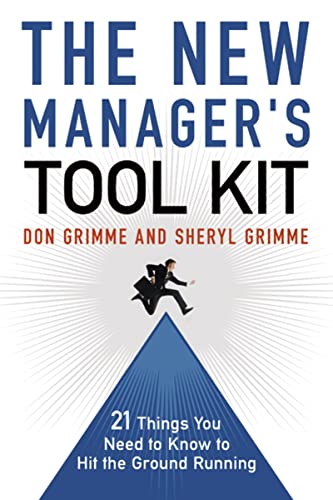
In this helpful guidebook, authors Don and Sheryl Grimme provide a fresh, friendly approach to tackling the challenges of management and leveraging your new position to help your organization succeed.
Novice managers have their work cut out for them: all new skills to learn, different personalities to deal with, and greater responsibilities to fulfill. The New Manager's Tool Kit provides you with fast, powerful lessons to help them:
- increase productivity;
- unlock hidden talent;
- work with different types of people;
- communicate effectively;
- diagnose problems;
- coach both good and problematic employees;
- encourage teamwork;
- avoid burnout;
- eliminate conflict;
- and nurture the next generation of managers.
With lessons covering both basic management skills as well as more advanced leadership tactics and bonus tips to help managers overcome the most difficult leadership challenges, The New Manager's Tool Kit provides those charged with managing and leading others the tools and real-world knowledge they need to succeed and open themselves up for further advancement.
Die Inhaltsangabe kann sich auf eine andere Ausgabe dieses Titels beziehen.
Über die Autorinnen und Autoren
Don Grimme is a co-owner of GHR Training Solutions, which provides training for companies and government agencies including Motorola, NASA's Kennedy Space Center, and Auntie Anne's. He is a frequent keynote speaker and presenter at national conferences.
Sheryl Grimme (Tamarac, FL) are co-owners of GHR Training Solutions, which provides training for companies and government agencies including Motorola, NASA's Kennedy Space Center, and Auntie Anne's. They are frequent keynote speakers and presenters at national conferences.
Von der hinteren Coverseite
As a new manager, you've got your work more than cut out for you: all new skills to learn, different personalities to deal with, and greater responsibilities to fulfill. The New Manager’s Tool Kit arms you with the fast, practical advice you need to:
increase productivity • unlock hidden talent in your people • work with different types of employees • communicate effectively with your reports • diagnose problems • coach good or problematic employees • turn on teamwork • avoid burnout • eliminate conflict • and even nurture the next generation of managers!
You'll learn how to understand and work with fundamental personal and interpersonal components of your job including attitude, assertiveness, and managing stress and anger. You'll also discover powerful techniques for mentoring and motivating employees, optimizing performance, and encouraging positive and productive communication. In addition, the book covers issues of special relevance to today's workplace, such as retention, diversity, rapid or unexpected change, different generations in the workforce, disabilities, harassment, workplace violence, and more.
Ranging from basic skills to those more advanced, The New Manager’s Tool Kit helps you take on the many challenges of management without missing a beat, offering you advice, encouragement, and practical, no-nonsense methods for immediately succeeding in your new role.
“Useful at every level of an organization, it is a practical and comprehensive guide to becoming a skilled manager of people.”
—Peter Schwartz, Chairman, Monitor Global Business Network, and author of The Art of the Long View
Don & Sheryl Grimme are co-owners of GHR Training Solutions. They train companies and government agencies, including Pfizer, AOL, Nestle-Purina, NASA, and the Veterans Administration, and speak at national conferences. Based in South Florida, the Grimmes travel throughout the U.S. to deliver their training and speaking services.
Auszug. © Genehmigter Nachdruck. Alle Rechte vorbehalten.
TOOL 1
Turn On Talent ... and Turn Off Turnover
There is a crisis in America today. The one we?re talking about has noth-
ing to do with telemarketing, as annoying as that is, or even the troubling
economy. Rather, we're referring to the diminishing ability of organizations
in every sector of our society to attract, retain, and motivate talented
employees, that is, to survive.
It is employee retention especially that has emerged as the workplace
issue of the decade. In 2006, the Society for Human Resource Management
(SHRM), in its Workplace Forecast, predicted that the number one
employment trend most likely to have a major impact on the workplace is
a greater emphasis on retention strategies.
And in a 2007 study by the global employee retention research firm
TalentKeepers, 88 percent of employers reported turnover had stayed the
same or increased...and 45 percent forecasted a further increase in
turnover (only 3 percent predicted a decrease).
You see, our longheld assumption of an everexpanding talent pool
has been shattered by such factors as the retirement of aging Baby
Boomers, lower birthrates, tighter immigration rules, and an increase in
the skills demanded for today's jobs.
The first three factors explain this quantitatively. But it is the last one,
the qualitative factor, that is the sticking point. More than a shortage of
bodies, this is a crisis of abilities--the talent in "talent pool."
In addition, employee loyalty is down. According to a 2005 survey
conducted by the Society for Human Resource Management, 79 percent of
employees are job searching, either actively or passively. In fact, the most
frequently asked question put to SHRM is, "How can we keep talent from
jumping to our competitors?"
Fortunately, every crisis contains not only danger but also opportunity.
In this tool, you will learn the secret to transforming this dangerous crisis
into an opportunity for you and your organization to flourish.
TRANSFORMING DANGER INTO OPPORTUNITY
Employers are groping for ways to attack the problem. The 2005 SHRM
survey found that the techniques used are salary adjustments, job promo-
tions, bonuses, more attractive benefits and retirement packages, and stock options--
all of which are expensive and (as found in the 2007
TalentKeepers' study) not very effective. The reason, as you will see, is that
they are misdirected.
Rather than leaping to implement techniques, it is important to begin
with an understanding of what really energizes and instills loyalty in
employees. Otherwise, you won?t know whether any technique is effective
and you won?t be very effective in implementing it.
UNDERSTANDING HUMAN MOTIVATION--THEORY
The best known motivation theory is probably Maslow?s Hierarchy of
Needs, shown in Figure 1.1.
Maslow categorized human needs into five sets:
1. The most fundamental is survival. This is our need for food,
water, and shelter, and in the modern era includes medical services, electricity,
transportation, and phones, all of which are jeopardized by natural disasters.
Visualize the aftermath of Hurricane Katrina.
2. Next is safety/security for which we look to the military, police, fire-
rescue, and insurance. All of these were called into play on and since 9/11.
3. What then emerges is social/belonging--our need for family,
friends, coworkers, and associations.
4. Then comes self-esteem--confidence, respect, appreciation, and recognition.
5. And the ultimate is self-actualization--fulfillment and happiness, which
most of us meet through career, marriage, and/or parenthood.
Maslow did more than just categorize. He posited that these needs do
not have equal force all the time. When our fundamental needs of survival,
safety, and security are threatened, say, by hurricanes or terrorism, that?s all
we care about. As South Florida residents, we have firsthand knowledge of
this. For the first several days after Hurricane Wilma in 2005, local televi-
sion stations had no network programming, not even national news. All
they reported was where to get water and ice, and where and when power was being restored.
However, for most Americans most of the time, these needs are met.
They become merely basic expectations (what psychologist Frederick
Herzberg called ?hygiene? factors) that we pay little attention to. What we
care about and are motivated by are the three highestlevel needs.
Maslow?s hierarchy provides a springboard for our own 3-Factor Theory (Figure 1.2),
which consolidates two other theories (Herzberg's 2-Factor Theory
and the Kano Model of Customer Satisfaction) from an employer's perspective.
As notated in Figure 1.1, employers satisfy Maslow?s fundamental sur-
vival, safety, and security needs primarily through a paycheck and benefits
plan: Earnings and Benefits. This is how employees buy groceries, put a...
„Über diesen Titel“ kann sich auf eine andere Ausgabe dieses Titels beziehen.
Suchergebnisse für The New Manager's Tool Kit: 21 Things You Need...

Beispielbild für diese ISBN
The New Manager's Tool Kit: 21 Things You Need to Know to Hit the Ground Running
Anbieter: World of Books (was SecondSale), Montgomery, IL, USA
Verkäuferbewertung 5 von 5 Sternen

Zustand: Very Good. Item in very good condition! Textbooks may not include supplemental items i.e. CDs, access codes etc. Artikel-Nr. 00102842825
Gebraucht kaufen
EUR 3,96
Versand gratis
Versand innerhalb von USA
Versand innerhalb von USA
Anzahl: 2 verfügbar
Beispielbild für diese ISBN
The New Manager's Tool Kit: 21 Things You Need to Know to Hit the Ground Running
Anbieter: World of Books (was SecondSale), Montgomery, IL, USA
Verkäuferbewertung 5 von 5 Sternen
Zustand: Good. Item in good condition. Textbooks may not include supplemental items i.e. CDs, access codes etc. Artikel-Nr. 00097256464
Gebraucht kaufen
EUR 3,96
Versand gratis
Versand innerhalb von USA
Versand innerhalb von USA
Anzahl: 5 verfügbar
Beispielbild für diese ISBN
The New Manager's Tool Kit: 21 Things You Need to Know to Hit the Ground Running
Anbieter: World of Books (was SecondSale), Montgomery, IL, USA
Verkäuferbewertung 5 von 5 Sternen
Zustand: Like New. Item is in like new condition. Artikel-Nr. 00107930300
Gebraucht kaufen
EUR 3,96
Versand gratis
Versand innerhalb von USA
Versand innerhalb von USA
Anzahl: 1 verfügbar
Beispielbild für diese ISBN
The New Manager's Tool Kit: 21 Things You Need to Know to Hit the Ground Running
Anbieter: BooksRun, Philadelphia, PA, USA
Verkäuferbewertung 5 von 5 Sternen
Paperback. Zustand: Fair. 1. The item might be beaten up but readable. May contain markings or highlighting, as well as stains, bent corners, or any other major defect, but the text is not obscured in any way. Artikel-Nr. 0814413064-7-18
Gebraucht kaufen
EUR 5,31
Versand gratis
Versand innerhalb von USA
Versand innerhalb von USA
Anzahl: 1 verfügbar
Beispielbild für diese ISBN
The New Manager's Tool Kit : 21 Things You Need to Know to Hit the Ground Running
Anbieter: Better World Books, Mishawaka, IN, USA
Verkäuferbewertung 5 von 5 Sternen
Zustand: Good. 1st Edition. Pages intact with minimal writing/highlighting. The binding may be loose and creased. Dust jackets/supplements are not included. Stock photo provided. Product includes identifying sticker. Better World Books: Buy Books. Do Good. Artikel-Nr. 5019811-6
Gebraucht kaufen
EUR 6,18
Versand gratis
Versand innerhalb von USA
Versand innerhalb von USA
Anzahl: 1 verfügbar
Beispielbild für diese ISBN
The New Manager's Tool Kit : 21 Things You Need to Know to Hit the Ground Running
Anbieter: Better World Books: West, Reno, NV, USA
Verkäuferbewertung 5 von 5 Sternen
Zustand: Very Good. 1st Edition. Former library copy. Pages intact with possible writing/highlighting. Binding strong with minor wear. Dust jackets/supplements may not be included. Includes library markings. Stock photo provided. Product includes identifying sticker. Better World Books: Buy Books. Do Good. Artikel-Nr. GRP96100740
Gebraucht kaufen
EUR 6,18
Versand gratis
Versand innerhalb von USA
Versand innerhalb von USA
Anzahl: 1 verfügbar
Beispielbild für diese ISBN
The New Manager's Tool Kit : 21 Things You Need to Know to Hit the Ground Running
Anbieter: Better World Books, Mishawaka, IN, USA
Verkäuferbewertung 5 von 5 Sternen
Zustand: Very Good. 1st Edition. Pages intact with possible writing/highlighting. Binding strong with minor wear. Dust jackets/supplements may not be included. Stock photo provided. Product includes identifying sticker. Better World Books: Buy Books. Do Good. Artikel-Nr. 4069600-75
Gebraucht kaufen
EUR 6,18
Versand gratis
Versand innerhalb von USA
Versand innerhalb von USA
Anzahl: 1 verfügbar
Beispielbild für diese ISBN
The New Manager's Tool Kit: 21 Things You Need to Know to Hit the Ground Running
Anbieter: ThriftBooks-Dallas, Dallas, TX, USA
Verkäuferbewertung 5 von 5 Sternen
Paperback. Zustand: Good. No Jacket. Pages can have notes/highlighting. Spine may show signs of wear. ~ ThriftBooks: Read More, Spend Less. Artikel-Nr. G0814413064I3N00
Gebraucht kaufen
EUR 6,22
Versand gratis
Versand innerhalb von USA
Versand innerhalb von USA
Anzahl: 1 verfügbar
Beispielbild für diese ISBN
The New Manager's Tool Kit: 21 Things You Need to Know to Hit the Ground Running
Anbieter: Revaluation Books, Exeter, Vereinigtes Königreich
Verkäuferbewertung 5 von 5 Sternen
Paperback. Zustand: Brand New. 1st edition. 256 pages. 9.00x5.75x0.75 inches. In Stock. Artikel-Nr. zk0814413064
Neu kaufen
EUR 26,57
EUR 11,84 Versand
Versand von Vereinigtes Königreich nach USA
Versand von Vereinigtes Königreich nach USA
Anzahl: 1 verfügbar