
Verwandte Artikel zu Leading at the Edge: Leadership Lessons from the Extraordina...
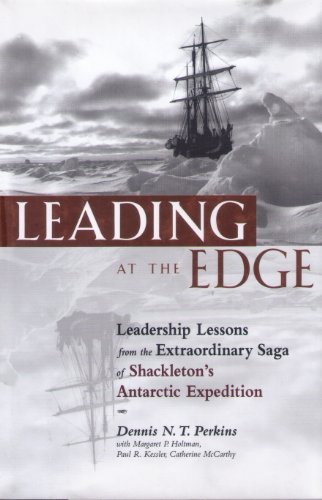
Leading at the Edge: Leadership Lessons from the Extraordinary Saga of Shackleton's Antarctic Expedition - Hardcover
Inhaltsangabe
Part adventure story, part leadership guide, this intriguing book examines Shackleton's legendary Antarctic expedition through the lens of business--to reveal a set of powerful strategies for corporate leaders. In the chronicles of extraordinary adventures and against-the-odds survival, nothing compares to the story of Sir Ernest Shackleton and his team of South Pole explorers. Stranded in the frozen sea for nearly two years, they endured extreme temperatures, hazardous ice, dwindling food, complete isolation, and perpetual blackness. Yet, despite the seemingly insurmountable obstacles, the group remained cohesive, congenial, and mercifully alive--a fact that speaks not just to luck but to an unparalleled feat in leadership. Now, for the first time ever, Leading at the Edge draws on this amazing story to reveal the power of effective organizational leadership under conditions of uncertainty, ambiguity, and rapid change. The book uncovers 10 lessons-- complete with stirring examples from the Shackleton expedition, as well as contemporary business case studies of the strategies in action--on what it takes to be a great leader. Readers learn how to: * Set a personal example with vivid symbols and behaviors * Instill optimism while staying grounded in reality * Reinforce the team message constantly * Find something to celebrate and something to laugh about * Have the courage to take big risks, and more. For managers and executives who feel stressed out or stretched thin, these memorable strategies will help bring order to chaos--and success in the face of the most daunting adversity.
Die Inhaltsangabe kann sich auf eine andere Ausgabe dieses Titels beziehen.
Über die Autorin bzw. den Autor
Dennis N. T. Perkins, Ph.D. (Branford, CT) is president of the Syncretics Group, a consultancy that specializes in effective leadership. Margaret P. Holtman is director of employee development at Hartford Life, Inc. Paul R. Kessler is a managing consultant at Stromberg Consulting. Catherine McCarthy, Ph.D., is a principal of the consulting firm Kaye & McCarthy.
Von der hinteren Coverseite
In December of 1914, the British Imperial Trans-Antarctic Expedition, led by Sir Ernest Shackleton, sailed from the island of South Georgia in the Southern Ocean. Its goal: the first overland crossing of Antarctica. Soon trapped in a prison of solid pack ice, the crew became engaged in a legendary fight against brutal cold, impenetrable ice, dwindling food, and complete isolation. Despite these seemingly insurmountable obstacles, the team remained cohesive, congenial, and mercifully alive - a fact that speaks not just to luck but to an unparalleled feat of leadership.
Part adventure tale, part leadership guide, Leading at The Edge demonstrates the power of strong leadership in times of adversity, uncertainty, and change. This engaging and practical book reveals Ten Strategies for Success™, illustrating how leaders can:
• Instill optimism while staying grounded in reality
• Have the courage to step up to risks worth taking
• Consistently reinforce the team message
• Set a personal example
• Find something to celebrate and something to laugh about
• Never give up—there’s always another move!
The second edition features new case studies highlighting the strategies in action, tools to uncover and resolve conflicts, and expanded resources. An updated epilogue compares Shackleton’s leadership style with that of famed polar explorers Roald Amundsen and Robert Scott, and offers insights into how their contrasting approaches led to strikingly different outcomes.
Today’s leaders have much to learn from this gripping account of survival against all odds. Leading at The Edge will help them navigate the rough waters of any turbulent environment and achieve success in the face of adversity.
Advance Praise for Leading at the Edge
“Shackleton’s extraordinary adventure demonstrates invaluable, practical traits of leadership. I could not recommend Leading at the Edge more highly.”
— John H. Dalton, Former Secretary of the Navy
“Fascinating. Great story after story, along with important learnings about leadership.”
— Ed Lawler, Director, Center for Effective Organizations, USC
DENNIS N. T. PERKINS, Ph.D., is Chief Executive Officer of The Syncretics Group, a consulting firm dedicated to effective leadership in demanding environments. A graduate of the United States Naval Academy, he served as a Marine company commander and later a faculty member of the Yale School of Management. He has taken his passion for The Edge to Antarctica, where he retraced Shackleton’s journey, and now resides in Madison, Connecticut.
MARGARET P. HOLTMAN, PAUL R. KESSLER, and CATHERINE McCARTHY, Ph.D., are consultants specializing in leadership, coaching, and team development.
Auszug. © Genehmigter Nachdruck. Alle Rechte vorbehalten.
Preface
On August 3, 1913, a Canadian expedition led by Vilhjalmur Stefansson set out to explore the frozen Arctic, between the northernmost shores of Canada and the North Pole. On December 5, 1914, the British Imperial Trans-Antarctic Expedition, led by Sir Ernest Shackleton, sailed from the island of South Georgia in the Southern Ocean. Its goal was the first overland crossing of Antarctica.
Both ships, the Karluk in the north and the Endurance in the south, soon found themselves beset in solid pack ice. Trapped by the ice, each crew was soon engaged in a fight for survival. But the outcomes of these two adventures--and the ways in which the two leaders dealt with the obstacles they faced--were as far apart as the poles each leader set out to explore.
In the north, the crew of the Karluk found themselves transformed in the months that followed into a band of self-interested, disparate individuals. Lying, cheating, and stealing became common behaviors. The disintegration of the team had tragic consequences for its eleven members who died in the Arctic wasteland.
In the frozen south, the story of the Endurance could not have been more different. Shackleton's expedition faced the same problems of ice, cold, and shortages of food and supplies. The response of his crew to these hellish conditions, however, was in almost every respect the obverse of those of the Karluk's crew. Teamwork, self-sacrifice, and astonishing good cheer replaced lying, cheating, and rapacious self-interest. It was as if the Endurance existed not just in a different polar region, but in a different, contrary, parallel universe.
What Can Today's Leaders Learn from Explorers at the World's Edge?
There were many variables at play in the Endurance and Karluk adventures. I believe, however, that these two cases reflect something far different from a simple twist of fate. Having studied numerous situations in which teams faced the edge of life and death--the physical limits of human endurance--I have found that there are systematic differences between those that succeed and those that fail.
Over the past fifteen years, I have examined numerous stories of other groups that have been at the edge of survival, including accounts of shipwrecks, airplane crashes, mountain-climbing expeditions, and polar exploration. From this research, ten leadership principles have emerged as the critical factors that distinguish groups that triumph from those that fail. These core leadership strategies form the backbone of this book.
My goal is to show how these ten principles, employed by Shackleton and others who have succeeded in the face of extreme adversity, can help leaders reach the limits of individual and organizational performance. Leading at the Edge will demonstrate how these leadership lessons can be applied to organizations confronting such contemporary challenges as competition, economic uncertainty, and the need for constant innovation, growth, and change.
Each chapter in Part One of the book illustrates how one of the ten strategies has been used under life-and-death conditions. It also includes specific tactics for implementing these strategies and uses brief case examples to show how these concepts can be applied to any organizational challenge. Finally, each chapter poses a set of questions for reflection in the form of a personal Expedition Log.
Part Two of the book includes four extended case studies. These cases show how leaders have applied the ten strategies in situations ranging from short-term crises to cultural transformation. The cases, drawn from different industries, illustrate the power of effective leadership under conditions of ambiguity, uncertainty, and change. They also demonstrate how leaders can create teams that work together and succeed in the face of enormous odds.
In Part Three, I share my perspective on the fundamental issue of success and failure and on learning the art of "leading at The Edge." Finally, Part Four includes a number of resources, including tools for individual assessment and for further reading about leadership and adventure.
Origins of the Leading at The Edge Concept
A major part of my life has been spent trying to understand what it really means to be a leader--particularly under conditions of adversity, ambiguity, and change. My passion to understand the art of leadership began at the United States Naval Academy. As a midshipman at Annapolis, I looked at the discipline of leadership as the foundation of a military career.
My quest to understand leadership began in earnest after graduation, when I was commissioned as a second lieutenant in the Marine Corps. As a platoon commander, I found myself in the sand dunes of Camp Lejeune, North Carolina, faced with the challenge of leading some thirty-five young Marines.
As a platoon leader I tried to apply what I had learned at Annapolis, and I watched other leaders to see what worked and what did not. I was naively amazed to find that--although we had all gone through the same training--the actual practice of leadership varied tremendously. Mostly I saw good leadership; sometimes I saw exceptional leadership.
The differences between good and exceptional had effects on the attitudes and behavior of the troops, but the consequences in peacetime were not profound. Mistakes were simply mistakes, and no one died. The troops might grumble, but it was the Marine Corps and everyone followed orders.
My leadership "postgraduate education" continued off the coast of Vietnam with the 3rd Battalion, 5th Marines. As part of the Special Landing Force, we sailed along the coast, launching amphibious operations to relieve units that got into trouble near the demilitarized zone. Later, I went "in country" and experienced the war in many roles. As a civil affairs officer, I saw it from the perspective of the Vietnamese. I helped build wells, distribute CARE packages, and bring medical and dental care to the local villagers. Later, as the commanding officer of a rifle company, I saw Vietnam through a different set of lenses.
In Vietnam, the stakes were higher and blind obedience was not something to be taken for granted. Under combat conditions--in an unpopular war filled with...
„Über diesen Titel“ kann sich auf eine andere Ausgabe dieses Titels beziehen.
Suchergebnisse für Leading at the Edge: Leadership Lessons from the Extraordina...

Beispielbild für diese ISBN
Leading at the Edge : Leadership Lessons from the Extraordinary Saga of Shackleton's Antarctic Expedition
Anbieter: World of Books (was SecondSale), Montgomery, IL, USA
Verkäuferbewertung 5 von 5 Sternen

Zustand: Good. Item in good condition. Textbooks may not include supplemental items i.e. CDs, access codes etc. Artikel-Nr. 00083214388
Gebraucht kaufen
EUR 3,78
Versand gratis
Versand innerhalb von USA
Versand innerhalb von USA
Anzahl: 13 verfügbar
Beispielbild für diese ISBN
Leading at the Edge : Leadership Lessons from the Extraordinary Saga of Shackleton's Antarctic Expedition
Anbieter: World of Books (was SecondSale), Montgomery, IL, USA
Verkäuferbewertung 5 von 5 Sternen
Zustand: Very Good. Item in very good condition! Textbooks may not include supplemental items i.e. CDs, access codes etc. Artikel-Nr. 00107661989
Gebraucht kaufen
EUR 3,78
Versand gratis
Versand innerhalb von USA
Versand innerhalb von USA
Anzahl: 2 verfügbar
Beispielbild für diese ISBN
Leading at the Edge : Leadership Lessons from the Extraordinary Saga of Shackleton's Antarctic Expedition
Verlag:
Amacom Books (edition First Edition), 2000
ISBN 10: 0814405436
ISBN 13: 9780814405437
Gebraucht
Hardcover
Erstausgabe
Anbieter: BooksRun, Philadelphia, PA, USA
Verkäuferbewertung 5 von 5 Sternen
Hardcover. Zustand: Very Good. First Edition. With dust jacket. It's a well-cared-for item that has seen limited use. The item may show minor signs of wear. All the text is legible, with all pages included. It may have slight markings and/or highlighting. Artikel-Nr. 0814405436-8-18-29
Gebraucht kaufen
EUR 4,89
Versand gratis
Versand innerhalb von USA
Versand innerhalb von USA
Anzahl: 1 verfügbar
Beispielbild für diese ISBN
Leading at the Edge : Leadership Lessons from the Extraordinary Saga of Shackleton's Antarctic Expedition
Verlag:
Amacom Books (edition First Edition), 2000
ISBN 10: 0814405436
ISBN 13: 9780814405437
Gebraucht
Hardcover
Erstausgabe
Anbieter: BooksRun, Philadelphia, PA, USA
Verkäuferbewertung 5 von 5 Sternen
Hardcover. Zustand: Very Good. First Edition. With dust jacket. It's a well-cared-for item that has seen limited use. The item may show minor signs of wear. All the text is legible, with all pages included. It may have slight markings and/or highlighting. Artikel-Nr. 0814405436-8-1-29
Gebraucht kaufen
EUR 5,18
Versand gratis
Versand innerhalb von USA
Versand innerhalb von USA
Anzahl: 1 verfügbar
Beispielbild für diese ISBN
Leading at the Edge : Leadership Lessons from the Extraordinary Saga of Shackleton's Antarctic Expedition
Anbieter: Wonder Book, Frederick, MD, USA
Verkäuferbewertung 5 von 5 Sternen
Zustand: As New. Like New condition. Very Good dust jacket. A near perfect copy that may have very minor cosmetic defects. Artikel-Nr. G05A-04275
Gebraucht kaufen
EUR 5,54
Versand gratis
Versand innerhalb von USA
Versand innerhalb von USA
Anzahl: 1 verfügbar
Beispielbild für diese ISBN
Leading at the Edge : Leadership Lessons from the Extraordinary Saga of Shackleton's Antarctic Expedition
Verlag:
Amacom Books (edition First Edition), 2000
ISBN 10: 0814405436
ISBN 13: 9780814405437
Gebraucht
Hardcover
Erstausgabe
Anbieter: BooksRun, Philadelphia, PA, USA
Verkäuferbewertung 5 von 5 Sternen
Hardcover. Zustand: Very Good. First Edition. With dust jacket. It's a well-cared-for item that has seen limited use. The item may show minor signs of wear. All the text is legible, with all pages included. It may have slight markings and/or highlighting. Artikel-Nr. 0814405436-11-6-29
Gebraucht kaufen
EUR 5,58
Versand gratis
Versand innerhalb von USA
Versand innerhalb von USA
Anzahl: 1 verfügbar
Beispielbild für diese ISBN
Leading at the Edge: Leadership Lessons from the Extraordinary Saga of Shackleton's Antarctic Expedition
Anbieter: ThriftBooks-Dallas, Dallas, TX, USA
Verkäuferbewertung 5 von 5 Sternen
Hardcover. Zustand: Very Good. No Jacket. May have limited writing in cover pages. Pages are unmarked. ~ ThriftBooks: Read More, Spend Less. Artikel-Nr. G0814405436I4N00
Gebraucht kaufen
EUR 5,87
Versand gratis
Versand innerhalb von USA
Versand innerhalb von USA
Anzahl: 1 verfügbar
Beispielbild für diese ISBN
Leading at the Edge: Leadership Lessons from the Extraordinary Saga of Shackleton's Antarctic Expedition
Anbieter: ThriftBooks-Reno, Reno, NV, USA
Verkäuferbewertung 5 von 5 Sternen
Hardcover. Zustand: As New. No Jacket. Pages are clean and are not marred by notes or folds of any kind. ~ ThriftBooks: Read More, Spend Less. Artikel-Nr. G0814405436I2N00
Gebraucht kaufen
EUR 5,87
Versand gratis
Versand innerhalb von USA
Versand innerhalb von USA
Anzahl: 1 verfügbar
Beispielbild für diese ISBN
Leading at the Edge: Leadership Lessons from the Extraordinary Saga of Shackleton's Antarctic Expedition
Anbieter: ThriftBooks-Dallas, Dallas, TX, USA
Verkäuferbewertung 5 von 5 Sternen
Hardcover. Zustand: As New. No Jacket. Pages are clean and are not marred by notes or folds of any kind. ~ ThriftBooks: Read More, Spend Less. Artikel-Nr. G0814405436I2N00
Gebraucht kaufen
EUR 5,87
Versand gratis
Versand innerhalb von USA
Versand innerhalb von USA
Anzahl: 1 verfügbar
Beispielbild für diese ISBN
Leading at the Edge: Leadership Lessons from the Extraordinary Saga of Shackleton's Antarctic Expedition
Anbieter: ThriftBooks-Atlanta, AUSTELL, GA, USA
Verkäuferbewertung 5 von 5 Sternen
Hardcover. Zustand: As New. No Jacket. Pages are clean and are not marred by notes or folds of any kind. ~ ThriftBooks: Read More, Spend Less. Artikel-Nr. G0814405436I2N00
Gebraucht kaufen
EUR 5,87
Versand gratis
Versand innerhalb von USA
Versand innerhalb von USA
Anzahl: 1 verfügbar