
Verwandte Artikel zu Race: The Reality of Human Differences
Inhaltsangabe
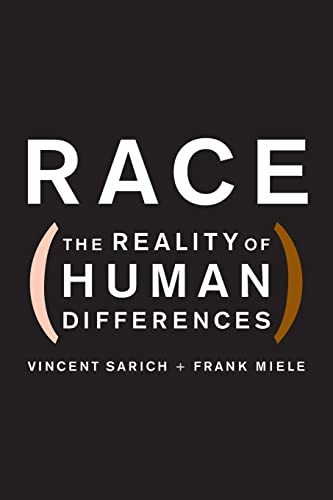
The conventional wisdom in contemporary social science claims that human races are not biologically valid categories. Many argue the very words '”race” and “racial differences” should be abolished because they support racism. In Race, Vincent Sarich and Frank Miele challenge both these tenets. First, they cite the historical record, the art and literature of other civilizations and cultures, morphological studies, cognitive psychology, and the latest research in medical genetics, forensics, and the human genome to demonstrate that racial differences are not trivial, but very real. They conclude with the paradox that, while, scientific honesty requires forthright recognition of racial differences, public policy should not recognize racial-group membership. The evidence and issues raised in this book will be of critical interest to students of race in behavioral and political science, medicine, and law.
Die Inhaltsangabe kann sich auf eine andere Ausgabe dieses Titels beziehen.
Über die Autorin bzw. den Autor
Vincent Sarichis Emeritus Professor of Anthropology at the University of California, Berkeley.Frank Miele is senior editor with Skeptic magazine. Frank Miele'shighly regarded Skeptic interviews include conversations with evolutionists Richard Dawkins and E. O. Wilson, anthropologists Donald Johanson, Lionel Tiger, and Robin Fox, ecologist Garrett Hardin, and psychologist Robert Sternberg. His articles have appeared on many web pages, including those of the Human Behavior and Evolution Society. He lives in Sunnyvale, California, with his Great Dane, Payce
Auszug. © Genehmigter Nachdruck. Alle Rechte vorbehalten.
Race
The Reality of Human DifferencesBy Vincent SarichWestview Press
Copyright © 2005 Vincent SarichAll right reserved.
ISBN: 9780813343228
Chapter One
Race and the LawIn contrast to a recent (2003), highly acclaimed PBS documentarythat termed race "an illusion," a myth constructed by Europeans in theAge of Exploration to justify colonialism and slavery, we argue thatrace is real.
We begin the case for race by noting how one of the most contentiousfacets of our society, our legal system, has no trouble in recognizingeither the existence of race or the ability of the average citizen todo so. Further, DNA markers have been used to identified the race ofperpetrators.
We have an inborn tendency to sort people into groups. The latestevidence shows how this tendency can mirror biological reality.
Some twenty years ago, coauthor Vincent Sarich received a callfrom a San Francisco attorney who was serving as defense attorneyin a racial discrimination case brought by a man who claimedhe had been discriminated against because of his American Indianancestry. As part of their discussion, the question of legal"standing" arose; that is, did the plaintiff actually have the requisiteracial ancestry-was he, in fact, an Indian? Vince naivelyasked for the legal definition of "race" and was told there wasn'tone. Still, in the spirit of scientific inquiry, he observed the proceedingsuntil the first break, at which point he told the attorneythat, in his opinion, the attorney's client had no chance of arguingsuccessfully that the plaintiff lacked standing. To Vince's eyes,the plaintiff obviously "looked" Amerindian. End of case.
As we began working on this book, we discussed the issue ofthe legal definition of "race" and asked the opinion of an attorneywho specializes in civil rights law, which touches on this issue. Heinformed us that there is still no legal definition of "race"; nor, asfar as we know, does it appear that the legal system feels the needfor one. Thus, it appears that the most adversarial part of ourcomplex society, the legal system, not only continues to acceptthe existence of "race" but also relies on the ability of the averageindividual to sort people into races. Our legal system treats "racialidentification" as self-evident, whereas an increasing number ofanthropologists (the profession, one would think, with the pertinentexpertise) have signed on to proclamations that categoricallystate the term has long ago ceased to have any scientificlegitimacy.
Why this clash? To us the answer is simple: The courts havecome to accept the commonsense definition of race, and it is thiscommonsense view that, as we show, best conforms to reality. Alook at two recent (2000) cases is illustrative. In both Rice v. Officeof Hawaiian Affairs and in Haak v. Rochester School District, neitherside raised any questions about the existence of human racesor the ability of the average citizen to make valid judgments as towho belongs to which race (even if the racial categories are euphemisticallytermed "peoples" or "populations"). No special expertisewas assumed or granted in defining or recognizing raceother than the everyday commonsense usage, as given in the OxfordEnglish Dictionary, that a race is "a group of persons connectedby common descent" or "a tribe, nation, or people, regarded as ofcommon stock." The courts and the contending parties, in effect,accepted as givens the existence of race and the ability of the ordinaryperson to distinguish between races based on a set of physicalfeatures.
RICE V. OFFICE OF HAWAIIAN AFFAIRS-RACE BY ANY OTHER NAME IS STILL RACE
In the first case, the United States Supreme Court reversed ajudgment of the 9th Circuit Court of Appeals. The petitioner,H. F. Rice, had challenged the State of Hawaii for not allowinghim to vote in an election for the nine trustees of the Office ofHawaiian Affairs, an agency that administers programs designedfor the benefit of "Hawaiians."
Originally, "Hawaiian" was defined as "any descendant of theraces inhabiting the Hawaiian Islands, prior to 1788" [the yearthe first European, Captain James Cook, reached the islands].That was later changed to "any descendant of the aboriginal peopleswhich exercised sovereignty and subsisted in the HawaiianIslands in 1778, and which peoples thereafter have continued toreside in Hawaii." The term "Native Hawaiian" was defined as"any descendant of not less than one-half part of the races inhabitingthe Hawaiian Islands previous to 1778-provided that thedefinition identically refers to the descendants of such bloodquantum of such aboriginal peoples which exercised sovereigntyand subsisted in the Hawaiians in 1778, and which peoples thereaftercontinued to reside in Hawaii."
The tortuous, convoluted text in the Hawaii statutes is not justthe usual legalese. Both the drafters of the amendments and thecourt in its decision admitted that the substitution of "peoples"for "races" was cosmetic, not substantive, and that "peoples" doesindeed mean "races." The sole reason for the changes was to banishany mention of the offending word, "race," and substitute apalatable euphemism.
Rice, everyone agreed, was a Hawaiian citizen but without therequisite ancestry to be recognized as "Hawaiian" under state law.The state therefore argued that denying Rice the vote in theOHA election was justified, and the 9th Circuit concurred whenRice challenged.
However, the U.S. Supreme Court reversed the 9th Circuit by a7-2 margin (Stevens and Ginsburg dissenting), citing in particularthe 15th Amendment: "The right of the citizens of the UnitedStates to vote shall not be denied or abridged by the United Statesor by any State on account of race, color, or previous condition ofservitude." The Court found the Hawaiian law unconstitutionalbecause it defined voter eligibility on the basis of race.
The 15th Amendment is explicit-race means what the averageperson thinks it means-and the majority of the SupremeCourt read it that way. In the end, the tortuous, convoluted verbiageintroduced into the Hawaiian statutes to avoid the offensiveterm "race" accomplished nothing.
HAAK V. ROCHESTER SCHOOL DISTRICT-WHAT WE SEE IS WHAT YOU GET
In the other case, the 2nd Circuit Court of Appeals ruled that awhite fourth-grade student named Jessica Haak could not transferfrom her home district to an adjoining, primarily white districtbecause the transfer program was enacted for the explicitpurpose of lessening racial isolation among the six districts involved.The plaintiffs, Haak's parents, challenged on the groundsthat denying the right to transfer based upon racial classificationviolated the clause in section 1 of the 14th Amendment, whichmakes it unconstitutional for any state to "deny any personwithin its jurisdiction the equal protection of the law." The districtcourt ruled in Haak's favor, but the 2nd Circuit overturnedthat decision, noting that although the U. S. Supreme Court hadhad many opportunities to rule that race could not be used as afactor in deciding who attended which school, it had never takenthe opportunity to establish a precedent by doing so.
In Haak, neither side even raised the issue of who belonged towhich group (race or ethnicity). A "minority pupil" was defined as"a pupil who is of Black or Hispanic origin or is a member of anotherminority group that historically has been the subject of discrimination."Interestingly, however, neither the application totransfer under the program, the program brochures, nor the...
„Über diesen Titel“ kann sich auf eine andere Ausgabe dieses Titels beziehen.
Suchergebnisse für Race: The Reality of Human Differences

Beispielbild für diese ISBN
Race: The Reality of Human Differences
Anbieter: World of Books (was SecondSale), Montgomery, IL, USA
Verkäuferbewertung 5 von 5 Sternen

Paperback. Zustand: Good. Many argue the words 'race' and 'racial differences' should be abolished because they support racism. This book challenges both these tenets. They cite the history, the art and literature of other cultures, psychology, and the latest research in medical genetics and forensics to demonstrate that racial differences are not trivial, but very real. Artikel-Nr. 00105326643
Gebraucht kaufen
EUR 5,72
Versand gratis
Versand innerhalb von USA
Versand innerhalb von USA
Anzahl: 1 verfügbar
Beispielbild für diese ISBN
Race : The Reality of Human Differences
Anbieter: Better World Books: West, Reno, NV, USA
Verkäuferbewertung 5 von 5 Sternen
Zustand: Very Good. New Ed. Former library copy. Pages intact with possible writing/highlighting. Binding strong with minor wear. Dust jackets/supplements may not be included. Includes library markings. Stock photo provided. Product includes identifying sticker. Better World Books: Buy Books. Do Good. Artikel-Nr. 18603980-75
Gebraucht kaufen
EUR 12,50
Versand gratis
Versand innerhalb von USA
Versand innerhalb von USA
Anzahl: 1 verfügbar
Beispielbild für diese ISBN
Race
Anbieter: Ria Christie Collections, Uxbridge, Vereinigtes Königreich
Verkäuferbewertung 5 von 5 Sternen
Zustand: New. In English. Artikel-Nr. ria9780813343228_new
Neu kaufen
EUR 85,07
EUR 13,34 Versand
Versand von Vereinigtes Königreich nach USA
Versand von Vereinigtes Königreich nach USA
Anzahl: Mehr als 20 verfügbar
Beispielbild für diese ISBN
Race: The Reality of Human Differences
Anbieter: Revaluation Books, Exeter, Vereinigtes Königreich
Verkäuferbewertung 5 von 5 Sternen
Paperback. Zustand: Brand New. 287 pages. 9.50x6.50x1.00 inches. In Stock. Artikel-Nr. x-0813343224
Neu kaufen
EUR 101,24
EUR 11,82 Versand
Versand von Vereinigtes Königreich nach USA
Versand von Vereinigtes Königreich nach USA
Anzahl: 2 verfügbar
Beispielbild für diese ISBN
Race: The Reality of Human Differences
Anbieter: Kennys Bookstore, Olney, MD, USA
Verkäuferbewertung 5 von 5 Sternen
Zustand: New. Contends that race is a biologically real phenomenon with important consequences, contrary to widespread and politically correct views that race doesn't matter - or doesn't even exist Num Pages: 304 pages, black & white illustrations. BIC Classification: JFSL; JHMP. Category: (G) General (US: Trade). Dimension: 229 x 152 x 18. Weight in Grams: 428. . 2005. 1st Edition. paperback. . . . . Books ship from the US and Ireland. Artikel-Nr. V9780813343228
Neu kaufen
EUR 106,17
EUR 9,37 Versand
Versand innerhalb von USA
Versand innerhalb von USA
Anzahl: Mehr als 20 verfügbar