
Verwandte Artikel zu Stuffocation: Why We've Had Enough of Stuff and...
Inhaltsangabe
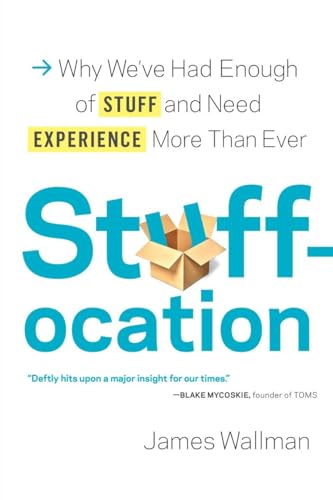
Stuffocation is a movement manifesto for “experiential” living, a call to arms to stop accumulating stuff and start accumulating experiences, and a road map for a new way forward with the potential to transform our lives.
Reject materialism. Embrace experientialism. Live more with less.
Stuffocation is one of the most pressing problems of the twenty-first century. We have more stuff than we could ever need, and it isn’t making us happier. It’s bad for the planet. It’s cluttering up our homes. It’s making us stressed—and it might even be killing us.
A rising number of us are already turning our backs on all-you-can-get consumption. We are choosing access over ownership, and taking our business to companies like Zipcar, Spotify, and Netflix. Fed up with materialism, we are ready for a new way forward.
Trend forecaster James Wallman traces our obsession with stuff back to the original Mad Men, who first created desire through advertising. He interviews anthropologists studying the clutter crisis, economists searching for new ways of measuring progress, and psychologists who link stuffocation to declining well-being. And he introduces us to the innovators who are already living more consciously and with more meaning by choosing experience over stuff.
Experientialism does not mean giving up all of our possessions. It is a solution that is less extreme but equally fundamental. It’s about transforming what we value. Stuffocation is a paradigm-shifting look at our habits and an inspiring call for living more with less. It’s the one important book you won’t be able to live without.
Praise for Stuffocation
“The revelations come fast and furious as he asserts that acquiring ‘stuff’ is often just an easy way to ignore the tougher questions of life, dodging ‘why am I here?’ and ‘how should I live?’ for ‘will that go with the top I bought last week?’ Tart and often funny . . . [Stuffocation] will be an eye-opener for those long ago persuaded that more is better. A scintillating read that will provoke conversation (or at least closet cleaning).”—Booklist
“James Wallman deftly hits upon a major insight for our times: that acquiring ‘stuff’ and ‘things’ is not nearly as meaningful as collecting experiences. Some of the happiest days of my life were when I had nothing and lived on a houseboat. Without stuff to tie me down, I felt completely free.”—Blake Mycoskie, founder of TOMS and author of the New York Times bestseller Start Something That Matters
“A must-read . . . We think that more stuff will make us happier, but as the book nicely shows, we’re just plain wrong. A great mix of stories and science, Stuffocation reveals the downside of more, and what we can do about it.”—Jonah Berger, author of the New York Times bestseller Contagious
“Wallman offers a deeply important message by weaving contemporary social science into very engaging stories. Reading the book is such a pleasure that you hardly recognize you’re being told that you should change how you live your life.”—Barry Schwartz, author of The Paradox of Choice
“With a sociologist’s eye and a storyteller’s ear, Wallman takes us on a tour of today’s experience economy from the perspective not of businesses, nor even of consumers per se, but of everyday people.”—B. Joseph Pine II and James H. Gilmore, authors of The Experience Economy
Die Inhaltsangabe kann sich auf eine andere Ausgabe dieses Titels beziehen.
Über die Autorin bzw. den Autor
James Wallman is a trend forecaster, journalist, and speaker who has written for The New York Times, GQ, Fast Company, and the Financial Times. His clients include Absolut, BMW, Burberry, and Nike. He has an MA in classics from Oxford University and an MA in journalism from the University of the Arts London. He has lived in France, Greece, and Palo Alto, California, and currently lives in London with his wife and two children.
Auszug. © Genehmigter Nachdruck. Alle Rechte vorbehalten.
1
The Anthropologist and the Clutter Crisis
Sometime in the summer of 2000, there was a knock on the door of Jeanne Arnold’s office. It was most likely one of her doctoral candidates or grad students, come to ask her about methodology or whether an inference they were making about some evidence they had brought back from a dig sounded reasonable. In those days, Arnold’s salt-and-pepper hair was swept up and back in a bouffant style that ended somewhere around her shoulders. The glasses she wore had oversized, 1980s-style metal frames. She looked up from her research, and smiled when she saw Elinor Ochs, one of her colleagues at the University of California, Los Angeles. “Got a minute, Jeanne?” Ochs asked—when what she really meant was, “Have you got ten years?”
Ochs was putting together a bid for a project, she explained. Would Arnold be interested in working with her on it? She was gathering a team to document life in the twenty-first century. They would use the same methods as anthropologists studying tribes in Africa, or archaeologists analyzing a dead civilization’s remains, like Inca ruins in South America—except they would be doing the work right there in Los Angeles, with case studies who were very much still alive. The study would be the first of its kind. Well, there had been one or two studies a bit like it before, like one in New York that looked at the art people bought. But there had never been a study as ambitious as this. Instead of trying to understand people through one aspect of their lives, the plan was to record as much of their lives as possible, to create the definitive record of how people were living in the early part of the twenty-first century. The project, Ochs said, could really use a material culture expert like Jeanne. Arnold was not sure though. It sounded exciting, like it might be groundbreaking, but this wasn’t really her field.
Arnold’s specialty was the past, not the present. That had been her passion ever since she had gotten the bug as a little girl. Back then, she had spent her long summer holidays in the woods by her home near the Great Lakes, digging up crinoids and leaf fossils and arrowheads. “They were only little,” Arnold recalls. “Nothing a real paleontologist or archaeologist would be interested in.”
They were a start though. And as Arnold grew, so did her interest in the ancient past, especially archaeology, and its sister discipline, anthropology. She studied them at summer camp, at the local university, and then at the University of California. That is where, in 1980, she stumbled across her life’s work—a native tribe called the Chumash and their old home on Santa Cruz, one of the Channel Islands off the coast of California.
When Arnold talks about the Chumash sites now, you can almost see her arriving on Santa Cruz those thirty-odd years ago. She would have just stepped off the navy supply boat. It was the only way to reach the island back then. It went once a week. The wind would have been blowing her brown hair around as she walked up the green hill to the site. There, she would have walked around wearing dark sunglasses, reading the landscape the way only an archaeologist could. Where you or I would have only seen dips in the ground, she saw the footprints of real people, and hints of where the Chumash had sited their pole and thatched huts. If you or I had ferreted around in the ground, we might have found some old fish bones. “A Chumash toss zone,” Arnold would say. “They weren’t bothered about mess. After they’d eaten, they just threw them on the ground.” If we had kept looking we might have found, even up here, far from the sea, shell remains and the beginnings of beads. That is when Arnold would have asked us to stop. Those remains were for the professionals. With those, and many more like them, she could understand how the Chumash lived, what mattered to them, and how their society was structured.
After more than a decade of gathering and analyzing Chumash artifacts, Arnold realized she was not only excavating a site, she was building a case. Until the late twentieth century, the conventional wisdom had been that complex societies, in which there is an established hierarchy of a ruling elite and bureaucrats, had only emerged from agricultural communities—like Egypt under the pharaohs, for instance. But as the years went by and the evidence stacked up, Arnold became convinced that the Chumash—who hunted, gathered, and fished, but did not farm—had also lived in a complex society called a chiefdom. “That meant,” Arnold will tell you now, “that a society didn’t have to be agricultural for complex systems to emerge.” In other words, as Arnold’s work helped prove, the conventional wisdom was wrong, and it had to be replaced with a new theory that reflected the new evidence. “There are a few grumpy old men out there who still say they’re not persuaded,” Arnold admits. “But they’re slowly disappearing.”
Arnold was the sort of person who was not afraid of confronting the conventional wisdom when it no longer accurately reflected the evidence. No wonder Ochs wanted someone like her on the team.
After a few days, Arnold said she was in. Then she and the rest of Ochs’s team at the Center on the Everyday Lives of Families (CELF)—anthropologists, archaeologists, ethnographers, photographers, and psychologists—worked out a methodology, and got approval and the funds they needed. In 2000, the team set to work, and soon found themselves in the middle of a clutter crisis of epidemic proportions.
The Middle-Class Clutter Crisis
With funding and methodology established, the CELF team began the next task: finding some families who were willing to open their lives to scientific inquiry—average, middle-class ones who were typical of households everywhere, and thirty-two of them. Once they had found them, explained what the commitment would mean to their lives, and what it would mean for social scientists who wanted to understand life at the turn of the twenty-first century, they began. They noted the makeup of their households, the size of their homes, what jobs they did. Each family had at least one child aged between seven and twelve. Their homes ranged from 980 to 3,000 square feet. The professions of the parents included teachers and lawyers, dentists and businesspeople, an airline pilot and a firefighter.
Ochs’s team drew up plans of their homes. They photographed them—their bedrooms, bathrooms, kitchens, living rooms, playrooms, second bathrooms, garages, gardens. They came early. They stayed late. They asked questions. They stayed silent. But they never stopped taking notes—of where their case studies went, what they did, when they ate, what they ate. They were like flies on the wall or spy drones in the air, always there. They were the ultimate voyeurs, granted special permission to access all areas of their case studies’ homes. And even when the scientists were not there, they found another way in. They gave the families video cameras to record their own home video diaries.
Sometimes it got to be too much—for the scientists at least. Once, when one family was having a heated argument, the researcher who was following them around could not cope and had to go outside. But rather than stop recording what was happening, he carried on watching through the window of the family’s bungalow. When the people inside—still arguing—moved to another room, he moved too. He stepped round the house...
„Über diesen Titel“ kann sich auf eine andere Ausgabe dieses Titels beziehen.
Suchergebnisse für Stuffocation: Why We've Had Enough of Stuff and...

Beispielbild für diese ISBN
Stuffocation: Why We've Had En
Anbieter: World of Books (was SecondSale), Montgomery, IL, USA
Verkäuferbewertung 5 von 5 Sternen

Zustand: Good. Item in good condition and has highlighting/writing on text. Used texts may not contain supplemental items such as CDs, info-trac etc. Artikel-Nr. 00102387222
Gebraucht kaufen
EUR 4,85
Versand gratis
Versand innerhalb von USA
Versand innerhalb von USA
Anzahl: 1 verfügbar
Beispielbild für diese ISBN
Stuffocation: Why We've Had Enough of Stuff and Need Experience More Than Ever
Anbieter: ThriftBooks-Atlanta, AUSTELL, GA, USA
Verkäuferbewertung 5 von 5 Sternen
Hardcover. Zustand: Very Good. No Jacket. Former library book; May have limited writing in cover pages. Pages are unmarked. ~ ThriftBooks: Read More, Spend Less. Artikel-Nr. G081299759XI4N10
Gebraucht kaufen
EUR 5,86
Versand gratis
Versand innerhalb von USA
Versand innerhalb von USA
Anzahl: 1 verfügbar
Beispielbild für diese ISBN
Stuffocation: Why We've Had Enough of Stuff and Need Experience More Than Ever
Anbieter: ThriftBooks-Dallas, Dallas, TX, USA
Verkäuferbewertung 5 von 5 Sternen
Hardcover. Zustand: Very Good. No Jacket. Former library book; May have limited writing in cover pages. Pages are unmarked. ~ ThriftBooks: Read More, Spend Less. Artikel-Nr. G081299759XI4N10
Gebraucht kaufen
EUR 5,86
Versand gratis
Versand innerhalb von USA
Versand innerhalb von USA
Anzahl: 1 verfügbar
Foto des Verkäufers
Stuffocation: Why We've Had Enough of Stuff and Need Experience More Than Ever
Anbieter: Goodwill Northern Illinois, Rockford, IL, USA
Verkäuferbewertung 5 von 5 Sternen
Zustand: good. The cover shows wear with possible indentations, creases, and small tears. The pages show wear that may include evidence of handling, smudges, and edge discoloration markings stains . The book may or may not have mild corner dings. The imagery is a stock photo of the item. Artikel-Nr. 4LFY2M0000UE_ns
Gebraucht kaufen
EUR 8,05
Versand gratis
Versand innerhalb von USA
Versand innerhalb von USA
Anzahl: 1 verfügbar
Beispielbild für diese ISBN
Stuffocation : Why We've Had Enough of Stuff and Need Experience More Than Ever
Verlag:
Random House Publishing Group, 2015
ISBN 10: 081299759X
ISBN 13: 9780812997590
Gebraucht
Hardcover
Anbieter: Better World Books, Mishawaka, IN, USA
Verkäuferbewertung 5 von 5 Sternen
Zustand: Very Good. Former library copy. Pages intact with possible writing/highlighting. Binding strong with minor wear. Dust jackets/supplements may not be included. Includes library markings. Stock photo provided. Product includes identifying sticker. Better World Books: Buy Books. Do Good. Artikel-Nr. 6006217-75
Gebraucht kaufen
EUR 8,37
Versand gratis
Versand innerhalb von USA
Versand innerhalb von USA
Anzahl: 2 verfügbar
Beispielbild für diese ISBN
Stuffocation : Why We've Had Enough of Stuff and Need Experience More Than Ever
Verlag:
Random House Publishing Group, 2015
ISBN 10: 081299759X
ISBN 13: 9780812997590
Gebraucht
Hardcover
Anbieter: Better World Books, Mishawaka, IN, USA
Verkäuferbewertung 5 von 5 Sternen
Zustand: Good. Former library copy. Pages intact with minimal writing/highlighting. The binding may be loose and creased. Dust jackets/supplements are not included. Includes library markings. Stock photo provided. Product includes identifying sticker. Better World Books: Buy Books. Do Good. Artikel-Nr. 6411184-20
Gebraucht kaufen
EUR 8,37
Versand gratis
Versand innerhalb von USA
Versand innerhalb von USA
Anzahl: 1 verfügbar
Beispielbild für diese ISBN
Stuffocation: Why We've Had Enough of Stuff and Need Experience More Than Ever
Anbieter: WorldofBooks, Goring-By-Sea, WS, Vereinigtes Königreich
Verkäuferbewertung 5 von 5 Sternen
Paperback. Zustand: Very Good. The book has been read, but is in excellent condition. Pages are intact and not marred by notes or highlighting. The spine remains undamaged. Artikel-Nr. GOR009188456
Gebraucht kaufen
EUR 3,00
EUR 6,52 Versand
Versand von Vereinigtes Königreich nach USA
Versand von Vereinigtes Königreich nach USA
Anzahl: 1 verfügbar
Foto des Verkäufers
Stuffocation: Why We've Had Enough of Stuff and Need Experience More Than Ever
Anbieter: WeBuyBooks, Rossendale, LANCS, Vereinigtes Königreich
Verkäuferbewertung 5 von 5 Sternen
hardcover. Zustand: Very Good. Most items will be dispatched the same or the next working day. A copy that has been read, but is in excellent condition. Pages are intact and not marred by notes or highlighting. The spine remains undamaged. Artikel-Nr. rev2770132863
Gebraucht kaufen
EUR 2,40
EUR 8,29 Versand
Versand von Vereinigtes Königreich nach USA
Versand von Vereinigtes Königreich nach USA
Anzahl: 1 verfügbar
Beispielbild für diese ISBN
Stuffocation: Why We've Had Enough of Stuff and Need Experience More Than Ever
Anbieter: Revaluation Books, Exeter, Vereinigtes Königreich
Verkäuferbewertung 5 von 5 Sternen
Hardcover. Zustand: Brand New. 288 pages. 9.50x6.50x1.50 inches. In Stock. Artikel-Nr. 081299759X
Neu kaufen
EUR 45,76
EUR 14,55 Versand
Versand von Vereinigtes Königreich nach USA
Versand von Vereinigtes Königreich nach USA
Anzahl: 1 verfügbar