
Verwandte Artikel zu Rocket Men: The Daring Odyssey of Apollo 8 and the...
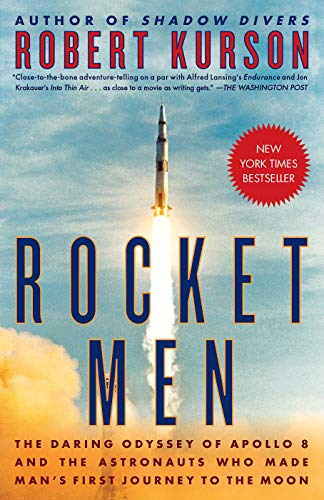
Rocket Men: The Daring Odyssey of Apollo 8 and the Astronauts Who Made Man's First Journey to the Moon - Softcover
Inhaltsangabe
NEW YORK TIMES BESTSELLER • The riveting inside story of three heroic astronauts who took on the challenge of mankind’s historic first mission to the Moon, from the bestselling author of Shadow Divers.
“Robert Kurson tells the tale of Apollo 8 with novelistic detail and immediacy.”—Andy Weir, #1 New York Times bestselling author of The Martian and Artemis
By August 1968, the American space program was in danger of failing in its two most important objectives: to land a man on the Moon by President Kennedy’s end-of-decade deadline, and to triumph over the Soviets in space. With its back against the wall, NASA made an almost unimaginable leap: It would scrap its usual methodical approach and risk everything on a sudden launch, sending the first men in history to the Moon—in just four months. And it would all happen at Christmas.
In a year of historic violence and discord—the Tet Offensive, the assassinations of Martin Luther King, Jr., and Robert Kennedy, the riots at the Democratic National Convention in Chicago—the Apollo 8 mission would be the boldest, riskiest test of America’s greatness under pressure. In this gripping insider account, Robert Kurson puts the focus on the three astronauts and their families: the commander, Frank Borman, a conflicted man on his final mission; idealistic Jim Lovell, who’d dreamed since boyhood of riding a rocket to the Moon; and Bill Anders, a young nuclear engineer and hotshot fighter pilot making his first space flight.
Drawn from hundreds of hours of one-on-one interviews with the astronauts, their loved ones, NASA personnel, and myriad experts, and filled with vivid and unforgettable detail, Rocket Men is the definitive account of one of America’s finest hours. In this real-life thriller, Kurson reveals the epic dangers involved, and the singular bravery it took, for mankind to leave Earth for the first time—and arrive at a new world.
“Rocket Men is a riveting introduction to the [Apollo 8] flight. . . . Kurson details the mission in crisp, suspenseful scenes. . . . [A] gripping book.”—The New York Times Book Review
Die Inhaltsangabe kann sich auf eine andere Ausgabe dieses Titels beziehen.
Über die Autorin bzw. den Autor
Robert Kurson earned a bachelor’s degree in philosophy from the University of Wisconsin and a law degree from Harvard Law School. His award-winning stories have appeared in The New York Times Magazine, Rolling Stone, and Esquire, where he was a contributing editor. He is the New York Times bestselling author of Shadow Divers, the 2005 American Booksellers Association’s nonfiction Book Sense Book of the Year; Crashing Through, based on Kurson’s 2006 National Magazine Award–winning profile in Esquire of the blind speed skier, CIA analyst, and entrepreneur Mike May; and Pirate Hunters. He lives in Chicago.
Auszug. © Genehmigter Nachdruck. Alle Rechte vorbehalten.
Chapter One
Do You Want to Go to the Moon?
August 3, 1968—Four months earlier
As he sat on a beach in the Caribbean, a quiet engineer named George Low ran his fingers through the sand and wondered whether he should risk everything to win the Space Race and help save the world.
At forty-one, Low was already a top manager and one of the most important people at NASA, in charge of making sure the Apollo spacecraft was flightworthy.
Apollo had a single goal, perhaps the greatest and most audacious ever conceived: to land a man on the Moon and return him safely to Earth. In 1961, President John F. Kennedy had committed the United States to achieving this goal by the end of the decade. Never had a more inspiring promise been made to the American people—or one that could be so easily verified.
Now, Kennedy’s end-of-decade deadline was in jeopardy. Design and engineering problems with the lunar module—the spidery landing craft that would move astronauts from their orbiting ship to the lunar surface and back again—threatened to stall the Apollo program and put Kennedy’s deadline, just sixteen months away, out of reach. And that led to another problem. Every day that Apollo languished, the Soviet Union moved closer to landing its own crew on the Moon. And that mattered. The nation that landed the first men on the Moon would score the ultimate victory in the years-long Space Race between the two superpowers, one from which the second place finisher might never recover.
For months, NASA’s best minds had worked around the clock to fix the issues with the lunar module, but the temperamental and complex landing craft only fell further and further behind schedule. By summer, many at the space agency had abandoned hope of making a manned lunar landing by the end of the decade.
And then Low had an idea.
It had come to him just a few weeks before he’d arrived at this beach, and it was wild, an epiphany, a dream. It was also dangerous, risky beyond anything NASA had ever attempted. But the more Low thought about it, the more he believed it could keep the Apollo program moving and save Kennedy’s deadline—and maybe even beat the Soviets to the Moon.
Low inhaled the fresh, salty air and tried to push space travel out of his thoughts. At home, his mind burned nonstop with ideas, formulae, trajectories. Now he needed a break, and it should have been easy to find one in this tropical paradise. About the only reminder of America was the local newspaper, which told of the Newport Pop Festival in Costa Mesa, California, where more than a hundred thousand music fans were expected, and brought word of potential protests at the coming Democratic National Convention in Chicago. It had been an explosive year already, with assassinations, riots, and violence. A quiet beach was just where a man like Low needed to be.
But Low could not relax. He walked the beach, looking out over the ocean toward Moscow and the Moon, thinking, imagining, America and the world on fire behind him.
Five days after Low returned from vacation, a serious man with an oversized head went to work inside a giant assembly plant in Downey, California. His mission: to build a machine from the future that would help make the world safe for democracy.
Over and over, astronaut Frank Borman opened and closed the hatch on the Apollo command module, a cone-shaped capsule made to fly a three-man crew to the Moon. He’d already certified that the hatch worked, then certified it again, but he would not stop pushing on it, making sure it opened, no matter what.
Nearby, Borman’s two crewmates, Jim Lovell and rookie Bill Anders, got ready to test the hundreds of dials, switches, levers, lights, and gauges that made the command module work. The spacecraft was small, measuring just eleven feet tall and thirteen feet wide at its base, but every inch of it had been designed by Borman and others to be impervious to a galaxy of deadly forces.
A nearby transistor radio played Top 40 music, which caught Borman’s ear.
“That’s a pretty slick song,” Borman said. “Who’s the fella singing it?”
“That’s the Beatles, Frank,” Lovell said, laughing.
Borman preferred the standards. As a kid, he’d memorized the lyrics to all the great Western songs played on the radio in Arizona. He could still sing “Cowboy Jack”—a ditty that dated to the nineteenth century—but didn’t dare start because he knew Lovell and Anders would insist that he sing it to the end.
Borman stuck to classic films, too. Alone among astronauts, it seemed, he hadn’t bothered to see 2001: A Space Odyssey, the new Stanley Kubrick film released in April that showed men flying to the Moon. That stuff was science fiction, Borman told his colleagues; America had real people to get to the Moon.
Borman and his crewmates knew that the lunar module was troubled and behind schedule. But until designers and engineers could make the fixes, these astronauts could do little more than make certain that the command module was perfect. So they climbed inside their spacecraft and began testing it, pushing the command module mercilessly, because that’s what outer space would do to it, too.
And then the phone rang.
Smart people knew better than to bother Borman at work. But the man on the line went back a long way with Borman. And he said it was urgent.
Donald Kent “Deke” Slayton was in charge of managing astronaut training and choosing crews for manned space missions. If an astronaut flew on board a NASA spacecraft, it was because Slayton had chosen him to go.
When Borman heard who was calling, he wriggled out of the capsule and grabbed an extension.
“Deke, I’m in the middle of a big test here,” he said.
“Frank, I need you back in Houston.”
“Talk to me now.”
“No, I can’t talk over the phone. It’s gotta be in person. Grab an airplane and get to Houston. On the double.”
Borman grimaced—America did not have time for nonsense and delays—but Slayton was in charge, and NASA, no matter its official designation as a civilian organization, was a military operation to Borman, so he took his orders. Poking his head back inside the spacecraft, he told his partners, “You guys are stuck with the module. I’ve gotta go back to Houston.”
Borman grabbed his rental car, drove to Los Angeles International Airport, and hopped in a T-38 Talon, a two-seat twin-engine supersonic jet used by astronauts for training, commuting, and even some fun, and pointed it toward Texas. At forty, he still looked every bit the West Point cadet: sandy blond near-crewcut, square jaw and chin set for combat, arched eyebrows that seemed a radar for anything askew. Even his head was military issue, all right angles and slightly larger than life, a feature that had earned him the childhood nickname Squarehead.
Borman couldn’t imagine why he was needed in Houston, and so suddenly. He was commander of Apollo 9, the third of four manned test flights NASA planned before it would attempt to land men on the Moon. Apollo 9 was to be a basic mission—orbit Earth, test the spacecraft, come home. It wasn’t scheduled to launch for another six months. Still, Borman knew he hadn’t been summoned for nothing. The last time he’d received a “drop everything” call had been the darkest day in NASA’s history.
It had happened about a year and half earlier, on January 27, 1967, when a fire broke out in the spacecraft during a simulated countdown on the launchpad in Florida. The Apollo 1 rehearsal should have been...
„Über diesen Titel“ kann sich auf eine andere Ausgabe dieses Titels beziehen.
Suchergebnisse für Rocket Men: The Daring Odyssey of Apollo 8 and the...

Beispielbild für diese ISBN
Rocket Men The Daring Odyssey
Verlag:
Random House Trade Paperbacks, 2019
ISBN 10: 081298871X
ISBN 13: 9780812988710
Gebraucht
Softcover
Anbieter: World of Books (was SecondSale), Montgomery, IL, USA
Verkäuferbewertung 5 von 5 Sternen

Zustand: Good. Item in good condition. Textbooks may not include supplemental items i.e. CDs, access codes etc. Artikel-Nr. 00098842249
Gebraucht kaufen
EUR 5,50
Versand gratis
Versand innerhalb von USA
Versand innerhalb von USA
Anzahl: Mehr als 20 verfügbar
Beispielbild für diese ISBN
Rocket Men The Daring Odyssey
Verlag:
Random House Trade Paperbacks, 2019
ISBN 10: 081298871X
ISBN 13: 9780812988710
Gebraucht
Softcover
Anbieter: World of Books (was SecondSale), Montgomery, IL, USA
Verkäuferbewertung 5 von 5 Sternen
Zustand: Very Good. Item in very good condition! Textbooks may not include supplemental items i.e. CDs, access codes etc. Artikel-Nr. 00110385579
Gebraucht kaufen
EUR 5,50
Versand gratis
Versand innerhalb von USA
Versand innerhalb von USA
Anzahl: 1 verfügbar
Beispielbild für diese ISBN
Rocket Men The Daring Odyssey
Verlag:
Random House Trade Paperbacks, 2019
ISBN 10: 081298871X
ISBN 13: 9780812988710
Gebraucht
Softcover
Anbieter: World of Books (was SecondSale), Montgomery, IL, USA
Verkäuferbewertung 5 von 5 Sternen
Zustand: Acceptable. Item in acceptable condition! Textbooks may not include supplemental items i.e. CDs, access codes etc. Artikel-Nr. 00097656685
Gebraucht kaufen
EUR 5,50
Versand gratis
Versand innerhalb von USA
Versand innerhalb von USA
Anzahl: 3 verfügbar
Foto des Verkäufers
Rocket Men: The Daring Odyssey of Apollo 8 and the Astronauts Who Made Man's First Journey to the Moon
Verlag:
Random House Trade Paperbacks, 2019
ISBN 10: 081298871X
ISBN 13: 9780812988710
Gebraucht
Softcover
Anbieter: Dream Books Co., Denver, CO, USA
Verkäuferbewertung 5 von 5 Sternen
Zustand: good. Gently used with minimal wear on the corners and cover. A few pages may contain light highlighting or writing, but the text remains fully legible. Dust jacket may be missing, and supplemental materials like CDs or codes may not be included. May be ex-library with library markings. Ships promptly! Artikel-Nr. DBV.081298871X.G
Gebraucht kaufen
EUR 5,51
Versand gratis
Versand innerhalb von USA
Versand innerhalb von USA
Anzahl: 1 verfügbar
Beispielbild für diese ISBN
Rocket Men: The Daring Odyssey of Apollo 8 and the Astronauts Who Made Man's First Journey to the Moon
Verlag:
Random House Trade Paperbacks (edition Reprint), 2019
ISBN 10: 081298871X
ISBN 13: 9780812988710
Gebraucht
Paperback
Anbieter: BooksRun, Philadelphia, PA, USA
Verkäuferbewertung 5 von 5 Sternen
Paperback. Zustand: Fair. Reprint. The item might be beaten up but readable. May contain markings or highlighting, as well as stains, bent corners, or any other major defect, but the text is not obscured in any way. Artikel-Nr. 081298871X-7-1-13
Gebraucht kaufen
EUR 5,59
Versand gratis
Versand innerhalb von USA
Versand innerhalb von USA
Anzahl: 1 verfügbar
Beispielbild für diese ISBN
Rocket Men: The Daring Odyssey of Apollo 8 and the Astronauts Who Made Man's First Journey to the Moon
Anbieter: ThriftBooks-Atlanta, AUSTELL, GA, USA
Verkäuferbewertung 5 von 5 Sternen
Paperback. Zustand: Fair. No Jacket. Readable copy. Pages may have considerable notes/highlighting. ~ ThriftBooks: Read More, Spend Less. Artikel-Nr. G081298871XI5N00
Gebraucht kaufen
EUR 6,23
Versand gratis
Versand innerhalb von USA
Versand innerhalb von USA
Anzahl: 1 verfügbar
Beispielbild für diese ISBN
Rocket Men : The Daring Odyssey of Apollo 8 and the Astronauts Who Made Man's First Journey to the Moon
Verlag:
Random House Publishing Group, 2019
ISBN 10: 081298871X
ISBN 13: 9780812988710
Gebraucht
Softcover
Anbieter: Better World Books, Mishawaka, IN, USA
Verkäuferbewertung 5 von 5 Sternen
Zustand: Good. Pages intact with minimal writing/highlighting. The binding may be loose and creased. Dust jackets/supplements are not included. Stock photo provided. Product includes identifying sticker. Better World Books: Buy Books. Do Good. Artikel-Nr. 17424932-6
Gebraucht kaufen
EUR 6,42
Versand gratis
Versand innerhalb von USA
Versand innerhalb von USA
Anzahl: 5 verfügbar
Beispielbild für diese ISBN
Rocket Men : The Daring Odyssey of Apollo 8 and the Astronauts Who Made Man's First Journey to the Moon
Verlag:
Random House Publishing Group, 2019
ISBN 10: 081298871X
ISBN 13: 9780812988710
Gebraucht
Softcover
Anbieter: Better World Books: West, Reno, NV, USA
Verkäuferbewertung 5 von 5 Sternen
Zustand: Good. Pages intact with minimal writing/highlighting. The binding may be loose and creased. Dust jackets/supplements are not included. Stock photo provided. Product includes identifying sticker. Better World Books: Buy Books. Do Good. Artikel-Nr. 17424932-6
Gebraucht kaufen
EUR 6,42
Versand gratis
Versand innerhalb von USA
Versand innerhalb von USA
Anzahl: 1 verfügbar
Beispielbild für diese ISBN
Rocket Men: The Daring Odyssey of Apollo 8 and the Astronauts Who Made Man's First Journey to the Moon
Verlag:
Random House Trade Paperbacks, 2019
ISBN 10: 081298871X
ISBN 13: 9780812988710
Gebraucht
paperback
Anbieter: Roundabout Books, Greenfield, MA, USA
Verkäuferbewertung 4 von 5 Sternen

paperback. Zustand: Near Fine. Condition Notes: Excellent, unmarked copy with little wear and tight binding. We ship in recyclable American-made mailers. 100% money-back guarantee on all orders. Artikel-Nr. 1772051
Gebraucht kaufen
EUR 10,97
Versand gratis
Versand innerhalb von USA
Versand innerhalb von USA
Anzahl: 1 verfügbar
Beispielbild für diese ISBN
Rocket Men: The Daring Odyssey of Apollo 8 and the Astronauts Who Made Man's First Journey to the Moon
Anbieter: AwesomeBooks, Wallingford, Vereinigtes Königreich
Verkäuferbewertung 5 von 5 Sternen
Paperback. Zustand: Very Good. Rocket Men: The Daring Odyssey of Apollo 8 and the Astronauts Who Made Man's First Journey to the Moon This book is in very good condition and will be shipped within 24 hours of ordering. The cover may have some limited signs of wear but the pages are clean, intact and the spine remains undamaged. This book has clearly been well maintained and looked after thus far. Money back guarantee if you are not satisfied. See all our books here, order more than 1 book and get discounted shipping. Artikel-Nr. 7719-9780812988710
Gebraucht kaufen
EUR 8,70
EUR 4,80 Versand
Versand von Vereinigtes Königreich nach USA
Versand von Vereinigtes Königreich nach USA
Anzahl: 2 verfügbar