
Verwandte Artikel zu Connectography: Mapping the Future of Global Civilization
Inhaltsangabe
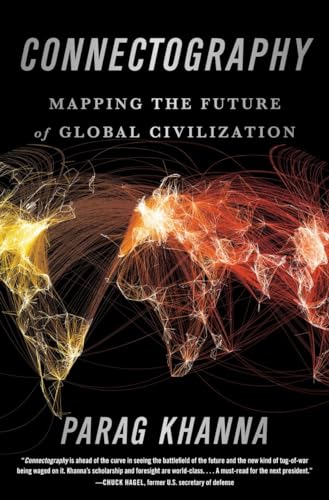
From the visionary bestselling author of The Second World and How to Run the World comes a bracing and authoritative guide to a future shaped less by national borders than by global supply chains, a world in which the most connected powers—and people—will win.
Connectivity is the most revolutionary force of the twenty-first century. Mankind is reengineering the planet, investing up to ten trillion dollars per year in transportation, energy, and communications infrastructure linking the world’s burgeoning megacities together. This has profound consequences for geopolitics, economics, demographics, the environment, and social identity. Connectivity, not geography, is our destiny.
In Connectography, visionary strategist Parag Khanna travels from Ukraine to Iran, Mongolia to North Korea, Pakistan to Nigeria, and across the Arctic Circle and the South China Sea to explain the rapid and unprecedented changes affecting every part of the planet. He shows how militaries are deployed to protect supply chains as much as borders, and how nations are less at war over territory than engaged in tugs-of-war over pipelines, railways, shipping lanes, and Internet cables. The new arms race is to connect to the most markets—a race China is now winning, having launched a wave of infrastructure investments to unite Eurasia around its new Silk Roads. The United States can only regain ground by fusing with its neighbors into a super-continental North American Union of shared resources and prosperity.
Connectography offers a unique and hopeful vision for the future. Khanna argues that new energy discoveries and technologies have eliminated the need for resource wars; ambitious transport corridors and power grids are unscrambling Africa’s fraught colonial borders; even the Arab world is evolving a more peaceful map as it builds resource and trade routes across its war-torn landscape. At the same time, thriving hubs such as Singapore and Dubai are injecting dynamism into young and heavily populated regions, cyber-communities empower commerce across vast distances, and the world’s ballooning financial assets are being wisely invested into building an inclusive global society. Beneath the chaos of a world that appears to be falling apart is a new foundation of connectivity pulling it together.
Praise for Connectography
“Incredible . . . With the world rapidly changing and urbanizing, [Khanna’s] proposals might be the best way to confront a radically different future.”—The Washington Post
“Clear and coherent . . . a well-researched account of how companies are weaving ever more complicated supply chains that pull the world together even as they squeeze out inefficiencies. . . . [He] has succeeded in demonstrating that the forces of globalization are winning.”—Adrian Woolridge, The Wall Street Journal
“Bold . . . With an eye for vivid details, Khanna has . . . produced an engaging geopolitical travelogue.”—Foreign Affairs
“For those who fear that the world is becoming too inward-looking, Connectography is a refreshing, optimistic vision.”—The Economist
“Connectivity has become a basic human right, and gives everyone on the planet the opportunity to provide for their family and contribute to our shared future. Connectography charts the future of this connected world.”—Marc Andreessen, general partner, Andreessen Horowitz
“Khanna’s scholarship and foresight are world-class. A must-read for the next president.”—Chuck Hagel, former U.S. secretary of defense
Die Inhaltsangabe kann sich auf eine andere Ausgabe dieses Titels beziehen.
Über die Autorin bzw. den Autor
Parag Khanna is a global strategist, world traveler, and bestselling author. He is a CNN Global Contributor and a Senior Research Fellow at the Lee Kuan Yew School of Public Policy at the National University of Singapore. Khanna is the co-author of Hybrid Reality: Thriving in the Emerging Human-Technology Civilization and author of How to Run the World: Charting a Course to the Next Renaissance and The Second World: Empires and Influence in the New Global Order. He has been a fellow at the New America Foundation and Brookings Institution, advised the U.S. National Intelligence Council, and worked in Iraq and Afghanistan as a senior geopolitical adviser to U.S. Special Operations Forces. He holds undergraduate and graduate degrees from the School of Foreign Service at Georgetown University and a Ph.D. from the London School of Economics. He serves on numerous governmental and corporate advisory boards and is a councilor of the American Geographical Society, a trustee of the New Cities Foundation, and a Young Global Leader of the World Economic Forum.
Auszug. © Genehmigter Nachdruck. Alle Rechte vorbehalten.
Chapter 1
From Borders to Bridges
A Journey Around
the World
Let’s take a journey around the world—without ever getting on a plane. If we get an early start in Edinburgh, Scotland, we’ll arrive at London Euston station around noon, stroll quickly past the British Library, and have a quick lunch at the masterfully renovated Victorian-era St. Pancras station, from which we’ll board the Eurostar train, travel under the Dover Strait to Paris, followed by a high-speed TGV to Munich and a German ICE to Budapest. An overnight train along the Danube River brings us to Bucharest, Romania, and another overnight along the Black Sea to Istanbul. Where once a creaky ferry was the fastest way to cross from Europe to Asia across the Bosporus Strait, today we can glide over one or the other suspension bridge or continue by train through the newly opened Marmaray tunnel and onward to Iran. We could also catch the revived Hejaz Railway through southeastern Turkey, stopping in Damascus and Amman before continuing to Medina or across Israel and the Sinai to Cairo, from which we might ultimately descend through Africa all the way to Cape Town on a sturdy upgrade of the “Red Line” British colonialists began in the late nineteenth century. From Tehran, we’ll head eastward on a new Chinese-built railway through the rugged Asian steppe, cross Turkmenistan and Uzbekistan to Kazakhstan’s commercial hub of Almaty. Several times per week, we can cross into China’s largest province of Xinjiang to its capital, Urumqi, and onward via Xi’an to Beijing.
Back in Paris, we might have opted for an overnight sleeper to Moscow, from which we could catch the fabled Trans-Siberian Railway to Vladivostok—and carry on to Pyongyang and Seoul—or branch off a bit earlier toward Beijing, via either Manchuria or Mongolia. Either way, if we opt for the tropical route, we’ll speed southward along the world’s most extensive high-speed rail network into mountainous Yunnan and its capital, Kunming. From there, we can cross directly into Laos and take in Vientiane before crossing into Thailand toward Bangkok, or take a coastal route along the South China Sea via Hanoi and Ho Chi Minh City in Vietnam and through Phnom Penh in Cambodia to Bangkok. Now the options narrow with the geography: we speed on down the Malay Peninsula to Kuala Lumpur and Singapore, the southernmost point on mainland Asia.
But water hasn’t stopped us so far, so let’s continue by train through a tunnel under the strategic Strait of Malacca onto Indonesia’s largest island of Sumatra, then over the Sunda Strait bridge to reach the capital, Jakarta, on Java, the world’s most populous island with more than 150 million people. Just a bit farther and we’re on the beaches of Bali, from which we can catch a cruise ship to Australia. If we choose the fastest routes and don’t miss any connections, we will have traversed the entire Eurasian landmass—Scotland to Singapore, and then some—in about a week.
And yet we’re only halfway done. Instead of the Antipodes, from Beijing we should actually head north through Vladivostok and eastern Siberia. If you fancy sushi, we could take a bridge to Sakhalin Island and pass through a 45-kilometer tunnel to Japan’s northernmost Hokkaido Island, passing seamlessly southward across Japan’s major islands on high-speed Shinkansen trains. When we reach Kyushu, we’ll loop back through a 120-kilometer undersea tunnel to Busan, zipping northward through the Korean peninsula back toward Siberia to continue our next 13,000-kilometer segment that takes us parallel to the volcanic Kamchatka Peninsula and through a 200-kilometer tunnel under the Bering Strait that emerges in Alaska and takes us to Fairbanks. From there, of course, it’s straight south to Juneau and Vancouver, Seattle and Portland, San Francisco and Los Angeles. California, Texas, Illinois, and New York all want more Acela Express high-speed rail (though it’s planned to hit only about two hundred kilometers per hour, about half as fast as the Japanese). Still, we’ll make it from Pacific to Atlantic across the Lower 48 in two days. All that’s left is to catch a zippy but smooth hovercraft to London, followed by any of the more than twenty daily trains headed to Edinburgh. A journey around the world—as promised.
One could fly almost seamlessly along this itinerary, drive much of it too except for the oceans, and indeed eventually do it the old-fashioned way on iron railroads. Many of these routes already exist, and all of them will in due course. The more connections there are, the more options we have.
“Geography is destiny,” one of the most famous adages about the world, is becoming obsolete. Centuries-old arguments about how climate and culture condemn some societies to fail, or how small countries are forever trapped and subject to the whims of larger ones, are being overturned. Thanks to global transportation, communications, and energy infrastructures—highways, railways, airports, pipelines, electricity grids, Internet cables, and more—the future has a new maxim: “Connectivity is destiny.”
Seeing the world through the lens of connectivity generates new visions of how we organize ourselves as a species. Global infrastructures are morphing our world system from divisions to connections and from nations to nodes. Infrastructure is like a nervous system connecting all parts of the planetary body; capital and code are the blood cells flowing through it. More connectivity creates a world beyond states, a global society greater than the sum of its parts. Much as the world evolved from vertically integrated empires to horizontally interdependent states, now it is graduating toward a global network civilization whose map of connective corridors will supersede traditional maps of national borders. Each continental zone is already becoming an internally integrated mega-region (North America, South America, Europe, Africa, Arabia, South Asia, East Asia) with increasingly free trade coupled with intense connectivity across their thriving city-states.
At the same time, maps of connectivity are also better at revealing geopolitical dynamics among superpowers, city-states, stateless companies, and virtual communities of all kinds as they compete to capture resources, markets, and mind share. We are moving into an era where cities will matter more than states and supply chains will be a more important source of power than militaries—whose main purpose will be to protect supply chains rather than borders. Competitive connectivity is the arms race of the twenty-first century.
Connectivity is nothing less than our path to collective salvation. Competition over connectivity is by its nature less violent than international border conflicts, providing an escape hatch from historical cycles of great power conflict. Furthermore, connectivity has made previously unimaginable progress possible as resources and technologies move much more easily to where they are needed, while people can more quickly relocate to escape natural disasters or to cities for economic opportunity. Better connectivity allows societies to diversify where their imports come from and where their exports go. Connectivity is therefore how we make the most of our geography. The grand story of human civilization is more than just tragic cycles of war and peace or economic booms and busts. The arc of history is long, but it bends toward connectivity.
Bridges to Everywhere
The central fact of the age we live in is that every country, every...
„Über diesen Titel“ kann sich auf eine andere Ausgabe dieses Titels beziehen.
Suchergebnisse für Connectography: Mapping the Future of Global Civilization

Beispielbild für diese ISBN
Connectography: Mapping the Future of Global Civilization
Anbieter: World of Books (was SecondSale), Montgomery, IL, USA
Verkäuferbewertung 5 von 5 Sternen

Zustand: Good. Item in good condition. Textbooks may not include supplemental items i.e. CDs, access codes etc. Artikel-Nr. 00091458193
Gebraucht kaufen
EUR 3,91
Versand gratis
Versand innerhalb von USA
Versand innerhalb von USA
Anzahl: 7 verfügbar
Beispielbild für diese ISBN
Connectography: Mapping the Future of Global Civilization
Anbieter: World of Books (was SecondSale), Montgomery, IL, USA
Verkäuferbewertung 5 von 5 Sternen
Zustand: Acceptable. Item in good condition. Textbooks may not include supplemental items i.e. CDs, access codes etc. Artikel-Nr. 00065019103
Gebraucht kaufen
EUR 3,91
Versand gratis
Versand innerhalb von USA
Versand innerhalb von USA
Anzahl: 1 verfügbar
Beispielbild für diese ISBN
Connectography: Mapping the Future of Global Civilization
Verlag:
Random House (edition First Edition), 2016
ISBN 10: 0812988558
ISBN 13: 9780812988550
Gebraucht
Hardcover
Erstausgabe
Anbieter: BooksRun, Philadelphia, PA, USA
Verkäuferbewertung 5 von 5 Sternen
Hardcover. Zustand: Very Good. First Edition. With dust jacket. It's a well-cared-for item that has seen limited use. The item may show minor signs of wear. All the text is legible, with all pages included. It may have slight markings and/or highlighting. Artikel-Nr. 0812988558-11-1-29
Gebraucht kaufen
EUR 5,63
Versand gratis
Versand innerhalb von USA
Versand innerhalb von USA
Anzahl: 1 verfügbar
Beispielbild für diese ISBN
Connectography: Mapping the Future of Global Civilization
Anbieter: ThriftBooks-Reno, Reno, NV, USA
Verkäuferbewertung 5 von 5 Sternen
Hardcover. Zustand: Very Good. No Jacket. May have limited writing in cover pages. Pages are unmarked. ~ ThriftBooks: Read More, Spend Less. Artikel-Nr. G0812988558I4N00
Gebraucht kaufen
EUR 5,90
Versand gratis
Versand innerhalb von USA
Versand innerhalb von USA
Anzahl: 1 verfügbar
Beispielbild für diese ISBN
Connectography: Mapping the Future of Global Civilization
Anbieter: ThriftBooks-Dallas, Dallas, TX, USA
Verkäuferbewertung 5 von 5 Sternen
Hardcover. Zustand: Very Good. No Jacket. May have limited writing in cover pages. Pages are unmarked. ~ ThriftBooks: Read More, Spend Less. Artikel-Nr. G0812988558I4N00
Gebraucht kaufen
EUR 5,90
Versand gratis
Versand innerhalb von USA
Versand innerhalb von USA
Anzahl: 1 verfügbar
Beispielbild für diese ISBN
Connectography: Mapping the Future of Global Civilization
Anbieter: ThriftBooks-Atlanta, AUSTELL, GA, USA
Verkäuferbewertung 5 von 5 Sternen
Hardcover. Zustand: Very Good. No Jacket. May have limited writing in cover pages. Pages are unmarked. ~ ThriftBooks: Read More, Spend Less. Artikel-Nr. G0812988558I4N00
Gebraucht kaufen
EUR 5,90
Versand gratis
Versand innerhalb von USA
Versand innerhalb von USA
Anzahl: 1 verfügbar
Beispielbild für diese ISBN
Connectography: Mapping the Future of Global Civilization
Anbieter: Wonder Book, Frederick, MD, USA
Verkäuferbewertung 5 von 5 Sternen
Zustand: As New. Like New condition. Very Good dust jacket. A near perfect copy that may have very minor cosmetic defects. Artikel-Nr. P14T-01070
Gebraucht kaufen
EUR 6,32
Versand gratis
Versand innerhalb von USA
Versand innerhalb von USA
Anzahl: 1 verfügbar
Beispielbild für diese ISBN
Connectography: Mapping the Future of Global Civilization
Anbieter: Wonder Book, Frederick, MD, USA
Verkäuferbewertung 5 von 5 Sternen
Zustand: Very Good. Very Good condition. Very Good dust jacket. A copy that may have a few cosmetic defects. May also contain light spine creasing or a few markings such as an owner's name, short gifter's inscription or light stamp. Artikel-Nr. U06B-05506
Gebraucht kaufen
EUR 6,32
Versand gratis
Versand innerhalb von USA
Versand innerhalb von USA
Anzahl: 2 verfügbar
Beispielbild für diese ISBN
Connectography: Mapping the Future of Global Civilization
Verlag:
Random House (edition First Edition), 2016
ISBN 10: 0812988558
ISBN 13: 9780812988550
Gebraucht
Hardcover
Erstausgabe
Anbieter: BooksRun, Philadelphia, PA, USA
Verkäuferbewertung 5 von 5 Sternen
Hardcover. Zustand: Very Good. First Edition. With dust jacket. It's a well-cared-for item that has seen limited use. The item may show minor signs of wear. All the text is legible, with all pages included. It may have slight markings and/or highlighting. Artikel-Nr. 0812988558-8-1-29
Gebraucht kaufen
EUR 6,86
Versand gratis
Versand innerhalb von USA
Versand innerhalb von USA
Anzahl: 1 verfügbar
Beispielbild für diese ISBN
Connectography : Mapping the Future of Global Civilization
Verlag:
Penguin Random House, 2016
ISBN 10: 0812988558
ISBN 13: 9780812988550
Gebraucht
Hardcover
Erstausgabe
Anbieter: Better World Books, Mishawaka, IN, USA
Verkäuferbewertung 5 von 5 Sternen
Zustand: Good. 1st. Former library copy. Pages intact with minimal writing/highlighting. The binding may be loose and creased. Dust jackets/supplements are not included. Includes library markings. Stock photo provided. Product includes identifying sticker. Better World Books: Buy Books. Do Good. Artikel-Nr. 11638472-6
Gebraucht kaufen
EUR 7,46
Versand gratis
Versand innerhalb von USA
Versand innerhalb von USA
Anzahl: 1 verfügbar