
Inhaltsangabe
NEW YORK TIMES BESTSELLER • NAMED ONE OF THE BEST BOOKS OF THE YEAR BY The Washington Post • Los Angeles Times • San Francisco Chronicle • Harper’s Bazaar • St. Louis Post-Dispatch • The Guardian • The Kansas City Star • National Post • BookPage • Kirkus Reviews
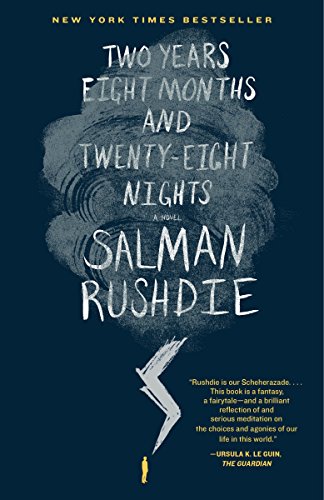
From Salman Rushdie, one of the great writers of our time, comes a spellbinding work of fiction that blends history, mythology, and a timeless love story. A lush, richly layered novel in which our world has been plunged into an age of unreason, Two Years Eight Months and Twenty-Eight Nights is a breathtaking achievement and an enduring testament to the power of storytelling.
In the near future, after a storm strikes New York City, the strangenesses begin. A down-to-earth gardener finds that his feet no longer touch the ground. A graphic novelist awakens in his bedroom to a mysterious entity that resembles his own sub–Stan Lee creation. Abandoned at the mayor’s office, a baby identifies corruption with her mere presence, marking the guilty with blemishes and boils. A seductive gold digger is soon tapped to combat forces beyond imagining.
Unbeknownst to them, they are all descended from the whimsical, capricious, wanton creatures known as the jinn, who live in a world separated from ours by a veil. Centuries ago, Dunia, a princess of the jinn, fell in love with a mortal man of reason. Together they produced an astonishing number of children, unaware of their fantastical powers, who spread across generations in the human world.
Once the line between worlds is breached on a grand scale, Dunia’s children and others will play a role in an epic war between light and dark spanning a thousand and one nights—or two years, eight months, and twenty-eight nights. It is a time of enormous upheaval, in which beliefs are challenged, words act like poison, silence is a disease, and a noise may contain a hidden curse.
Inspired by the traditional “wonder tales” of the East, Salman Rushdie’s novel is a masterpiece about the age-old conflicts that remain in today’s world. Two Years Eight Months and Twenty-Eight Nights is satirical and bawdy, full of cunning and folly, rivalries and betrayals, kismet and karma, rapture and redemption.
Praise for Two Years Eight Months and Twenty-Eight Nights
“Rushdie is our Scheherazade. . . . This book is a fantasy, a fairytale—and a brilliant reflection of and serious meditation on the choices and agonies of our life in this world.”—Ursula K. Le Guin, The Guardian
“One of the major literary voices of our time . . . In reading this new book, one cannot escape the feeling that [Rushdie’s] years of writing and success have perhaps been preparation for this moment, for the creation of this tremendously inventive and timely novel.”—San Francisco Chronicle
“A wicked bit of satire . . . [Rushdie] riffs and expands on the tales of Scheherazade, another storyteller whose spinning of yarns was a matter of life and death.”—USA Today
“A swirling tale of genies and geniuses [that] translates the bloody upheavals of our last few decades into the comic-book antics of warring jinn wielding bolts of fire, mystical transmutations and rhyming battle spells.”—The Washington Post
“Great fun . . . The novel shines brightest in the panache of its unfolding, the electric grace and nimble eloquence and extraordinary range and layering of his voice.”—The Boston Globe
Die Inhaltsangabe kann sich auf eine andere Ausgabe dieses Titels beziehen.
Über die Autorin bzw. den Autor
Salman Rushdie is the author of eleven previous novels—Grimus, Midnight’s Children (for which he won the Booker Prize and the Best of the Booker), Shame, The Satanic Verses, Haroun and the Sea of Stories, The Moor’s Last Sigh, The Ground Beneath Her Feet, Fury, Shalimar the Clown, The Enchantress of Florence, and Luka and the Fire of Life—and one collection of short stories: East, West. He has also published four works of nonfiction—Joseph Anton, The Jaguar Smile, Imaginary Homelands, and Step Across This Line—and co-edited two anthologies, Mirrorwork and Best American Short Stories 2008. He is a member of the American Academy of Arts and Letters and a Distinguished Writer in Residence at New York University. A former president of PEN American Center, Rushdie was knighted in 2007 for services to literature.
Auszug. © Genehmigter Nachdruck. Alle Rechte vorbehalten.
Very little is known, though much has been written, about the true nature of the jinn, the creatures made of smokeless fire. Whether they are good or evil, devilish or benign, such questions are hotly disputed. These qualities are broadly accepted: that they are whimsical, capricious, wanton; that they can move at high speed, alter their size and form, and grant many of the wishes of mortal men and women should they so choose, or if by coercion they are obliged to do so; and that their sense of time differs radically from that of human beings. They are not to be confused with angels, even though some of the old stories erroneously state that the Devil himself, the fallen angel Lucifer, son of the morning, was the greatest of the jinn. For a long time their dwelling places were also in dispute. Some ancient stories said, slanderously, that the jinn lived among us here on earth, the so-called “lower world,” in ruined buildings and many insalubrious zones--garbage dumps, graveyards, outdoor latrines, sewers, and, wherever possible, in dunghills. According to these defamatory tales we would do well to wash ourselves thoroughly after any contact with a jinni. They are malodorous and carry disease. However, the most eminent commentators long asserted what we now know to be true: that the jinn live in their own world, separated from ours by a veil, and that this upper world, sometimes called Peristan or Fairyland, is very extensive, though its nature is concealed from us.
To say that the jinn are inhuman may seem to be stating the obvious, but human beings share some qualities at least with their fantastical counterparts. In the matter of faith, for example, there are adherents among the jinn of every belief system on earth, and there are jinn who do not believe, for whom the notion of gods and angels is strange in the same way as the jinn themselves are strange to human beings. And though many jinn are amoral, at least some of these powerful beings do know the difference between good and evil, between the right-hand and the left-hand path.
Some of the jinn can fly, but some slither on the ground in the form of snakes, or run about barking and baring their fangs in the shape of giant dogs. In the sea, and sometimes in the air as well, they assume the outward appearance of dragons. Some of the lesser jinn are unable, when on earth, to maintain their form for long periods. These amorphous creatures sometimes slide into human beings through the ears, nose or eyes, and occupy those bodies for a while, discarding them when they tire of them. The occupied human beings, regrettably, do not survive.
The female jinn, the jinnias or jiniri, are even more mysterious, even subtler and harder to grasp, being shadow-women made of fireless smoke. There are savage jiniri, and jiniri of love, but it may also be that these two different kind of jinnia are actually one and the same--that a savage spirit may be soothed by love, or a loving creature roused by maltreatment to a savagery beyond the comprehension of mortal men.
This is the story of a jinnia, a great princess of the jinn, known as the Lightning Princess on account of her mastery over the thunderbolt, who loved a mortal man long ago, in the twelfth century, as we would say, and of her many descendants, and of her return to the world, after a long absence, to fall in love again, at least for a moment, and then to go to war. It is also the tale of many other jinn, male and female, flying and slithering, good, bad, and uninterested in morality; and of the time of crisis, the time-out-of-joint which we call the time of the strangenesses, which lasted for two years, eight months and twenty-eight nights, which is to say, one thousand nights and one night more. And yes, we have lived another thousand years since those days, but we are all forever changed by that time. Whether for better or for worse, that is for our future to decide.
In the year 1195, the great philosopher Ibn Rushd, once the Qadi, or judge, of Seville and most recently the personal physician to the Caliph Abu Yusuf Yaqub in his hometown of Córdoba, was formally discredited and disgraced on account of his liberal ideas, which were unacceptable to the increasingly powerful Berber fanatics who were spreading like a pestilence across Arab Spain, and sent to live in internal exile in the small village of Lucena outside his native city, a village full of Jews who could no longer say they were Jews because the previous ruling dynasty of al-Andalus, the Almoravides, had forced them to convert to Islam. Ibn Rushd, a philosopher who was no longer permitted to expound his philosophy, all of whose writing had been banned and his books burned, felt instantly at home among the Jews who could not say they were Jews. He had been the favorite of the Caliph of the present ruling dynasty, the Almohads, but favorites go out of fashion, and Abu Yusuf Yaqub allowed the fanatics to push the great commentator on Aristotle out of town.
The philosopher who could not speak his philosophy lived in a narrow unpaved street in a humble house with small windows and was terribly oppressed by the absence of light. He set up a medical practice in Lucena and his status as the ex-physician of the Caliph himself brought him patients; in addition he used what assets he had to enter modestly into the horse trade, and also financed the making of the large earthenware vessels, tinajas, in which the Jews who were no longer Jews stored and sold olive oil and wine. One day soon after the beginning of his exile a girl of perhaps sixteen summers appeared outside his door, smiling gently, not knocking or intruding on his thoughts in any other way, and simply stood there waiting patiently until he became aware of her presence and invited her in. She told him that she was newly orphaned; that she had no source of income, but preferred not to work in the whorehouse; and that her name was Dunia, which did not sound like a Jewish name because she was not allowed to speak her Jewish name and because she was illiterate she could not write it down. She told him a traveler had suggested the name and said it was from Greek and meant “the world” and she had liked that idea. Ibn Rushd the translator of Aristotle did not quibble with her, knowing that it meant “the world” in enough tongues to make pedantry unnecessary. “Why have you named yourself after the world?” he asked her, and she replied, looking him in the eye as she spoke, “Because a world will flow from me and those who flow from me will spread across the world.”
Being a man of reason, he did not guess that she was a supernatural creature, a jinnia, of the tribe of female jinn, the jiniri: a grand princess of that tribe, on an earthly adventure, pursuing her fascination with human men in general and brilliant ones in particular. He took her into his cottage as housekeeper and lover and in the muffled night she whispered her “true”--that is to say, false--Jewish name into his ear and that was their secret. Dunia the jinnia was as spectacularly fertile as her prophecy had implied. In the two years, eight months and twenty-eight days and nights that followed, she was pregnant three times and on each occasion brought forth a multiplicity of children, at least seven on each occasion, it would appear, and on one occasion eleven, or possibly nineteen, though the records are vague and inexact. All the children inherited her most distinctive feature: they had no earlobes.
If Ibn Rushd had been an adept of the occult arcana he would have realized then that his children were the offspring of a nonhuman mother, but he was too wrapped up in himself to work it out. (We sometimes think that it was fortunate for him, and for our entire history, that Dunia loved him for the brilliance of his mind, his nature being perhaps too...
„Über diesen Titel“ kann sich auf eine andere Ausgabe dieses Titels beziehen.
Weitere beliebte Ausgaben desselben Titels

Suchergebnisse für Two Years Eight Months and Twenty-Eight Nights: A Novel

Beispielbild für diese ISBN
Two Years Eight Months and Twe
Verlag:
Random House Publishing Group, 2016
ISBN 10: 0812988205
ISBN 13: 9780812988208
Gebraucht
Softcover
Anbieter: World of Books (was SecondSale), Montgomery, IL, USA
Verkäuferbewertung 5 von 5 Sternen

Zustand: Good. Item in good condition. Textbooks may not include supplemental items i.e. CDs, access codes etc. Artikel-Nr. 00092479867
Gebraucht kaufen
EUR 4,33
Versand gratis
Versand innerhalb von USA
Versand innerhalb von USA
Anzahl: 5 verfügbar
Beispielbild für diese ISBN
Two Years Eight Months and Twe
Verlag:
Random House Publishing Group, 2016
ISBN 10: 0812988205
ISBN 13: 9780812988208
Gebraucht
Softcover
Anbieter: World of Books (was SecondSale), Montgomery, IL, USA
Verkäuferbewertung 5 von 5 Sternen
Zustand: Very Good. Item in very good condition! Textbooks may not include supplemental items i.e. CDs, access codes etc. Artikel-Nr. 00095247048
Gebraucht kaufen
EUR 4,33
Versand gratis
Versand innerhalb von USA
Versand innerhalb von USA
Anzahl: 3 verfügbar
Beispielbild für diese ISBN
Two Years Eight Months and Twe
Verlag:
Random House Publishing Group, 2016
ISBN 10: 0812988205
ISBN 13: 9780812988208
Gebraucht
Softcover
Anbieter: World of Books (was SecondSale), Montgomery, IL, USA
Verkäuferbewertung 5 von 5 Sternen
Zustand: Acceptable. Item in acceptable condition! Textbooks may not include supplemental items i.e. CDs, access codes etc. Artikel-Nr. 00068981518
Gebraucht kaufen
EUR 4,33
Versand gratis
Versand innerhalb von USA
Versand innerhalb von USA
Anzahl: 1 verfügbar
Beispielbild für diese ISBN
Two Years Eight Months and Twe
Verlag:
Random House Trade Paperbacks, 2016
ISBN 10: 0812988205
ISBN 13: 9780812988208
Gebraucht
Softcover
Anbieter: World of Books (was SecondSale), Montgomery, IL, USA
Verkäuferbewertung 5 von 5 Sternen
Zustand: Good. Item in very good condition! Textbooks may not include supplemental items i.e. CDs, access codes etc. Artikel-Nr. 00077844403
Gebraucht kaufen
EUR 5,48
Versand gratis
Versand innerhalb von USA
Versand innerhalb von USA
Anzahl: 1 verfügbar
Beispielbild für diese ISBN
Two Years Eight Months and Twenty-Eight Nights: A Novel
Verlag:
Random House Publishing Group, 2016
ISBN 10: 0812988205
ISBN 13: 9780812988208
Gebraucht
Softcover
Anbieter: Wonder Book, Frederick, MD, USA
Verkäuferbewertung 5 von 5 Sternen
Zustand: Very Good. Very Good condition. A copy that may have a few cosmetic defects. May also contain light spine creasing or a few markings such as an owner's name, short gifter's inscription or light stamp. Artikel-Nr. M14R-00642
Gebraucht kaufen
EUR 6,76
Versand gratis
Versand innerhalb von USA
Versand innerhalb von USA
Anzahl: 2 verfügbar
Beispielbild für diese ISBN
Two Years Eight Months and Twenty-Eight Nights: A Novel
Verlag:
Random House Publishing Group, 2016
ISBN 10: 0812988205
ISBN 13: 9780812988208
Gebraucht
Softcover
Anbieter: Wonder Book, Frederick, MD, USA
Verkäuferbewertung 5 von 5 Sternen
Zustand: Good. Good condition. A copy that has been read but remains intact. May contain markings such as bookplates, stamps, limited notes and highlighting, or a few light stains. Artikel-Nr. B17A-03658
Gebraucht kaufen
EUR 6,76
Versand gratis
Versand innerhalb von USA
Versand innerhalb von USA
Anzahl: 1 verfügbar
Beispielbild für diese ISBN
Two Years Eight Months and Twenty-Eight Nights
Anbieter: ThriftBooks-Dallas, Dallas, TX, USA
Verkäuferbewertung 5 von 5 Sternen
Paperback. Zustand: Good. No Jacket. Pages can have notes/highlighting. Spine may show signs of wear. ~ ThriftBooks: Read More, Spend Less. Artikel-Nr. G0812988205I3N00
Gebraucht kaufen
EUR 7,31
Versand gratis
Versand innerhalb von USA
Versand innerhalb von USA
Anzahl: 1 verfügbar
Beispielbild für diese ISBN
Two Years Eight Months and Twenty-Eight Nights
Anbieter: ThriftBooks-Atlanta, AUSTELL, GA, USA
Verkäuferbewertung 5 von 5 Sternen
Paperback. Zustand: As New. No Jacket. Pages are clean and are not marred by notes or folds of any kind. ~ ThriftBooks: Read More, Spend Less. Artikel-Nr. G0812988205I2N00
Gebraucht kaufen
EUR 7,31
Versand gratis
Versand innerhalb von USA
Versand innerhalb von USA
Anzahl: 1 verfügbar
Beispielbild für diese ISBN
Two Years Eight Months and Twenty-Eight Nights: A Novel
Verlag:
Random House Publishing Group (edition Reprint), 2016
ISBN 10: 0812988205
ISBN 13: 9780812988208
Gebraucht
Paperback
Anbieter: BooksRun, Philadelphia, PA, USA
Verkäuferbewertung 5 von 5 Sternen
Paperback. Zustand: Very Good. Reprint. It's a well-cared-for item that has seen limited use. The item may show minor signs of wear. All the text is legible, with all pages included. It may have slight markings and/or highlighting. Artikel-Nr. 0812988205-8-6
Gebraucht kaufen
EUR 7,70
Versand gratis
Versand innerhalb von USA
Versand innerhalb von USA
Anzahl: 1 verfügbar
Beispielbild für diese ISBN
Two Years Eight Months and Twenty-Eight Nights
Verlag:
Random House Trade Paperbacks July 2016, 2016
ISBN 10: 0812988205
ISBN 13: 9780812988208
Neu
Paper Back
Anbieter: Eagle Eye Books, Decatur, GA, USA
Verkäuferbewertung 4 von 5 Sternen

Paper Back. Zustand: New. Artikel-Nr. 507101
Neu kaufen
EUR 15,03
EUR 3,42 Versand
Versand innerhalb von USA
Versand innerhalb von USA
Anzahl: 1 verfügbar