
Verwandte Artikel zu In Europe's Shadow: Two Cold Wars and a Thirty-Year...
Inhaltsangabe
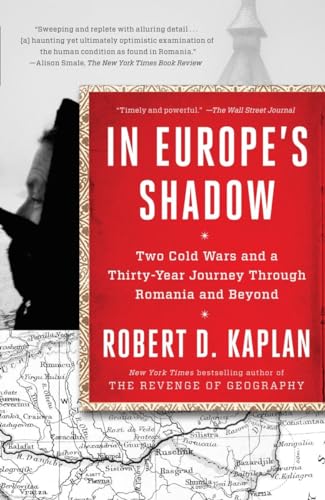
“Sweeping and replete with alluring detail . . . [a] haunting yet ultimately optimistic examination of the human condition as found in Romania.”—Alison Smale, The New York Times Book Review
From the New York Times bestselling author Robert D. Kaplan, named one of the world’s Top 100 Global Thinkers by Foreign Policy magazine, comes a riveting journey through one of Europe’s frontier countries—and a potent examination of the forces that will determine Europe’s fate in the postmodern age.
Robert Kaplan first visited Romania in the 1970s, when he was a young journalist and the country was a bleak Communist backwater. It was one of the darkest corners of Europe, but few Westerners were paying attention. What ensued was a lifelong obsession with a critical, often overlooked country—a country that, today, is key to understanding the current threat that Russia poses to Europe. In Europe’s Shadow is a vivid blend of memoir, travelogue, journalism, and history, a masterly work thirty years in the making—the story of a journalist coming of age, and a country struggling to do the same. Through the lens of one country, Kaplan examines larger questions of geography, imperialism, the role of fate in international relations, the Cold War, the Holocaust, and more.
Here Kaplan illuminates the fusion of the Latin West and the Greek East that created Romania, the country that gave rise to Ion Antonescu, Hitler’s chief foreign accomplice during World War II, and the country that was home to the most brutal strain of Communism under Nicolae Ceaușescu. Romania past and present are rendered in cinematic prose: the ashen faces of citizens waiting in bread lines in Cold War–era Bucharest; the Bărăgan Steppe, laid bare by centuries of foreign invasion; the grim labor camps of the Black Sea Canal; the majestic Gothic church spires of Transylvania and Maramureş. Kaplan finds himself in dialogue with the great thinkers of the past, and with the Romanians of today, the philosophers, priests, and politicians—those who struggle to keep the flame of humanism alive in the era of a resurgent Russia.
Upon his return to Romania in 2013 and 2014, Kaplan found the country transformed yet again—now a traveler’s destination shaped by Western tastes, yet still emerging from the long shadows of Hitler and Stalin. In Europe’s Shadow is the story of an ideological and geographic frontier—and the book you must read in order to truly understand the crisis Europe faces, from Russia and from within.
Die Inhaltsangabe kann sich auf eine andere Ausgabe dieses Titels beziehen.
Über die Autorin bzw. den Autor
Robert D. Kaplan is the bestselling author of twenty books on foreign affairs and travel translated into many languages, including Adriatic, The Good American, The Revenge of Geography, Asia’s Cauldron, Monsoon, The Coming Anarchy, and Balkan Ghosts. He holds the Robert Strausz-Hupé Chair in Geopolitics at the Foreign Policy Research Institute. For three decades he reported on foreign affairs for The Atlantic. He was a member of the Pentagon’s Defense Policy Board and the U.S. Navy’s Executive Panel. Foreign Policy magazine twice named him one of the world’s “Top 100 Global Thinkers.”
Von der hinteren Coverseite
From the "New York Times" bestselling author Robert D. Kaplan, named one of the world s Top 100 Global Thinkers by "Foreign Policy" magazine, comes a riveting journey through one of Europe s frontier countries and a potent examination of the forces that will determine Europe s fate in the postmodern age.
Robert Kaplan first visited Romania in the 1970s, when he was a young journalist and the country was a bleak Communist backwater. It was one of the darkest corners of Europe, but few Westerners were paying attention. What ensued was a lifelong obsession with a critical, often overlooked country a country that, today, is key to understanding the current threat that Russia poses to Europe. "In Europe s Shadow" is a vivid blend of memoir, travelogue, journalism, and history, a masterly work thirty years in the making the story of a journalist coming of age, and a country struggling to do the same. Through the lens of one country, Kaplan examines larger questions of geography, imperialism, the role of fate in international relations, the Cold War, the Holocaust, and more.
Here Kaplan illuminates the fusion of the Latin West and the Greek East that created Romania, the country that gave rise to Ion Antonescu, Hitler s chief foreign accomplice during World War II, and the country that was home to the most brutal strain of Communism under Nicolae Ceau escu. Romania past and present are rendered in cinematic prose: the ashen faces of citizens waiting in bread lines in Cold War era Bucharest; the B r gan Steppe, laid bare by centuries of foreign invasion; the grim labor camps of the Black Sea Canal; the majestic Gothic church spires of Transylvania and Maramure . Kaplan finds himself in dialogue with the great thinkers of the past, and with the Romanians of today, the philosophers, priests, and politicians those who struggle to keep the flame of humanism alive in the era of a resurgent Russia.
Aus dem Klappentext
From the "New York Times" bestselling author Robert D. Kaplan, named one of the world s Top 100 Global Thinkers by "Foreign Policy" magazine, comes a riveting journey through one of Europe s frontier countries and a potent examination of the forces that will determine Europe s fate in the postmodern age.
Robert Kaplan first visited Romania in the 1970s, when he was a young journalist and the country was a bleak Communist backwater. It was one of the darkest corners of Europe, but few Westerners were paying attention. What ensued was a lifelong obsession with a critical, often overlooked country a country that, today, is key to understanding the current threat that Russia poses to Europe. "In Europe s Shadow" is a vivid blend of memoir, travelogue, journalism, and history, a masterly work thirty years in the making the story of a journalist coming of age, and a country struggling to do the same. Through the lens of one country, Kaplan examines larger questions of geography, imperialism, the role of fate in international relations, the Cold War, the Holocaust, and more.
Here Kaplan illuminates the fusion of the Latin West and the Greek East that created Romania, the country that gave rise to Ion Antonescu, Hitler s chief foreign accomplice during World War II, and the country that was home to the most brutal strain of Communism under Nicolae Ceau escu. Romania past and present are rendered in cinematic prose: the ashen faces of citizens waiting in bread lines in Cold War era Bucharest; the B r gan Steppe, laid bare by centuries of foreign invasion; the grim labor camps of the Black Sea Canal; the majestic Gothic church spires of Transylvania and Maramure . Kaplan finds himself in dialogue with the great thinkers of the past, and with the Romanians of today, the philosophers, priests, and politicians those who struggle to keep the flame of humanism alive in the era of a resurgent Russia.
Auszug. © Genehmigter Nachdruck. Alle Rechte vorbehalten.
Chapter I
Bucharest 1981
The motion of travel relieves sadness. “The novel look of streets in novel countries . . . The peace they seem to offer for our sorrows,” remarks the early-twentieth-century Portuguese poet and existentialist writer Fernando Pessoa. New surroundings prompt forgetfulness of old ones, and thus speed up the passage of time. The moment I left the plane at Bucharest’s Otopeni airport, I exchanged a world of loud, intense colors in the sun-blinded Middle East for one of a black-and-white engraving in the shivery, November-hued Balkans. Only hours removed, Israel was, nevertheless, already part of a distant, earlier existence.
Otopeni was a marble and dirty glass blockhouse with passport officers in slummy cubicles. A red star and photo of the dictator hung from the otherwise lonely walls. I waited half an hour in the cold for a plywood seat in a bus to take me downtown. Bare wiry branches—beeches, poplars, and large-leaved lindens—crackled in the steppe wind breaching the bus windows, signaling winter in the dead afternoon light under an iron vault of clouds. The forest of deciduous trees—hardly known in the Eastern Mediterranean I had just left and here dominant—only sharpened the sense of distance I had traveled. So did the steep-roofed houses that emerged as we entered a grand boulevard of the city, with their northern baroque influence and expectations of snow.
For six years I had not traveled beyond North Africa and the Eastern Mediterranean. The times I had left Israel had only been for extended trips to Greece. The return to what—in comparison—was the north had a sudden and dramatic effect on me. “Nothing discourages thought so much as this perpetual blue sky,” writes André Gide in The Immoralist. It is said that when we think seriously, we think abstractly: Gide suggests that a cold northern clime of leaden clouds encourages abstraction, and by inference, analysis and introspection. For years I had held out the dream of living in a house on a Greek island in summer. My first hours in Bucharest began a psychological journey that would culminate decades later in the quest to live in Maine in darkest winter. With it would come a break in reading habits: exchanging the glittering Mediterranean sensuality of Lawrence Durrell for the cold, economical passion of Thomas Mann; leaving behind the occasional half-baked, Grecian ecstasies of Henry Miller and discovering anew the realist discipline of that most essential Greek, Thucydides, and by progression, his twentieth-century inheritors, Hans Morgenthau, Kenneth Waltz, and Samuel Huntington.
You don’t grow up gradually. You grow up in short bursts at pivotal moments, by suddenly realizing how ignorant and immature you are. Bucharest, as I rode in from the airport and saw the ashen, moldy faces of the bus driver and other Romanians aboard, crushed in their overcoats and winter hats with earmuffs and their worries, made me instinctually aware of all the history I had been missing the last half decade. Here was a whole category of suffering foreign to the Levant.
The gargantuan Scânteia building, grand in a Stalinist sort of way—named after the Communist Party daily, “The Spark”—heralded the entrance to the city. The 1950s Stalinist architecture with the courtyard statue of Lenin on a high plinth spiritually defeated everything around it. Here, the next day, I would visit a Mr. Tuiu in an empty concrete office to the right of the entrance: this official of the Communist wire agency AgerPres advised me “to be careful about anyone you talk to except” whom he approved.
Eroilor Aerului (“To the Heroes of the Air”) were the words emblazoned on the soaring monument on Piața Aviatorilor (Aviators’ Plaza), dedicated in 1935 to World War I fliers and other aviation pioneers, which I caught a glimpse of as the bus rumbled by. I grasped immediately the word, making the connection with Beethoven’s Eroica (“Heroic”) or Third Symphony. From the travel guides I knew that Romanian was a Latin language. But the words on the monument made me abruptly, palpably aware of it: just as the altogether bleak, wintry surroundings and virtually empty streets and boulevards made me palpably aware that I was in a part of the world not ordinarily associated with Latinity. (True, an exotic geography provided Romanian with elements of Slavic, Hungarian, Turkish, Greek, and Roma, in addition to a Thracian substratum—and yet the Latin basis was dominant.)
Soon the bread and fuel lines began: beyond Piața Romană on Bulevardul General Gheorghe Magheru. The silence of the streets was devastating as I alighted from the bus with my backpack on Strada Academiei. The city had been reduced to a vast echo. There were few cars, and everyone was dressed in the same shapeless coats and furry hats that evoked internal exile somewhere on the eastern steppe. People clutched cheap jute bags in expectation of stale bread. I looked at their faces: nervous, shy, clumsy, calculating, heartrending, as if they were struggling to master the next catastrophe. Those clammy complexions seemed as if they had never seen the sunlight.
This was the beginning of a decade that would be among the worst in Romanian history, even if the political repression was actually more suffocating in the 1950s, when the Communists under Gheorghe Gheorghiu-Dej had to establish total thought control over an ideologically hostile population. A distinguished British historian would later write that in the 1980s Romanians had been “reduced . . . to an animal state, concerned only with the problems of day-to-day survival.”
The situation would deteriorate by stages: with food, fuel, water, and electricity shortages worse than during World War I. In late 1982, there was a widely circulating rumor that bread was deliberately held in the bakeries for twenty-four hours before selling, so it would become stale and the population would buy less. A local joke of the era: “If only the Russians invaded, then we would get to eat like the Czechs and get passports like the Hungarians.” By the middle of the decade, the buses would no longer run on diesel, but on the much cheaper and more dangerous methane gas, with tanks attached to the roofs.
I had chosen the Hotel Muntenia on Strada Academiei from a budget guide: it was downtown and cheap enough, less than twenty-five dollars per night. All I can remember about the room was that it was brown with one bare lightbulb, with a common toilet and shower at the other end of a yawning and drafty hallway. I turned on the black-and-white television: speeches of the leader interspersed with folk dancing. The room had a phone with a corroded cord which required going through the hotel switchboard. In such mournful surroundings, I began to feel liberated from my previous life.
“Of course you can come in tomorrow for a briefing, and maybe we can get you in to see the ambassador,” a friendly and welcoming second secretary or other at the U.S. Embassy told me over the phone, as if lightening all the brown in my room. I had suddenly gone from being a nobody in a crowded journalistic field in Jerusalem to a person with more status, simply by showing up in this Cold War backwater. “You’re staying at the InterCon, aren’t you?” she asked. My reply was nervous and noncommittal. The coming years would be about perfecting the technique of so-to-speak interviewing the prime minister while staying at the youth hostel.
The next morning I walked past the dirty cream-and-white, run-of-the-mill modernist hulk of the InterContinental Hotel, towering upward in a half arc, completed in 1970 and the epitome of luxury in late-Communist...
„Über diesen Titel“ kann sich auf eine andere Ausgabe dieses Titels beziehen.
Suchergebnisse für In Europe's Shadow: Two Cold Wars and a Thirty-Year...

Beispielbild für diese ISBN
In Europe's Shadow: Two Cold Wars and a Thirty-Year Journey Through Romania and Beyond
Anbieter: World of Books (was SecondSale), Montgomery, IL, USA
Verkäuferbewertung 5 von 5 Sternen

Paperback. Zustand: Fair. "Sweeping and replete with alluring detail . . . a haunting yet ultimately optimistic examination of the human condition as found in Romania."-Alison Smale, The New York Times Book Review From the New York Times bestselling author Robert D. Kaplan, named one of the world's Top 100 Global Thinkers by Foreign Policy magazine, comes a riveting journey through one of Europe's frontier countries-and a potent examination of the forces that will determine Europe's fate in the postmodern age. Robert Kaplan first visited Romania in the 1970s, when he was a young journalist and the country was a bleak Communist backwater. It was one of the darkest corners of Europe, but few Westerners were paying attention. What ensued was a lifelong obsession with a critical, often overlooked country-a country that, today, is key to understanding the current threat that Russia poses to Europe. In Europe's Shadow is a vivid blend of memoir, travelogue, journalism, and history, a masterly work thirty years in the making-the story of a journalist coming of age, and a country struggling to do the same. Through the lens of one country, Kaplan examines larger questions of geography, imperialism, the role of fate in international relations, the Cold War, the Holocaust, and more. Here Kaplan illuminates the fusion of the Latin West and the Greek East that created Romania, the country that gave rise to Ion Antonescu, Hitler's chief foreign accomplice during World War II, and the country that was home to the most brutal strain of Communism under Nicolae Ceaușescu. Romania past and present are rendered in cinematic prose: the ashen faces of citizens waiting in bread lines in Cold War-era Bucharest; the Bărăgan Steppe, laid bare by centuries of foreign invasion; the grim labor camps of the Black Sea Canal; the majestic Gothic church spires of Transylvania and Maramureş Kaplan finds himself in dialogue with the great thinkers of the past, and with the Romanians of today, the philosophers, priests, and politicians-those who struggle to keep the flame of humanism alive in the era of a resurgent Russia. Upon his return to Romania in 2013 and 2014, Kaplan found the country transformed yet again-now a traveler's destination shaped by Western tastes, yet still emerging from the long shadows of Hitler and Stalin. In Europe's Shadow is the story of an ideological and geographic frontier-and the book you must read in order to truly understand the crisis Europe faces, from Russia and from within. Artikel-Nr. CIN0812986628A
Gebraucht kaufen
EUR 4,98
Versand gratis
Versand innerhalb von USA
Versand innerhalb von USA
Anzahl: 1 verfügbar
Beispielbild für diese ISBN
In Europe's Shadow: Two Cold Wars and a Thirty-Year Journey Through Romania and Beyond
Anbieter: ThriftBooks-Phoenix, Phoenix, AZ, USA
Verkäuferbewertung 5 von 5 Sternen
Paperback. Zustand: Very Good. No Jacket. May have limited writing in cover pages. Pages are unmarked. ~ ThriftBooks: Read More, Spend Less. Artikel-Nr. G0812986628I4N00
Gebraucht kaufen
EUR 6,88
Versand gratis
Versand innerhalb von USA
Versand innerhalb von USA
Anzahl: 1 verfügbar
Beispielbild für diese ISBN
In Europe's Shadow: Two Cold Wars and a Thirty-Year Journey Through Romania and Beyond
Anbieter: ThriftBooks-Reno, Reno, NV, USA
Verkäuferbewertung 5 von 5 Sternen
Paperback. Zustand: Very Good. No Jacket. May have limited writing in cover pages. Pages are unmarked. ~ ThriftBooks: Read More, Spend Less. Artikel-Nr. G0812986628I4N00
Gebraucht kaufen
EUR 6,88
Versand gratis
Versand innerhalb von USA
Versand innerhalb von USA
Anzahl: 1 verfügbar
Beispielbild für diese ISBN
In Europe's Shadow: Two Cold Wars and a Thirty-Year Journey Through Romania and Beyond
Anbieter: ThriftBooks-Atlanta, AUSTELL, GA, USA
Verkäuferbewertung 5 von 5 Sternen
Paperback. Zustand: As New. No Jacket. Pages are clean and are not marred by notes or folds of any kind. ~ ThriftBooks: Read More, Spend Less. Artikel-Nr. G0812986628I2N00
Gebraucht kaufen
EUR 6,90
Versand gratis
Versand innerhalb von USA
Versand innerhalb von USA
Anzahl: 1 verfügbar
Beispielbild für diese ISBN
In Europe's Shadow: Two Cold Wars and a Thirty-Year Journey Through Romania and Beyond
Anbieter: ThriftBooks-Dallas, Dallas, TX, USA
Verkäuferbewertung 5 von 5 Sternen
Paperback. Zustand: Very Good. No Jacket. May have limited writing in cover pages. Pages are unmarked. ~ ThriftBooks: Read More, Spend Less. Artikel-Nr. G0812986628I4N00
Gebraucht kaufen
EUR 6,90
Versand gratis
Versand innerhalb von USA
Versand innerhalb von USA
Anzahl: 2 verfügbar
Beispielbild für diese ISBN
In Europe's Shadow: Two Cold Wars and a Thirty-Year Journey Through Romania and Beyond
Anbieter: ThriftBooks-Dallas, Dallas, TX, USA
Verkäuferbewertung 5 von 5 Sternen
Paperback. Zustand: Fair. No Jacket. Readable copy. Pages may have considerable notes/highlighting. ~ ThriftBooks: Read More, Spend Less. Artikel-Nr. G0812986628I5N00
Gebraucht kaufen
EUR 6,90
Versand gratis
Versand innerhalb von USA
Versand innerhalb von USA
Anzahl: 1 verfügbar
Beispielbild für diese ISBN
In Europe's Shadow: Two Cold Wars and a Thirty-Year Journey Through Romania and Beyond
Anbieter: ThriftBooks-Atlanta, AUSTELL, GA, USA
Verkäuferbewertung 5 von 5 Sternen
Paperback. Zustand: Fair. No Jacket. Readable copy. Pages may have considerable notes/highlighting. ~ ThriftBooks: Read More, Spend Less. Artikel-Nr. G0812986628I5N00
Gebraucht kaufen
EUR 6,90
Versand gratis
Versand innerhalb von USA
Versand innerhalb von USA
Anzahl: 1 verfügbar
Beispielbild für diese ISBN
In Europe's Shadow: Two Cold Wars and a Thirty-Year Journey Through Romania and Beyond
Anbieter: ThriftBooks-Dallas, Dallas, TX, USA
Verkäuferbewertung 5 von 5 Sternen
Paperback. Zustand: As New. No Jacket. Pages are clean and are not marred by notes or folds of any kind. ~ ThriftBooks: Read More, Spend Less. Artikel-Nr. G0812986628I2N00
Gebraucht kaufen
EUR 6,90
Versand gratis
Versand innerhalb von USA
Versand innerhalb von USA
Anzahl: 1 verfügbar
Beispielbild für diese ISBN
In Europe's Shadow: Two Cold Wars and a Thirty-Year Journey Through Romania and Beyond
Anbieter: ThriftBooks-Atlanta, AUSTELL, GA, USA
Verkäuferbewertung 5 von 5 Sternen
Paperback. Zustand: Very Good. No Jacket. May have limited writing in cover pages. Pages are unmarked. ~ ThriftBooks: Read More, Spend Less. Artikel-Nr. G0812986628I4N00
Gebraucht kaufen
EUR 6,90
Versand gratis
Versand innerhalb von USA
Versand innerhalb von USA
Anzahl: 2 verfügbar
Beispielbild für diese ISBN
In Europe's Shadow : Two Cold Wars and a Thirty-Year Journey Through Romania and Beyond
Verlag:
Random House Publishing Group, 2016
ISBN 10: 0812986628
ISBN 13: 9780812986624
Gebraucht
Softcover
Anbieter: Better World Books, Mishawaka, IN, USA
Verkäuferbewertung 5 von 5 Sternen
Zustand: Good. Pages intact with minimal writing/highlighting. The binding may be loose and creased. Dust jackets/supplements are not included. Stock photo provided. Product includes identifying sticker. Better World Books: Buy Books. Do Good. Artikel-Nr. 14288131-6
Gebraucht kaufen
EUR 10,08
Versand gratis
Versand innerhalb von USA
Versand innerhalb von USA
Anzahl: 1 verfügbar