
Verwandte Artikel zu Condominium: A Novel
Inhaltsangabe
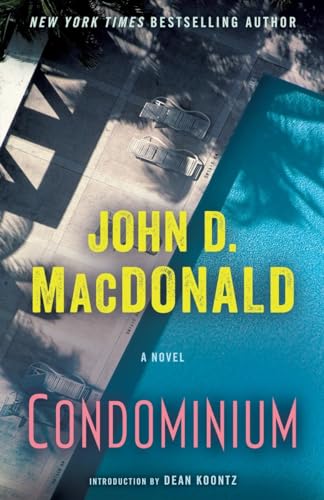
A “first-rate entertainment” (New York Daily News), Condominium is a panoramic novel from a master of suspense that follows the disappearance of an American paradise, the corrupt souls willing to sell out to make a buck, the innocent masses caught in their wake—and the perfect storm that washes everything away.
Introduction by Dean Koontz
Welcome to Florida’s Golden Sands, the dream condominium complex built on a weak foundation and a thousand dirty secrets. The real estate was a steal—literally. The maintenance charges run high as the locals are run out. It’s the home of shortcuts, crackdowns, breakups, oversights, and payoffs.
Add it all up, and the new coastline community doesn’t stand a chance against the ever-present specter of disaster: the dreaded hurricane. The big one is coming. Golden Sands is right in its path. And only a few brave souls have the power to stop this towering eyesore from going underwater for good.
Praise for John D. MacDonald and Condominium
“Most readers loved John D. MacDonald’s work because he told a rip-roaring yarn. I loved it because he was the first modern writer to nail Florida dead-center, to capture all its languid sleaze, racy sense of promise, and breath-grabbing beauty.”—Carl Hiaasen
“A narrative of wracking suspense that mounts to a devastating climax.”—Cosmopolitan
“John D. MacDonald created a staggering quantity of wonderful books, each rich with characterization, suspense, and an almost intoxicating sense of place.”—Jonathan Kellerman
Die Inhaltsangabe kann sich auf eine andere Ausgabe dieses Titels beziehen.
Über die Autorin bzw. den Autor
John D. MacDonald was an American novelist and short-story writer. His works include the Travis McGee series and the novel The Executioners, which was adapted into the film Cape Fear. In 1962 MacDonald was named a Grand Master of the Mystery Writers of America; in 1980, he won a National Book Award. In print he delighted in smashing the bad guys, deflating the pompous, and exposing the venal. In life, he was a truly empathetic man; his friends, family, and colleagues found him to be loyal, generous, and practical. In business, he was fastidiously ethical. About being a writer, he once expressed with gleeful astonishment, “They pay me to do this! They don’t realize, I would pay them.” He spent the later part of his life in Florida with his wife and son. He died in 1986.
Auszug. © Genehmigter Nachdruck. Alle Rechte vorbehalten.
1
Howard Elbright finally found Julian Higbee, the condominium manager, lounging against a concrete column, staring toward the pool area where two young women were taking turns diving from the low board.
“Excuse me,” Elbright said. “The girl in the office thought you were maybe by the tennis courts. That’s where I looked first.”
Higbee, the manager, did not respond in any way. He just stood there beside Elbright, big brown arms folded, thick brown ankles crossed. He was a large and meaty fellow, and on all areas not covered by his pale blue sports shirt and his dark blue shorts, his sun-darkened hide was fuzzed with sun-bleached white hairs. On his solid jowls the hair was pale stubble. Though obviously too young a fellow for a hairpiece, his auburn hair was so carefully coifed to sweep across his forehead just above eyebrow level, it looked glossy and wiglike.
Howard Elbright wondered if the fellow could be deaf and also lack peripheral vision. Alternatively, there was the possibility that Elbright himself had become invisible and inaudible, condemned forever to wander around this bright Florida island trying to join incomprehensible conversations, trying to get people to take his money in exchange for indestructible plastic merchandise. It seemed to him he had been having dreams like that lately.
“Excuse me!” he said.
Without turning toward him, Higbee said, “The so-called girl in the office is my wife. She is Mrs. Higbee. Lorrie Higbee.” He spoke in a curiously loud voice, accenting every syllable, as if accustomed to speaking to the semi-deaf.
“I didn’t mean any--”
“What it was about the tennis courts, it was Colonel Simmins that lives in One-G. It was Colonel Simmins telling me there are ripples in the west service court, in the second of our two tennis courts, and his serve bounces funny. He made me watch his serve bouncing funny. Okay, so it bounces funny. So, like I told him, everybody’s serve bounces funny.” He spun so suddenly that he startled Howard Elbright. “Fair for one, fair for all! Right?” Julian Higbee shouted.
“I’m not a tennis player myself.”
“What he should do, I told him, like I tell everybody: Take it up with your Association. That’s what they are there for. That’s what you elected them for. Then if they want something done, they’ll come to me and they’ll ask me if I can get it done. Right?”
“I guess that’s right.”
The manager put his big brown hand out. “My name is Julian Higbee, sir. I am the manager here. If you are interested in purchasing, there are only two units left here at beautiful Golden Sands. Five-A and Six-E. Every apartment has a breathtaking view of the Gulf of Mexico. If you are interested in renting, I can show you a wide assortment of beautifully furnished--”
“We’re in Four-C.”
Higbee went blank and then grinned. “That’s right! I knew I’d seen you before somewhere. Moved in day before yesterday, right?”
“No. Ten days ago. May third, exactly.”
“Congratulations on finding a new and rewarding life-style, Mister. . . . Don’t tell me. Please don’t tell me.” Higbee closed his eyes, bowed his head, made a fist and pressed the back of his fist to his lips. He made a barely audible humming sound. “Elmore!” he yelled. “I never fail.”
“It’s very close. Elmore. Elbright.”
“It’s close enough, Mr. Elmore. What’s on your mind?”
“I’ve got a list.”
“A list? A list of what?”
“A list of things that have to be fixed. In Four-C.”
“Have to be fixed? That’s very strong language. Are you making a threat of some kind, Mr. Elmore?”
“Elbright. No threats. I just mean that you move into a new place, little things are always wrong and sooner or later they have to be fixed to make the place livable. For example, the air conditioning is--”
“Let’s go to my office and I’ll get out your file.”
Higbee led the way through the parking garage. Golden Sands was an eight-story building. The parking garage, the entrance foyer and the manager’s office and apartment were on the ground floor. The floor above that was called the first floor. There were seven apartments on each floor, but, because of penthouse patios, only five apartments on the top floor. Forty-seven, plus the manager’s efficiency. It was a pale concrete building, one apartment thick, shaped like an angular boomerang. It stood on four cramped acres of land, its rear convexity backing upon an impenetrable jungle of water oak, palmetto, mangrove and miscellaneous vines and bushes. Its concave front faced the constant noisy traffic on two-lane Beach Drive and, at a greater distance, the space between two taller beach-front condominiums and, beyond them, the wide blue Gulf of Mexico.
Higbee stopped suddenly, turned and put a big hand on Howard Elbright’s shoulder, and turned him to the left and said, “Look at that! Damn it to hell, will you look at that?”
Elbright stared in the indicated direction, saw only a silver gray Oldsmobile parked with its nose toward the concrete wall of one of the storage enclosures.
“Don’t you see it?” Higbee demanded. He took a steel tape out of his pocket and went to the Oldsmobile. A rear wheel was on the orange dividing line. He measured the amount of overhang, then went to the front of the car and measured the distance from the bumper to the wall.
“This is Hascoll’s car. Five-F. This time he’s slopped fourteen inches over the side line, and he’s eight inches short of the wall. You know what that does? When there’s a car over there, nobody can get by to these next two spaces, right? Then what happens? I’m watching the television and somebody comes crying they can’t park their damned car. I told him once, I told him thirty times, if his old lady doesn’t know how to park a car, he should park it for her. Is it too much to ask? Keep it between the lines. Touch the wall with the front bumper. Is that too much to ask? I’m telling you, you people have just got to learn how to park your cars.”
Howard Elbright stared up at the young man’s angry face. Howard felt his ears heat up and felt his neck swell. He knew he was not supposed to let himself get angry.
“Did you say ‘you people’? Was that your phrase, Higbee?”
“What am I supposed to call you people?”
“Residents. Owners. With respect rather than derision.”
“Rather than what?”
“Derision, contempt. I help pay your salary, do I not?”
“You pay for management, Mr. Elmore.”
“Elbright. Then shouldn’t you make an effort to please the owners here?”
“Why should I? Oh, I see. Look, you got it wrong. I don’t work for you people. I work for the Gulfway Management Corporation. And Gulfway has got a twenty-year contract to manage this place. Me and Lorrie work for Gulfway. That’s the people I got to please. There’s no use you getting uptight about me, Mr. Elmore. You people can’t do anything about me. Maybe you’re better off with me than the next guy they send over here. You want to know how it works, why don’t you talk with Mr. McGinnity. Seven-B. Pete McGinnity. He’s president of the board of directors of the Golden Sands Association. He doesn’t like it any better...
„Über diesen Titel“ kann sich auf eine andere Ausgabe dieses Titels beziehen.
Weitere beliebte Ausgaben desselben Titels

Suchergebnisse für Condominium: A Novel

Beispielbild für diese ISBN
Condominium
Verlag:
Random House Publishing Group, 2014
ISBN 10: 0812985303
ISBN 13: 9780812985306
Gebraucht
Paperback
Anbieter: ThriftBooks-Phoenix, Phoenix, AZ, USA
Verkäuferbewertung 5 von 5 Sternen

Paperback. Zustand: Good. No Jacket. Pages can have notes/highlighting. Spine may show signs of wear. ~ ThriftBooks: Read More, Spend Less. Artikel-Nr. G0812985303I3N00
Gebraucht kaufen
EUR 6,59
Versand gratis
Versand innerhalb von USA
Versand innerhalb von USA
Anzahl: 1 verfügbar
Beispielbild für diese ISBN
Condominium
Verlag:
Random House Publishing Group, 2014
ISBN 10: 0812985303
ISBN 13: 9780812985306
Gebraucht
Paperback
Anbieter: ThriftBooks-Atlanta, AUSTELL, GA, USA
Verkäuferbewertung 5 von 5 Sternen
Paperback. Zustand: Fair. No Jacket. Readable copy. Pages may have considerable notes/highlighting. ~ ThriftBooks: Read More, Spend Less. Artikel-Nr. G0812985303I5N00
Gebraucht kaufen
EUR 6,60
Versand gratis
Versand innerhalb von USA
Versand innerhalb von USA
Anzahl: 1 verfügbar
Beispielbild für diese ISBN
Condominium
Verlag:
Random House Publishing Group, 2014
ISBN 10: 0812985303
ISBN 13: 9780812985306
Gebraucht
Paperback
Anbieter: ThriftBooks-Dallas, Dallas, TX, USA
Verkäuferbewertung 5 von 5 Sternen
Paperback. Zustand: Good. No Jacket. Pages can have notes/highlighting. Spine may show signs of wear. ~ ThriftBooks: Read More, Spend Less. Artikel-Nr. G0812985303I3N00
Gebraucht kaufen
EUR 6,60
Versand gratis
Versand innerhalb von USA
Versand innerhalb von USA
Anzahl: 1 verfügbar
Beispielbild für diese ISBN
Condominium : A Novel
Verlag:
Random House Publishing Group, 2014
ISBN 10: 0812985303
ISBN 13: 9780812985306
Gebraucht
Softcover
Anbieter: Better World Books, Mishawaka, IN, USA
Verkäuferbewertung 5 von 5 Sternen
Zustand: Good. Former library copy. Pages intact with minimal writing/highlighting. The binding may be loose and creased. Dust jackets/supplements are not included. Includes library markings. Stock photo provided. Product includes identifying sticker. Better World Books: Buy Books. Do Good. Artikel-Nr. 5108850-75
Gebraucht kaufen
EUR 9,85
Versand gratis
Versand innerhalb von USA
Versand innerhalb von USA
Anzahl: 1 verfügbar
Beispielbild für diese ISBN
Condominium: A Novel
Verlag:
Random House Publishing Group, 2014
ISBN 10: 0812985303
ISBN 13: 9780812985306
Gebraucht
Paperback
Anbieter: WorldofBooks, Goring-By-Sea, WS, Vereinigtes Königreich
Verkäuferbewertung 5 von 5 Sternen
Paperback. Zustand: Very Good. The book has been read, but is in excellent condition. Pages are intact and not marred by notes or highlighting. The spine remains undamaged. Artikel-Nr. GOR009481043
Gebraucht kaufen
EUR 3,61
EUR 6,53 Versand
Versand von Vereinigtes Königreich nach USA
Versand von Vereinigtes Königreich nach USA
Anzahl: 1 verfügbar
Beispielbild für diese ISBN
Condominium: A Novel
Verlag:
Random House Trade Paperbacks, 2014
ISBN 10: 0812985303
ISBN 13: 9780812985306
Gebraucht
paperback
Anbieter: Magers and Quinn Booksellers, Minneapolis, MN, USA
Verkäuferbewertung 5 von 5 Sternen
paperback. Zustand: Very Good. May have light to moderate shelf wear and/or a remainder mark. Complete. Clean pages. Artikel-Nr. 1160451
Gebraucht kaufen
EUR 7,38
EUR 3,47 Versand
Versand innerhalb von USA
Versand innerhalb von USA
Anzahl: 1 verfügbar
Beispielbild für diese ISBN
Condominium: A Novel
Verlag:
Random House Trade Paperbacks, 2014
ISBN 10: 0812985303
ISBN 13: 9780812985306
Gebraucht
Softcover
Anbieter: World of Books (was SecondSale), Montgomery, IL, USA
Verkäuferbewertung 5 von 5 Sternen
Zustand: Very Good. Item in very good condition! Textbooks may not include supplemental items i.e. CDs, access codes etc. Artikel-Nr. 00107129909
Gebraucht kaufen
EUR 10,90
Versand gratis
Versand innerhalb von USA
Versand innerhalb von USA
Anzahl: 1 verfügbar
Foto des Verkäufers
Condominium: A Novel
Anbieter: WeBuyBooks, Rossendale, LANCS, Vereinigtes Königreich
Verkäuferbewertung 5 von 5 Sternen
Zustand: Like New. Most items will be dispatched the same or the next working day. An apparently unread copy in perfect condition. Dust cover is intact with no nicks or tears. Spine has no signs of creasing. Pages are clean and not marred by notes or folds of any kind. Artikel-Nr. rev2321961437
Gebraucht kaufen
EUR 3,09
EUR 8,03 Versand
Versand von Vereinigtes Königreich nach USA
Versand von Vereinigtes Königreich nach USA
Anzahl: 1 verfügbar
Beispielbild für diese ISBN
Condominium
Anbieter: Revaluation Books, Exeter, Vereinigtes Königreich
Verkäuferbewertung 5 von 5 Sternen
Paperback. Zustand: Brand New. reprint edition. 557 pages. 8.25x5.50x1.50 inches. In Stock. Artikel-Nr. x-0812985303
Neu kaufen
EUR 25,27
EUR 14,59 Versand
Versand von Vereinigtes Königreich nach USA
Versand von Vereinigtes Königreich nach USA
Anzahl: 2 verfügbar