
Verwandte Artikel zu The Work: Searching for a Life That Matters
Inhaltsangabe
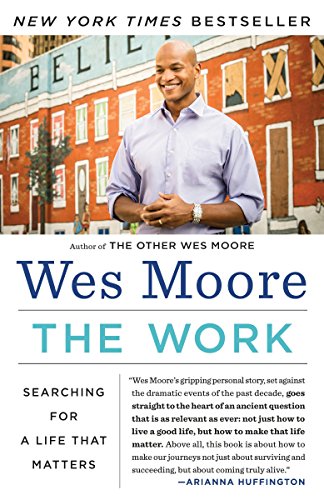
NEW YORK TIMES BESTSELLER • The acclaimed author of The Other Wes Moore and governor of Maryland continues his inspirational quest for a meaningful life and shares the powerful lessons—about self-discovery, service, and risk-taking—that led him to a new definition of success for our times.
“This book is about how to make our journeys not just about surviving and succeeding, but about coming truly alive.”—Arianna Huffington
The Work is the story of how one young man traced a path through the world to find his life’s purpose. Wes Moore graduated from a difficult childhood in the Bronx and Baltimore to an adult life that would find him at some of the most critical moments in our recent history: as a combat officer in Afghanistan; a White House fellow in a time of wars abroad and disasters at home; and a Wall Street banker during the financial crisis. In this insightful book, Moore shares the lessons he learned from people he met along the way—from the brave Afghan translator who taught him to find his fight, to the resilient young students in Katrina-ravaged Mississippi who showed him the true meaning of grit, to his late grandfather, who taught him to find grace in service.
Moore also tells the stories of other twenty-first-century change-makers who’ve inspired him in his search, from Daniel Lubetzky, the founder of KIND, to Esther Benjamin, a Sri Lankan immigrant who rose to help lead the Peace Corps. What their lives—and his own misadventures and moments of illumination—reveal is that our truest work happens when we serve others, at the intersection between our gifts and our broken world. That’s where we find the work that lasts.
An intimate narrative about finding meaning in a volatile age, The Work will inspire readers to see how we can each find our own path to purpose and help create a better world.
Die Inhaltsangabe kann sich auf eine andere Ausgabe dieses Titels beziehen.
Über die Autorin bzw. den Autor
Wes Moore is the governor of Maryland. He is the New York Times bestselling author of The Other Wes Moore; The Work, which was featured on Oprah Winfrey’s SuperSoul Sunday; and Five Days, a finalist for the Porchlight Business Book Award. He’s also a former Rhodes Scholar, a combat veteran of Afghanistan, and a social entrepreneur who served as the CEO of the Robin Hood Foundation, one of the largest antipoverty organizations in the country. Wes Moore lives in his hometown of Baltimore with his wife and two children.
Auszug. © Genehmigter Nachdruck. Alle Rechte vorbehalten.
1
The Lesson of the Student
Come to Learn, Leave to Lead
“Flight attendants, please be seated and prepare for landing.”
I sat back in my chair and started flipping through the British Airways magazine in my lap, hoping it would help pass the time before we touched down. As my eyes darted from one glossy picture to the next, I noticed that the young woman sitting to my right was gripping the armrest between us with a desperate ferocity, as if our safe landing were dependent on her hanging on to the support. She stared straight ahead, not blinking, not flinching. At one point she flicked her eyes in my direction and I gave her what I hoped was a reassuring smile, wanting to soothe her but not come off as weird. After a moment her face softened and she returned the smile. As if a trance had broken, her shoulders relaxed and the death grip she had on the armrest eased. She looked at me and said in an English accent, “I guess everything has changed.”
I arrived at London’s Heathrow Airport on September 23, 2001, on one of the first transatlantic flights granted airspace after the attacks of September 11, 2001. What should have been an unexceptional flight was filled with passengers afraid to sleep, instead sitting rigid and vigilant for the six-hour journey, like soldiers standing their post. I was right there with them, fighting off the idea that kept reappearing somewhere in my mind that this flight might be my last. I had just turned twenty-three.
The passengers applauded the crew as the plane touched down on the runway at Heathrow, a ritual likely shared on aircrafts around the world that day, and we all collectively breathed a sigh of relief. This at first seemed odd to me, the idea of applauding someone for successfully accomplishing their job. Nobody applauds the garbage collector as they patrol a neighborhood collecting overstuffed bags filled with the week’s trash. Nobody applauds the taxi driver as they pull to a stop and yank the receipt from the meter. But the repeated images emblazoned into our minds, planes that took off but never landed, reminded us of the miracle of landing. The hundreds of people onboard, including me, sat patiently and waited for the seat belt light to be turned off, and then gratefully filed off the plane. Everyone was unusually polite and deferential--very different from the usual mosh pit that forms in the aisle when it’s time to disembark. While I would later learn that in other countries, applause for a safe landing is a kind of ritual, that day at Heathrow the clapping was something different. I smiled again at my new British friend seated next to me as we headed together toward baggage claim. Her smile back was one of relief.
Along with thirty other passengers on that plane, I was headed to Oxford University, one of the oldest and most prestigious institutions of higher learning in the world, but my mind swirled with grief for the lives taken too soon.
Less than two weeks earlier, September 11, 2001, had been my little sister’s twenty-first birthday. I was scheduled to have a meeting that day at Morgan Stanley, whose offices were in one of the towers, but I’d moved it to September 13 because my mother and I decided to surprise my sister for her birthday. Mom and I were in the car, driving up from Baltimore to New Jersey, where my sister lived, when we began to get the news. By the time the second tower fell, we knew we would never make it to New Jersey. Once we were able to confirm that my sister was safely at home, we turned around and drove home.
I’d done work, through the military, on the rise and ramifications of radical Islamism before September 11. I’d done research on South America’s tri-border region, the lawless area between Argentina, Brazil, and Paraguay where Islamist terrorists were suspected to train, and I had closely followed the events around the suicide bombing of the USS Cole that killed seventeen American servicemen. I wasn’t one of these people that had never heard of the group Al-Qaeda before. Still, I had no idea this was coming or what it was when it first went down. I was a reserve officer, not exactly privy to the National Security Council’s daily briefing. But my years of military training told me this much: I knew that when the first reports came in from Washington saying “we are going to respond,” that could only mean one thing: we were going to war.
When our plane landed in London on September 23, all of the passengers sat patiently and waited for the seat belt light to be turned off, then gratefully filed off the plane. Everyone was unusually polite and deferential--very different from the usual center-aisle mosh pit that forms when it’s time to disembark. Our countries would soon be at war, but in the moments after the towers fell, there was this: small pockets of unprecedented peace.
This was the context in which I opened the next stage of my life. Part of me wondered if I was making the right choice. I was leaving behind my family and friends, including my mother. I was leaving behind my home country, which was still reeling from a terrorist attack, while starting a new life far away from the people whom I loved the most and who depended on me. I had an unbelievable opportunity in England, but I never felt more American than the moment I left it.
My American Journey was, not coincidentally, the name of one of the most influential books I’d ever read. When I was a teenager attending military school, few books offered me the opportunity to see myself--and my potential--the way Colin Powell’s autobiography did. The book was published in the aftermath of the first war in Iraq, but before his beleaguered term as secretary of state, when he helped usher in the second Iraq War. When I read the book, my sense of politics was hazy at best, but what drew me to it were the stunning similarities between our early journeys.
Like me, Powell hailed from Jamaican roots. He was born in New York and I was born in Maryland, but we were both raised in the Bronx. We were both shaped by our military experience. My short time around the military--as a cadet in military school--had changed me. It gave me more discipline and direction, but more than that, it provided me with a kind of brotherhood that I had never imagined would be possible. I suspected the same was true for Powell, who had reached the highest rank the Army had to offer: a four-star general and chairman of the Joint Chiefs of Staff.
One big difference between us--aside from the fact that Powell was among the most famous people in the world and I was an anonymous teenager--was that Powell was a father, whereas I was a son. In his book, Powell tells of a letter he wrote each of his children when they turned sixteen. My own father was not alive and could not write me such a letter, so I took Powell’s advice as if it had come from my own dad:
You now begin to leave childhood behind and start on the road to manhood. . . . You will establish definitively the type person you will be the remaining fifty years of your lifetime. You know what is right and wrong and I have confidence in your judgment. Don’t be afraid of failure. Be more afraid of not trying. . . . Take chances and risks--not foolhardy actions, but actions which could result in failure, yet promise success and reward. And always remember that no matter how bad something may seem, it will not be that bad tomorrow.
Don’t be afraid of failure. Take chances and risks. Have confidence in your judgment. I thought of those words on the morning of September 23, 2001. To me the lesson in those words was that life will throw opportunities of all kinds at you--but it’s up to you to use...
„Über diesen Titel“ kann sich auf eine andere Ausgabe dieses Titels beziehen.
Suchergebnisse für The Work: Searching for a Life That Matters

Beispielbild für diese ISBN
The Work: Searching for a Life That Matters
Anbieter: World of Books (was SecondSale), Montgomery, IL, USA
Verkäuferbewertung 5 von 5 Sternen

Zustand: Acceptable. Item in acceptable condition! Textbooks may not include supplemental items i.e. CDs, access codes etc. Artikel-Nr. 00093622084
Gebraucht kaufen
EUR 3,64
Versand gratis
Versand innerhalb von USA
Versand innerhalb von USA
Anzahl: 2 verfügbar
Beispielbild für diese ISBN
The Work: Searching for a Life That Matters
Anbieter: World of Books (was SecondSale), Montgomery, IL, USA
Verkäuferbewertung 5 von 5 Sternen
Zustand: Very Good. Item in very good condition! Textbooks may not include supplemental items i.e. CDs, access codes etc. Artikel-Nr. 00084734966
Gebraucht kaufen
EUR 3,64
Versand gratis
Versand innerhalb von USA
Versand innerhalb von USA
Anzahl: 7 verfügbar
Beispielbild für diese ISBN
The Work: Searching for a Life That Matters
Anbieter: World of Books (was SecondSale), Montgomery, IL, USA
Verkäuferbewertung 5 von 5 Sternen
Zustand: Good. Item in good condition. Textbooks may not include supplemental items i.e. CDs, access codes etc. Artikel-Nr. 00095387050
Gebraucht kaufen
EUR 3,64
Versand gratis
Versand innerhalb von USA
Versand innerhalb von USA
Anzahl: 8 verfügbar
Beispielbild für diese ISBN
The Work: Searching for a Life That Matters
Verlag:
One World (edition Reprint), 2015
ISBN 10: 081298384X
ISBN 13: 9780812983845
Gebraucht
Paperback
Anbieter: BooksRun, Philadelphia, PA, USA
Verkäuferbewertung 5 von 5 Sternen
Paperback. Zustand: Fair. Reprint. The item might be beaten up but readable. May contain markings or highlighting, as well as stains, bent corners, or any other major defect, but the text is not obscured in any way. Artikel-Nr. 081298384X-7-1-13
Gebraucht kaufen
EUR 4,19
Versand gratis
Versand innerhalb von USA
Versand innerhalb von USA
Anzahl: 1 verfügbar
Beispielbild für diese ISBN
The Work: Searching for a Life That Matters
Anbieter: ThriftBooks-Dallas, Dallas, TX, USA
Verkäuferbewertung 5 von 5 Sternen
Paperback. Zustand: As New. No Jacket. Pages are clean and are not marred by notes or folds of any kind. ~ ThriftBooks: Read More, Spend Less. Artikel-Nr. G081298384XI2N00
Gebraucht kaufen
EUR 5,86
Versand gratis
Versand innerhalb von USA
Versand innerhalb von USA
Anzahl: 1 verfügbar
Beispielbild für diese ISBN
The Work: Searching for a Life That Matters
Anbieter: ThriftBooks-Atlanta, AUSTELL, GA, USA
Verkäuferbewertung 5 von 5 Sternen
Paperback. Zustand: As New. No Jacket. Pages are clean and are not marred by notes or folds of any kind. ~ ThriftBooks: Read More, Spend Less. Artikel-Nr. G081298384XI2N00
Gebraucht kaufen
EUR 5,86
Versand gratis
Versand innerhalb von USA
Versand innerhalb von USA
Anzahl: 1 verfügbar
Beispielbild für diese ISBN
The Work : Searching for a Life That Matters
Verlag:
Random House Publishing Group, 2015
ISBN 10: 081298384X
ISBN 13: 9780812983845
Gebraucht
Softcover
Anbieter: Better World Books, Mishawaka, IN, USA
Verkäuferbewertung 5 von 5 Sternen
Zustand: Good. Reprint. Pages intact with minimal writing/highlighting. The binding may be loose and creased. Dust jackets/supplements are not included. Stock photo provided. Product includes identifying sticker. Better World Books: Buy Books. Do Good. Artikel-Nr. 5394185-6
Gebraucht kaufen
EUR 6,05
Versand gratis
Versand innerhalb von USA
Versand innerhalb von USA
Anzahl: 3 verfügbar
Beispielbild für diese ISBN
The Work : Searching for a Life That Matters
Verlag:
Random House Publishing Group, 2015
ISBN 10: 081298384X
ISBN 13: 9780812983845
Gebraucht
Softcover
Anbieter: Better World Books, Mishawaka, IN, USA
Verkäuferbewertung 5 von 5 Sternen
Zustand: Very Good. Reprint. Pages intact with possible writing/highlighting. Binding strong with minor wear. Dust jackets/supplements may not be included. Stock photo provided. Product includes identifying sticker. Better World Books: Buy Books. Do Good. Artikel-Nr. 5204907-6
Gebraucht kaufen
EUR 6,05
Versand gratis
Versand innerhalb von USA
Versand innerhalb von USA
Anzahl: 2 verfügbar
Beispielbild für diese ISBN
The Work: Searching for a Life That Matters
Anbieter: Wonder Book, Frederick, MD, USA
Verkäuferbewertung 5 von 5 Sternen
Zustand: Very Good. Very Good condition. A copy that may have a few cosmetic defects. May also contain light spine creasing or a few markings such as an owner's name, short gifter's inscription or light stamp. Artikel-Nr. T00H-03278
Gebraucht kaufen
EUR 6,29
Versand gratis
Versand innerhalb von USA
Versand innerhalb von USA
Anzahl: 1 verfügbar
Beispielbild für diese ISBN
The Work: Searching for a Life That Matters
Anbieter: Wonder Book, Frederick, MD, USA
Verkäuferbewertung 5 von 5 Sternen
Zustand: Good. Good condition. A copy that has been read but remains intact. May contain markings such as bookplates, stamps, limited notes and highlighting, or a few light stains. Artikel-Nr. H20I-01469
Gebraucht kaufen
EUR 6,29
Versand gratis
Versand innerhalb von USA
Versand innerhalb von USA
Anzahl: 3 verfügbar