
Inhaltsangabe
NEW YORK TIMES BESTSELLER
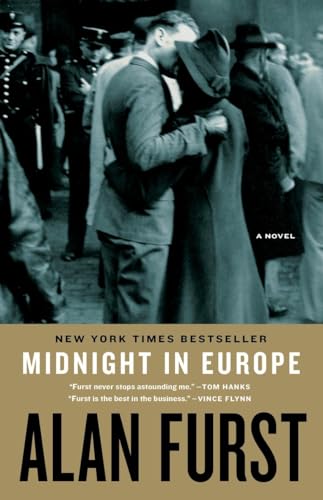
Paris, 1938. As the shadow of war darkens Europe, democratic forces on the Continent struggle against fascism and communism, while in Spain the war has already begun. Alan Furst, whom Vince Flynn has called “the most talented espionage novelist of our generation,” now gives us a taut, suspenseful, romantic, and richly rendered novel of spies and secret operatives in Paris and New York, in Warsaw and Odessa, on the eve of World War II.
Cristián Ferrar, a brilliant and handsome Spanish émigré, is a lawyer in the Paris office of a prestigious international law firm. Ferrar is approached by the embassy of the Spanish Republic and asked to help a clandestine agency trying desperately to supply weapons to the Republic’s beleaguered army—an effort that puts his life at risk in the battle against fascism.
Joining Ferrar in this mission is a group of unlikely men and women: idealists and gangsters, arms traders and aristocrats and spies. From shady Paris nightclubs to white-shoe New York law firms, from brothels in Istanbul to the dockyards of Poland, Ferrar and his allies battle the secret agents of Hitler and Franco. And what allies they are: there’s Max de Lyon, a former arms merchant now hunted by the Gestapo; the Marquesa Maria Cristina, a beautiful aristocrat with a taste for danger; and the Macedonian Stavros, who grew up “fighting Bulgarian bandits. After that, being a gangster was easy.” Then there is Eileen Moore, the American woman Ferrar could never forget.
In Midnight in Europe, Alan Furst paints a spellbinding portrait of a continent marching into a nightmare—and the heroes and heroines who fought back against the darkness.
Praise for Alan Furst and Midnight in Europe
“Furst never stops astounding me.”—Tom Hanks
“Furst is the best in the business.”—Vince Flynn
“Elegant, gripping . . . [Furst] remains at the top of his game.”—The New York Times
“Suspenseful and sophisticated . . . No espionage author, it seems, is better at summoning the shifting moods and emotional atmosphere of Europe before the start of World War II than Alan Furst.”—The Wall Street Journal
“Endlessly compelling . . . Furst delivers an observant, sexy, and thrilling tale set in the outskirts of World War II. In Furst’s hands, Paris once again comes alive with intrigue.”—Erik Larson
“Too much fun to put down . . . [Furst is] a master of the atmospheric thriller.”—The Boston Globe
Die Inhaltsangabe kann sich auf eine andere Ausgabe dieses Titels beziehen.
Über die Autorin bzw. den Autor
Alan Furst is widely recognized as the master of the historical spy novel. Now translated into eighteen languages, he is the author of Night Soldiers, Dark Star, The Polish Officer, The World at Night, Red Gold, Kingdom of Shadows, Blood of Victory, Dark Voyage, The Foreign Correspondent, The Spies of Warsaw, Spies of the Balkans, Mission to Paris, and Midnight in Europe. Born in New York, he lived for many years in Paris, and now lives on Long Island.
Auszug. © Genehmigter Nachdruck. Alle Rechte vorbehalten.
On a soft, winter evening in Manhattan, the fifteenth of December, 1937, it started to snow; big flakes spun lazily in the sky, danced in the lights of the office buildings, then melted as they hit the pavement. At Saks Fifth Avenue the window displays were lush and glittering—tinsel, toy trains, sugary frost dusted on the glass—and a crowd had gathered at the main entrance, drawn by a group of carolers dressed for a Dickens Christmas in long mufflers, top hats, and bonnets. Here then, for as long as it lasted, was a romantic New York, the New York in a song on the radio.
Cristián Ferrar, a Spanish émigré who lived in Paris, took a moment to enjoy the spectacle, then hurried across the avenue as the traffic light turned red and began to work his way through the crowd. In a buckled briefcase carried under his arm, he had that morning’s New York Times. The international news was as usual: marches, riots, assassinations, street brawls, arson; political warfare was tearing Europe apart. Real war was coming, this was merely the overture. In Spain, political warfare had flared into civil war, and, the Times reported, the Army of the Republic had attacked General Franco’s fascist forces at the Aragonese town of Teruel. And, you only had to turn the page, there was more: Hitler’s Nazi Germany had issued new restrictions on the Jews, while here was a photograph of Benito Mussolini, shown by his personal railcar as he gave the stiff-armed fascist salute, and there a photograph of Marshal Stalin, reviewing a parade of tank columns.
Cristián Ferrar would force himself to read it, would ask himself, Is there anything to be done? Is it hopeless? So it seemed. Elsewhere in the newspaper, the democratic opposition to the dictators tried not to show fear, but it was in their every word, the nervous dithering of the losing side. As Franco and his generals attacked the elected Republic, the others joined in, troops and warplanes provided by Germany and Italy, and with every victory they boasted and bragged and strutted: It’s our turn, get out of our way.
Or else.
He’d had a long, long day. A lawyer with the Coudert Frères law firm in Paris—“coo-DARE,” he would remind his American clients—he’d spent hours at the Coudert Brothers home office at 2 Rector Street. There’d been files to read, meetings to attend, and confidential discussions with the partners, as they worked on matters that involved both the Paris and the New York offices, whose wealthy clientele had worldwide business interests and, sometimes, eccentric lives. Coudert had, early in the century, famously untangled the byzantine affairs of the son of Jacques Lebaudy. Lebaudy père had earned millions of dollars, becoming known as “the Sugar King of France,” but the son was another story. On receipt of his father’s fortune he’d gone thoroughly mad and led a private army to North Africa and there declared himself “Emperor of the Sahara.” In time, the French Foreign Legion had sent the emperor packing and he’d wound up living on Long Island, where his wife shot and killed him.
But the difficulties of the Lebaudy case were minor compared to what Coudert had faced that day: the legal hell created by the Spanish Civil War, now in its seventeenth month; individuals and corporations cut off from their money, families in hiding because they were trapped on the wrong side—whatever side that was—burnt homes, burnt factories, burnt records, with no means of proving anything to insurance companies, or banks, or government bureaucracies. The Coudert lawyers in Paris and New York did the best they could, but sometimes there was little to be done. “We regret your misfortune, monsieur, but the oil tanker has apparently vanished.”
Ferrar had left the Coudert office at five-thirty and headed uptown to his hotel, the Gotham, then, as a favor to a friend at the Spanish embassy in Paris, he’d walked over to the Spanish Republic’s arms-buying office at 515 Madison Avenue. Here he’d picked up two manila envelopes he would take back to Paris—the days when you could trust the mail were long gone. He went next to Saks, meaning to buy Christmas presents—a hammered-silver bracelet and a cashmere sweater—for a woman friend he was to meet at seven. This love affair had gone on for more than two years as, every three months or so, he flew to Lisbon, where one could take the Pan Am flying boat to New York.
Actually, Ferrar was not precisely a Spaniard. He’d been born in Barcelona and so thought of himself as Catalan, from Catalonia, in ancient times a principality that included the French province of Roussillon. A Castilian from Madrid might well have recognized Ferrar’s origin: his skin at the pale edge of dark, a gentle hawkish slope to the nose, and the deep green eyes common to the Catalan, with thick, black hair combed straight back from a high forehead and cut in the European style; noticeably long, and low on the neck. In June he’d turned forty, rode horseback in the Bois de Boulogne twice a week, and stayed lean and tight with just that exercise. Heading toward the entrance to Saks, he wore a kind of lawyer’s battle dress: good, sober suit beneath a tan, delicately soiled raincoat, fedora hat slightly tilted over the left eye, maroon muffler, and brown leather gloves. With the briefcase under his arm, Ferrar looked like what he was, a lawyer, a hardworking paladin ready to defend you against Uncle Henry’s raid on your trusts.
As he reached the entry to the department store, Ferrar saw once again a thin little fellow who wore gold-rimmed spectacles, hands in the pockets of a blue overcoat, shoulders slumped as from fatigue or sorrow, who had followed him all day. This time he was leaning against the door of a taxi while the driver read a newspaper by the light of a streetlamp. The man in the blue overcoat had been with Ferrar at every stop, waiting outside at each location but not at all secretive, as though someone wanted Ferrar to know he was being watched.
Now who would that be?
There were many possibilities. For the secret services of Germany, Italy, and the USSR, the civil war in Spain was a spymaster’s dream, and attacks were organized against targets everywhere in Europe: politicians of the left, diplomats, intellectuals, journalists, idealists—all much-favored prey of the clandestine forces, be they fascist or communist. At embassies, social salons, grand hotels, and nightclubs, the predators worked day and night. As for the man who followed him, Ferrar suspected he might be a local communist in service to the NKVD, since the USSR—the Republic’s crucial, almost its only, ally—famously spied on its enemies, its friends, and everybody else. Or could the man be working for Franco’s secret police?
Ferrar was determined not to brood about it, he could think of nothing to do in response, and he was not someone easily intimidated. He dismissed the man’s presence with an unvoiced sigh, pulled the massive door open, and entered the store. Barely audible above the din of the shopping crowd, yet another band of carolers was singing “joyful and tri-umm-phant.” Momentarily adrift in an aromatic maze of perfume and cosmetics counters, Ferrar searched for the jewelry department. The man in the blue overcoat waited outside.
p. j. delaney it said on the window. Then, below that, bar & grill.
The very perfection of what the gossip columnists would call “the local saloon.” It had been there forever, on East Thirty-Seventh Street in Murray...
„Über diesen Titel“ kann sich auf eine andere Ausgabe dieses Titels beziehen.
Weitere beliebte Ausgaben desselben Titels

Suchergebnisse für Midnight in Europe: A Novel

Beispielbild für diese ISBN
Midnight in Europe: A Novel
Verlag:
Random House Trade Paperbacks, 2015
ISBN 10: 0812981839
ISBN 13: 9780812981834
Gebraucht
Softcover
Anbieter: World of Books (was SecondSale), Montgomery, IL, USA
Verkäuferbewertung 5 von 5 Sternen

Zustand: Good. Item in good condition. Textbooks may not include supplemental items i.e. CDs, access codes etc. Artikel-Nr. 00091957874
Gebraucht kaufen
EUR 3,39
Versand gratis
Versand innerhalb von USA
Versand innerhalb von USA
Anzahl: 18 verfügbar
Beispielbild für diese ISBN
Midnight in Europe: A Novel
Verlag:
Random House Trade Paperbacks, 2015
ISBN 10: 0812981839
ISBN 13: 9780812981834
Gebraucht
Softcover
Anbieter: World of Books (was SecondSale), Montgomery, IL, USA
Verkäuferbewertung 5 von 5 Sternen
Zustand: Acceptable. Item in good condition. Textbooks may not include supplemental items i.e. CDs, access codes etc. Artikel-Nr. 00061800041
Gebraucht kaufen
EUR 3,39
Versand gratis
Versand innerhalb von USA
Versand innerhalb von USA
Anzahl: 3 verfügbar
Beispielbild für diese ISBN
Midnight in Europe: A Novel
Verlag:
Random House Trade Paperbacks (edition Reprint), 2015
ISBN 10: 0812981839
ISBN 13: 9780812981834
Gebraucht
Paperback
Anbieter: BooksRun, Philadelphia, PA, USA
Verkäuferbewertung 5 von 5 Sternen
Paperback. Zustand: Very Good. Reprint. It's a well-cared-for item that has seen limited use. The item may show minor signs of wear. All the text is legible, with all pages included. It may have slight markings and/or highlighting. Artikel-Nr. 0812981839-11-1
Gebraucht kaufen
EUR 4,71
Versand gratis
Versand innerhalb von USA
Versand innerhalb von USA
Anzahl: 2 verfügbar
Beispielbild für diese ISBN
Midnight in Europe
Verlag:
Random House Publishing Group, 2015
ISBN 10: 0812981839
ISBN 13: 9780812981834
Gebraucht
Paperback
Anbieter: ThriftBooks-Dallas, Dallas, TX, USA
Verkäuferbewertung 5 von 5 Sternen
Paperback. Zustand: Very Good. No Jacket. Former library book; May have limited writing in cover pages. Pages are unmarked. ~ ThriftBooks: Read More, Spend Less. Artikel-Nr. G0812981839I4N10
Gebraucht kaufen
EUR 6,63
Versand gratis
Versand innerhalb von USA
Versand innerhalb von USA
Anzahl: 1 verfügbar
Beispielbild für diese ISBN
Midnight in Europe
Verlag:
Random House Publishing Group, 2015
ISBN 10: 0812981839
ISBN 13: 9780812981834
Gebraucht
Paperback
Anbieter: ThriftBooks-Reno, Reno, NV, USA
Verkäuferbewertung 5 von 5 Sternen
Paperback. Zustand: Very Good. No Jacket. May have limited writing in cover pages. Pages are unmarked. ~ ThriftBooks: Read More, Spend Less. Artikel-Nr. G0812981839I4N00
Gebraucht kaufen
EUR 6,63
Versand gratis
Versand innerhalb von USA
Versand innerhalb von USA
Anzahl: 1 verfügbar
Beispielbild für diese ISBN
Midnight in Europe
Verlag:
Random House Publishing Group, 2015
ISBN 10: 0812981839
ISBN 13: 9780812981834
Gebraucht
Paperback
Anbieter: ThriftBooks-Phoenix, Phoenix, AZ, USA
Verkäuferbewertung 5 von 5 Sternen
Paperback. Zustand: Very Good. No Jacket. May have limited writing in cover pages. Pages are unmarked. ~ ThriftBooks: Read More, Spend Less. Artikel-Nr. G0812981839I4N00
Gebraucht kaufen
EUR 6,63
Versand gratis
Versand innerhalb von USA
Versand innerhalb von USA
Anzahl: 1 verfügbar
Beispielbild für diese ISBN
Midnight in Europe
Verlag:
Random House Publishing Group, 2015
ISBN 10: 0812981839
ISBN 13: 9780812981834
Gebraucht
Paperback
Anbieter: ThriftBooks-Dallas, Dallas, TX, USA
Verkäuferbewertung 5 von 5 Sternen
Paperback. Zustand: Very Good. No Jacket. May have limited writing in cover pages. Pages are unmarked. ~ ThriftBooks: Read More, Spend Less. Artikel-Nr. G0812981839I4N00
Gebraucht kaufen
EUR 6,63
Versand gratis
Versand innerhalb von USA
Versand innerhalb von USA
Anzahl: 1 verfügbar
Beispielbild für diese ISBN
Midnight in Europe
Verlag:
Random House Publishing Group, 2015
ISBN 10: 0812981839
ISBN 13: 9780812981834
Gebraucht
Paperback
Anbieter: ThriftBooks-Atlanta, AUSTELL, GA, USA
Verkäuferbewertung 5 von 5 Sternen
Paperback. Zustand: Very Good. No Jacket. May have limited writing in cover pages. Pages are unmarked. ~ ThriftBooks: Read More, Spend Less. Artikel-Nr. G0812981839I4N00
Gebraucht kaufen
EUR 6,63
Versand gratis
Versand innerhalb von USA
Versand innerhalb von USA
Anzahl: 1 verfügbar
Beispielbild für diese ISBN
Midnight in Europe
Verlag:
Random House Publishing Group, 2015
ISBN 10: 0812981839
ISBN 13: 9780812981834
Gebraucht
Paperback
Anbieter: ThriftBooks-Atlanta, AUSTELL, GA, USA
Verkäuferbewertung 5 von 5 Sternen
Paperback. Zustand: Good. No Jacket. Pages can have notes/highlighting. Spine may show signs of wear. ~ ThriftBooks: Read More, Spend Less. Artikel-Nr. G0812981839I3N00
Gebraucht kaufen
EUR 6,63
Versand gratis
Versand innerhalb von USA
Versand innerhalb von USA
Anzahl: 1 verfügbar
Beispielbild für diese ISBN
Midnight in Europe: A Novel
Verlag:
Random House Publishing Group, 2015
ISBN 10: 0812981839
ISBN 13: 9780812981834
Gebraucht
Softcover
Anbieter: Wonder Book, Frederick, MD, USA
Verkäuferbewertung 5 von 5 Sternen
Zustand: Very Good. Very Good condition. A copy that may have a few cosmetic defects. May also contain light spine creasing or a few markings such as an owner's name, short gifter's inscription or light stamp. Artikel-Nr. W06K-01008
Gebraucht kaufen
EUR 6,74
Versand gratis
Versand innerhalb von USA
Versand innerhalb von USA
Anzahl: 3 verfügbar