
Verwandte Artikel zu The Mystery of Edwin Drood (Modern Library Classics)
Inhaltsangabe
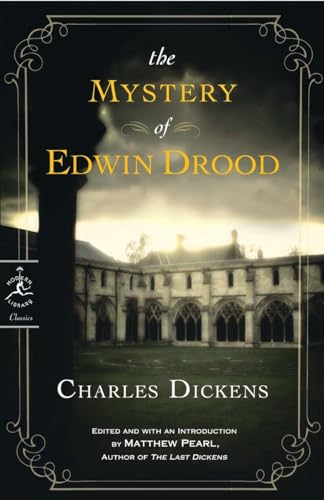
The Mystery of Edwin Drood is a novel that is itself the subject of one of literature’ s most enduring mysteries. The story recounts the troubled romance of Rosa Bud and the book’s eponymous character, who later vanishes. Was Drood murdered, and if so by whom? All clues point to John Jasper, Drood’s lugubrious uncle, who coveted Rosa. Or did Drood orchestrate his own disappearance? As Charles Dickens died before finishing the book, the ending is intriguingly ambiguous.
In his Introduction, Matthew Pearl illuminates the 150-year-long quest to unravel The Mystery of Edwin Drood and lends new insight into the novel, the literary milieu of 1870s England, and the private life of Charles Dickens. This Modern Library edition includes new endnotes and a full transcript of “The Trial of John Jasper for the Murder of Edwin Drood,” the 1914 mock court case presided over and argued by the likes of G. K. Chesterton and George Bernard Shaw. Now diehard fans, new readers, and armchair detectives have another opportunity to solve the mystery Dickens took to his grave.
Die Inhaltsangabe kann sich auf eine andere Ausgabe dieses Titels beziehen.
Über die Autorin bzw. den Autor
CHARLES DICKENS is the author of such timeless classics as Oliver Twist, David Copperfield, A Tale of Two Cities, and Great Expectations.
MATTHEW PEARL is the New York Times bestselling author of The Dante Club, The Poe Shadow, The Last Dickens, The Technologists, The Last Bookaneer, and The Dante Chamber, and the editor of the Modern Library editions of Dante’s Inferno (translated by Henry Wadsworth Longfellow) and Edgar Allan Poe’s The Murders in the Rue Morgue: The Dupin Tales. His books have been translated into more than thirty languages, and his nonfiction writing has appeared in The New York Times, The Wall Street Journal, The Boston Globe, and Slate.
Auszug. © Genehmigter Nachdruck. Alle Rechte vorbehalten.
Chapter One
The Dawn
An ancient English Cathedral Town? How can the ancient English Cathedral town be here! The well-known massive grey square tower of its old Cathedral? How can that be here! There is no spike of rusty iron in the air, between the eye and it, from any point of the real prospect. What IS the spike that intervenes, and who has set it up? Maybe, it is set up by the Sultan’s orders for the impaling of a horde of Turkish robbers, one by one. It is so, for cymbals clash, and the Sultan goes by to his palace in long procession. Ten thousand scimitars flash in the sunlight, and thrice ten thousand dancing- girls strew flowers. Then, follow white elephants caparisoned in countless gorgeous colors, and infinite in number and attendants. Still, the Cathedral Tower rises in the background, where it cannot be, and still no writhing figure is on the grim spike. Stay! Is the spike so low a thing as the rusty spike on the top of a post of an old bedstead that has tumbled all awry? Some vague period of drowsy laughter must be devoted to the consideration of this possibility.
Shaking from head to foot, the man whose scattered consciousness has thus fantastically pieced itself together, at length rises, supports his trembling frame upon his arms, and looks around. He is in the meanest and closest of small rooms. Through the ragged window- curtain, the light of early day steals in from a miserable court. He lies, dressed, across a large unseemly bed, upon a bedstead that has indeed given way under the weight upon it. Lying, also dressed and also across the bed, not longwise, are a Chinaman, a Lascar, and a haggard woman. The two first are in a sleep or stupor; the last is blowing at a kind of pipe, to kindle it. And as she blows, and shading it with her lean hand, concentrates its red spark of light, it serves in the dim morning as a lamp to show him what he sees of her.
“Another?” says this woman, in a querulous, rattling whisper. “Have another?”
He looks about him, with his hand to his forehead.
“Ye’ve smoked as many as five since ye come in at midnight,” the woman goes on, as she chronically complains. “Poor me, poor me, my head is so bad! Them two come in after ye. Ah, poor me, the business is slack, is slack! Few Chinamen about the Docks, and fewer Lascars, and no ships coming in, these say! Here’s another ready for ye, dreary. Ye’ll remember like a good soul, won’t ye, that the market price is
dreffle high just now? More than three shillings and sixpence for a thimbleful! And ye’ll remember that nobody but me (and Jack Chinaman t’other side the court; but he can’t do it as well as me) has the true secret of mixing it? Ye’ll pay up according, dreary, won’t ye?”
She blows at the pipe as she speaks, and, occasionally bubbling at it, inhales much of its contents.
“O me, O me, my lungs is weak, my lungs is bad! It’s nearly ready for ye, dreary. Ah poor me, poor me, my poor hand shakes like to drop off! I see ye coming-to, and I ses to my poor self, ‘I’ll have another ready for him, and he’ll bear in mind the market price of opium, and pay according.’ O my poor head! I makes my pipes of old penny ink-bottles, ye see, dreary—this is one—and I fits in a mouthpiece, this way, and I takes my mixter out of this thimble with this little horn spoon; and so I fills, deary. Ah, my poor nerves! I got Heavens-hard drunk for sixteen year afore I took to this; but this don’t hurt me, not to speak of. And it takes away the hunger as well as wittles, deary.”
She hands him the nearly-emptied pipe, and sinks back, turning over on her face.
He rises unsteadily from the bed, lays the pipe upon the hearthstone, draws back the ragged curtain, and looks with repugnance at his three companions. He notices that the woman has opium-smoked herself into a strange likeness of the Chinaman. His form of cheek, eye, and temple, and his color, are repeated in her. Said Chinaman convulsively wrestles with one of his many Gods, or Devils, perhaps, and snarls horribly. The Lascar laughs and dribbles at the mouth. The hostess is still.
“What visions can she have?” the waking man muses, as he turns her face towards him, and stands looking down at it. “Visions of many butchers’ shops, and public-houses, and much credit? Of an increase of hideous customers, and this horrible bedstead set upright again, and this horrible court swept clean? What can she rise to, under any quantity of opium, higher than that!—Eh?”
He bends down his ear, to listen to her mutterings.
“Unintelligible!”
As he watches the spasmodic shoots and darts that break out of her face and limbs, like fitful lightning out of a dark sky, some contagion in them seizes upon him: insomuch that he has to withdraw himself to a lean arm-chair by the hearth—placed there, perhaps, for such emergencies—and to sit in it, holding tight, until he has got the better of this unclean spirit of imitation.
Then he comes back, pounces on the Chinaman, and, seizing him with both hands by the throat, turns him violently on the bed. The Chinaman clutches the aggressive hands, resists, gasps, and protests.
“What do you say?”
A watchful pause.
“Unintelligible!”
Slowly loosening his grasp as he listens to the incoherent jargon with an attentive frown, he turns to the Lascar and fairly drags him forth upon the floor. As he falls, the Lascar starts into a half- risen attitude, glares with his eyes, lashes about him fiercely with his arms, and draws a phantom knife. It then becomes apparent that the woman has taken possession of his knife, for safety’s sake; for, she too starting up, and restraining and expostulating with him, the knife is visible in her dress, not in his, when they drowsily drop back, side by side.
There has been chattering and clattering enough between them, but to no purpose. When any distinct word has been flung into the air, it has had no sense or sequence. Wherefore “unintelligible!” is again the comment of the watcher, made with some reassured nodding of his head, and a gloomy smile. He then lays certain silver money on the table, finds his hat, gropes his way down the broken stairs, gives a good morning to some rat-ridden doorkeeper, in bed in a black hutch beneath the stairs, and passes out.
That same afternoon, the massive grey square tower of an old Cathedral rises before the sight of a jaded traveller. The bells are going for daily vesper service, and he must needs attend it, one would say, from his haste to reach the open cathedral door. The choir are getting on their sullied white robes, in a hurry, when he arrives among them, gets on his own robe, and falls into the procession filing in to service. Then, the Sacristan locks the iron-barred gates that divide the sanctuary from the chancel, and all of the procession having scuttled into their places, hide their faces; and then the intoned words, “When the Wicked Man—” rise among groins of arches and beams of roof, awakening muttered thunder.
Chapter Two
A Dean, and a Chapter Also
Whosoever has observed that sedate and clerical bird, the rook, may perhaps have noticed that when he wings his way homeward towards nightfall, in a sedate and clerical company, two rooks will suddenly detach themselves from the rest, will retrace their flight for some distance, and will there poise and linger; conveying to mere men the fancy that it is of some occult importance to the body politic, that this artful couple should pretend to have renounced connection with it.
Similarly, service being over in the...
„Über diesen Titel“ kann sich auf eine andere Ausgabe dieses Titels beziehen.
Suchergebnisse für The Mystery of Edwin Drood (Modern Library Classics)

Beispielbild für diese ISBN
The Mystery of Edwin Drood
Anbieter: World of Books (was SecondSale), Montgomery, IL, USA
Verkäuferbewertung 5 von 5 Sternen

Paperback. Zustand: Good. Charles Dickens's final, unfinished novel, and one that has puzzled readers and inspired writers since its publication Edwin Drood is contracted to marry orphan Rosa Bud when he comes of age, but when they find that duty has gradually replaced affection, they agree to break off the engagement. Shortly afterwards, in the middle of a storm on Christmas Eve, Edwin disappears, leaving nothing behind but some personal belongings and the suspicion that his jealous uncle John Jasper, madly in love with Rosa, is the killer. And beyond this presumed crime there are further intrigues: the dark opium dens of the sleepy cathedral town of Cloisterham, and the sinister double life of Choirmaster Jasper, whose drug-fuelled fantasy life belies his respectable appearance. Dickens died before completing The Mystery of Edwin Drood, leaving its tantalising mystery unsolved and encouraging successive generations of readers to turn detective. This edition contains an introduction by David Paroissien, discussing the novel's ending, with a chronology, notes, original illustrations by Samuel Luke Fildes, appendices on opium use in the nineteenth century, the 'Sapsea Fragment' and Dickens's plans for the story's conclusion. For more than seventy years, Penguin has been the leading publisher of classic literature in the English-speaking world. With more than 1,700 titles, Penguin Classics represents a global bookshelf of the best works throughout history and across genres and disciplines. Readers trust the series to provide authoritative texts enhanced by introductions and notes by distinguished scholars and contemporary authors, as well as up-to-date translations by award-winning translators. Artikel-Nr. 00106147190
Gebraucht kaufen
EUR 6,22
Versand gratis
Versand innerhalb von USA
Versand innerhalb von USA
Anzahl: 1 verfügbar
Beispielbild für diese ISBN
The Mystery of Edwin Drood
Verlag:
Random House Publishing Group, 2009
ISBN 10: 081298045X
ISBN 13: 9780812980455
Gebraucht
Softcover
Anbieter: Better World Books, Mishawaka, IN, USA
Verkäuferbewertung 5 von 5 Sternen
Zustand: Good. Former library copy. Pages intact with minimal writing/highlighting. The binding may be loose and creased. Dust jackets/supplements are not included. Includes library markings. Stock photo provided. Product includes identifying sticker. Better World Books: Buy Books. Do Good. Artikel-Nr. 5108870-6
Gebraucht kaufen
EUR 8,38
Versand gratis
Versand innerhalb von USA
Versand innerhalb von USA
Anzahl: 1 verfügbar
Beispielbild für diese ISBN
The Mystery of Edwin Drood
Verlag:
Random House Publishing Group, 2009
ISBN 10: 081298045X
ISBN 13: 9780812980455
Gebraucht
Softcover
Anbieter: Better World Books, Mishawaka, IN, USA
Verkäuferbewertung 5 von 5 Sternen
Zustand: Very Good. Pages intact with possible writing/highlighting. Binding strong with minor wear. Dust jackets/supplements may not be included. Stock photo provided. Product includes identifying sticker. Better World Books: Buy Books. Do Good. Artikel-Nr. 4989700-6
Gebraucht kaufen
EUR 8,38
Versand gratis
Versand innerhalb von USA
Versand innerhalb von USA
Anzahl: 1 verfügbar
Foto des Verkäufers
The Mystery of Edwin Drood (Modern Library Classics)
Anbieter: WeBuyBooks, Rossendale, LANCS, Vereinigtes Königreich
Verkäuferbewertung 5 von 5 Sternen
paperback. Zustand: Good. Most items will be dispatched the same or the next working day. A copy that has been read but remains in clean condition. All of the pages are intact and the cover is intact and the spine may show signs of wear. The book may have minor markings which are not specifically mentioned. Ex library copy with usual stamps & stickers. Artikel-Nr. rev2658360878
Gebraucht kaufen
EUR 19,46
EUR 6,78 Versand
Versand von Vereinigtes Königreich nach USA
Versand von Vereinigtes Königreich nach USA
Anzahl: 1 verfügbar
Beispielbild für diese ISBN
The Mystery of Edwin Drood
Anbieter: Revaluation Books, Exeter, Vereinigtes Königreich
Verkäuferbewertung 5 von 5 Sternen
Paperback. Zustand: Brand New. 363 pages. 8.50x5.25x1.00 inches. In Stock. Artikel-Nr. x-081298045X
Neu kaufen
EUR 22,00
EUR 11,84 Versand
Versand von Vereinigtes Königreich nach USA
Versand von Vereinigtes Königreich nach USA
Anzahl: 2 verfügbar
Beispielbild für diese ISBN
The Mystery of Edwin Drood
Anbieter: Majestic Books, Hounslow, Vereinigtes Königreich
Verkäuferbewertung 4 von 5 Sternen

Zustand: New. pp. 400. Artikel-Nr. 7936066
Neu kaufen
EUR 33,45
EUR 7,69 Versand
Versand von Vereinigtes Königreich nach USA
Versand von Vereinigtes Königreich nach USA
Anzahl: 1 verfügbar
Beispielbild für diese ISBN
The Mystery of Edwin Drood
Anbieter: Buchpark, Trebbin, Deutschland
Verkäuferbewertung 5 von 5 Sternen
Zustand: Gut. Zustand: Gut | Seiten: 400 | Sprache: Englisch | Produktart: Bücher | The Mystery of Edwin Drood is a novel that is itself the subject of one of literature's most enduring mysteries. The story recounts the troubled romance of Rosa Bud and the book's eponymous character, who later vanishes. Was Drood murdered, and if so by whom? All clues point to John Jasper, Drood's lugubrious uncle, who coveted Rosa. Or did Drood orchestrate his own disappearance? As Charles Dickens died before finishing the book, the ending is intriguingly ambiguous.In his Introduction, Matthew Pearl illuminates the 150-year-long quest to unravel The Mystery of Edwin Drood and lends new insight into the novel, the literary milieu of 1870s England, and the private life of Charles Dickens. This Modern Library edition includes new endnotes and a full transcript of "The Trial of John Jasper for the Murder of Edwin Drood,” the 1914 mock court case presided over and argued by the likes of G. K. Chesterton and George Bernard Shaw. Now diehard fans, new readers, and armchair detectives have another opportunity to solve the mystery Dickens took to his grave. Artikel-Nr. 5399472/3
Gebraucht kaufen
EUR 14,33
EUR 105,00 Versand
Versand von Deutschland nach USA
Versand von Deutschland nach USA
Anzahl: 1 verfügbar