
Verwandte Artikel zu The Duchess
Inhaltsangabe
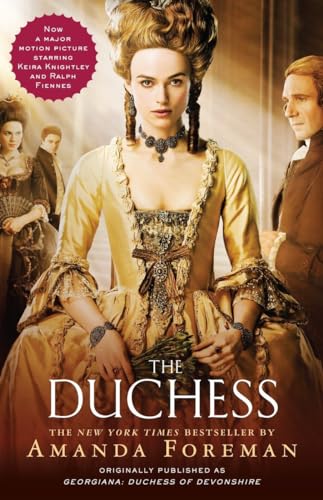
Provides a dramatic portrait of the colorful life of eighteenth-century British aristocrat Lady Georgiana Spencer, her roles as a society and political hostess, and her disastrous and profligate private life. Originally published as Georgiana: Duchess of Devonshire. Reprint. (A Paramount/Vantage film, directed by Saul Dibb, written by Jeffrey Hatcher & Anders Thomas Jensen, releasing September 2008, starring Kiera Knightley & Ralph Fiennes) (Biography & Autobiography)
Die Inhaltsangabe kann sich auf eine andere Ausgabe dieses Titels beziehen.
Über die Autorin bzw. den Autor
Amanda Foreman is a Visiting Research Fellow at Queen Mary, University of London. She won the Whitbread Prize for Georgiana, Duchess of Devonshire. She is married with five children, and lives in both New York and London.
Auszug. © Genehmigter Nachdruck. Alle Rechte vorbehalten.
C H A P T E R 1
DÉBUTANTE
1757—1774
"I know I was handsome . . . and have always been fashionable, but I do assure you,” Georgiana, Duchess of Devonshire, wrote to her daughter at the end of her life, “our negligence and ommissions have been forgiven and we have been loved, more from our being free from airs than from any other circumstance.”* Lacking airs was only part of her charm. She had always fascinated people. According to the retired French diplomat Louis Dutens, who wrote a memoir of English society in the 1780s and 1790s, “When she appeared, every eye was turned towards her; when absent, she was the subject of universal conversation.” Georgiana was not classically pretty, but she was tall, arresting, sexually attractive, and extremely stylish. Indeed, the newspapers dubbed her the Empress of Fashion.
The famous Gainsborough portrait of Georgiana succeeds in capturing something of the enigmatic charm which her contemporaries found so compelling. However, it is not an accurate depiction of her features: her eyes were heavier, her mouth larger. Georgiana’s son Hart (short for Marquess of Hartington) insisted that no artist ever succeeded in painting a true representation of his mother. Her character was too full of contradictions, the spirit which animated her thoughts too quick to be caught in a single expression.
Georgiana Spencer was the eldest child of the Earl and Countess Spencer.* She was born on June 7, 1757, at the family country seat, Althorp Park, situated some one hundred miles north of London in the sheep-farming county of Northamptonshire. She was a precocious and affectionate baby and the birth of her brother George, a year later, failed to diminish Lady Spencer’s infatuation with her daughter. Georgiana would always have first place in her heart, she confessed: “I will own I feel so partial to my Dear little Gee, that I think I never shall love another so well.” The arrival of a second daughter, Harriet, in 1761 did not alter Lady Spencer’s feelings. Writing soon after the birth, she dismissed Georgiana’s sister as a “little ugly girl” with “no beauty to brag of but an abundance of fine brown hair.” The special bond between Georgiana and her mother endured throughout her childhood and beyond. They loved each other with a rare intensity. “You are my best and dearest friend,” Georgiana told her when she was seventeen. “You have my heart and may do what you will with it.”
By contrast, Georgiana–like her sister and brother–was always a little frightened of her father. He was not violent, but his explosive temper inspired awe and sometimes terror. “I believe he was a man of generous and amiable disposition,” wrote his grandson, who never knew him. But his character had been spoiled, partly by almost continual ill-health and partly by his “having been placed at too early a period of his life in the possession of what then appeared to him inexhaustible wealth.” Georgiana’s father was only eleven when his own father died of alcoholism, leaving behind an estate worth £750,000–roughly equivalent to $74 million today.† It was one of the largest fortunes in England and included 100,000 acres in twenty-seven different counties, five substantial residences, and a sumptuous collection of plate, jewels, and old-master paintings. Lord Spencer had an income of £700 a week in an era when a gentleman could live off £300 a year.
Georgiana’s earliest memories were of travelling between the five houses. She learnt to associate the change in seasons with her family’s move to a different location. During the “season,” when society took up residence “in town” and Parliament was in session, they lived in a draughty, old-fashioned house in Grosvenor Street a few minutes’ walk from where the American embassy now resides. In the summer, when the stench of the cesspool next to the house and the clouds of dust generated by passing traffic became unbearable, they took refuge at Wimbledon Park, a Palladian villa on the outskirts of London. In the autumn they went north to their hunting lodge in Pytchley outside Kettering, and in the winter months, from November to March, they stayed at Althorp, the country seat of the Spencers for over three hundred years.
When the diarist John Evelyn visited Althorp in the seventeenth century he described the H-shaped building as almost palatial, “a noble pile . . . such as may become a great prince.” He particularly admired the great saloon, which had been the courtyard of the house until one of Georgiana’s ancestors covered it over with a glass roof. To Lord and Lady Spencer it was the ballroom; to the children it was an indoor playground. On rainy days they would take turns to slide down the famous ten-foot-wide staircase or run around the first-floor gallery playing tag. From the top of the stairs, dominating the hall, a full-length portrait of Robert, first Baron Spencer (created 1603), gazed down at his descendants, whose lesser portraits lined the ground floor.*
Georgiana was seven when the family moved their London residence to the newly built Spencer House in St. James’s, overlooking Green Park. The length of time and sums involved in the building–almost £50,000 over seven years–reflected Lord Spencer’s determination to create a house worthy of his growing collection of classical antiquities. The travel writer and economist Arthur Young was among the first people to view the house when Lord Spencer opened it to the public. “I know not in England a more beautiful piece of architecture,” he wrote, “superior to any house I have seen. . . . The hangings, carpets, glasses, sofas, chairs, tables, slabs, everything, are not only astonishingly beautiful, but contain a vast variety.” Everything, from the elaborate classical façade to the lavishly decorated interior, so much admired by Arthur Young, reflected Lord Spencer’s taste. He was a noted connoisseur and passionate collector of rare books and Italian art. Each time he went abroad he returned with a cargo of paintings and statues for the house. His favourite room, the Painted Room, as it has always been called, was the first complete neoclassical interior in Europe.
The Spencers entertained constantly and were generous patrons. Spencer House was often used for plays and concerts, and Georgiana grew up in an extraordinarily sophisticated milieu of writers, politicians, and artists. After dinner the guests would sometimes be entertained by a soliloquy delivered by the actor David Garrick or a reading by the writer Laurence Sterne, who dedicated a section of Tristram Shandy to the Spencers. The house had been built not to attract artists, however, but to consolidate the political prestige and influence of the family. The urban palaces of the nobility encircled the borough of Westminster, where the Houses of Parliament reside, like satellite courts. They were deliberately designed to combine informal politics with a formal social life. A ball might fill the vast public rooms one night, a secret political meeting the next. Many a career began with a witty remark made in a drawing room; many a governmentpolicy emerged out of discussions over dinner. Jobs were discreetly sought, positions gained, and promises of support obtained in return. This was the age of oligarch politics, when the great landowning families enjoyed unchallenged pre-eminence in government. While the Lords sat in the chamber known as the Upper House, or the House of Lords, their younger brothers, sons, and nephews filled up most of the Lower House, known as the House of Commons. There were very few electoral...
„Über diesen Titel“ kann sich auf eine andere Ausgabe dieses Titels beziehen.
Suchergebnisse für The Duchess

Beispielbild für diese ISBN
The Duchess
Anbieter: World of Books (was SecondSale), Montgomery, IL, USA
Verkäuferbewertung 5 von 5 Sternen

Paperback. Zustand: Fair. A NEW YORK TIMES NOTABLE BOOK * NOW A MAJOR MOTION PICTURE Lady Georgiana Spencer was the great-great-great-great-aunt of Diana, Princess of Wales, and was nearly as famous in her day. In 1774 Georgiana achieved immediate celebrity by marrying William Cavendish, fifth duke of Devonshire, one of England's richest and most influential aristocrats. She became the queen of fashionable society and founder of the most important political salon of her time. But Georgiana's public success concealed an unhappy marriage, a gambling addiction, drinking, drug-taking, and rampant love affairs with the leading politicians of the day. With penetrating insight, Amanda Foreman reveals a fascinating woman whose struggle against her own weaknesses, whose great beauty and flamboyance, and whose determination to play a part in the affairs of the world make her a vibrant, astonishingly contemporary figure. Praise for The Duchess "Georgiana bursts from the pages of Amanda Foreman's dazzling biography like the force of nature she undoubtedly was-passionate, political, addicted to gambling, and drunk on life. This is a stunning book about an astonishing woman."-Simon Schama "Biography at its best . . . seamlessly merges a life and its times, capturing not just an individual but an age."-The New York Times Book Review "Riveting . . . marvelously diverting."-The New Yorker. Artikel-Nr. 00054530773
Gebraucht kaufen
EUR 3,80
Versand gratis
Versand innerhalb von USA
Versand innerhalb von USA
Anzahl: 10 verfügbar
Beispielbild für diese ISBN
The Duchess
Anbieter: World of Books (was SecondSale), Montgomery, IL, USA
Verkäuferbewertung 5 von 5 Sternen
Paperback. Zustand: Good. A NEW YORK TIMES NOTABLE BOOK * NOW A MAJOR MOTION PICTURE Lady Georgiana Spencer was the great-great-great-great-aunt of Diana, Princess of Wales, and was nearly as famous in her day. In 1774 Georgiana achieved immediate celebrity by marrying William Cavendish, fifth duke of Devonshire, one of England's richest and most influential aristocrats. She became the queen of fashionable society and founder of the most important political salon of her time. But Georgiana's public success concealed an unhappy marriage, a gambling addiction, drinking, drug-taking, and rampant love affairs with the leading politicians of the day. With penetrating insight, Amanda Foreman reveals a fascinating woman whose struggle against her own weaknesses, whose great beauty and flamboyance, and whose determination to play a part in the affairs of the world make her a vibrant, astonishingly contemporary figure. Praise for The Duchess "Georgiana bursts from the pages of Amanda Foreman's dazzling biography like the force of nature she undoubtedly was-passionate, political, addicted to gambling, and drunk on life. This is a stunning book about an astonishing woman."-Simon Schama "Biography at its best . . . seamlessly merges a life and its times, capturing not just an individual but an age."-The New York Times Book Review "Riveting . . . marvelously diverting."-The New Yorker. Artikel-Nr. 00050440442
Gebraucht kaufen
EUR 3,80
Versand gratis
Versand innerhalb von USA
Versand innerhalb von USA
Anzahl: 16 verfügbar
Beispielbild für diese ISBN
The Duchess
Anbieter: World of Books (was SecondSale), Montgomery, IL, USA
Verkäuferbewertung 5 von 5 Sternen
Paperback. Zustand: Very Good. A NEW YORK TIMES NOTABLE BOOK * NOW A MAJOR MOTION PICTURE Lady Georgiana Spencer was the great-great-great-great-aunt of Diana, Princess of Wales, and was nearly as famous in her day. In 1774 Georgiana achieved immediate celebrity by marrying William Cavendish, fifth duke of Devonshire, one of England's richest and most influential aristocrats. She became the queen of fashionable society and founder of the most important political salon of her time. But Georgiana's public success concealed an unhappy marriage, a gambling addiction, drinking, drug-taking, and rampant love affairs with the leading politicians of the day. With penetrating insight, Amanda Foreman reveals a fascinating woman whose struggle against her own weaknesses, whose great beauty and flamboyance, and whose determination to play a part in the affairs of the world make her a vibrant, astonishingly contemporary figure. Praise for The Duchess "Georgiana bursts from the pages of Amanda Foreman's dazzling biography like the force of nature she undoubtedly was-passionate, political, addicted to gambling, and drunk on life. This is a stunning book about an astonishing woman."-Simon Schama "Biography at its best . . . seamlessly merges a life and its times, capturing not just an individual but an age."-The New York Times Book Review "Riveting . . . marvelously diverting."-The New Yorker. Artikel-Nr. 00107821027
Gebraucht kaufen
EUR 3,80
Versand gratis
Versand innerhalb von USA
Versand innerhalb von USA
Anzahl: 4 verfügbar
Beispielbild für diese ISBN
The Duchess
Verlag:
Random House Publishing Group (edition Media tie-in), 2008
ISBN 10: 0812979699
ISBN 13: 9780812979695
Gebraucht
Paperback
Anbieter: BooksRun, Philadelphia, PA, USA
Verkäuferbewertung 5 von 5 Sternen
Paperback. Zustand: Very Good. Media tie-in. It's a well-cared-for item that has seen limited use. The item may show minor signs of wear. All the text is legible, with all pages included. It may have slight markings and/or highlighting. Artikel-Nr. 0812979699-11-1
Gebraucht kaufen
EUR 4,58
Versand gratis
Versand innerhalb von USA
Versand innerhalb von USA
Anzahl: 1 verfügbar
Beispielbild für diese ISBN
The Duchess
Verlag:
Random House Publishing Group (edition Media tie-in), 2008
ISBN 10: 0812979699
ISBN 13: 9780812979695
Gebraucht
Paperback
Anbieter: BooksRun, Philadelphia, PA, USA
Verkäuferbewertung 5 von 5 Sternen
Paperback. Zustand: Very Good. Media tie-in. It's a well-cared-for item that has seen limited use. The item may show minor signs of wear. All the text is legible, with all pages included. It may have slight markings and/or highlighting. Artikel-Nr. 0812979699-8-1
Gebraucht kaufen
EUR 4,74
Versand gratis
Versand innerhalb von USA
Versand innerhalb von USA
Anzahl: 1 verfügbar
Beispielbild für diese ISBN
The Duchess
Verlag:
Random House Publishing Group (edition Media tie-in), 2008
ISBN 10: 0812979699
ISBN 13: 9780812979695
Gebraucht
Paperback
Anbieter: BooksRun, Philadelphia, PA, USA
Verkäuferbewertung 5 von 5 Sternen
Paperback. Zustand: Very Good. Media tie-in. It's a well-cared-for item that has seen limited use. The item may show minor signs of wear. All the text is legible, with all pages included. It may have slight markings and/or highlighting. Artikel-Nr. 0812979699-11-6
Gebraucht kaufen
EUR 5,07
Versand gratis
Versand innerhalb von USA
Versand innerhalb von USA
Anzahl: 1 verfügbar
Beispielbild für diese ISBN
The Duchess
Verlag:
Random House Publishing Group, 2008
ISBN 10: 0812979699
ISBN 13: 9780812979695
Gebraucht
Paperback
Anbieter: ThriftBooks-Atlanta, AUSTELL, GA, USA
Verkäuferbewertung 5 von 5 Sternen
Paperback. Zustand: Good. No Jacket. Pages can have notes/highlighting. Spine may show signs of wear. ~ ThriftBooks: Read More, Spend Less. Artikel-Nr. G0812979699I3N00
Gebraucht kaufen
EUR 6,27
Versand gratis
Versand innerhalb von USA
Versand innerhalb von USA
Anzahl: 1 verfügbar
Beispielbild für diese ISBN
The Duchess
Verlag:
Random House Publishing Group, 2008
ISBN 10: 0812979699
ISBN 13: 9780812979695
Gebraucht
Softcover
Anbieter: Wonder Book, Frederick, MD, USA
Verkäuferbewertung 5 von 5 Sternen
Zustand: Good. Good condition. A copy that has been read but remains intact. May contain markings such as bookplates, stamps, limited notes and highlighting, or a few light stains. Artikel-Nr. D08P-00298
Gebraucht kaufen
EUR 6,42
Versand gratis
Versand innerhalb von USA
Versand innerhalb von USA
Anzahl: 1 verfügbar
Beispielbild für diese ISBN
The Duchess
Verlag:
Random House Publishing Group, 2008
ISBN 10: 0812979699
ISBN 13: 9780812979695
Gebraucht
Softcover
Anbieter: Wonder Book, Frederick, MD, USA
Verkäuferbewertung 5 von 5 Sternen
Zustand: Very Good. Very Good condition. A copy that may have a few cosmetic defects. May also contain light spine creasing or a few markings such as an owner's name, short gifter's inscription or light stamp. Artikel-Nr. O11J-01844
Gebraucht kaufen
EUR 6,42
Versand gratis
Versand innerhalb von USA
Versand innerhalb von USA
Anzahl: 3 verfügbar
Beispielbild für diese ISBN
The Duchess
Verlag:
Random House Publishing Group, 2008
ISBN 10: 0812979699
ISBN 13: 9780812979695
Gebraucht
Softcover
Anbieter: Better World Books: West, Reno, NV, USA
Verkäuferbewertung 5 von 5 Sternen
Zustand: Good. Reprint. Former library copy. Pages intact with minimal writing/highlighting. The binding may be loose and creased. Dust jackets/supplements are not included. Includes library markings. Stock photo provided. Product includes identifying sticker. Better World Books: Buy Books. Do Good. Artikel-Nr. 3525692-75
Gebraucht kaufen
EUR 6,56
Versand gratis
Versand innerhalb von USA
Versand innerhalb von USA
Anzahl: 1 verfügbar