
Verwandte Artikel zu Buffett: The Making of an American Capitalist
Inhaltsangabe
Since its hardcover publication in August of 1995, Buffett has appeared on the Wall Street Journal, New York Times, San Francisco Chronicle, Los Angeles Times, Seattle Times, Newsday and Business Week bestseller lists.
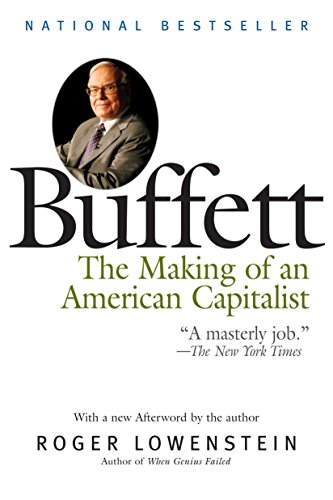
Starting from scratch, simply by picking stocks and companies for investment, Warren Buffett amassed one of the epochal fortunes of the twentieth century—an astounding net worth of $10 billion, and counting. His awesome investment record has made him a cult figure popularly known for his seeming contradictions: a billionaire who has a modest lifestyle, a phenomenally successful investor who eschews the revolving-door trading of modern Wall Street, a brilliant dealmaker who cultivates a homespun aura.
Journalist Roger Lowenstein draws on three years of unprecedented access to Buffett’s family, friends, and colleagues to provide the first definitive, inside account of the life and career of this American original. Buffett explains Buffett’s investment strategy—a long-term philosophy grounded in buying stock in companies that are undervalued on the market and hanging on until their worth invariably surfaces—and shows how it is a reflection of his inner self.
Die Inhaltsangabe kann sich auf eine andere Ausgabe dieses Titels beziehen.
Über die Autorin bzw. den Autor
Roger Lowenstein, author of the bestselling Buffett: The Making of an American Capitalist, reported for The Wall Street Journal for more than a decade, and wrote the Journal's stock market column, Heard on the Street, from 1989 to 1991 and the Intrinsic Value column from 1995 to 1997. He now writes a column in Smart Money magazine, and has written for the New York Times and The New Republic, among other publications. Lowenstein has three children and lives in Westfield, New Jersey.
Auszug. © Genehmigter Nachdruck. Alle Rechte vorbehalten.
Chapter 1
OMAHA
Like a diamond set in emerald, gracing the west bank of the Missouri River, lies Omaha, the wonder city of the West and marvel of enterprise, ability, and progressiveness.
TELEPHONE COMPANY PROMOTION, 1900
Almost from the day that Dr. Pollard awakened him to the world, six pounds strong and five weeks early, Warren Buffett had a thirst for numbers. As a boy, he and his friend Bob Russell would pass an afternoon on the Russells’ front porch, which overlooked a busy intersection, recording the license-plate numbers of passing cars. When the sky darkened, they would go inside and spread open the Omaha World-Herald, counting how often each letter appeared and filling entire scrapbooks with progressions of numbers, as though they held the key to some Euclidean riddle. Often, Russell would reach for the almanac and read out a list of cities. One by one, Warren would spit back the populations. “I’d say a city, he’d hit it on the nose,” Russell would recall, half a century later. “I might say, ‘Davenport, Iowa; Topeka, Kansas; Akron, Ohio.’ If I gave him ten cities, he’d hit every one.” Baseball scores, horse-racing odds—every numeral was fodder for that precocious memory. Combed, scrubbed, and stuffed into a pew of Dundee Presbyterian Church, Warren would pass the time on Sundays calculating the life spans of ecclesiastical composers. He would stand in the living room with a paddle and ball, counting, counting by the hour. He would play Monopoly for what seemed forever—counting his imagined riches.
Blue-eyed, with a fair complexion and pink cheeks, Warren was intrigued not merely with numbers, but with money. His first possession was a nickel-coated money changer, given to him by his Aunt Alice at Christmas and thereafter proudly strapped to his belt. When he was five, he set up a gum stand on his family’s sidewalk and sold Chiclets to passersby. After that, he sold lemonade—not on the Buffetts’ quiet street, but in front of the Russells’ house, where the traffic was heavier.
At nine, Warren and “Russ” would count the bottle caps from the soda machine at the gas station across from the Russells’ house. This was not idle counting, but a primitive market survey. How many Orange Crush caps? How many Cokes and root beers? The boys would cart the caps in a wagon and store them in Warren’s basement, piles of them. The idea was, which brand had the highest sales? Which was the best business?
At an age when few children knew what a business was, Warren would get rolls of ticker tape from his stockbroker father, set them on the floor, and decipher the ticker symbols from his father’s Standard & Poor’s. He would search the local golf course for used but marketable golf balls. He would go to Ak-Sar-Ben* racetrack and scour the saw-dusted floors, turning over torn and discarded stubs and often finding a winning ticket that had been erroneously thrown away. In the sweltering Nebraska summers, Warren and Russ would carry golf clubs for the rich gentlemen at the Omaha Country Club and earn $3 for the day. And at dusk, as they rocked on the Russells’ front-porch glider in the stillness of the Midwestern twilight, the parade of Nashes and Stude-bakers and the clanging of the trolley car would put a thought in Warren’s mind. All of that traffic with no place to go but right by the Russells’ house, he would say—if only there were a way to make some money off it. Russell’s mom, Evelyn, recalled Warren after fifty years. “All that traffic,” he would say to her. “What a shame you aren’t making money from the people going by.” As if the Russells could set up a toll booth on North 52nd Street. “What a shame, Mrs. Russell.”
What, then, was the source?
Warren was the second of three children, and the only son. His mother was a petite, feisty woman from a small town in Nebraska. She had a lively temperament and, as was said of women relegated to a supporting role, “a good head for numbers.” Warren’s father, a serious but kind man, was surely the dominant influence in his life. Opening to Warren’s eyes the world of stocks and bonds, he must have planted a seed, but insofar as such things are knowable, Howard Buffett’s acumen for numbers was not on a par with his son’s. Nor was his passion for making money. What was it, then, that prompted Warren to turn from that mannered, comfortable household—to crawl along the floor of the racetrack as though it were a bed of pearl oysters? What was it that would enable him, years later, to stun his colleagues in business-time and again—by computing columns of figures in his head, and by recalling encyclopedic volumes of data as easily as he had the population of Akron? Warren’s younger sister, Roberta, said flatly, “I think it was in his genes.”
The Buffetts were said to be gentle and sweet-natured, traits that endured. They were skilled at business and loath to spend a dollar. The earliest known Buffett (pronounced Buffett) in America, John Buffett, was a serge weaver of French Huguenot origin. He married Hannah Titus, in Huntington, on the north shore of Long Island, in 1696.1 The Buffetts remained on Long Island, as farmers, until after the Civil War. But they had a streak of ambition, which clashed with the family’s frugal ways. In 1867, Sidney Homan Buffett was employed at clearing land for Zebulon Buffett, his grandfather. On hearing of his fifty-cent-per-diem wage, Sidney became so disgusted that he put down his ax and headed west. He took a job driving a stage out of Omaha, and in 1869 opened the S. H. Buffett grocery. With Omaha still in its frontier beginnings, the Buffetts were ensconced in the city’s commercial life, a mile and a half from the wooded site of the future office of America’s richest man.
Omaha was a cluster of frame and log buildings, set against the rugged bluffs rising from the Missouri River. Though the plains stood at its door, the town itself was hilly. The area had been wilderness until 1854, when a treaty with the Maha Indians (later the Omahas) opened the Nebraska Territory to settlement. The seminal moment in its growth was in 1859, when an Illinois railroad lawyer named Abraham Lincoln visited the area and took a parcel of land as collateral for a defaulted loan. A few years later, President Lincoln designated the city as the eastern terminal of the Union Pacific Railroad.
Sidney Buffett opened his store, with impeccable timing, three months after the railroads joined the continent. Omaha was already “the great jumping-off place” for engines belching across the plains.3 It soon was teeming with settlers, drifters, speculators, Civil War veterans, railroad men, ex-convicts, and prostitutes, many of whom happened upon the Buffett grocery, where
Sidney sold quail, wild ducks, and prairie chickens over the counter. Zebulon was highly dubious of his prospects. Writing to his twenty-one-year-old grandson, Zebulon stressed that prudence in business was the Buffetts’ watchword.
You can’t expect to make much, but I hope business will get better in the spring. But if you can’t make it, do leave off in time to pay your debts and save your credit, for that is better than money.
But the young city prospered, and Sidney prospered with it. By the 1870s, Omaha had cast-iron architecture and an opera house. By the turn of the century, it had skyscrapers, cable cars, and a swelling population of 140,000. Sidney built a bigger store and brought two sons into the business....
„Über diesen Titel“ kann sich auf eine andere Ausgabe dieses Titels beziehen.
Suchergebnisse für Buffett: The Making of an American Capitalist

Beispielbild für diese ISBN
Buffett: The Making of an American Capitalist
Anbieter: World of Books (was SecondSale), Montgomery, IL, USA
Verkäuferbewertung 5 von 5 Sternen

Paperback. Zustand: Good. Since its hardcover publication in August of 1995, Buffett has appeared on the Wall Street Journal, New York Times, San Francisco Chronicle, Los Angeles Times, Seattle Times, Newsday and Business Week bestseller lists. Starting from scratch, simply by picking stocks and companies for investment, Warren Buffett amassed one of the epochal fortunes of the twentieth century--an astounding net worth of $10 billion, and counting. His awesome investment record has made him a cult figure popularly known for his seeming contradictions: a billionaire who has a modest lifestyle, a phenomenally successful investor who eschews the revolving-door trading of modern Wall Street, a brilliant dealmaker who cultivates a homespun aura. Journalist Roger Lowenstein draws on three years of unprecedented access to Buffett's family, friends, and colleagues to provide the first definitive, inside account of the life and career of this American original. Buffett explains Buffett's investment strategy--a long-term philosophy grounded in buying stock in companies that are undervalued on the market and hanging on until their worth invariably surfaces--and shows how it is a reflection of his inner self. Artikel-Nr. 00102830465
Gebraucht kaufen
EUR 4,05
Versand gratis
Versand innerhalb von USA
Versand innerhalb von USA
Anzahl: Mehr als 20 verfügbar
Beispielbild für diese ISBN
Buffett: The Making of an American Capitalist
Anbieter: World of Books (was SecondSale), Montgomery, IL, USA
Verkäuferbewertung 5 von 5 Sternen
Paperback. Zustand: Fair. Since its hardcover publication in August of 1995, Buffett has appeared on the Wall Street Journal, New York Times, San Francisco Chronicle, Los Angeles Times, Seattle Times, Newsday and Business Week bestseller lists. Starting from scratch, simply by picking stocks and companies for investment, Warren Buffett amassed one of the epochal fortunes of the twentieth century--an astounding net worth of $10 billion, and counting. His awesome investment record has made him a cult figure popularly known for his seeming contradictions: a billionaire who has a modest lifestyle, a phenomenally successful investor who eschews the revolving-door trading of modern Wall Street, a brilliant dealmaker who cultivates a homespun aura. Journalist Roger Lowenstein draws on three years of unprecedented access to Buffett's family, friends, and colleagues to provide the first definitive, inside account of the life and career of this American original. Buffett explains Buffett's investment strategy--a long-term philosophy grounded in buying stock in companies that are undervalued on the market and hanging on until their worth invariably surfaces--and shows how it is a reflection of his inner self. Artikel-Nr. 00109016953
Gebraucht kaufen
EUR 4,05
Versand gratis
Versand innerhalb von USA
Versand innerhalb von USA
Anzahl: 1 verfügbar
Beispielbild für diese ISBN
Buffett: The Making of an American Capitalist
Anbieter: ThriftBooks-Phoenix, Phoenix, AZ, USA
Verkäuferbewertung 5 von 5 Sternen
Paperback. Zustand: Fair. No Jacket. Readable copy. Pages may have considerable notes/highlighting. ~ ThriftBooks: Read More, Spend Less. Artikel-Nr. G0812979273I5N00
Gebraucht kaufen
EUR 6,04
Versand gratis
Versand innerhalb von USA
Versand innerhalb von USA
Anzahl: 1 verfügbar
Beispielbild für diese ISBN
Buffett: The Making of an American Capitalist
Anbieter: ThriftBooks-Reno, Reno, NV, USA
Verkäuferbewertung 5 von 5 Sternen
Paperback. Zustand: Good. No Jacket. Pages can have notes/highlighting. Spine may show signs of wear. ~ ThriftBooks: Read More, Spend Less. Artikel-Nr. G0812979273I3N00
Gebraucht kaufen
EUR 6,04
Versand gratis
Versand innerhalb von USA
Versand innerhalb von USA
Anzahl: 5 verfügbar
Beispielbild für diese ISBN
Buffett: The Making of an American Capitalist
Anbieter: ThriftBooks-Reno, Reno, NV, USA
Verkäuferbewertung 5 von 5 Sternen
Paperback. Zustand: Fair. No Jacket. Readable copy. Pages may have considerable notes/highlighting. ~ ThriftBooks: Read More, Spend Less. Artikel-Nr. G0812979273I5N00
Gebraucht kaufen
EUR 6,04
Versand gratis
Versand innerhalb von USA
Versand innerhalb von USA
Anzahl: 1 verfügbar
Beispielbild für diese ISBN
Buffett: The Making of an American Capitalist
Anbieter: ThriftBooks-Phoenix, Phoenix, AZ, USA
Verkäuferbewertung 5 von 5 Sternen
Paperback. Zustand: Good. No Jacket. Pages can have notes/highlighting. Spine may show signs of wear. ~ ThriftBooks: Read More, Spend Less. Artikel-Nr. G0812979273I3N00
Gebraucht kaufen
EUR 6,04
Versand gratis
Versand innerhalb von USA
Versand innerhalb von USA
Anzahl: 5 verfügbar
Beispielbild für diese ISBN
Buffett: The Making of an American Capitalist
Anbieter: ThriftBooks-Reno, Reno, NV, USA
Verkäuferbewertung 5 von 5 Sternen
Paperback. Zustand: Very Good. No Jacket. May have limited writing in cover pages. Pages are unmarked. ~ ThriftBooks: Read More, Spend Less. Artikel-Nr. G0812979273I4N00
Gebraucht kaufen
EUR 6,04
Versand gratis
Versand innerhalb von USA
Versand innerhalb von USA
Anzahl: 1 verfügbar
Beispielbild für diese ISBN
Buffett: The Making of an American Capitalist
Anbieter: ThriftBooks-Atlanta, AUSTELL, GA, USA
Verkäuferbewertung 5 von 5 Sternen
Paperback. Zustand: Good. No Jacket. Pages can have notes/highlighting. Spine may show signs of wear. ~ ThriftBooks: Read More, Spend Less. Artikel-Nr. G0812979273I3N00
Gebraucht kaufen
EUR 6,06
Versand gratis
Versand innerhalb von USA
Versand innerhalb von USA
Anzahl: 6 verfügbar
Beispielbild für diese ISBN
Buffett: The Making of an American Capitalist
Anbieter: ThriftBooks-Atlanta, AUSTELL, GA, USA
Verkäuferbewertung 5 von 5 Sternen
Paperback. Zustand: Very Good. No Jacket. May have limited writing in cover pages. Pages are unmarked. ~ ThriftBooks: Read More, Spend Less. Artikel-Nr. G0812979273I4N00
Gebraucht kaufen
EUR 6,06
Versand gratis
Versand innerhalb von USA
Versand innerhalb von USA
Anzahl: 1 verfügbar
Beispielbild für diese ISBN
Buffett: The Making of an American Capitalist
Anbieter: ThriftBooks-Atlanta, AUSTELL, GA, USA
Verkäuferbewertung 5 von 5 Sternen
Paperback. Zustand: Fair. No Jacket. Readable copy. Pages may have considerable notes/highlighting. ~ ThriftBooks: Read More, Spend Less. Artikel-Nr. G0812979273I5N00
Gebraucht kaufen
EUR 6,06
Versand gratis
Versand innerhalb von USA
Versand innerhalb von USA
Anzahl: 2 verfügbar