
Verwandte Artikel zu Check the Technique: Liner Notes for Hip-Hop Junkies
Inhaltsangabe
A Tribe Called Quest • Beastie Boys • De La Soul • Eric B. & Rakim • The Fugees • KRS-One • Pete Rock & CL Smooth • Public Enemy • The Roots • Run-DMC • Wu-Tang Clan • and twenty-five more hip-hop immortals
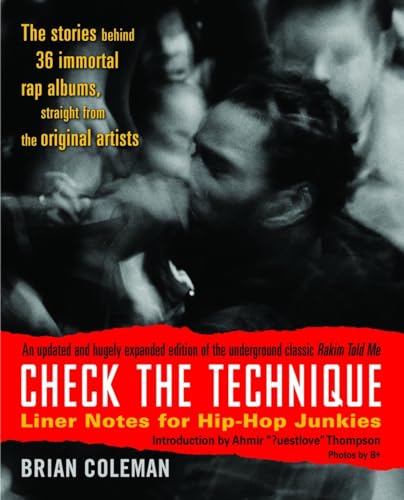
It’s a sad fact: hip-hop album liners have always been reduced to a list of producer and sample credits, a publicity photo or two, and some hastily composed shout-outs. That’s a damn shame, because few outside the game know about the true creative forces behind influential masterpieces like PE’s It Takes a Nation of Millions. . ., De La’s 3 Feet High and Rising, and Wu-Tang’s Enter the Wu-Tang (36 Chambers). A longtime scribe for the hip-hop nation, Brian Coleman fills this void, and delivers a thrilling, knockout oral history of the albums that define this dynamic and iconoclastic art form.
The format: One chapter, one artist, one album, blow-by-blow and track-by-track, delivered straight from the original sources. Performers, producers, DJs, and b-boys–including Big Daddy Kane, Muggs and B-Real, Biz Markie, RZA, Ice-T, and Wyclef–step to the mic to talk about the influences, environment, equipment, samples, beats, beefs, and surprises that went into making each classic record. Studio craft and street smarts, sonic inspiration and skate ramps, triumph, tragedy, and take-out food–all played their part in creating these essential albums of the hip-hop canon.
Insightful, raucous, and addictive, Check the Technique transports you back to hip-hop’s golden age with the greatest artists of the ’80s and ’90s. This is the book that belongs on the stacks next to your wax.
“Brian Coleman’s writing is a lot like the albums he covers: direct, uproarious, and more than six-fifths genius.”
–Jeff Chang, author of Can’t Stop Won’t Stop
“All producers and hip-hop fans must read this book. It really shows how these albums were made and touches the music fiend in everyone.”
–DJ Evil Dee of Black Moon and Da Beatminerz
“A rarity in mainstream publishing: a truly essential rap history.”
–Ronin Ro, author of Have Gun Will Travel
Die Inhaltsangabe kann sich auf eine andere Ausgabe dieses Titels beziehen.
Über die Autorin bzw. den Autor
Brian Coleman has been mesmerized and energized by hip-hop since he first heard Run-DMC's "Rock Box" in 1984. Over the past decade, he has written hundreds of reviews and features for a wide variety of publications including Scratch, XXL, Wax Poetics, Complex, CMJWeekly and CMJ Monthly, URB, the Boston Herald, the Miami New Times, the Boston Phoenix, and NY Press. Brian was a nationally recognized jazz publicist with Braithwaite & Katz Communications in Boston.
Questlove, cofounder of hip-hop superstars the Roots and bandleader for Jimmy Fallon’s The Tonight Show, is one of our great cultural commentators—a wide-ranging mind whose interests span from music to politics to race to design to food. He is the author of Somethingtofoodabout: Exploring Creativity with Innovative Chefs. To learn more, visit questlove.com.
Auszug. © Genehmigter Nachdruck. Alle Rechte vorbehalten.
ERIC B. & RAKIM
Paid in Full
(4th & Bway/Island, 1987)
“I came in the door, I said it before/I never let the mic magnetize me no more.”
When you hear those first lines, your whole body starts to shiver. You’re instantly transported to New York, 1986. The verses are so ill that your mom could say them and they’d still move a crowd. And they don’t stop for the duration of Eric B. & Rakim’s unsinkable classic, “Eric B. Is President.” A song like that only comes along maybe twice a decade, and few of them stay with you like the duo’s master tome. Eric B. and Rakim set off a lot of things in 1986–an onslaught of raids on the James Brown sampling archive; a rebirth of anti-party, pro-scientific lyricism; and a 500 percent rise in purchases of dinosaur-choking gold medallions from Bushwick to Bangkok.
Interestingly, William Griffin Jr.–the youngest of three Griffin brothers and better known to hip-hop as Rakim–didn’t figure their booming single (first released on Zakia Records, B-sided with the also mind-blowing “My Melody”) would change hip-hop the way it did. “I had no idea it would impact like that, but maybe that’s because I’m my own worst critic,” Rakim Allah says, adding, “I had already been rhyming for so long at that point that I wasn’t looking to pursue a recording career. To be honest, at the time I was hoping to play football at Stony Brook [University, in Long Island], since my cousin had a scholarship there. I played quarterback and had met with the coach there. He told me to get my grades up and we could talk.” Luckily for hip-hop fans, fate turned Rakim away from the gridiron and
gave the duo a monster hit.
Although he had deep family roots in Brooklyn, William Jr. was born and raised in Long Island’s Wyandanch, New York, and came up through an established hip-hop scene that wasn’t as flashy as New York’s–though skills were most certainly required at the door. “Wyandanch played a big influence in my life,” he says. “There was always block parties and DJs at the park. DJs like Pleasure, Nelson PR, DJ Motor, and DJ Maniac. These guys were around–like, back when I said in ‘Microphone Fiend’ that I was too small to get on the mic. There were a lot of parties in the school gyms. We had a lot going on.” He adds, talking about his New York experiences, “I had lots of family in Brooklyn and cousins in Queens, so I used to go to their cribs and go to the park in Jamaica [Queens]. I’d also make sure I always saw the Cold Crush Brothers. [Grandmaster] Caz was a big influence on me. We’d go to DJ battles in New York all the time, like Mike & Dave Productions. I remember joining in on a rap convention back then, I think it was on 127th Street. Biz Markie was there, I remember that.”
Aside from his cousins and local friends who introduced him to the hip-hop life, he also had an important musical influence in his family: his aunt, legendary R&B vocalist Ruth Brown. “She used to keep her eye on me, babysit me,” he says, also adding that he saw her perform on several occasions in his youth. “Being in that environment, watching her do what she do, that kept me grounded once I got on for myself.” Did the music legend approve of her nephew making hip-hop? “Once she heard my first record she called me up to let me know how much she liked it,” he says. “She told me to keep doing my thing and to stay focused. She definitely appreciated it, because what I was doing was about poetry and rhythm. She respected that.”
Back in his earlier teens, before he picked up a mic and started dropping supreme knowledge, young William flexed behind the turntables as Kid Wizard (he says he started using Rakim in late ’84 or early ’85). “I started DJing before I was rapping. I didn’t know which one to do, so I did both. Back then you had to do everything. You had to break-dance, beatbox, all that,” he recalls. “But after a while a lot of crews were trying to recruit me on the mic, even when I was too young to even hang out. Plus it was always easier to get on the mic than it was to get on somebody’s turntables. Once I started rapping, a lot of people forgot I could even DJ. They started realizing that I had more skill than anyone in the area, and they wanted me.
“Melle Mel was always using big words and ill rhythms, but he’d break it down and get a little political, too, like ‘White Lines’ or the joint he did on Beat Street,” Rakim says, discussing one of his biggest influences on the mic. “He was scientifical with it. Kool Moe Dee and Caz [from Cold Crush] were conscious and lyrical with their skills, and witty, too. I knew that Melle Mel and Caz and Moe always put something into their work, and every time I sat down to write a rhyme I always wanted to make sense and show that I went to school and I took language and social studies and that I knew how to write a book report. That’s the way I took my rhymes, because of those guys. Listening to them coming up was the best thing that could have happened to me.”
Around 1985, as his MC skills were beginning to hit full stride, he made an important trip to the crib of DJ Maniac (a friend of his older brother Stevie). “I went over to his house and made a tape, so when I went to college and cats start yappin’ off about how great they were, I could put in my tape and shut all that talk down,” says Rakim. “I had ninety minutes with different beats and me rapping on the whole thing, all the way through.” That tape was soon heard by an up-and-coming DJ and producer named Eric Barrier through a mutual friend–future record exec Alvin Toney, also from Wyandanch. Eric B. was engineering mobile broadcasts for New York’s WBLS-FM at the time. “Eric was looking for an MC, and Alvin brought him to my crib and we played him the tape that me and Maniac made,” Rakim recalls. The rest, as they say, is history.
“I told Eric that I wasn’t really interested in the rap game, but I said that if he popped something off I’d be a special guest,” Rakim explains. Eric wasn’t so casual about what might go down. He knew they had chemistry and something big could be made of the situation. As such, he started shopping rough demos around, and literally didn’t have to go far before he found their first home: Robert Hill’s Zakia Records. “I think that’s the first place that Eric took our music to,” Rakim says. “Zakia was right around the corner from his mom’s place. She lived on 124th Street, and Zakia was between 124th and 125th on Adam Clayton Powell Boulevard in Harlem. They liked what they heard and we did a deal with them.” With Zakia behind them (“Robert Hill ran the label and took care of studio costs,” Rakim says), they went in the studio and the duo was born–the single even reflected Rakim’s request for “special guest” status: “Eric B. featuring Rakim.”
The Marley Marl—overseen single (technically and nominally Eric B. produced it, but Rakim claims that Marley’s sonic input truly made it what it was), was recorded in late 1985 and hit streets in early 1986. It straight-up sideswiped the hip-hop world, boasting a new sound, a slower tempo, and Rakim dropping quotable line after quotable line. “Whenever I heard a slow track, what would click in my head was that I could put more rhythms and more words into it,” explains Rakim. “I could triple up on words, take the rhythm, syncopate it, and take you where...
„Über diesen Titel“ kann sich auf eine andere Ausgabe dieses Titels beziehen.
Suchergebnisse für Check the Technique: Liner Notes for Hip-Hop Junkies

Beispielbild für diese ISBN
Check the Technique: Liner Notes for Hip-Hop Junkies
Anbieter: ThriftBooks-Atlanta, AUSTELL, GA, USA
Verkäuferbewertung 5 von 5 Sternen

Paperback. Zustand: Very Good. No Jacket. Former library book; May have limited writing in cover pages. Pages are unmarked. ~ ThriftBooks: Read More, Spend Less. Artikel-Nr. G0812977750I4N10
Gebraucht kaufen
EUR 11,93
Versand gratis
Versand innerhalb von USA
Versand innerhalb von USA
Anzahl: 1 verfügbar
Beispielbild für diese ISBN
Check the Technique : Liner Notes for Hip-Hop Junkies
Verlag:
Random House Publishing Group, 2007
ISBN 10: 0812977750
ISBN 13: 9780812977752
Gebraucht
Softcover
Anbieter: Better World Books, Mishawaka, IN, USA
Verkäuferbewertung 5 von 5 Sternen
Zustand: Good. Former library copy. Pages intact with minimal writing/highlighting. The binding may be loose and creased. Dust jackets/supplements are not included. Includes library markings. Stock photo provided. Product includes identifying sticker. Better World Books: Buy Books. Do Good. Artikel-Nr. 3525203-6
Gebraucht kaufen
EUR 15,40
Versand gratis
Versand innerhalb von USA
Versand innerhalb von USA
Anzahl: 1 verfügbar
Foto des Verkäufers
Check the Technique: Liner Notes for Hip-Hop Junkies
Verlag:
Random House Publishing Group, 2007
ISBN 10: 0812977750
ISBN 13: 9780812977752
Gebraucht
Softcover
Anbieter: BoundlessBookstore, Wallingford, Vereinigtes Königreich
Verkäuferbewertung 5 von 5 Sternen
Zustand: Good. Very good condition paperback with minimal wear. Contents are clean and bright throughout with no markings. Artikel-Nr. 9999-999103308253
Gebraucht kaufen
EUR 13,78
EUR 8,33 Versand
Versand von Vereinigtes Königreich nach USA
Versand von Vereinigtes Königreich nach USA
Anzahl: 1 verfügbar
Beispielbild für diese ISBN
Check the Technique: Liner Notes for Hip-Hop Junkies
Verlag:
Random House USA Inc, United States, New York, 2007
ISBN 10: 0812977750
ISBN 13: 9780812977752
Gebraucht
Paperback
Anbieter: WorldofBooks, Goring-By-Sea, WS, Vereinigtes Königreich
Verkäuferbewertung 5 von 5 Sternen
Paperback. Zustand: Very Good. The book has been read, but is in excellent condition. Pages are intact and not marred by notes or highlighting. The spine remains undamaged. Artikel-Nr. GOR006251545
Gebraucht kaufen
EUR 16,85
EUR 6,69 Versand
Versand von Vereinigtes Königreich nach USA
Versand von Vereinigtes Königreich nach USA
Anzahl: 4 verfügbar
Beispielbild für diese ISBN
Check the Technique: Liner Notes for the Hip-hop Junkies
Anbieter: Revaluation Books, Exeter, Vereinigtes Königreich
Verkäuferbewertung 5 von 5 Sternen
Paperback. Zustand: Brand New. 509 pages. 9.00x7.25x1.25 inches. In Stock. Artikel-Nr. zk0812977750
Neu kaufen
EUR 47,19
EUR 14,93 Versand
Versand von Vereinigtes Königreich nach USA
Versand von Vereinigtes Königreich nach USA
Anzahl: 1 verfügbar
Foto des Verkäufers
Check the Technique : Liner Notes for Hip-Hop Junkies
Verlag:
Random House Publishing Group Jun 2007, 2007
ISBN 10: 0812977750
ISBN 13: 9780812977752
Neu
Taschenbuch
Anbieter: AHA-BUCH GmbH, Einbeck, Deutschland
Verkäuferbewertung 5 von 5 Sternen
Taschenbuch. Zustand: Neu. Neuware - A Tribe Called Quest Beastie Boys De La Soul Eric B. & Rakim The Fugees KRS-One Pete Rock & CL Smooth Public Enemy The Roots Run-DMC Wu-Tang Clan and twenty-five more hip-hop immortalsIt's a sad fact: hip-hop album liners have always been reduced to a list of producer and sample credits, a publicity photo or two, and some hastily composed shout-outs. That's a damn shame, because few outside the game know about the true creative forces behind influential masterpieces like PE's It Takes a Nation of Millions. . ., De La's 3 Feet High and Rising, and Wu-Tang's Enter the Wu-Tang (36 Chambers). A longtime scribe for the hip-hop nation, Brian Coleman fills this void, and delivers a thrilling, knockout oral history of the albums that define this dynamic and iconoclastic art form. The format: One chapter, one artist, one album, blow-by-blow and track-by-track, delivered straight from the original sources. Performers, producers, DJs, and b-boysincluding Big Daddy Kane, Muggs and B-Real, Biz Markie, RZA, Ice-T, and Wyclefstep to the mic to talk about the influences, environment, equipment, samples, beats, beefs, and surprises that went into making each classic record. Studio craft and street smarts, sonic inspiration and skate ramps, triumph, tragedy, and take-out foodall played their part in creating these essential albums of the hip-hop canon.Insightful, raucous, and addictive, Check the Technique transports you back to hip-hop's golden age with the greatest artists of the '80s and '90s. This is the book that belongs on the stacks next to your wax."Brian Coleman's writing is a lot like the albums he covers: direct, uproarious, and more than six-fifths genius." Jeff Chang, author of Can't Stop Won't Stop "All producers and hip-hop fans must read this book. It really shows how these albums were made and touches the music fiend in everyone." DJ Evil Dee of Black Moon and Da Beatminerz "A rarity in mainstream publishing: a truly essential rap history." Ronin Ro, author of Have Gun Will Travel. Artikel-Nr. 9780812977752
Neu kaufen
EUR 35,65
EUR 35,00 Versand
Versand von Deutschland nach USA
Versand von Deutschland nach USA
Anzahl: 2 verfügbar
Foto des Verkäufers
Check the Technique: Liner Notes for Hip-Hop Junkies
Verlag:
Random House Publishing Group, 2007
ISBN 10: 0812977750
ISBN 13: 9780812977752
Neu
Softcover
Anbieter: moluna, Greven, Deutschland
Verkäuferbewertung 5 von 5 Sternen
Zustand: New. Brian Coleman has been mesmerized and energized by hip-hop since he first heard Run-DMC s Rock Box in 1984. Over the past decade, he has written hundreds of reviews and features for a wide variety of publications including Scratch, XXL. Artikel-Nr. 595037363
Neu kaufen
EUR 26,61
EUR 48,99 Versand
Versand von Deutschland nach USA
Versand von Deutschland nach USA
Anzahl: Mehr als 20 verfügbar