
Verwandte Artikel zu Women of the Raj: The Mothers, Wives, and Daughters...
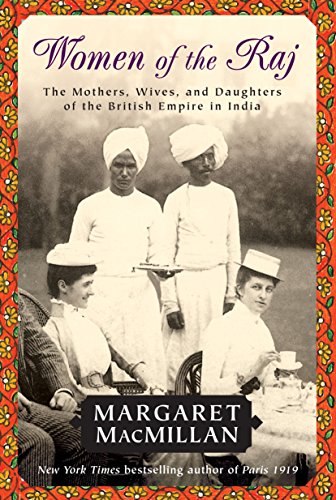
Women of the Raj: The Mothers, Wives, and Daughters of the British Empire in India: The Mothers, Wives, and Daughters of the Bristish Empire in India - Softcover
Inhaltsangabe
In the nineteenth century, at the height of colonialism, the British ruled India under a government known as the Raj. British men and women left their homes and traveled to this mysterious, beautiful country–where they attempted to replicate their own society. In this fascinating portrait, Margaret MacMillan examines the hidden lives of the women who supported their husbands’ conquests–and in turn supported the Raj, often behind the scenes and out of the history books. Enduring heartbreaking separations from their families, these women had no choice but to adapt to their strange new home, where they were treated with incredible deference by the natives but found little that was familiar. The women of the Raj learned to cope with the harsh Indian climate and ward off endemic diseases; they were forced to make their own entertainment–through games, balls, and theatrics–and quickly learned to abide by the deeply ingrained Anglo-Indian love of hierarchy.
Weaving interviews, letters, and memoirs with a stunning selection of illustrations, MacMillan presents a vivid cultural and social history of the daughters, sisters, mothers, and wives of the men at the center of a daring imperialist experiment–and reveals India in all its richness and vitality.
“A marvellous book . . . [Women of the Raj] successfully [re-creates] a vanished world that continues to hold a fascination long after the sun has set on the British empire.”
–The Globe and Mail
“MacMillan has that essential quality of the historian, a narrative gift.”
–The Daily Telegraph
“MacMillan is a superb writer who can bring history to life.”
–The Philadelphia Inquirer
“Well researched and thoroughly enjoyable.”
–Evening Standard
Die Inhaltsangabe kann sich auf eine andere Ausgabe dieses Titels beziehen.
Über die Autorin bzw. den Autor
Margaret MacMillan received her PhD from Oxford University and is now a professor of international history at Oxford, where she is also the warden of St. Antony’s College. She is a fellow of the Royal Society of Literature; a senior fellow of Massey College, University of Toronto; and an honorary fellow of Trinity College, University of Toronto, and of St. Hilda’s College, Oxford University. Her previous books include Dangerous Games: The Uses and Abuses of History; Nixon and Mao: The Week That Changed the World; Women of the Raj: The Mothers, Wives, and Daughters of the British Empire in India; and Paris 1919: Six Months That Changed the World, which won the Samuel Johnson Prize, the PEN Hessell-Tiltman Prize, and the Duff Cooper Prize and was a New York Times Editors’ Choice.
Auszug. © Genehmigter Nachdruck. Alle Rechte vorbehalten.
Chapter 1
The Voyage Out
Englishwomen—and Welsh and Scots and Irish women—had been going to India for generations by the time the Raj reached its peak in the late nineteenth century. The first to make the voyage may have been a Mrs. Hudson and her maid, Frances Webb, who went in 1617 as companions to an Armenian lady who had been born in India. (Frances had a love affair on the voyage, unwittingly setting the pattern for countless women who came after her.) Over the years, India drew a few women looking for work—as milliners, perhaps, or governesses. And some women had a calling to be missionaries. Others simply went because they had been summoned back by their families after an education in Britain.
The great majority, however, went to India because their husbands were there or because they hoped to find husbands for themselves. (To keep them chaste for the marriage market, unmarried women traveled, until well into the twentieth century, under the care of chaperones, usually married women who were making the voyage anyway.) The “fishing fleet,” as it was known unkindly but accurately by the nineteenth century, arrived in India in the autumn at the start of the cold weather. One lady who came out in 1779 divided what she called “the speculative ladies” into old maids, “of the shrivelled and dry description,” and girls, “educated merely to cover the surface of their mental deformity.” The odds were that their fishing would meet success: throughout the period of British rule in India, European men outnumbered European women by about three to one.
Understandably, few British women had cared to come to the unsettled India of the seventeenth and early eighteenth centuries; and, what is more, the early charters of the East India Company pointedly forbade women on its posts. Its employees ignored that regulation as they did so many others. They took Indian mistresses; worse, from the point of view of the Company’s staunch Protestant directors, they married Catholics, daughters or widows of the Portuguese. To save the souls of its men, the Company, for a time, played matchmaker. In the later part of the seventeenth century it shipped batches of young women from Britain to India. The cargo, divided into “gentlewomen” and “others,” were given one set of clothes each and were supported for a year—quite long enough, it was thought, for them to find themselves husbands. Some did not; and the Company tried to deny that it had any obligation to look after them further. Most unfairly it also warned them to mind their morals: “Whereas some of these women are grown scandalous to our nation, religion and Government interest,” said a letter from London to the Deputy Governor of Bombay in 1675, “we require you to give them fair warning that they do apply themselves to a more sober and Christian conversation.” If that warning did not have the right effect, the women were to be fed on bread and water and shipped back to Britain. The experiment was not a happy one and it must have been with relief that the Company abandoned the practice in the eighteenth century. British women still traveled to India but they came individually.
The voyage was a dreadful one. The wooden sailing vessels, tiny by today’s standards, were tossed about in every storm—and the South Atlantic and the Indian Ocean were famous for their storms. The passengers faced at best being thrown about in their cabins, at worst drowning. The Reverend Hobart Caunter recorded one such storm, which took place off the east coast of India in the 1830s. The weather began to turn foul early one morning. “The only lady among us every now and then expressed her fears, when a sudden gust caused the vessel to lurch with an increased momentum, as if the billows were already commencing a fiercer conflict.” By late afternoon, they were in the midst of a full-blown hurricane. The ship pitched violently and furniture was torn from its fastenings. More dangerously, a cannon got loose and threatened to batter a hole in the side. Even Caunter, a seasoned traveler, found the noise, coupled with the crashing of waves and the howling of the wind, “painful in the extreme.” Night came on and the storm increased in fury. As Caunter and the captain were in the main cabin, or cuddy, trying to carry on a conversation, “suddenly, a heavy sea struck her astern, but happily on the quarter, and in an instant carried away the quarter-galley on that side, swamping the cabin into which the poor lady before spoken of had retired for the night. The force of the water was so great, that it dashed open the door of the cabin, and its fair occupant was borne head foremost into the cuddy, dripping like a mermaid, her hair hanging about her shoulders in thin strips, when she was rescued by the captain from further mischief. She was drenched to the skin.”
At its shortest the voyage under sail took under two months; at its longest well over six. Sometimes the winds were so contrary on the west coast of Africa that the ships were blown off course almost to Brazil. The crew and passengers gasped with the heat; then, when they were rounding the Cape of Good Hope, they shivered in the cold. There was the danger of being dashed against the shore by a sudden shift in the winds. Those who survived often ended up in the great slave markets along the east coast of Africa. Occasionally the winds might fail altogether and the unhappy ship would sit becalmed for weeks on end.
Accommodations were cramped and dirty and often had to be shared with huge rats which scurried about, boldly eating any food that was left out and nibbling holes in clothing. Women who could afford it had cabins abovedecks. Otherwise they were housed below, in stuffy cubbyholes, often with walls made of canvas, where they had very little privacy. A bucket of salt water was the closest passengers got to a wash tub; another bucket made do for a toilet. Mrs. Sherwood, later famous as a writer of sentimental children’s stories, accompanied her army officer husband out to India at the beginning of the nineteenth century; she had to sleep in a hammock strung above a cannon while filthy water from the bilges ran across the floor beneath.
Mrs. Eliza Fay, who lived in India in the late eighteenth century, endured the voyage several times. Fortunately she was a woman who faced difficulties (and she had many—from imprisonment by an Indian ruler to her wastrel of a husband) in an optimistic spirit. Her letters to her sister are filled with cheerful gossip and appalling details of shipboard life. On one voyage back to England, she nearly suffocated. “The port of my cabin being kept almost constantly shut, and the door opening into the steerage; I had neither light nor air but from a scuttle.” On her first voyage the captain was “overbearing and insolent” and kept his passengers half starved. At meals, Mrs. Fay reported proudly, “the longest arm fared best; and you cannot imagine what a good scrambler I am become.”
When they could, women on the sailing ships escaped from their cabins to the fresh air of the deck, but that depended on both the weather and the mood of the captain. Many of the captains of the East Indiamen were quite charmingly eccentric on dry land; at sea they seemed half mad and one of their more common phobias was women. Ladies were often forced to take their meals in their cabins rather than in the cuddy because the gentlemen drank and swore so dreadfully. Mrs. Sherwood confided to her diary that “those who have not been at sea can never conceive the hundredth part of the horrors of a long voyage to a female in a sailing vessel.”
At the start of the voyage, there might be...
„Über diesen Titel“ kann sich auf eine andere Ausgabe dieses Titels beziehen.
Weitere beliebte Ausgaben desselben Titels

Suchergebnisse für Women of the Raj: The Mothers, Wives, and Daughters...

Beispielbild für diese ISBN
Women of the Raj: The Mothers, Wives, and Daughters of the British Empire in India
ISBN 10: 0812976398
ISBN 13: 9780812976397
Gebraucht
Paperback
Anbieter: BooksRun, Philadelphia, PA, USA
Verkäuferbewertung 5 von 5 Sternen

Paperback. Zustand: Very Good. First PB Edition, First Printing. It's a well-cared-for item that has seen limited use. The item may show minor signs of wear. All the text is legible, with all pages included. It may have slight markings and/or highlighting. Artikel-Nr. 0812976398-8-1
Gebraucht kaufen
EUR 4,40
Versand gratis
Versand innerhalb von USA
Versand innerhalb von USA
Anzahl: 1 verfügbar
Beispielbild für diese ISBN
Women of the Raj: The Mothers, Wives, and Daughters of the British Empire in India
Anbieter: ThriftBooks-Atlanta, AUSTELL, GA, USA
Verkäuferbewertung 5 von 5 Sternen
Paperback. Zustand: Good. No Jacket. Pages can have notes/highlighting. Spine may show signs of wear. ~ ThriftBooks: Read More, Spend Less. Artikel-Nr. G0812976398I3N00
Gebraucht kaufen
EUR 5,84
Versand gratis
Versand innerhalb von USA
Versand innerhalb von USA
Anzahl: 1 verfügbar
Beispielbild für diese ISBN
Women of the Raj: The Mothers, Wives, and Daughters of the British Empire in India
Anbieter: ThriftBooks-Reno, Reno, NV, USA
Verkäuferbewertung 5 von 5 Sternen
Paperback. Zustand: Good. No Jacket. Former library book; Pages can have notes/highlighting. Spine may show signs of wear. ~ ThriftBooks: Read More, Spend Less. Artikel-Nr. G0812976398I3N10
Gebraucht kaufen
EUR 5,84
Versand gratis
Versand innerhalb von USA
Versand innerhalb von USA
Anzahl: 1 verfügbar
Beispielbild für diese ISBN
Women of the Raj: The Mothers, Wives, and Daughters of the British Empire in India
Anbieter: ThriftBooks-Reno, Reno, NV, USA
Verkäuferbewertung 5 von 5 Sternen
Paperback. Zustand: Good. No Jacket. Pages can have notes/highlighting. Spine may show signs of wear. ~ ThriftBooks: Read More, Spend Less. Artikel-Nr. G0812976398I3N00
Gebraucht kaufen
EUR 5,84
Versand gratis
Versand innerhalb von USA
Versand innerhalb von USA
Anzahl: 1 verfügbar
Beispielbild für diese ISBN
Women of the Raj: The Mothers, Wives, and Daughters of the British Empire in India
Anbieter: ThriftBooks-Atlanta, AUSTELL, GA, USA
Verkäuferbewertung 5 von 5 Sternen
Paperback. Zustand: Very Good. No Jacket. May have limited writing in cover pages. Pages are unmarked. ~ ThriftBooks: Read More, Spend Less. Artikel-Nr. G0812976398I4N00
Gebraucht kaufen
EUR 5,84
Versand gratis
Versand innerhalb von USA
Versand innerhalb von USA
Anzahl: 1 verfügbar
Beispielbild für diese ISBN
Women of the Raj: The Mothers, Wives, and Daughters of the British Empire in India
Anbieter: ThriftBooks-Dallas, Dallas, TX, USA
Verkäuferbewertung 5 von 5 Sternen
Paperback. Zustand: Good. No Jacket. Pages can have notes/highlighting. Spine may show signs of wear. ~ ThriftBooks: Read More, Spend Less. Artikel-Nr. G0812976398I3N00
Gebraucht kaufen
EUR 5,84
Versand gratis
Versand innerhalb von USA
Versand innerhalb von USA
Anzahl: 1 verfügbar
Beispielbild für diese ISBN
Women of the Raj: The Mothers, Wives, and Daughters of the British Empire in India
Anbieter: ThriftBooks-Atlanta, AUSTELL, GA, USA
Verkäuferbewertung 5 von 5 Sternen
Paperback. Zustand: Fair. No Jacket. Readable copy. Pages may have considerable notes/highlighting. ~ ThriftBooks: Read More, Spend Less. Artikel-Nr. G0812976398I5N00
Gebraucht kaufen
EUR 5,84
Versand gratis
Versand innerhalb von USA
Versand innerhalb von USA
Anzahl: 1 verfügbar
Beispielbild für diese ISBN
Women of the Raj: The Mothers, Wives, and Daughters of the British Empire in India
Anbieter: ThriftBooks-Dallas, Dallas, TX, USA
Verkäuferbewertung 5 von 5 Sternen
Paperback. Zustand: Good. No Jacket. Former library book; Pages can have notes/highlighting. Spine may show signs of wear. ~ ThriftBooks: Read More, Spend Less. Artikel-Nr. G0812976398I3N10
Gebraucht kaufen
EUR 5,84
Versand gratis
Versand innerhalb von USA
Versand innerhalb von USA
Anzahl: 1 verfügbar
Beispielbild für diese ISBN
Women of the Raj : The Mothers, Wives, and Daughters of the British Empire in India
Verlag:
Random House Publishing Group, 2007
ISBN 10: 0812976398
ISBN 13: 9780812976397
Gebraucht
Softcover
Anbieter: Better World Books: West, Reno, NV, USA
Verkäuferbewertung 5 von 5 Sternen
Zustand: Good. Pages intact with minimal writing/highlighting. The binding may be loose and creased. Dust jackets/supplements are not included. Stock photo provided. Product includes identifying sticker. Better World Books: Buy Books. Do Good. Artikel-Nr. 4131843-20
Gebraucht kaufen
EUR 6,38
Versand gratis
Versand innerhalb von USA
Versand innerhalb von USA
Anzahl: 1 verfügbar
Beispielbild für diese ISBN
Women of the Raj : The Mothers, Wives, and Daughters of the British Empire in India
Verlag:
Random House Publishing Group, 2007
ISBN 10: 0812976398
ISBN 13: 9780812976397
Gebraucht
Softcover
Anbieter: Better World Books, Mishawaka, IN, USA
Verkäuferbewertung 5 von 5 Sternen
Zustand: Good. Pages intact with minimal writing/highlighting. The binding may be loose and creased. Dust jackets/supplements are not included. Stock photo provided. Product includes identifying sticker. Better World Books: Buy Books. Do Good. Artikel-Nr. 4131843-20
Gebraucht kaufen
EUR 6,38
Versand gratis
Versand innerhalb von USA
Versand innerhalb von USA
Anzahl: 2 verfügbar