
Verwandte Artikel zu Summer Crossing: A Novel (Modern Library Paperbacks)
Inhaltsangabe
“Witness the coming together of Truman Capote’s voice, the electric-into-neon blaze that is surely one of the premier styles of postwar American literature.”—The Washington Post Book World
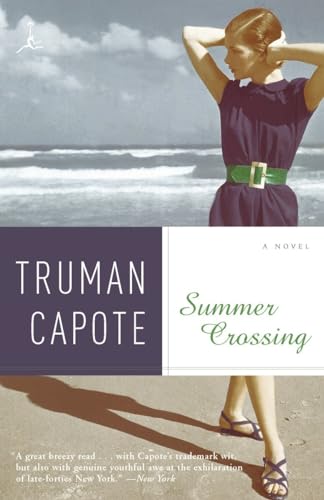
“A great breezy read . . . with Capote’s trademark wit, but also with genuine youthful awe at the exhilaration of late-forties New York.”—New York
A lost treasure only recently found, Truman Capote’s Summer Crossing is a precocious, confident first novel from one of the twentieth century’s greatest writers.
Set in New York just after World War II, the story follows a young carefree socialite, Grady McNeil, whose parents leave her alone in their Fifth Avenue penthouse for the summer. Left to her own devices, Grady turns up the heat on the secret affair she’s been having with a Brooklyn-born Jewish war veteran who works as a parking lot attendant. As the season passes, the romance turns more serious and morally ambiguous, and Grady must eventually make a series of decisions that will forever affect her life and the lives of everyone around her.
Die Inhaltsangabe kann sich auf eine andere Ausgabe dieses Titels beziehen.
Über die Autorin bzw. den Autor
Truman Capote was a native of New Orleans, where he was born on September 30, 1924. His first novel, Other Voices, Other Rooms, was an international literary success when first published in 1948, and accorded the author a prominent place among the writers of America's postwar generation. He sustained this position subsequently with short-story collections (A Tree of Night, among others), novels and novellas (The Grass Harp and Breakfast at Tiffany's), some of the best travel writing of our time (Local Color), profiles and reportage that appeared originally in The New Yorker (The Duke in His Domain and The Muses Are Heard), a true-crime masterpiece (In Cold Blood), several short memiors about his childhood in the South (A Christmas Memory, The Thanksgiving Visitor, and One Christmas), two plays (The Grass Harp and House of Flowers and two films (Beat the devil and The Innocents).
Mr. Capote twice won the O.Henry Memorial Short Story Prize and was a member of the National Institute of Arts and Letters. He died in August 1984, shortly before his sixtieth birthday.
Auszug. © Genehmigter Nachdruck. Alle Rechte vorbehalten.
Chapter 1
“You are a mystery, my dear,” her mother said, and Grady, gazing across the table through a centerpiece of roses and fern, smiled indulgently: yes, I am a mystery, and it pleased her to think so. But Apple, eight years older, married, far from mysterious, said: “Grady is only foolish; I wish I were going with you. Imagine, Mama, this time next week you’ll be having breakfast in Paris! George keeps promising that we’ll go . . . I don’t know, though.” She paused and looked at her sister. “Grady, why on earth do you want to stay in New York in the dead of summer?” Grady wished they would leave her alone; still this harping, and here now was the very morning the boat sailed: what was there to say beyond what she’d said? After that there was only the truth, and the truth she did not entirely intend to tell. “I’ve never spent a summer here,” she said, escaping their eyes and looking out the window: the dazzle of traffic heightened the June morning quiet of Central Park, and the sun, full of first summer, that dries the green crust of spring, plunged through the trees fronting the Plaza, where they were breakfasting. “I’m perverse; have it your own way.” She realized with a smile it was perhaps a mistake to have said that: her family did come rather near thinking her perverse; and once when she was fourteen she’d had a terrible and quite acute insight: her mother, she saw, loved her without really liking her; she had thought at first that this was because her mother considered her plainer, more obstinate, less playful than Apple, but later, when it was apparent, and painfully so to Apple, that Grady was finer looking by far, then she gave up reasoning about her mother’s viewpoint: the answer of course, and at last she saw this too, was simply that in an inactive sort of way, she’d never, not even as a very small girl, much liked her mother. Yet there was little flamboyancy in either attitude; indeed, the house of their hostility was modestly furnished with affection, which Mrs. McNeil now expressed by closing her daughter’s hand in her own and saying: “We will worry about you, darling. We can’t help that. I don’t know. I don’t know. I’m not sure it’s safe. Seventeen isn’t very old, and you’ve never been really alone before.”
Mr. McNeil, who whenever he spoke sounded as though he was bidding in a poker game, but who seldom spoke in any event, partly because his wife did not like to be interrupted and partly because he was a very tired man, dunked out a cigar in his coffee cup, causing both Apple and Mrs. McNeil to wince, and said: “When I was eighteen, why hell, I’d been out in California three years.”
“But after all, Lamont . . . you’re a man.”
“What’s the difference?” he grunted. “There has been no difference between men and women for some while. You say so yourself.”
As though the conversation had taken an unpleasant turn, Mrs. McNeil cleared her throat. “It remains, Lamont, that I am very uneasy in leaving—”
Rising inside Grady was an ungovernable laughter, a joyous agitation which made the white summer stretching before her seem like an unrolling canvas on which she might draw those first rude pure strokes that are free. Then, too, and with a straight face, she was laughing because there was so little they suspected, nothing. The light quivering against the table silver seemed to at once encourage her excitement and to flash a warning signal: careful, dear. But elsewhere something said Grady, be proud, you are tall so fly your pennant high above and in the wind. What could have spoken, the rose? Roses speak, they are the hearts of wisdom, she’d read so somewhere. She looked out the window again; the laughter was flowing up, it was flooding on her lips: what a sparkling sun-slapped day for Grady McNeil and roses that speak!
“Why is that so funny, Grady?” Apple did not have a pleasant voice; it suggested the subvocal prattlings of an ill-natured baby. “Mother asks a simple question, and you laugh as though she were an idiot.”
“Grady doesn’t think me an idiot, surely not,” said Mrs. McNeil, but a tone of weak conviction indicated doubt, and her eyes, webbed by the spidery hat-veil she now lowered over her face, were dimly confused with the sting she always felt when confronted by what she considered Grady’s contempt. It was all very well that between them there should be only the thinnest contact: there was no real sympathy, she knew that; still, that Grady by her remoteness could suggest herself superior was unendurable: in such moments Mrs.
McNeil’s hands twitched. Once, but this had been a great many years ago and when Grady was still a tomboy with chopped hair and scaly knees, she had not been able to control them, her hands, and on that occasion, which of course was during that period which is the most nervously trying of a woman’s life, she had, provoked by Grady’s inconsiderate aloofness, slapped her daughter fiercely. Whenever she’d known afterwards similar impulses she steadied her hands on some solid surface, for, at the time of her previous unrestraint, Grady, whose green estimating eyes were like scraps of sea, had stared her down, had stared through her and turned a searchlight on the spoiled mirror of her vanities: because she was a limited woman, it was her first experience with a will-power harder than her own. “Surely not,” she said, twinkling with artificial humor.
“I’m sorry,” said Grady. “Did you ask a question? I never seem to hear anymore.” She intended the last not so much as an apology as a serious confession.
“Really,” twittered Apple, “one would think you were in love.”
There was a knocking at her heart, a sense of danger, the silver shook momentously, and a lemon-wheel, half-squeezed in Grady’s finger, paused still: she glanced swiftly into her sister’s eyes to see if anything were there that was more shrewd than stupid. Satisfied, she finished squeezing the lemon into her tea and heard her mother say: “It is about the dress, dear. I think I may as well have it made in Paris: Dior or Fath, someone like that. It might even be less expensive in the long run. A soft leaf green would be heaven, especially with your coloring and hair—though I must say I wish you wouldn’t cut it so short: it seems unsuitable and not—not quite feminine. A pity debutantes can’t wear green. Now I think something in white watered silk—”
Grady interrupted her with a frown. “If this is the party dress, I don’t want it. I don’t want a party, and I don’t intend to go to any, not those kind at any rate. I will not be made a fool.”
Of all the things that fatigued her, this tried and annoyed Mrs. McNeil most: she trembled as if unnatural vibrations jarred the sane and stable precincts of the Plaza dining-room. Nor do I mean to be made a fool, she might have said, for, in contemplating the promotion of Grady’s debut year, she’d done already a great lot of work, maneuvering: there was even some idea of hiring a secretary. Furthermore, and in a self-righteous vein, she could have gone even so far as to say that the whole of her social life, every drab luncheon and tiresome tea (as in this light she would describe them), had...
„Über diesen Titel“ kann sich auf eine andere Ausgabe dieses Titels beziehen.
Suchergebnisse für Summer Crossing: A Novel (Modern Library Paperbacks)

Beispielbild für diese ISBN
Summer Crossing: A Novel
Anbieter: World of Books (was SecondSale), Montgomery, IL, USA
Verkäuferbewertung 5 von 5 Sternen

Paperback. Zustand: Fair. The long-lost first novel from literary titan Truman Capote: a razor-sharp account of love and wayward youth in 1940s New York City "Witness the coming together of Truman Capote's voice, the electric-into-neon blaze that is surely one of the premier styles of postwar American literature."--The Washington Post Book World "A great breezy read . . . with Capote's trademark wit, but also with genuine youthful awe at the exhilaration of late-forties New York."--New York In late 2004, a trove of abandoned documents from Truman Capote's Brooklyn apartment went up for auction at Sotheby's. Included in the lot were four notebooks containing the handwritten manuscript of Summer Crossing, which Capote began writing in 1943 and set aside when he turned his attentions into what would be his stunning literary debut, Other Voices, Other Rooms. Since the time of his death in 1984, Capote scholars and biographers had long believed this manuscript gone, never to be recovered. Set in New York just after World War II, Summer Crossing follows a carefree young socialite, Grady McNeil, whose parents leave her alone in their Fifth Avenue penthouse for the summer. Left to her own devices, Grady turns up the heat on the secret affair she's been having with a Brooklyn-born Jewish war veteran who works as a parking lot attendant. As the season passes, the romance turns more serious and morally ambiguous, and Grady must eventually make a series of decisions that will forever affect her life and the lives of everyone around her. A lost treasure found, Summer Crossing is a precocious, confident first novel that displays the nearly perfect prose and flawless narrative sense of one of the twentieth century's greatest writers. Artikel-Nr. 00108606191
Gebraucht kaufen
EUR 6,03
Versand gratis
Versand innerhalb von USA
Versand innerhalb von USA
Anzahl: 1 verfügbar
Beispielbild für diese ISBN
Summer Crossing: A Novel
Anbieter: World of Books (was SecondSale), Montgomery, IL, USA
Verkäuferbewertung 5 von 5 Sternen
Paperback. Zustand: Good. The long-lost first novel from literary titan Truman Capote: a razor-sharp account of love and wayward youth in 1940s New York City "Witness the coming together of Truman Capote's voice, the electric-into-neon blaze that is surely one of the premier styles of postwar American literature."--The Washington Post Book World "A great breezy read . . . with Capote's trademark wit, but also with genuine youthful awe at the exhilaration of late-forties New York."--New York In late 2004, a trove of abandoned documents from Truman Capote's Brooklyn apartment went up for auction at Sotheby's. Included in the lot were four notebooks containing the handwritten manuscript of Summer Crossing, which Capote began writing in 1943 and set aside when he turned his attentions into what would be his stunning literary debut, Other Voices, Other Rooms. Since the time of his death in 1984, Capote scholars and biographers had long believed this manuscript gone, never to be recovered. Set in New York just after World War II, Summer Crossing follows a carefree young socialite, Grady McNeil, whose parents leave her alone in their Fifth Avenue penthouse for the summer. Left to her own devices, Grady turns up the heat on the secret affair she's been having with a Brooklyn-born Jewish war veteran who works as a parking lot attendant. As the season passes, the romance turns more serious and morally ambiguous, and Grady must eventually make a series of decisions that will forever affect her life and the lives of everyone around her. A lost treasure found, Summer Crossing is a precocious, confident first novel that displays the nearly perfect prose and flawless narrative sense of one of the twentieth century's greatest writers. Artikel-Nr. 00107020880
Gebraucht kaufen
EUR 6,03
Versand gratis
Versand innerhalb von USA
Versand innerhalb von USA
Anzahl: 6 verfügbar
Beispielbild für diese ISBN
Summer Crossing: A Novel
Anbieter: World of Books (was SecondSale), Montgomery, IL, USA
Verkäuferbewertung 5 von 5 Sternen
Paperback. Zustand: Very Good. The long-lost first novel from literary titan Truman Capote: a razor-sharp account of love and wayward youth in 1940s New York City "Witness the coming together of Truman Capote's voice, the electric-into-neon blaze that is surely one of the premier styles of postwar American literature."--The Washington Post Book World "A great breezy read . . . with Capote's trademark wit, but also with genuine youthful awe at the exhilaration of late-forties New York."--New York In late 2004, a trove of abandoned documents from Truman Capote's Brooklyn apartment went up for auction at Sotheby's. Included in the lot were four notebooks containing the handwritten manuscript of Summer Crossing, which Capote began writing in 1943 and set aside when he turned his attentions into what would be his stunning literary debut, Other Voices, Other Rooms. Since the time of his death in 1984, Capote scholars and biographers had long believed this manuscript gone, never to be recovered. Set in New York just after World War II, Summer Crossing follows a carefree young socialite, Grady McNeil, whose parents leave her alone in their Fifth Avenue penthouse for the summer. Left to her own devices, Grady turns up the heat on the secret affair she's been having with a Brooklyn-born Jewish war veteran who works as a parking lot attendant. As the season passes, the romance turns more serious and morally ambiguous, and Grady must eventually make a series of decisions that will forever affect her life and the lives of everyone around her. A lost treasure found, Summer Crossing is a precocious, confident first novel that displays the nearly perfect prose and flawless narrative sense of one of the twentieth century's greatest writers. Artikel-Nr. 00109591526
Gebraucht kaufen
EUR 6,03
Versand gratis
Versand innerhalb von USA
Versand innerhalb von USA
Anzahl: 1 verfügbar
Beispielbild für diese ISBN
Summer Crossing : A Novel
Verlag:
Random House Publishing Group, 2006
ISBN 10: 0812975936
ISBN 13: 9780812975932
Gebraucht
Softcover
Anbieter: Better World Books, Mishawaka, IN, USA
Verkäuferbewertung 5 von 5 Sternen
Zustand: Good. Reprint. Former library copy. Pages intact with minimal writing/highlighting. The binding may be loose and creased. Dust jackets/supplements are not included. Includes library markings. Stock photo provided. Product includes identifying sticker. Better World Books: Buy Books. Do Good. Artikel-Nr. GRP89132973
Gebraucht kaufen
EUR 6,19
Versand gratis
Versand innerhalb von USA
Versand innerhalb von USA
Anzahl: 1 verfügbar
Beispielbild für diese ISBN
Summer Crossing : A Novel
Verlag:
Random House Publishing Group, 2006
ISBN 10: 0812975936
ISBN 13: 9780812975932
Gebraucht
Softcover
Anbieter: Better World Books, Mishawaka, IN, USA
Verkäuferbewertung 5 von 5 Sternen
Zustand: Very Good. Reprint. Pages intact with possible writing/highlighting. Binding strong with minor wear. Dust jackets/supplements may not be included. Stock photo provided. Product includes identifying sticker. Better World Books: Buy Books. Do Good. Artikel-Nr. 10808775-6
Gebraucht kaufen
EUR 6,19
Versand gratis
Versand innerhalb von USA
Versand innerhalb von USA
Anzahl: 2 verfügbar
Beispielbild für diese ISBN
Summer Crossing : A Novel
Verlag:
Random House Publishing Group, 2006
ISBN 10: 0812975936
ISBN 13: 9780812975932
Gebraucht
Softcover
Anbieter: Better World Books, Mishawaka, IN, USA
Verkäuferbewertung 5 von 5 Sternen
Zustand: Good. Reprint. Pages intact with minimal writing/highlighting. The binding may be loose and creased. Dust jackets/supplements are not included. Stock photo provided. Product includes identifying sticker. Better World Books: Buy Books. Do Good. Artikel-Nr. 2520845-6
Gebraucht kaufen
EUR 6,19
Versand gratis
Versand innerhalb von USA
Versand innerhalb von USA
Anzahl: 1 verfügbar
Beispielbild für diese ISBN
Summer Crossing
Anbieter: ThriftBooks-Atlanta, AUSTELL, GA, USA
Verkäuferbewertung 5 von 5 Sternen
Paperback. Zustand: Fair. No Jacket. Readable copy. Pages may have considerable notes/highlighting. ~ ThriftBooks: Read More, Spend Less. Artikel-Nr. G0812975936I5N00
Gebraucht kaufen
EUR 6,34
Versand gratis
Versand innerhalb von USA
Versand innerhalb von USA
Anzahl: 2 verfügbar
Beispielbild für diese ISBN
Summer Crossing
Anbieter: ThriftBooks-Dallas, Dallas, TX, USA
Verkäuferbewertung 5 von 5 Sternen
Paperback. Zustand: Fair. No Jacket. Readable copy. Pages may have considerable notes/highlighting. ~ ThriftBooks: Read More, Spend Less. Artikel-Nr. G0812975936I5N00
Gebraucht kaufen
EUR 6,34
Versand gratis
Versand innerhalb von USA
Versand innerhalb von USA
Anzahl: 2 verfügbar
Beispielbild für diese ISBN
Summer Crossing
Anbieter: ThriftBooks-Reno, Reno, NV, USA
Verkäuferbewertung 5 von 5 Sternen
Paperback. Zustand: Fair. No Jacket. Readable copy. Pages may have considerable notes/highlighting. ~ ThriftBooks: Read More, Spend Less. Artikel-Nr. G0812975936I5N00
Gebraucht kaufen
EUR 6,34
Versand gratis
Versand innerhalb von USA
Versand innerhalb von USA
Anzahl: 2 verfügbar
Beispielbild für diese ISBN
Summer Crossing
Anbieter: ThriftBooks-Dallas, Dallas, TX, USA
Verkäuferbewertung 5 von 5 Sternen
Paperback. Zustand: Good. No Jacket. Pages can have notes/highlighting. Spine may show signs of wear. ~ ThriftBooks: Read More, Spend Less. Artikel-Nr. G0812975936I3N00
Gebraucht kaufen
EUR 6,34
Versand gratis
Versand innerhalb von USA
Versand innerhalb von USA
Anzahl: 1 verfügbar