
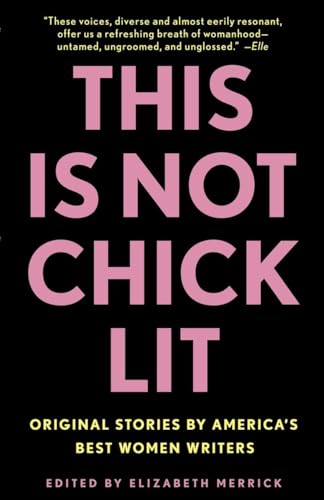
Verwandte Artikel zu This Is Not Chick Lit: Original Stories by America's...
Inhaltsangabe
Chick lit: A genre of fiction that often recycles the following plot: Girl in big city desperately searches for Mr. Right in between dieting and shopping for shoes. Girl gets dumped (sometimes repeatedly). Girl finds Prince Charming.
This Is Not Chick Lit is a celebration of America’s most dynamic literary voices, as well as a much needed reminder that, for every stock protagonist with a designer handbag and three boyfriends, there is a woman writer pushing the envelope of literary fiction with imagination, humor, and depth.
The original short stories in this collection touch on some of the same themes as chick lit–the search for love and identity–but they do so with extraordinary power, creativity, and range; they are also political, provocative, and, at turns, utterly surprising. Featuring marquee names as well as burgeoning talents, This Is Not Chick Lit will nourish your heart, and your mind.
Including these original stories:
“The Thing Around Your Neck” by Chimamanda Ngozi Adichie
“Two Days” by Aimee Bender
“An Open Letter to Doctor X” by Francine Prose
“Gabe” by Holiday Reinhorn
“Documents of Passion Love” by Carolyn Ferrell
“Volunteers Are Shining Stars” by Curtis Sittenfeld
“Selling the General” by Jennifer Egan
“The Seventy-two-Ounce Steak Challenge” by Dika Lam
“Love Machine” by Samantha Hunt
“Ava Bean” by Jennifer S. Davis
“Embrace” by Roxana Robinson
“The Epiphany Branch” by Mary Gordon
“Joan, Jeanne, La Pucelle, Maid of Orléans” by Judy Budnitz
“Gabriella, My Heart” by Cristina Henríquez
“The Red Coat” by Caitlin Macy
“The Matthew Effect” by Binnie Kirshenbaum
“The Recipe” by Lynne Tillman
“Meaning of Ends” by Martha Witt
Praise for This Is Not Chick Lit
“This Is Not Chick Lit is important not only for its content, but for its title. I’ll know we’re getting somewhere when equally talented male writers feel they have to separate themselves from the endless stream of fiction glorifying war, hunting and sports by naming an anthology This Is Not a Guy Thing.”—Gloria Steinem
“These voices, diverse and almost eerily resonant, offer us a refreshing breath of womanhood-untamed, ungroomed, and unglossed.”—Elle
Die Inhaltsangabe kann sich auf eine andere Ausgabe dieses Titels beziehen.
Über die Autorin bzw. den Autor
Chimamanda Ngozi Adichie was born in Nigeria. Her first novel,
Purple Hibiscus, won the Commonwealth Writers Prize and the
Hurston/Wright Legacy Award, was shortlisted for the Orange Prize and
the John Llewellyn Rhys Prize, and longlisted for the Booker. Her short
fiction has won the 2003 O. Henry Prize and has appeared in various literary
publications, including Granta and the Iowa Review. She is a
2005/2006 Hodder Fellow at Princeton University and divides her time
between the United States and Nigeria. Her second novel, Half of a Yellow
Sun, will be published in September 2006.
Aimee Bender is the author of three books, most recently the story collection
Willful Creatures. Her short fiction has been published in
Granta, GQ, Harper’s, The Paris Review, Tin House, and other publica-
tions and has been heard on Public Radio International’s This American
Life. She lives in Los Angeles.
Judy Budnitz’s stories have appeared in The New Yorker, Harper’s, Story,
The Paris Review, the Oxford American, Glimmer Train, Fence, and
McSweeney’s. She is the recipient of an O. Henry Prize, and her debut
collection, Flying Leap, was a New York Times Notable Book in 1998.
Budnitz is also the author of the novel If I Told You Once, which won the
Edward Lewis Wallant Award, and was shortlisted for the Orange Prize in
Britain. Her most recent book is the collection Nice Big American Baby.
She lives in San Francisco.
Jennifer S. Davis is the author of Her Kind of Want, winner of the
2002 Iowa Award for Short Fiction. Her fiction has appeared in such
magazines as the Oxford American, The Paris Review, Grand Street, and
One Story. Her new collection of short stories, Our Former Lives in Art,
is forthcoming from Random House in spring 2007.
Jennifer Egan is the author of the novels The Invisible Circus and
Look at Me, which was a finalist for the National Book Award in 2001,
and a short-story collection, Emerald City. Her short stories have appeared
in The New Yorker, Harper’s, and McSweeney’s, among other
publications. Also a journalist, she writes frequently for The New York
Times Magazine. Her new novel, The Keep, will be published in August
2006.
Carolyn Ferrell is the author of the short-story collection Don’t
Erase Me, which won the Art Seidenbaum Award for First Fiction, the
John C. Zacharis First Book Award, given by Ploughshares, and the New
Voices Award from Quality Paperback Book Club. Her stories have been
published in several anthologies, including The Best American Short Stories
of the Century, edited by John Updike, and Children of the Night:
The Best Short Stories by Black Writers, 1967 to the Present, edited by
Gloria Naylor. A recipient of a National Endowment for the Arts fellowship,
Ferrell teaches at Sarah Lawrence College. She lives in the Bronx
with her husband and two children.
Mary Gordon’s novels include Pearl, Spending, The Company of
Women, The Rest of Life, and The Other Side. She is also the author of the
memoir The Shadow Man, among other works of nonfiction. She has received
a Lila Wallace-Reader’s Digest Award, a Guggenheim Fellowship,
and the 1997 O. Henry Award for best story. She teaches at Barnard College
and lives in New York City.
Cristina Henríquez is the author of the short-story collection Come
Together, Fall Apart. She is a graduate of the Iowa Writers’ Workshop,
and her fiction has appeared in The New Yorker, Ploughshares, Glimmer
Train, TriQuarterly, and AGNI. She was featured in Virginia Quarterly
Review as one of “Fiction’s New Luminaries.” She lives in Dallas with
her husband.
Samantha Hunt is a writer and artist from New York. She is the author
of The Seas and the forthcoming novel The Invention of Everything Else.
Her stories have appeared in The New Yorker, McSweeney’s, Cabinet, and
Seed Magazine and have been heard on Public Radio International’s This
American Life. Hunt teaches writing at the Pratt Institute in Brooklyn.
Binnie Kirshenbaum is the author of two story collections, Married
Life and History on a Personal Note, and five novels, On Mermaid
Avenue, Pure Poetry, A Disturbance in One Place, Hester Among the
Ruins, and An Almost Perfect Moment. She is a professor at Columbia
University, Graduate School of the Arts.
Dika Lam was born in Canada and lives in Brooklyn. She was a New
York Times Fellow in the MFA program at New York University, and her
work has appeared in Scribner’s Best of the Fiction Workshops 1999, Story,
One Story, Failbetter.com, and elsewhere. The first chapter of her novel-in-
progress won the 2005 Bronx Writers’ Center Chapter One contest.
Caitlin Macy is the author of the novel The Fundamentals of Play and
is at work on a collection of short stories. Her short fiction has appeared
in The New Yorker and she is the recipient of a 2005 O. Henry Prize. She
lives with her family in London.
Francine Prose is the author of fourteen books of fiction, including,
most recently, A Changed Man and Blue Angel, which was a finalist for
the National Book Award. Her nonfiction includes the national bestseller
The Lives of the Muses: Nine Women and the Artists They Inspired
and Caravaggio: Painter of Miracles. Her next book, Reading Like a
Writer, will be out in summer 2006 from HarperCollins. A recipient of
numerous grants and awards, among them Guggenheim and Fulbright
fellowships, Prose was a Director’s Fellow at the Center for Scholars and
Writers at the New York Public Library. She lives in New York City.
Holiday Reinhorn lives in Los Angeles. Her debut collection of short
stories, Big Cats, was named one of the best books of 2005 by the San
Francisco Chronicle. She is a recipient of the Tobias Wolff Award for Fiction
and a Carl Djerassi Fiction Fellowship from the Creative Writing
Institute at the University of Wisconsin/Madison. Reinhorn’s stories
have appeared in Zoetrope, Tin House, Ploughshares, and Columbia,
among other publications. She is currently at work on a novel.
Roxana Robinson is the author of seven books: three novels, three
short-story collections, and a biography of Georgia O’Keeffe. Her most
recent book is the collection A Perfect Stranger. Robinson was named a
Literary Lion by the New York Public Library and has received fellowships
from the National Endowment for the Arts and the Guggenheim
Foundation. Four of her books were named Notable Books of the Year
by The New York Times. Her work has appeared in The New Yorker, The
Atlantic, Harper’s, One Story, Daedalus, Best American Short Stories,
The New York Times, and elsewhere. She lives in New York City and
teaches at the New School.
Curtis Sittenfeld’s first novel, Prep, was a national bestseller. Chosen
as one of the Ten Best Books of 2005 by The New York Times, it will
be published in twenty-three foreign countries, and its film rights have
been optioned by Paramount Pictures. Her second novel, The Man of
My Dreams, was published by Random House in May 2006. Sittenfeld’s
nonfiction has appeared in The New York Times, The Atlantic, Salon, Allure,
Glamour, and on Public Radio International’s This American Life.
Lynne Tillman’s last novel, No Lease on Life, was a finalist for the National
Book Critics Circle Award for fiction and a New York Times Notable
Book of the Year. Her most recent book is This Is Not It, a collection of
stories and novellas. Her new novel American Genius: A Comedy will be
published by Soft Skull Press in October 2006. Tillman is a fellow of the
New York Institute of the Humanities and a recent recipient of a
Guggenheim Fellowship.
Martha Witt is the author of the novel Broken as Things Are. Her short
fiction and translations are included in the anthologies Post-War Italian
Women Writers and The Literature of Tomorrow. She is a recipient of
a Thomas J. Watson Traveling Fellowship, a Spencer Fellowship, a
Walter E. Dakin Fellowship, and a New York Times Fellowship, as well
as residencies at the Yaddo and Ragdale artist colonies. Originally from
Hillsborough, North Carolina, she now lives in New York City with her
husband and two children
Auszug. © Genehmigter Nachdruck. Alle Rechte vorbehalten.
EMBRACE by Roxana Robinson
ONE
They’re married, but not to each other.
Nat unlocks the door and then steps back, to let Ella go in first.
The hotel room is high-ceilinged and square, and a double bed takes
up most of it. On the bed is a cream-colored quilted spread. Pale
heavy curtains frame the window; thinner, translucent ones obscure
the view. The carpet is thick and cocoa-colored. There is an ornate
bureau, imitation French, and a gilt-framed mirror. The room is
close and airless. They have no luggage.
Ella moves ahead of him, stopping near the bed. She’s in her late
twenties, and thin, with long chestnut-colored hair. She turns, so that
she won’t see herself in the mirror. She stands facing away from him,
looking down. She has never done this before. She hardly knows this
man, and this is a terrible mistake. She has made a terrible mistake,
coming to this airless room with someone who, it turns out, is a
stranger. She stands motionless, awaiting perdition.
Nat follows her into the room.
He has never done exactly this before, either, never done anything
quite so bold and crude as to rent a hotel room at lunchtime.
What he did was always out of town, with women he never intended
to see again. It was mostly in Los Angeles, a place full of beautiful,
willing girls, happy to be taken out for dinner and then back to his
hotel. Those encounters had been brief and distant. But this, now, is
in his own city, only blocks from his own apartment, with a woman
he does want to see again, and he’s afraid he’s starting something
large and irreversible. What it means is the end of his marriage. He
won’t be able to go on like this; he’s going too far. This is reckless, indefensible,
and he’s doing it in the name of lust, which is, right now,
notably absent. He understands that coming here was a mistake,
though he believes he loves this woman.
He wonders if today can be salvaged. Perhaps it’s the room—
should he have gotten a bigger one? But no: it’s the silence, the
immobility of the room that’s the problem, the implacably fixed furniture,
the hushing carpet, the heavy curtains, the whole place awaiting
human animation.
He likes looking at her. She’s small and slight, with a polished
curtain of hair spilling down her back. Her head is bent.
Ella is looking down at the bedspread, waiting for the worst. It is
shameful, it is excruciating, that she’s become part of this. What if
she’s seen by someone she knows, in this corridor of bedrooms, with
this man who is not her husband? What is she doing here at
lunchtime, with a man she hardly knows? She can’t look at him. She
can feel his presence—large, solid, he’s much taller and stronger
than she is—as he stands behind her. She’s now obligated to go
through with this, since she agreed to come. It feels like an execution.
She dreads his touch.
She thinks of her husband. He’s downtown right now, in his office,
in his shirtsleeves and suspenders. He’s on the phone, or making
a point to someone—he loves making points—or having another cup
of coffee. He’s doing something completely ordinary. He’s not betraying
her utterly, betraying her to the bone, though he has. But he’s not
doing it right now, and she is. She could call him, there’s an ivory
phone on the table by the bed. He’d answer at his desk, his voice familiar.
“Hello?”
It was a mistake, but she has to go through with it. She is obligated:
of course she knew what it meant, meeting at the Plaza for
lunch. Now she will have to have sex with him in this strange airless
room. She will have to offer him her naked body. She would
rather die.
Nat steps closer to her.
It was a mistake, that’s all.
He turns her body to him and glimpses her grieving face. He puts
his arms around her and stands still, holding her close without moving.
He can feel her, rigid and fearful. He says nothing, embracing
her quietly. It’s a mistake, that’s all. What he wants is for her not to be
miserable. He holds her until he feels her quiet, until she understands
that she is safe; that all he wants from her is this close holding,
this understanding.
TWO
They’re married, and now to each other.
The divorces were tumultuous and unhappy, but Nat and Ella
persevered. They weathered the storms, they made their way determinedly
through the torment toward each other.
Now they have been married for nine years, and they love each
other. They’re knitted deeply into each other, and they warm themselves
at each other’s hearts. They long for each other, and their
bodies teach each other pleasure, but they fight terribly. They say unforgivable
things to each other. Once, Nat took Ella violently by her
shoulders. “You make me so angry,” he said. “Someday I’m going to
kill you.”
Ella, beside herself with rage, was pleased. “Fine,” she told him,
satisfaction in her voice. It seemed a vindication, proof of something.
When they are not fighting they are happy, drunk on each other,
but when they fight, Ella fears they will split apart, and if they split
apart, she fears it will be the end of her. She can’t imagine herself, if
this marriage fails. She can’t imagine her life if Nat were to leave her.
She can’t imagine her existence without him; it would be black and
meaningless, the void. It is terrifying to her, this prospect, like falling
into deep space.
She knows, in one part of her mind, when she is calm, that this is
absurd. She has her own life, with friends and a career—she is a literary
publicist, and has founded her own agency. Her life won’t really
be over if she and Nat split up. Still, there are times, when they
are fighting, when rationality is not available. She has trouble breathing,
and she thinks of the blackness of deep space, which seems to be
waiting for her.
Now they are driving from Florence to Siena, along a narrow,
crowded motorway. The cars around them are lunatic: on the left,
Maseratis and Mercedeses pass at a hundred miles an hour; on the
right, huge trucks sway dangerously, taking up one and a half lanes.
Behind them headlights flare constantly, signaling them to move
over. For half an hour they have been driving in hostile silence.
Nat breaks it. “I just don’t know why you couldn’t have gone on
to the market yourself.”
“I just don’t know why you couldn’t have waited for me, with the
car. Or given me the car,” Ella says. “I don’t know why you have to
decide what we do and when we do it.”
Nat makes an exasperated sound. “I see,” he says, “ I decide everything.
Is that what you think?”
“Do you think I decide anything?”
“Do you think you don’t decide anything?”
They get into these maddening, circular series of questions, each
challenging the other, losing the point, going off on tangents, becoming
increasingly angry.
Nat is exasperated by Ella’s self-centeredness. How can she not
know that everything he does is with her in mind? What he wants is
for her to be happy. This entire trip—Florence and Siena, the
churches, the old hotels, the views—was for her. The impassive faces
of the holy martyrs, the mysterious half-smiles of Madonnas. It’s early
spring, and wildflowers star the long pale grasses in the fields. This
was all meant to make her happy, and why does it...
„Über diesen Titel“ kann sich auf eine andere Ausgabe dieses Titels beziehen.
Suchergebnisse für This Is Not Chick Lit: Original Stories by America's...

Beispielbild für diese ISBN
This Is Not Chick Lit: Original Stories by America's Best Women Writers
Anbieter: World of Books (was SecondSale), Montgomery, IL, USA
Verkäuferbewertung 5 von 5 Sternen

Paperback. Zustand: Very Good. Chick lit: A genre of fiction that often recycles the following plot: Girl in big city desperately searches for Mr. Right in between dieting and shopping for shoes. Girl gets dumped (sometimes repeatedly). Girl finds Prince Charming. This Is Not Chick Lit is a celebration of America's most dynamic literary voices, as well as a much needed reminder that, for every stock protagonist with a designer handbag and three boyfriends, there is a woman writer pushing the envelope of literary fiction with imagination, humor, and depth. The original short stories in this collection touch on some of the same themes as chick lit-the search for love and identity-but they do so with extraordinary power, creativity, and range; they are also political, provocative, and, at turns, utterly surprising. Featuring marquee names as well as burgeoning talents, This Is Not Chick Lit will nourish your heart, and your mind. Including these original stories: "The Thing Around Your Neck" by Chimamanda Ngozi Adichie "Two Days" by Aimee Bender "An Open Letter to Doctor X" by Francine Prose "Gabe" by Holiday Reinhorn "Documents of Passion Love" by Carolyn Ferrell "Volunteers Are Shining Stars" by Curtis Sittenfeld "Selling the General" by Jennifer Egan "The Seventy-two-Ounce Steak Challenge" by Dika Lam "Love Machine" by Samantha Hunt "Ava Bean" by Jennifer S. Davis "Embrace" by Roxana Robinson "The Epiphany Branch" by Mary Gordon "Joan, Jeanne, La Pucelle, Maid of Orléans" by Judy Budnitz "Gabriella, My Heart" by Cristina Henríquez "The Red Coat" by Caitlin Macy "The Matthew Effect" by Binnie Kirshenbaum "The Recipe" by Lynne Tillman "Meaning of Ends" by Martha Witt Praise for This Is Not Chick Lit "This Is Not Chick Lit is important not only for its content, but for its title. I'll know we're getting somewhere when equally talented male writers feel they have to separate themselves from the endless stream of fiction glorifying war, hunting and sports by naming an anthology This Is Not a Guy Thing."--Gloria Steinem "These voices, diverse and almost eerily resonant, offer us a refreshing breath of womanhood-untamed, ungroomed, and unglossed."--Elle. Artikel-Nr. 00040947656
Gebraucht kaufen
EUR 4,47
Versand gratis
Versand innerhalb von USA
Versand innerhalb von USA
Anzahl: 2 verfügbar
Beispielbild für diese ISBN
This Is Not Chick Lit: Original Stories by America's Best Women Writers
Anbieter: World of Books (was SecondSale), Montgomery, IL, USA
Verkäuferbewertung 5 von 5 Sternen
Paperback. Zustand: Good. Chick lit: A genre of fiction that often recycles the following plot: Girl in big city desperately searches for Mr. Right in between dieting and shopping for shoes. Girl gets dumped (sometimes repeatedly). Girl finds Prince Charming. This Is Not Chick Lit is a celebration of America's most dynamic literary voices, as well as a much needed reminder that, for every stock protagonist with a designer handbag and three boyfriends, there is a woman writer pushing the envelope of literary fiction with imagination, humor, and depth. The original short stories in this collection touch on some of the same themes as chick lit-the search for love and identity-but they do so with extraordinary power, creativity, and range; they are also political, provocative, and, at turns, utterly surprising. Featuring marquee names as well as burgeoning talents, This Is Not Chick Lit will nourish your heart, and your mind. Including these original stories: "The Thing Around Your Neck" by Chimamanda Ngozi Adichie "Two Days" by Aimee Bender "An Open Letter to Doctor X" by Francine Prose "Gabe" by Holiday Reinhorn "Documents of Passion Love" by Carolyn Ferrell "Volunteers Are Shining Stars" by Curtis Sittenfeld "Selling the General" by Jennifer Egan "The Seventy-two-Ounce Steak Challenge" by Dika Lam "Love Machine" by Samantha Hunt "Ava Bean" by Jennifer S. Davis "Embrace" by Roxana Robinson "The Epiphany Branch" by Mary Gordon "Joan, Jeanne, La Pucelle, Maid of Orléans" by Judy Budnitz "Gabriella, My Heart" by Cristina Henríquez "The Red Coat" by Caitlin Macy "The Matthew Effect" by Binnie Kirshenbaum "The Recipe" by Lynne Tillman "Meaning of Ends" by Martha Witt Praise for This Is Not Chick Lit "This Is Not Chick Lit is important not only for its content, but for its title. I'll know we're getting somewhere when equally talented male writers feel they have to separate themselves from the endless stream of fiction glorifying war, hunting and sports by naming an anthology This Is Not a Guy Thing."--Gloria Steinem "These voices, diverse and almost eerily resonant, offer us a refreshing breath of womanhood-untamed, ungroomed, and unglossed."--Elle. Artikel-Nr. 00027872844
Gebraucht kaufen
EUR 4,47
Versand gratis
Versand innerhalb von USA
Versand innerhalb von USA
Anzahl: 3 verfügbar
Beispielbild für diese ISBN
This Is Not Chick Lit: Original Stories by America's Best Women Writers
Anbieter: World of Books (was SecondSale), Montgomery, IL, USA
Verkäuferbewertung 5 von 5 Sternen
Paperback. Zustand: Fair. Chick lit: A genre of fiction that often recycles the following plot: Girl in big city desperately searches for Mr. Right in between dieting and shopping for shoes. Girl gets dumped (sometimes repeatedly). Girl finds Prince Charming. This Is Not Chick Lit is a celebration of America's most dynamic literary voices, as well as a much needed reminder that, for every stock protagonist with a designer handbag and three boyfriends, there is a woman writer pushing the envelope of literary fiction with imagination, humor, and depth. The original short stories in this collection touch on some of the same themes as chick lit-the search for love and identity-but they do so with extraordinary power, creativity, and range; they are also political, provocative, and, at turns, utterly surprising. Featuring marquee names as well as burgeoning talents, This Is Not Chick Lit will nourish your heart, and your mind. Including these original stories: "The Thing Around Your Neck" by Chimamanda Ngozi Adichie "Two Days" by Aimee Bender "An Open Letter to Doctor X" by Francine Prose "Gabe" by Holiday Reinhorn "Documents of Passion Love" by Carolyn Ferrell "Volunteers Are Shining Stars" by Curtis Sittenfeld "Selling the General" by Jennifer Egan "The Seventy-two-Ounce Steak Challenge" by Dika Lam "Love Machine" by Samantha Hunt "Ava Bean" by Jennifer S. Davis "Embrace" by Roxana Robinson "The Epiphany Branch" by Mary Gordon "Joan, Jeanne, La Pucelle, Maid of Orléans" by Judy Budnitz "Gabriella, My Heart" by Cristina Henríquez "The Red Coat" by Caitlin Macy "The Matthew Effect" by Binnie Kirshenbaum "The Recipe" by Lynne Tillman "Meaning of Ends" by Martha Witt Praise for This Is Not Chick Lit "This Is Not Chick Lit is important not only for its content, but for its title. I'll know we're getting somewhere when equally talented male writers feel they have to separate themselves from the endless stream of fiction glorifying war, hunting and sports by naming an anthology This Is Not a Guy Thing."--Gloria Steinem "These voices, diverse and almost eerily resonant, offer us a refreshing breath of womanhood-untamed, ungroomed, and unglossed."--Elle. Artikel-Nr. 00105598537
Gebraucht kaufen
EUR 4,47
Versand gratis
Versand innerhalb von USA
Versand innerhalb von USA
Anzahl: 1 verfügbar
Beispielbild für diese ISBN
This Is Not Chick Lit: Original Stories by America's Best Women Writers
Verlag:
Random House Publishing Group (edition ), 2006
ISBN 10: 0812975677
ISBN 13: 9780812975673
Gebraucht
Paperback
Anbieter: BooksRun, Philadelphia, PA, USA
Verkäuferbewertung 5 von 5 Sternen
Paperback. Zustand: Fair. The item might be beaten up but readable. May contain markings or highlighting, as well as stains, bent corners, or any other major defect, but the text is not obscured in any way. Artikel-Nr. 0812975677-7-1-13
Gebraucht kaufen
EUR 4,56
Versand gratis
Versand innerhalb von USA
Versand innerhalb von USA
Anzahl: 1 verfügbar
Beispielbild für diese ISBN
This Is Not Chick Lit: Original Stories by America's Best Women Writers
Verlag:
Random House Publishing Group, 2006
ISBN 10: 0812975677
ISBN 13: 9780812975673
Gebraucht
Softcover
Anbieter: Wonder Book, Frederick, MD, USA
Verkäuferbewertung 5 von 5 Sternen
Zustand: Very Good. Very Good condition. A copy that may have a few cosmetic defects. May also contain light spine creasing or a few markings such as an owner's name, short gifter's inscription or light stamp. Artikel-Nr. F19A-06055
Gebraucht kaufen
EUR 6,41
Versand gratis
Versand innerhalb von USA
Versand innerhalb von USA
Anzahl: 1 verfügbar
Beispielbild für diese ISBN
This Is Not Chick Lit: Original Stories by America's Best Women Writers
Anbieter: ThriftBooks-Atlanta, AUSTELL, GA, USA
Verkäuferbewertung 5 von 5 Sternen
Paperback. Zustand: Good. No Jacket. Pages can have notes/highlighting. Spine may show signs of wear. ~ ThriftBooks: Read More, Spend Less. Artikel-Nr. G0812975677I3N00
Gebraucht kaufen
EUR 6,54
Versand gratis
Versand innerhalb von USA
Versand innerhalb von USA
Anzahl: 1 verfügbar
Beispielbild für diese ISBN
This Is Not Chick Lit : Original Stories by America's Best Women Writers
Verlag:
Random House Publishing Group, 2006
ISBN 10: 0812975677
ISBN 13: 9780812975673
Gebraucht
Softcover
Anbieter: Better World Books, Mishawaka, IN, USA
Verkäuferbewertung 5 von 5 Sternen
Zustand: Good. Pages intact with minimal writing/highlighting. The binding may be loose and creased. Dust jackets/supplements are not included. Stock photo provided. Product includes identifying sticker. Better World Books: Buy Books. Do Good. Artikel-Nr. GRP92316274
Gebraucht kaufen
EUR 7,00
Versand gratis
Versand innerhalb von USA
Versand innerhalb von USA
Anzahl: 2 verfügbar
Beispielbild für diese ISBN
This Is Not Chick Lit : Original Stories by America's Best Women Writers
Verlag:
Random House Publishing Group, 2006
ISBN 10: 0812975677
ISBN 13: 9780812975673
Gebraucht
Softcover
Anbieter: Better World Books, Mishawaka, IN, USA
Verkäuferbewertung 5 von 5 Sternen
Zustand: Very Good. Pages intact with possible writing/highlighting. Binding strong with minor wear. Dust jackets/supplements may not be included. Stock photo provided. Product includes identifying sticker. Better World Books: Buy Books. Do Good. Artikel-Nr. GRP96060541
Gebraucht kaufen
EUR 7,00
Versand gratis
Versand innerhalb von USA
Versand innerhalb von USA
Anzahl: 1 verfügbar
Beispielbild für diese ISBN
This Is Not Chick Lit: Original Stories by America's Best Women Writers
Verlag:
Random House USA Inc, United States, New York, 2006
ISBN 10: 0812975677
ISBN 13: 9780812975673
Gebraucht
Paperback
Anbieter: WorldofBooks, Goring-By-Sea, WS, Vereinigtes Königreich
Verkäuferbewertung 5 von 5 Sternen
Paperback. Zustand: Very Good. The book has been read, but is in excellent condition. Pages are intact and not marred by notes or highlighting. The spine remains undamaged. Artikel-Nr. GOR001272565
Gebraucht kaufen
EUR 3,81
EUR 6,65 Versand
Versand von Vereinigtes Königreich nach USA
Versand von Vereinigtes Königreich nach USA
Anzahl: 1 verfügbar
Beispielbild für diese ISBN
This Is Not Chick Lit : Original Stories by America's Best Women Writers
Verlag:
Random House Publishing Group, 2006
ISBN 10: 0812975677
ISBN 13: 9780812975673
Gebraucht
Softcover
Anbieter: Better World Books Ltd, Dunfermline, Vereinigtes Königreich
Verkäuferbewertung 5 von 5 Sternen
Zustand: Very Good. Pages intact with possible writing/highlighting. Binding strong with minor wear. Dust jackets/supplements may not be included. Stock photo provided. Product includes identifying sticker. Better World Books: Buy Books. Do Good. Artikel-Nr. GRP96060541
Gebraucht kaufen
EUR 5,71
EUR 5,94 Versand
Versand von Vereinigtes Königreich nach USA
Versand von Vereinigtes Königreich nach USA
Anzahl: 1 verfügbar