
Verwandte Artikel zu Siddhartha: An Indian Poem (Modern Library Classics)
Inhaltsangabe
The classic novel of a quest for knowledge that has delighted, inspired, and influenced generations of readers, writers, and thinkers.
Nominated as one of America’s best-loved novels by PBS’s The Great American Read
Though set in a place and time far removed from the Germany of 1922, the year of the book’s debut, the novel is infused with the sensibilities of Hermann Hesse’s time, synthesizing disparate philosophies–Eastern religions, Jungian archetypes, Western individualism–into a unique vision of life as expressed through one man’s search for meaning.
It is the story of the quest of Siddhartha, a wealthy Indian Brahmin who casts off a life of privilege and comfort to seek spiritual fulfillment and wisdom. On his journey, Siddhartha encounters wandering ascetics, Buddhist monks, and successful merchants, as well as a courtesan named Kamala and a simple ferryman who has attained enlightenment. Traveling among these people and experiencing life’s vital passages–love, work, friendship, and fatherhood–Siddhartha discovers that true knowledge is guided from within.
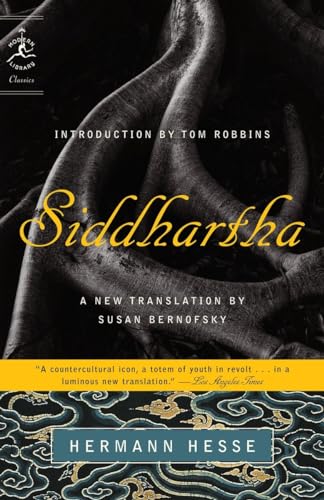
Susan Bernofsky’s magnificent translation brings out Hesse’s inspired lyricism and his elegant, melodious cadences, illuminating the novel’s universal themes and timeless wisdom about the human condition.
This original Modern Library edition includes a lively new Introduction by Tom Robbins and a glossary of Indian terms.
Die Inhaltsangabe kann sich auf eine andere Ausgabe dieses Titels beziehen.
Über die Autorin bzw. den Autor
Herman Hesse was the author of Siddhartha, Steppenwolf, and The Glass Bead Game. He received the Nobel Prize for Literature in 1946.
Auszug. © Genehmigter Nachdruck. Alle Rechte vorbehalten.
Chapter 1
The Son of the Brahmin
In the shade of the house, in the sunlight on the riverbank where the boats were moored, in the shade of the sal wood and the shade of the fig tree, Siddhartha grew up, the Brahmin’s handsome son, the young falcon, together with his friend Govinda, the son of a Brahmin. Sunlight darkened his fair shoulders on the riverbank as he bathed, performed the holy ablutions, the holy sacrifices. Shade poured into his dark eyes in the mango grove as he played with the other boys, listened to his mother’s songs, performed the holy sacrifices, heard the teachings of his learned father and the wise men’s counsels. Siddhartha had long since begun to join in the wise men’s counsels, to practice with Govinda the art of wrestling with words, to practice with Govinda the art of contemplation, the duty of meditation. He had mastered Om, the Word of Words, learned to speak it soundlessly into himself while drawing a breath, to speak it out soundlessly as his breath was released, his soul collected, brow shining with his mind’s clear thought. He had learned to feel Atman’s presence at the core of his being, inextinguishable, one with the universe.
Joy leaped into his father’s heart at the thought of his son, this studious boy with his thirst for knowledge; he envisioned him growing up to be a great wise man and priest, a prince among Brahmins.
Delight leaped into his mother’s breast when she beheld him, watched him as he walked and sat and stood, Siddhartha, the strong handsome boy walking on slender legs, greeting her with flawless grace.
Love stirred in the hearts of the young Brahmin girls when Siddhartha walked through the streets of their town with his radiant brow, his regal eye, his narrow hips.
But none of them loved him more dearly than Govinda, his friend, the Brahmin’s son. He loved Siddhartha’s eyes and his sweet voice, loved the way he walked and the flawless grace of his movements; he loved all that Siddhartha did and all he said and most of all he loved his mind, his noble, passionate thoughts, his ardent will, his noble calling. Govinda knew: This would be no ordinary Brahmin, no indolent pen pusher overseeing the sacrifices, no greedy hawker of incantations, no vain, shallow orator, no wicked, deceitful priest, and no foolish, good sheep among the herd of the multitude. Nor did he, Govinda, have any intention of becoming such a creature, one of the tens of thousands of ordinary Brahmins. His wish was to follow Siddhartha, the beloved, splendid one. And if Siddhartha should ever become a god, if he were ever to take his place among the Radiant Ones, Govinda wished to follow him, as his friend, his companion, his servant, his spear bearer, his shadow.
Thus was Siddhartha beloved by all. He brought them all joy, filled them with delight.
To himself, though, Siddhartha brought no joy, gave no delight. Strolling along the rosy pathways of the fig garden, seated in the blue-tinged shade of the Grove of Contemplation, washing his limbs in the daily expiatory baths, performing sacrifices in the deep-shadowed mango wood, with his gestures of flawless grace, he was beloved by all, a joy to all, yet was his own heart bereft of joy. Dreams assailed him, and troubled thoughts—eddying up from the waves of the river, sparkling down from the stars at night, melting out of the sun’s rays; dreams came to him, and a disquiet of the soul wafting in the smoke from the sacrifices, murmuring among the verses of the Rig-Veda, welling up in the teachings of the old Brahmins.
Siddhartha had begun to harbor discontent. He had begun to feel that his father’s love and the love of his mother, even the love of his friend Govinda, would not always and forever suffice to gladden him, content him, sate him, fulfill him. He had begun to suspect that his venerable father and his other teachers, all wise Brahmins, had already given him the richest and best part of their wisdom, had already poured their plenty into his waiting vessel, yet the vessel was not full: His mind was not content, his soul not at peace, his heart restless. The ablutions were good, but they were only water; they could not wash away sin, could not quench his mind’s thirst or dispel his heart’s fear. The sacrifices and the invocations of the gods were most excellent—but was this all? Did the sacrifices bring happiness? And what of the gods? Was it really Prajapati who had created the world? Was it not rather Atman, He, the Singular, the One and Only? Weren’t the gods mere shapes, creations like you and me, subject to time, transitory? And was it then good, was it proper, was it meaningful, a noble act, to sacrifice to the gods? To whom else should one sacrifice, to whom else show devotion, if not to Him, the Singular, Atman? And where was Atman to be found, where did He reside, where did His eternal heart lie beating? Where else but within oneself, in the innermost indestructible core each man carries inside him. But where, where was this Self, this innermost, utmost thing? It was not flesh and bone, it was not thought and not consciousness, at least according to the wise men’s teachings. Where was it then, where? To penetrate to this point, to reach the Self, oneself, Atman—could there be any other path worth seeking? Yet this was a path no one was showing him; it was a path no one knew, not his father, not the teachers and wise men, not the holy songs intoned at the sacrifices! They knew everything, these Brahmins and their holy books, everything, and they had applied themselves to everything, more than everything: to the creation of the world, the origins of speech, of food, of inhalation and exhalation; to the orders of the senses, the deeds of the gods—they knew infinitely many things—but was there value in knowing all these things without knowing the One, the Only thing, that which was important above all else, that was, indeed, the sole matter of importance?
To be sure, many verses in the holy books, above all the Upanishads of the Sama-Veda, spoke of this innermost, utmost thing: splendid verses. “Your soul is the entire world” was written there, and it was written as well that in sleep, the deepest sleep, man entered the innermost core of his being and dwelt in Atman. There was glorious wisdom in these verses; all the knowledge of the wisest men was collected here in magic words, pure as the honey collected by bees. It was not to be disregarded, this massive sum of knowledge that had been collected here by countless generations of wise Brahmins.
But where were the Brahmins, where the priests, where the wise men or penitents who had succeeded not merely in knowing this knowledge but in living it? Where was the master who had been able to transport his own being-at-home-in-Atman from sleep to the waking realm, to life, to all his comings and goings, his every word and deed?
Siddhartha knew a great many venerable Brahmins, above all his father, a pure, learned, utterly venerable man. Worthy of admiration was his father, still and regal his bearing, his life pure, his words full of wisdom; fine and noble thoughts resided in his brow. But even he, who was possessed of such knowledge, did he dwell in bliss, did he know peace? Was not he too only a seeker, a man tormented by thirst? Was he not compelled to drink again and again from the holy springs, a thirsty man drinking in the sacrifices, the books, the dialogues of the Brahmins? Why must he, who was without blame, wash away sin day after day, labor daily to...
„Über diesen Titel“ kann sich auf eine andere Ausgabe dieses Titels beziehen.
Suchergebnisse für Siddhartha: An Indian Poem (Modern Library Classics)

Beispielbild für diese ISBN
Siddhartha
Verlag:
Random House Publishing Group, 2007
ISBN 10: 0812974786
ISBN 13: 9780812974782
Gebraucht
Softcover
Anbieter: Better World Books: West, Reno, NV, USA
Verkäuferbewertung 5 von 5 Sternen

Zustand: Good. Pages intact with minimal writing/highlighting. The binding may be loose and creased. Dust jackets/supplements are not included. Stock photo provided. Product includes identifying sticker. Better World Books: Buy Books. Do Good. Artikel-Nr. 7624567-6
Gebraucht kaufen
EUR 6,57
Versand gratis
Versand innerhalb von USA
Versand innerhalb von USA
Anzahl: 1 verfügbar
Beispielbild für diese ISBN
Siddhartha
Verlag:
Random House Publishing Group, 2007
ISBN 10: 0812974786
ISBN 13: 9780812974782
Gebraucht
Softcover
Anbieter: Better World Books: West, Reno, NV, USA
Verkäuferbewertung 5 von 5 Sternen
Zustand: Good. Former library copy. Pages intact with minimal writing/highlighting. The binding may be loose and creased. Dust jackets/supplements are not included. Includes library markings. Stock photo provided. Product includes identifying sticker. Better World Books: Buy Books. Do Good. Artikel-Nr. GRP83141754
Gebraucht kaufen
EUR 6,57
Versand gratis
Versand innerhalb von USA
Versand innerhalb von USA
Anzahl: 2 verfügbar
Beispielbild für diese ISBN
Siddhartha
Verlag:
Random House Publishing Group, 2007
ISBN 10: 0812974786
ISBN 13: 9780812974782
Gebraucht
Softcover
Anbieter: Better World Books, Mishawaka, IN, USA
Verkäuferbewertung 5 von 5 Sternen
Zustand: Good. Former library copy. Pages intact with minimal writing/highlighting. The binding may be loose and creased. Dust jackets/supplements are not included. Includes library markings. Stock photo provided. Product includes identifying sticker. Better World Books: Buy Books. Do Good. Artikel-Nr. GRP83141754
Gebraucht kaufen
EUR 6,57
Versand gratis
Versand innerhalb von USA
Versand innerhalb von USA
Anzahl: 2 verfügbar
Beispielbild für diese ISBN
Siddhartha
Verlag:
Random House Publishing Group, 2007
ISBN 10: 0812974786
ISBN 13: 9780812974782
Gebraucht
Softcover
Anbieter: Better World Books, Mishawaka, IN, USA
Verkäuferbewertung 5 von 5 Sternen
Zustand: Good. Pages intact with minimal writing/highlighting. The binding may be loose and creased. Dust jackets/supplements are not included. Stock photo provided. Product includes identifying sticker. Better World Books: Buy Books. Do Good. Artikel-Nr. 7624567-6
Gebraucht kaufen
EUR 6,57
Versand gratis
Versand innerhalb von USA
Versand innerhalb von USA
Anzahl: 1 verfügbar
Beispielbild für diese ISBN
Siddhartha
Anbieter: ThriftBooks-Atlanta, AUSTELL, GA, USA
Verkäuferbewertung 5 von 5 Sternen
Paperback. Zustand: Fair. No Jacket. Readable copy. Pages may have considerable notes/highlighting. ~ ThriftBooks: Read More, Spend Less. Artikel-Nr. G0812974786I5N00
Gebraucht kaufen
EUR 6,87
Versand gratis
Versand innerhalb von USA
Versand innerhalb von USA
Anzahl: 2 verfügbar
Beispielbild für diese ISBN
Siddhartha
Anbieter: ThriftBooks-Phoenix, Phoenix, AZ, USA
Verkäuferbewertung 5 von 5 Sternen
Paperback. Zustand: Fair. No Jacket. Readable copy. Pages may have considerable notes/highlighting. ~ ThriftBooks: Read More, Spend Less. Artikel-Nr. G0812974786I5N00
Gebraucht kaufen
EUR 6,87
Versand gratis
Versand innerhalb von USA
Versand innerhalb von USA
Anzahl: 1 verfügbar
Beispielbild für diese ISBN
Siddhartha
Anbieter: ThriftBooks-Phoenix, Phoenix, AZ, USA
Verkäuferbewertung 5 von 5 Sternen
Paperback. Zustand: Good. No Jacket. Pages can have notes/highlighting. Spine may show signs of wear. ~ ThriftBooks: Read More, Spend Less. Artikel-Nr. G0812974786I3N00
Gebraucht kaufen
EUR 6,87
Versand gratis
Versand innerhalb von USA
Versand innerhalb von USA
Anzahl: 1 verfügbar
Beispielbild für diese ISBN
Siddhartha
Anbieter: ThriftBooks-Dallas, Dallas, TX, USA
Verkäuferbewertung 5 von 5 Sternen
Paperback. Zustand: Fair. No Jacket. Readable copy. Pages may have considerable notes/highlighting. ~ ThriftBooks: Read More, Spend Less. Artikel-Nr. G0812974786I5N00
Gebraucht kaufen
EUR 6,87
Versand gratis
Versand innerhalb von USA
Versand innerhalb von USA
Anzahl: 2 verfügbar
Beispielbild für diese ISBN
Siddhartha
Anbieter: ThriftBooks-Reno, Reno, NV, USA
Verkäuferbewertung 5 von 5 Sternen
Paperback. Zustand: Good. No Jacket. Pages can have notes/highlighting. Spine may show signs of wear. ~ ThriftBooks: Read More, Spend Less. Artikel-Nr. G0812974786I3N00
Gebraucht kaufen
EUR 6,87
Versand gratis
Versand innerhalb von USA
Versand innerhalb von USA
Anzahl: 1 verfügbar
Beispielbild für diese ISBN
Siddhartha
Anbieter: ThriftBooks-Dallas, Dallas, TX, USA
Verkäuferbewertung 5 von 5 Sternen
Paperback. Zustand: Good. No Jacket. Pages can have notes/highlighting. Spine may show signs of wear. ~ ThriftBooks: Read More, Spend Less. Artikel-Nr. G0812974786I3N00
Gebraucht kaufen
EUR 6,87
Versand gratis
Versand innerhalb von USA
Versand innerhalb von USA
Anzahl: 2 verfügbar