
Verwandte Artikel zu Founding Faith: How Our Founding Fathers Forged a Radical...
Founding Faith: How Our Founding Fathers Forged a Radical New Approach to Religious Liberty - Softcover
Inhaltsangabe
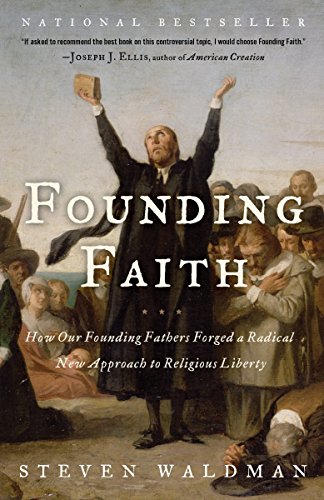
The culture wars have distorted the dramatic story of how Americans came to worship freely. Many activists on the right maintain that the United States was founded as a “Christian nation.” Many on the left contend that the First Amendment was designed to boldly separate church and state. Neither of these claims is true, argues Beliefnet.com editor in chief Steven Waldman. With refreshing objectivity, Waldman narrates the real story of how our nation’s Founders forged a new approach to religious liberty.
Founding Faith vividly describes the religious development of five Founders. Benjamin Franklin melded the Puritan theology of his youth and the Enlightenment philosophy of his adulthood. John Adams’s pungent views on religion stoked his revolutionary fervor and shaped his political strategy. George Washington came to view religious tolerance as a military necessity. Thomas Jefferson pursued a dramatic quest to “rescue” Jesus, in part by editing the Bible. Finally, it was James Madison who crafted an integrated vision of how to prevent tyranny while encouraging religious vibrancy.
The spiritual custody battle over the Founding Fathers and the role of religion in America continues today. Waldman at last sets the record straight, revealing the real history of religious freedom to be dramatic, unexpected, paradoxical, and inspiring.
Die Inhaltsangabe kann sich auf eine andere Ausgabe dieses Titels beziehen.
Über die Autorin bzw. den Autor
Steven Waldman is co-founder, CEO, and editor in chief of Beliefnet.com, the largest faith and spirituality website. Previously, Waldman was the national editor of U.S. News & World Report and a national correspondent for Newsweek. His writings have also appeared in The Atlantic, The Washington Post, The New York Times, Slate, The Washington Monthly, National Review, and elsewhere. He appears frequently on television and radio to discuss religion and politics. He is also the author of The Bill, a book about the creation of AmeriCorps. Waldman lives in New York with his wife, the writer Amy Cunningham, and their children, Joseph and Gordon.
Auszug. © Genehmigter Nachdruck. Alle Rechte vorbehalten.
1
Christian America
Settlers try to plant Protestantism as the official faith—and fail
The new world was settled to promote christianity. for more than 150 years, colonial governments actively supported and promoted Christianity. Less acknowledged today is a point well understood by the Founding Fathers: Nearly all of these experiments in state encouragement of religion failed.
Christopher Columbus believed the world would soon end. In the year 1652, to be exact, Christ would return and usher in a glorious new Kingdom—if certain prophecies were fulfilled before then. Columbus’s arrival in the New World in 1492 was one such event, he wrote later, a clear “fulfillment of what Isaiah had prophesied.” He was quite certain that God had guided him. “With a hand that could be felt, the Lord opened my mind to the fact that it would be possible to sail from here to the Indies.” Another precondition for Jesus’s return was the conquest of Jerusalem, which was held by the Muslims. His voyages to the New World would help with that, too, providing a glorious model to inspire Christian warriors, and the gold to pay their way. Finally, his discovery of the new lands would enable Christians to fulfill another essential requirement, the spreading of the Good News to all corners of the world. “The Gospel must now be proclaimed to so many lands in such a short time,” Columbus explained to Queen Isabella and King Ferdinand.1
After encountering hospitable natives in the Caribbean, he had become quite optimistic that he would indeed be able to bring these generous but unsaved souls to God, plus get some cheap labor. “If one asks for anything they have they never say no,” he wrote.2 “They should be good servants . . . and I believe they would easily be made Christians, for they appear to have no religion.”3
Though he declared a desire to convert them “by love and friendship rather than by force,” the Europeans did not have a light touch with the natives. Those in the Caribbean who rejected or destroyed statues of Christian saints were burned at the stake. Slaughter and European-borne disease killed all but a few thousand Indians.4 But the Spaniards persisted and their missions eventually made their way to current-day Florida and Mexico.
While the Spaniards did not ultimately win control of the land that became the thirteen American colonies, fear of Catholic Spain’s expansion helped prompt England to get serious about settling America in the early 1600s.5
Virginia’s Lawes Divine
The twin goals of converting Indians and defeating Catholics provided a strong rallying cry for Virginia’s settlers. Prospective settlers were instructed to bring “no traitors, nor Papists that depend on the Great Whore.”6 An Anglican promotional booklet argued that if the Spanish had so much luck pressing their corrupt religion, imagine how successful the English could be with their noble goals of saving “those wretched people,” drawing them from “darkness to light, from falsehood to truth, from dumb idols to the living God, from the deep pit of hell to the highest heaven.”7 King James’s charter for Virginia in 1606 made it official: The mission was to promote Christianity to those living “in darkness and miserable ignorance of the true knowledge and worship of God.”8
The faiths of the settlers were tested even before they landed in Virginia. One-third of the immigrants on the Godspeed, the Discovery, and the Susan Constant in 1607 died en route. Once in America, their goal of converting Indians soon took a backseat to survival. In 1609 and 1610, the period known as “the starving time,” the colony almost perished. Settlers ate dogs, cats, rats, and one another in order to survive. One man was executed for killing his wife for food.9
To try to salvage the colony, the Virginia Company in May 1611 sent Lord Thomas de la Warr and Thomas Dale, who swiftly issued a new set of laws to bring order, in part through forced religiosity. The law’s preamble declared that the job of the king is “principal care of true Religion and reverence to God”10 and that the settlers themselves were “especial souldiers in this sacred cause.” The new “Lawes Divine, Morall and Martiall” required worship twice each Sunday. Those who failed to do so would lose their daily allowance; a second infraction would draw a whipping, and the third offense would put them in the galleys at sea for six months. Settlers who failed to observe the Sabbath lost provisions for a week (first offense), received a whipping (second offense), or were executed (third offense). Women convicted of sexual misdeeds were required to wear white gowns, hold white wands, and “stand on chairs or stools during public worship.”11 Blasphemy—the use of “unlawful oaths” and “taking the name of God in vain”—was a serious crime, sometimes punishable by having a hot iron plunged through the tongue, and sometimes by execution.12 Eight settlers were put to death in Jamestown for violations of Dale’s laws. Though alien to us, the idea behind forced worship was practical: Pervasive worship would secure God’s favor and give settlers the strength and moral wherewithal to cope with the crushing burdens of disease, Indian attacks, and internal squabbling.
As in England, clergy were to be supported by taxes and public funds, or, to be more precise, ten pounds of tobacco and a bushel of corn per settler. A special patch of farmland, a glebe, was also set aside for the parson.13 Despite these provisions, there was a severe shortage of clergy. By 1662, there were only ten ministers serving forty-five different parishes.14 Since there was no ecclesiastic church structure to monitor religious matters and manage clergy, the state accepted that role, even disciplining clergy who hadn’t preached at least one sermon each Sunday.15
The settlers did survive, in part because of their strong faith. This alone prompted wonder. John Rolfe, an early Jamestown resident credited with the introduction of tobacco, wrote that the settlers were “chosen by the finger of God.”16
In surviving, they prevented encroachment from French and Spanish Catholics who settled west and south of Virginia. At that moment in history, the Catholic Church was viewed in England not as a competing form of Christianity but as a fraudulent faith. It was called “the Whore” because it had prostituted itself by selling indulgences (the promise that for a fee, the church would make sure that the soul of a loved one wouldn’t be stuck in purgatory). Protestants believed Catholics should be called papists, not Christians, because they had substituted worship of the pope for devotion to Christ. And only the Antichrist, it was thought, would use the trappings of faith to so distort the message of Jesus. Not surprisingly, the Virginia government attempted to squelch Catholicism within the colony. In 1640, it prohibited Catholics from holding public office unless they “had taken the oath of allegiance and supremacy” to the Church of England. It decreed that any “popish priests’’ who arrived in Virginia “should be deported forthwith.”17
The settlers’ other religious goal—that of pulling the Indians from the deep pit of hell—proved harder to meet. Pocahontas’s conversion to Christianity was much celebrated and, indeed, is depicted in a painting in the US Capitol to this day. But mostly the settlers just viewed the Indians as untamable savages, and vice versa.18 Moreover, Virginia certainly didn’t limit itself to punishing just...
„Über diesen Titel“ kann sich auf eine andere Ausgabe dieses Titels beziehen.
Suchergebnisse für Founding Faith: How Our Founding Fathers Forged a Radical...

Foto des Verkäufers
Founding Faith: How Our Founding Fathers Forged a Radical New Approach to Religious Liberty
Verlag:
Random House Publishing Group, 2009
ISBN 10: 0812974743
ISBN 13: 9780812974744
Gebraucht
Softcover
Anbieter: Dream Books Co., Denver, CO, USA
Verkäuferbewertung 5 von 5 Sternen

Zustand: acceptable. This copy has clearly been enjoyedâ"expect noticeable shelf wear and some minor creases to the cover. Binding is strong, and all pages are legible. May contain previous library markings or stamps. Artikel-Nr. DBV.0812974743.A
Gebraucht kaufen
EUR 3,91
Versand gratis
Versand innerhalb von USA
Versand innerhalb von USA
Anzahl: 1 verfügbar
Beispielbild für diese ISBN
Founding Faith: How Our Founding Fathers Forged a Radical New Approach to Religious Liberty
Verlag:
Random House Publishing Group (edition Reprint), 2009
ISBN 10: 0812974743
ISBN 13: 9780812974744
Gebraucht
Paperback
Anbieter: BooksRun, Philadelphia, PA, USA
Verkäuferbewertung 5 von 5 Sternen
Paperback. Zustand: Very Good. Reprint. It's a well-cared-for item that has seen limited use. The item may show minor signs of wear. All the text is legible, with all pages included. It may have slight markings and/or highlighting. Artikel-Nr. 0812974743-11-1
Gebraucht kaufen
EUR 4,34
Versand gratis
Versand innerhalb von USA
Versand innerhalb von USA
Anzahl: 2 verfügbar
Beispielbild für diese ISBN
Founding Faith: How Our Founding Fathers Forged a Radical New Approach to Religious Liberty
Verlag:
Random House Publishing Group (edition Reprint), 2009
ISBN 10: 0812974743
ISBN 13: 9780812974744
Gebraucht
Paperback
Anbieter: BooksRun, Philadelphia, PA, USA
Verkäuferbewertung 5 von 5 Sternen
Paperback. Zustand: Fair. Reprint. The item might be beaten up but readable. May contain markings or highlighting, as well as stains, bent corners, or any other major defect, but the text is not obscured in any way. Artikel-Nr. 0812974743-7-1
Gebraucht kaufen
EUR 4,59
Versand gratis
Versand innerhalb von USA
Versand innerhalb von USA
Anzahl: 1 verfügbar
Beispielbild für diese ISBN
Founding Faith: How Our Founding Fathers Forged a Radical New Approach to Religious Liberty
Anbieter: ThriftBooks-Dallas, Dallas, TX, USA
Verkäuferbewertung 5 von 5 Sternen
Paperback. Zustand: Fair. No Jacket. Readable copy. Pages may have considerable notes/highlighting. ~ ThriftBooks: Read More, Spend Less. Artikel-Nr. G0812974743I5N00
Gebraucht kaufen
EUR 5,97
Versand gratis
Versand innerhalb von USA
Versand innerhalb von USA
Anzahl: 1 verfügbar
Beispielbild für diese ISBN
Founding Faith: How Our Founding Fathers Forged a Radical New Approach to Religious Liberty
Anbieter: ThriftBooks-Reno, Reno, NV, USA
Verkäuferbewertung 5 von 5 Sternen
Paperback. Zustand: Good. No Jacket. Pages can have notes/highlighting. Spine may show signs of wear. ~ ThriftBooks: Read More, Spend Less. Artikel-Nr. G0812974743I3N00
Gebraucht kaufen
EUR 5,97
Versand gratis
Versand innerhalb von USA
Versand innerhalb von USA
Anzahl: 2 verfügbar
Beispielbild für diese ISBN
Founding Faith: How Our Founding Fathers Forged a Radical New Approach to Religious Liberty
Anbieter: ThriftBooks-Phoenix, Phoenix, AZ, USA
Verkäuferbewertung 5 von 5 Sternen
Paperback. Zustand: Good. No Jacket. Pages can have notes/highlighting. Spine may show signs of wear. ~ ThriftBooks: Read More, Spend Less. Artikel-Nr. G0812974743I3N00
Gebraucht kaufen
EUR 5,97
Versand gratis
Versand innerhalb von USA
Versand innerhalb von USA
Anzahl: 2 verfügbar
Beispielbild für diese ISBN
Founding Faith: How Our Founding Fathers Forged a Radical New Approach to Religious Liberty
Anbieter: ThriftBooks-Atlanta, AUSTELL, GA, USA
Verkäuferbewertung 5 von 5 Sternen
Paperback. Zustand: Fair. No Jacket. Readable copy. Pages may have considerable notes/highlighting. ~ ThriftBooks: Read More, Spend Less. Artikel-Nr. G0812974743I5N00
Gebraucht kaufen
EUR 5,97
Versand gratis
Versand innerhalb von USA
Versand innerhalb von USA
Anzahl: 1 verfügbar
Beispielbild für diese ISBN
Founding Faith: How Our Founding Fathers Forged a Radical New Approach to Religious Liberty
Anbieter: ThriftBooks-Dallas, Dallas, TX, USA
Verkäuferbewertung 5 von 5 Sternen
Paperback. Zustand: Good. No Jacket. Pages can have notes/highlighting. Spine may show signs of wear. ~ ThriftBooks: Read More, Spend Less. Artikel-Nr. G0812974743I3N00
Gebraucht kaufen
EUR 5,97
Versand gratis
Versand innerhalb von USA
Versand innerhalb von USA
Anzahl: 2 verfügbar
Beispielbild für diese ISBN
Founding Faith: How Our Founding Fathers Forged a Radical New Approach to Religious Liberty
Anbieter: ThriftBooks-Atlanta, AUSTELL, GA, USA
Verkäuferbewertung 5 von 5 Sternen
Paperback. Zustand: Good. No Jacket. Pages can have notes/highlighting. Spine may show signs of wear. ~ ThriftBooks: Read More, Spend Less. Artikel-Nr. G0812974743I3N00
Gebraucht kaufen
EUR 5,97
Versand gratis
Versand innerhalb von USA
Versand innerhalb von USA
Anzahl: 2 verfügbar
Beispielbild für diese ISBN
Founding Faith: How Our Founding Fathers Forged a Radical New Approach to Religious Liberty
Verlag:
Random House Publishing Group, 2009
ISBN 10: 0812974743
ISBN 13: 9780812974744
Gebraucht
Softcover
Anbieter: Wonder Book, Frederick, MD, USA
Verkäuferbewertung 5 von 5 Sternen
Zustand: Good. Good condition. A copy that has been read but remains intact. May contain markings such as bookplates, stamps, limited notes and highlighting, or a few light stains. Artikel-Nr. G09A-05133
Gebraucht kaufen
EUR 6,41
Versand gratis
Versand innerhalb von USA
Versand innerhalb von USA
Anzahl: 3 verfügbar