
Verwandte Artikel zu We: Forew. by Bruce Sterling (Modern Library Classics)
Inhaltsangabe
“[Zamyatin’s] intuitive grasp of the irrational side of totalitarianism— human sacrifice, cruelty as an end in itself—makes [We] superior to Huxley’s [Brave New World].”—George Orwell
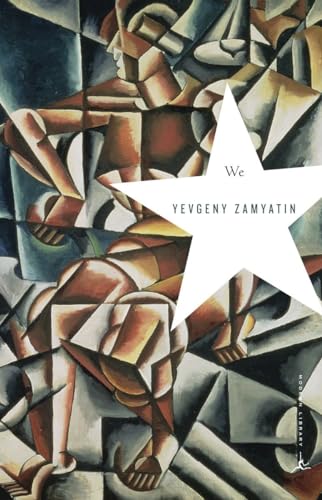
Translated by Natasha Randall • Foreword by Bruce Sterling
Written in 1921, We is set in the One State, where all live for the collective good and individual freedom does not exist. The novel takes the form of the diary of mathematician D-503, who, to his shock, experiences the most disruptive emotion imaginable: love. At once satirical and sobering—and now available in a powerful new translation—We is both a rediscovered classic and a work of tremendous relevance to our own times.
Die Inhaltsangabe kann sich auf eine andere Ausgabe dieses Titels beziehen.
Über die Autorin bzw. den Autor
Yevgeny Zamyatin (1884–1937) was a Russian author of political satire. Arrested during the 1905 revolution, he was exiled twice from St. Petersburg before receiving amnesty in 1913. After Zamyatin completed We, his only novel, in 1921, it was attacked by party-line critics, including the Russian Association of Proletarian Writers. Unable to publish his work, Zamyatin was granted permission to leave Russia with his wife in 1931. They moved to Paris, where he died in 1937.
Natasha Randall is a translator and writer living in New York City. Her work has appeared in The New York Times, Los Angeles Times, St. Petersburg Times, The Strad magazine, and on National Public Radio.
Auszug. © Genehmigter Nachdruck. Alle Rechte vorbehalten.
081297462X|excerpt
Zamyatin: WE
record one
keywords:
A Declaration. The Wisest of Lines. A Poem.
I am merely copying, word for word, what was printed in the State Gazette today:
In 120 days, the construction of the Integral will be complete. The great, historic hour when the Integral will soar through the Earth’s atmosphere is nigh. Some thousand years ago, your heroic ancestors subjugated the Earth to the power of the One State. Today, you are confronting an even greater conquest: the integration of the infinite equation of the universe with the crystalline, electrified, and fire-breathing Integral. You are confronting unknown creatures on alien planets, who may still be living in the savage state of freedom, and subjugating them to the beneficial yoke of reason. If they won’t understand that we bring them mathematically infallible happiness, it will be our duty to force them to be happy. But before resorting to arms, we will employ words.
In the name of the Benefactor, let it be known to all ciphers of the One State:
All those who are able are required to create treatises, poems, manifestos, odes, or any other composition addressing the beauty and majesty of the One State.
These works will compose the first cargo of the Integral.
All hail the One State, all hail ciphers, all hail the Benefactor!
As I write this, I feel something: my cheeks are burning. Integrating the grand equation of the universe: yes. Taming a wild zigzag along a tangent, toward the asymptote, into a straight line: yes. You see, the line of the One State—it is a straight line. A great, divine, precise, wise, straight line—the wisest of lines.
I am D-503. I am the Builder of the Integral. I am only one of the mathematicians of the One State. My pen, more accustomed to mathematical figures, is not up to the task of creating the music of unison and rhyme. But I might as well attempt to record what I see, what I think—or, more exactly, what we think. (Yes, that’s right: we. And let that also be the title of these records: We.) So these records will be manufactured from the stuff of our life, from the mathematically perfect life of the One State, and, as such, might they become, inadvertently, regardless of my intentions, a poem? Yes—I believe so and I know so.
As I write this: I feel my cheeks burn. I suppose this resembles what a woman experiences when she first hears a new pulse within her—the pulse of a tiny, unseeing, mini-being. These records are me; and simultaneously not me. And they will feed for many months on my sap, my blood, and then, in anguish, they will be ripped from my self and placed at the foot of the One State.
But I am ready and willing, just as every one—or almost every one of us. I am ready.
record two
keywords:
Ballet. Quadratic Harmony. X.
Spring. From beyond the Green Wall, from the wild, invisible plains, the wind brings the yellow honey-dust from a flower of some kind. This sweet dust parches the lips—you skim your tongue across them every minute—and you presume that there are sweet lips on every woman you encounter (and man, of course). This somewhat interferes with logical reasoning.
But then, the sky! Blue, untainted by a single cloud (the Ancients had such barbarous tastes given that their poets could have been inspired by such stupid, sloppy, silly-lingering clumps of vapor). I love—and I’m certain that I’m not mistaken if I say we love—skies like this, sterile and flawless!
On days like these, the whole world is blown from the same shatterproof, everlasting glass as the glass of the Green Wall and of all our structures. On days like these, you can see to the very blue depths of things, to their unknown surfaces, those marvelous expressions of mathematical equality—which exist in even the most usual and everyday objects.
For instance, this morning I was at the hangar, where the Integral is being built, and suddenly: I noticed the machines. Eyes shut, oblivious, the spheres of the regulators were spinning; the cranks were twinkling, dipping to the right and to the left; the shoulders of the balance wheel were rocking proudly; and the cutting head of the perforating machine curtsied, keeping time with some inaudible music. Instantly I saw the greater beauty of this grand mechanized ballet, suffused with nimble pale-blue sunbeams.
And then I thought to myself: why? Is this beautiful? Why is this dance beautiful? The answer: because it is non-free movement, because the whole profound point of this dance lies precisely in its absolute, aesthetic subordination, its perfect non-freedom. If indeed our ancestors were prone to dancing at the most inspired moments of their lives (religious mysteries, military parades), then all this can only mean one thing: the instinct for non-freedom, from the earliest of times, is inherently characteristic of humankind, and we, in our very contemporary life, are simply more conscious . . .
To be continued: the intercom is clicking. I lift my eyes: it reads “O-90,” of course. And, in half a minute, she herself will be here to collect me: we are scheduled for a walk.
Sweet O! It has always seemed to me that she looks like her name: she is about ten centimeters below the Maternal Norm, which makes her lines all rounded, and a pink O—her mouth—is open to receive my every word. Also: there are round, chubby creases around her wrists—such as you see on the wrists of children.
When she entered, I was still buzzing inside out with the fly-wheel of logic and, through inertia, I started to utter some words about this formula I had only just resolved (which justified all of us, the machines and the dance): “Stunning, isn’t it?” I asked.
“Yes, the spring, it is stunning . . .” O-90 smiled pinkly.
Wouldn’t you know it: spring . . . I say “stunning” and she thinks of spring. Women . . . I fell silent.
Downstairs. The avenue is crowded: we normally use the Personal Hour after lunch for extra walking when the weather is like this. As usual, the Music Factory was singing the March of the One State with all its pipes. All ciphers walked in measured rows, by fours, rapturously keeping step. Hundreds and thousands of ciphers, in pale bluish unifs,* with gold badges on their chests, indicating the state-given digits of each male and female. And I—we, our foursome—was one of the countless waves of this mighty torrent. On my left was O-90 (a thousand years ago, our hairy forebears most probably would have written that funny word “my” when referring to her just now); on my right were two rather unfamiliar ciphers, a female and a male.
The blessed-blue sky, the tiny baby suns on each badge, faces unclouded by the folly of thought . . . All these were rays, you see—all made of some sort of unified, radiant, smiling matter. And a brass beat: Tra-ta-ta-tam, Tra-ta-ta-tam—like sun-sparkling brass stairs—and with each step up, you climb higher and higher into the head-spinning blueness . . .
And here, like this morning in the hangar, I saw it all as though for the very first time: the immutably straight lanes, the ray- spraying glass of the streets, the divine parallelepipeds of the transparent buildings, and the quadratic harmony of the gray-blue ranks. And: it was as if I—not whole generations past—had personally, myself, conquered the old God and the old life. As if I personally had created all...
„Über diesen Titel“ kann sich auf eine andere Ausgabe dieses Titels beziehen.
Weitere beliebte Ausgaben desselben Titels

Suchergebnisse für We: Forew. by Bruce Sterling (Modern Library Classics)

Foto des Verkäufers
We
Anbieter: Dream Books Co., Denver, CO, USA
Verkäuferbewertung 5 von 5 Sternen

Zustand: acceptable. This copy has clearly been enjoyedâ"expect noticeable shelf wear and some minor creases to the cover. Binding is strong, and all pages are legible. May contain previous library markings or stamps. Artikel-Nr. DBV.081297462X.A
Gebraucht kaufen
EUR 5,19
Versand gratis
Versand innerhalb von USA
Versand innerhalb von USA
Anzahl: 3 verfügbar
Beispielbild für diese ISBN
We (Modern Library Classics)
Anbieter: Wonder Book, Frederick, MD, USA
Verkäuferbewertung 5 von 5 Sternen
Zustand: Good. Good condition. A copy that has been read but remains intact. May contain markings such as bookplates, stamps, limited notes and highlighting, or a few light stains. Artikel-Nr. K07T-00653
Gebraucht kaufen
EUR 8,29
Versand gratis
Versand innerhalb von USA
Versand innerhalb von USA
Anzahl: 1 verfügbar
Beispielbild für diese ISBN
We
Verlag:
Random House Publishing Group, 2006
ISBN 10: 081297462X
ISBN 13: 9780812974621
Gebraucht
Softcover
Anbieter: Better World Books, Mishawaka, IN, USA
Verkäuferbewertung 5 von 5 Sternen
Zustand: Very Good. Pages intact with possible writing/highlighting. Binding strong with minor wear. Dust jackets/supplements may not be included. Stock photo provided. Product includes identifying sticker. Better World Books: Buy Books. Do Good. Artikel-Nr. 4415208-75
Gebraucht kaufen
EUR 9,82
Versand gratis
Versand innerhalb von USA
Versand innerhalb von USA
Anzahl: 1 verfügbar
Beispielbild für diese ISBN
We
Anbieter: Eagle Eye Books, Decatur, GA, USA
Verkäuferbewertung 4 von 5 Sternen

Paper Back. Zustand: New. Artikel-Nr. 896496
Neu kaufen
EUR 15,18
EUR 3,46 Versand
Versand innerhalb von USA
Versand innerhalb von USA
Anzahl: 1 verfügbar
Beispielbild für diese ISBN
We (Modern Library Classics)
Verlag:
Random House USA Inc, United States, 2006
ISBN 10: 081297462X
ISBN 13: 9780812974621
Gebraucht
Paperback
Anbieter: WorldofBooks, Goring-By-Sea, WS, Vereinigtes Königreich
Verkäuferbewertung 5 von 5 Sternen
Paperback. Zustand: Very Good. The book has been read, but is in excellent condition. Pages are intact and not marred by notes or highlighting. The spine remains undamaged. Artikel-Nr. GOR001683132
Gebraucht kaufen
EUR 14,30
EUR 6,53 Versand
Versand von Vereinigtes Königreich nach USA
Versand von Vereinigtes Königreich nach USA
Anzahl: 2 verfügbar
Beispielbild für diese ISBN
We (Modern Library Classics)
Anbieter: Revaluation Books, Exeter, Vereinigtes Königreich
Verkäuferbewertung 5 von 5 Sternen
Paperback. Zustand: Brand New. reprint edition. 203 pages. 7.75x5.25x0.50 inches. In Stock. Artikel-Nr. x-081297462X
Neu kaufen
EUR 14,75
EUR 11,66 Versand
Versand von Vereinigtes Königreich nach USA
Versand von Vereinigtes Königreich nach USA
Anzahl: 2 verfügbar
Beispielbild für diese ISBN
We (Modern Library Classics)
Anbieter: Revaluation Books, Exeter, Vereinigtes Königreich
Verkäuferbewertung 5 von 5 Sternen
Paperback. Zustand: Brand New. reprint edition. 203 pages. 7.75x5.25x0.50 inches. In Stock. Artikel-Nr. __081297462X
Neu kaufen
EUR 17,17
EUR 11,66 Versand
Versand von Vereinigtes Königreich nach USA
Versand von Vereinigtes Königreich nach USA
Anzahl: 1 verfügbar
Beispielbild für diese ISBN
We (Modern Library Classics)
Anbieter: Kennys Bookstore, Olney, MD, USA
Verkäuferbewertung 5 von 5 Sternen
Zustand: New. 2006. 2006 Modern Library Pbk. Ed. Paperback. Series: Modern Library. Num Pages: 224 pages. BIC Classification: FA. Category: (G) General (US: Trade). Dimension: 203 x 131 x 11. Weight in Grams: 182. . . . . . Books ship from the US and Ireland. Artikel-Nr. V9780812974621
Neu kaufen
EUR 23,31
EUR 9,10 Versand
Versand innerhalb von USA
Versand innerhalb von USA
Anzahl: 20 verfügbar
Foto des Verkäufers
We
Verlag:
Random House Publishing Group, 2006
ISBN 10: 081297462X
ISBN 13: 9780812974621
Neu
Kartoniert / Broschiert
Anbieter: moluna, Greven, Deutschland
Verkäuferbewertung 5 von 5 Sternen
Kartoniert / Broschiert. Zustand: New. Yevgeny Zamyatin (1884&ndash1937) was a Russian author of political satire. Arrested during the 1905 revolution, he was exiled twice from St. Petersburg before receiving amnesty in 1913. After Zamyatin completed We, his only novel, in 1921. Artikel-Nr. 399138963
Neu kaufen
EUR 17,21
EUR 48,99 Versand
Versand von Deutschland nach USA
Versand von Deutschland nach USA
Anzahl: 2 verfügbar