
Verwandte Artikel zu Franklin and Winston: An Intimate Portrait of an Epic...
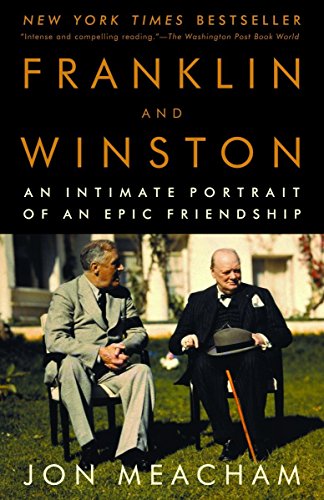
Inhaltsangabe
NEW YORK TIMES BESTSELLER • In this “beautifully written and superbly researched dual biography” (Los Angeles Times Book Review), Pulitzer Prize–winning biographer Jon Meacham “paints a powerful portrait of the enormous friendship between World War II allies [Franklin] Roosevelt and [Winston] Churchill” (Vanity Fair).
“Intense and compelling reading.”—The Washington Post
Franklin Roosevelt and Winston Churchill were the greatest leaders of “the Greatest Generation.” In Franklin and Winston, Jon Meacham explores the fascinating relationship between the two men who piloted the free world to victory in World War II.
Born in the nineteenth century and molders of the twentieth and twenty-first, Roosevelt and Churchill had much in common. In their own time both men were underestimated, dismissed as arrogant, and faced skeptics in their own nations—yet both magnificently rose to the central challenges of the twentieth century. Theirs was a kind of love story, with an emotional Churchill courting an elusive Roosevelt. The British prime minister, who rallied his nation in its darkest hour, standing alone against Adolf Hitler, was always somewhat insecure about his place in FDR’s affections—which was the way Roosevelt wanted it. A man of secrets, FDR liked to keep people off balance, including his wife, Eleanor, his White House aides—and Winston Churchill.
Meacham’s sources—including unpublished letters of FDR’ s great secret love, Lucy Mercer Rutherfurd, the papers of Pamela Churchill Harriman, and interviews with people who were in FDR and Churchill’s joint company—shed light on the characters of both men as he engagingly chronicles the hours in which they decided the course of the struggle.
Charting the personal drama behind the discussions of strategy and statecraft, Meacham has written the definitive account of the most remarkable friendship of the modern age.
Die Inhaltsangabe kann sich auf eine andere Ausgabe dieses Titels beziehen.
Über die Autorin bzw. den Autor
Jon Meacham is a Pulitzer Prize–winning biographer. The author of the New York Times bestsellers Thomas Jefferson: The Art of Power, American Lion: Andrew Jackson in the White House, Franklin and Winston, Destiny and Power: The American Odyssey of George Herbert Walker Bush, and The Soul of America: The Battle for Our Better Angels, he is a distinguished visiting professor at Vanderbilt University, a contributing writer for The New York Times Book Review, and a fellow of the Society of American Historians. Meacham lives in Nashville and in Sewanee with his wife and children.
Von der hinteren Coverseite
The most complete portrait ever drawn of the complex emotional connection between two of history's towering leaders
Franklin Roosevelt and Winston Churchill were the greatest leaders of "the Greatest Generation." In Franklin and Winston, Jon Meacham explores the fascinating relationship between the two men who piloted the free world to victory in World War II. It was a crucial friendship, and a unique one--a president and a prime minister spending enormous amounts of time together (113 days during the war) and exchanging nearly two thousand messages. Amid cocktails, cigarettes, and cigars, they met, often secretly, in places as far-flung as Washington, Hyde Park, Casablanca, and Teheran, talking to each other of war, politics, the burden of command, their health, their wives, and their children.
Born in the nineteenth century and molders of the twentieth and twenty-first, Roosevelt and Churchill had much in common. Sons of the elite, students of history, politicians of the first rank, they savored power. In their own time both men were underestimated, dismissed as arrogant, and faced skeptics and haters in their own nations--yet both magnificently rose to the central challenges of the twentieth century. Theirs was a kind of love story, with an emotional Churchill courting an elusive Roosevelt. The British prime minister, who rallied his nation in its darkest hour, standing alone against Adolf Hitler, was always somewhat insecure about his place in FDR's affections--which was the way Roosevelt wanted it. A man of secrets, FDR liked to keep people off balance, including his wife, Eleanor, his White House aides--and Winston Churchill.
Confronting tyranny and terror, Rooseveltand Churchill built a victorious alliance amid cataclysmic events and occasionally conflicting interests. Franklin and Winston is also the story of their marriages and their families, two clans caught up in the most sweeping global conflict in history.
Meacham's new sources--including unpublished letters of FDR's great secret love, Lucy Mercer Rutherfurd, the papers of Pamela Churchill Harriman, and interviews with the few surviving people who were in FDR and Churchill's joint company--shed fresh light on the characters of both men as he engagingly chronicles the hours in which they decided the course of the struggle.
Hitler brought them together; later in the war, they drifted apart, but even in the autumn of their alliance, the pull of affection was always there. Charting the personal drama behind the discussions of strategy and statecraft, Meacham has written the definitive account of the most remarkable friendship of the modern age.
"From the Hardcover edition.
Auszug. © Genehmigter Nachdruck. Alle Rechte vorbehalten.
CHAPTER 1
TWO LIONS ROARING AT THE SAME TIME
A Disappointing Early Encounter- Their Lives Down the Years-The Coming of World War II
In the opening hours of a mission to wartime Europe in July 1918, Franklin Roosevelt, then thirty-six and working for the Navy Department, looked over a typewritten "Memorandum For Assistant Secretary" to discover what was in store for him in London. Reading the schedule's description of his evening engagement for Monday, July 29, Roosevelt learned that he was "to dine at a function given for the Allied Ministers Prosecuting the War." Hosted by F. E. Smith, a government minister and good friend of Winston Churchill's, the banquet was held in the hall of Gray's Inn in London. It was a clear evening-the wind was calm-and Roosevelt and Churchill, the forty-three-year-old former first lord of the Admiralty who was then minister of munitions, mingled among the guests below a portrait of Elizabeth I.
What were Roosevelt and Churchill like on this summer night? Frances Perkins knew them both in these early years. A progressive reformer, the first female member of a president's cabinet-Roosevelt would name her secretary of labor after he was elected in 1932-Perkins saw their strengths and their weaknesses. She first encountered Roosevelt in 1910 at a tea dance in Manhattan's Gramercy Park. Perkins was a graduate student at Columbia, already immersed in the world of social causes and settlement houses; Roosevelt was running for the state senate from Dutchess County. "There was nothing particularly interesting about the tall, thin young man with the high collar and pince-nez," Perkins recalled. They spoke briefly of Roosevelt's cousin Theodore, the former president of the United States, but Perkins did not give this Roosevelt "a second thought" until she ran across him again in Albany a few years later. She watched him work the Capitol-"tall and slender, very active and alert, moving around the floor, going in and out of committee rooms, rarely talking with the members, who more or less avoided him, not particularly charming (that came later), artificially serious of face, rarely smiling, with an unfortunate habit-so natural that he was unaware of it-of throwing his head up. This, combined with his pince-nez and great height, gave him the appearance of looking down his nose at most people." Later, the toss of the head would signal confidence and cheer. In the young Roosevelt it seemed, Perkins said, "slightly supercilious." She once heard a fellow politician say: "Awful arrogant fellow, that Roosevelt."
Perkins had also spent time with Churchill when she visited pre-World War I England. He was, she recalled, "a very interesting, alert, and vigorous individual who was an intellectual clearly." Churchill, she would tell President Roosevelt years later, "is this kind of a fellow: You want to be careful. He runs ahead of himself, or at least he used to." He was stubborn, Perkins said, "so sure of himself that he would insist upon doing the thing that he thought was a good thing to do. He was a little bit vain. He thought people were old fuddy-duds if they didn't agree with him." Her bottom line?
"He's pig-headed in his own way," Perkins said. "He's often right and brilliant, but . . ." But. She left the sentence unfinished.
The Gray's Inn dinner was a glittering occasion, with high British officials going out of their way to pay homage to Roosevelt as the representative of their American ally. Hailing Roosevelt as "the member of a glorious family," Smith, who later became the earl of Birkenhead, said, "No one will welcome Mr. Roosevelt on his visit to England with a warmer hand and heart than we do." Then Roosevelt-to his "horror," he said-was unexpectedly asked to say a few words. He stumbled a bit as he began. Uncertainly, trying to find the right note, Roosevelt said he had been "given to understand that I should not be called upon to speak" and in his nervousness, looking around at the faces of his hosts, began to talk about the importance of the personal in politics and war. Citing the need for an "intimate personal relationship" among allied nations, Roosevelt said: "It is quite impossible . . . to sit at home 3000 miles or more away and to obtain that close man-to-man, shoulder-to-shoulder touch, which today characterizes the work of the Allies in conducting the War." Warming to his point, Roosevelt concluded: "We are with you-about ninety-nine and nine-tenths of 110,000,000 of our people are with you-in the declaration that we are going to see this thing through with you."
In later years, Churchill would not recall meeting the American visitor. Roosevelt certainly recalled meeting Churchill, however, and long remembered Churchill's brusqueness. "I always disliked him since the time I went to England in 1917 or 1918," Roosevelt said to Joseph P. Kennedy, the American ambassador to Britain, in a conversation in 1939. "At a dinner I attended he acted like a stinker." Roosevelt and Churchill would not be in contact again for another twenty-one years. When they were, Churchill, not Roosevelt, would be the one sounding the trumpet about the indispensability of an "intimate personal relationship." The man who would bring them together: Adolf Hitler, a corporal who won the Iron Cross, First Class, six days after Roosevelt and Churchill dined at Gray's Inn.
they had been born eight years and an ocean apart-Winston Leonard Spencer Churchill on November 30, 1874, at Blenheim Palace in Oxfordshire; Franklin Delano Roosevelt on January 30, 1882, at Hyde Park in Dutchess County, New York. They loved tobacco, strong drink, history, the sea, battleships, hymns, pageantry, patriotic poetry, high office, and hearing themselves talk. "Being with them was like sitting between two lions roaring at the same time," said Mary Soames. With Roosevelt in his naval cape and Churchill in his service uniforms, they understood the stagecraft of statesmanship. "There was a good deal of the actor in each," said Mike Reilly, Roosevelt's Secret Service chief, "and we Secret Service men who had to arrange their exits and their entrances found we were working for a pair of master showmen who were determined that no scenes would be stolen by the other."
They were the sons of rich American mothers. Jennie Jerome married Lord Randolph Churchill in 1874; Sara Delano became the second wife of James Roosevelt in 1880. Roosevelt, the cousin of a president, came from the Hudson Valley, Groton School, Harvard College, and Columbia Law School; Churchill, the grandson of a duke, from Blenheim, Harrow, and Sandhurst. In a sign of how small the elite Anglo-American world in which they moved was, one of the wives of Winston's cousin the duke of Marlborough was romanced by Winthrop Rutherfurd, the husband of Franklin's illicit love, Lucy Mercer Rutherfurd. As boys, Roosevelt and Churchill were obsessive collectors: stamps, birds, books, and naval prints for Roosevelt, toy soldiers and butterflies for Churchill. Cousin Theodore's legend fired young Roosevelt's political imagination; Lord Randolph's career fascinated his son. As children and young men, they read the same books: Edward Lear's Book of Nonsense, the naval writings of Admiral Thayer Mahan, G. A. Henty's boys' books about the glories of empire, Kipling's poems and fiction, and Macaulay's history and essays. They loved Shakespeare, the Sermon on the Mount, and movies-even bad ones.
Politics was a shared passion. "My husband always had a joy in the game of politics," Eleanor said. "It was always to him an interesting game, like chess-something in which you pitted your wits...
„Über diesen Titel“ kann sich auf eine andere Ausgabe dieses Titels beziehen.
Suchergebnisse für Franklin and Winston: An Intimate Portrait of an Epic...

Beispielbild für diese ISBN
Franklin and Winston: An Intimate Portrait of an Epic Friendship
Anbieter: World of Books (was SecondSale), Montgomery, IL, USA
Verkäuferbewertung 5 von 5 Sternen

Paperback. Zustand: Good. NEW YORK TIMES BESTSELLER * In this "beautifully written and superbly researched dual biography" (Los Angeles Times Book Review), Pulitzer Prize-winning biographer Jon Meacham "paints a powerful portrait of the enormous friendship between World War II allies [Franklin] Roosevelt and [Winston] Churchill" (Vanity Fair). "Intense and compelling reading."--The Washington Post Franklin Roosevelt and Winston Churchill were the greatest leaders of "the Greatest Generation." In Franklin and Winston, Jon Meacham explores the fascinating relationship between the two men who piloted the free world to victory in World War II. Born in the nineteenth century and molders of the twentieth and twenty-first, Roosevelt and Churchill had much in common. In their own time both men were underestimated, dismissed as arrogant, and faced skeptics in their own nations--yet both magnificently rose to the central challenges of the twentieth century. Theirs was a kind of love story, with an emotional Churchill courting an elusive Roosevelt. The British prime minister, who rallied his nation in its darkest hour, standing alone against Adolf Hitler, was always somewhat insecure about his place in FDR's affections--which was the way Roosevelt wanted it. A man of secrets, FDR liked to keep people off balance, including his wife, Eleanor, his White House aides--and Winston Churchill. Meacham's sources--including unpublished letters of FDR' s great secret love, Lucy Mercer Rutherfurd, the papers of Pamela Churchill Harriman, and interviews with people who were in FDR and Churchill's joint company--shed light on the characters of both men as he engagingly chronicles the hours in which they decided the course of the struggle. Charting the personal drama behind the discussions of strategy and statecraft, Meacham has written the definitive account of the most remarkable friendship of the modern age. Artikel-Nr. 00099655424
Gebraucht kaufen
EUR 3,72
Versand gratis
Versand innerhalb von USA
Versand innerhalb von USA
Anzahl: Mehr als 20 verfügbar
Beispielbild für diese ISBN
Franklin and Winston: An Intimate Portrait of an Epic Friendship
Anbieter: World of Books (was SecondSale), Montgomery, IL, USA
Verkäuferbewertung 5 von 5 Sternen
Paperback. Zustand: Very Good. NEW YORK TIMES BESTSELLER * In this "beautifully written and superbly researched dual biography" (Los Angeles Times Book Review), Pulitzer Prize-winning biographer Jon Meacham "paints a powerful portrait of the enormous friendship between World War II allies [Franklin] Roosevelt and [Winston] Churchill" (Vanity Fair). "Intense and compelling reading."--The Washington Post Franklin Roosevelt and Winston Churchill were the greatest leaders of "the Greatest Generation." In Franklin and Winston, Jon Meacham explores the fascinating relationship between the two men who piloted the free world to victory in World War II. Born in the nineteenth century and molders of the twentieth and twenty-first, Roosevelt and Churchill had much in common. In their own time both men were underestimated, dismissed as arrogant, and faced skeptics in their own nations--yet both magnificently rose to the central challenges of the twentieth century. Theirs was a kind of love story, with an emotional Churchill courting an elusive Roosevelt. The British prime minister, who rallied his nation in its darkest hour, standing alone against Adolf Hitler, was always somewhat insecure about his place in FDR's affections--which was the way Roosevelt wanted it. A man of secrets, FDR liked to keep people off balance, including his wife, Eleanor, his White House aides--and Winston Churchill. Meacham's sources--including unpublished letters of FDR' s great secret love, Lucy Mercer Rutherfurd, the papers of Pamela Churchill Harriman, and interviews with people who were in FDR and Churchill's joint company--shed light on the characters of both men as he engagingly chronicles the hours in which they decided the course of the struggle. Charting the personal drama behind the discussions of strategy and statecraft, Meacham has written the definitive account of the most remarkable friendship of the modern age. Artikel-Nr. 00109724095
Gebraucht kaufen
EUR 3,72
Versand gratis
Versand innerhalb von USA
Versand innerhalb von USA
Anzahl: 3 verfügbar
Beispielbild für diese ISBN
Franklin and Winston: An Intimate Portrait of an Epic Friendship
Anbieter: World of Books (was SecondSale), Montgomery, IL, USA
Verkäuferbewertung 5 von 5 Sternen
Paperback. Zustand: Fair. NEW YORK TIMES BESTSELLER * In this "beautifully written and superbly researched dual biography" (Los Angeles Times Book Review), Pulitzer Prize-winning biographer Jon Meacham "paints a powerful portrait of the enormous friendship between World War II allies [Franklin] Roosevelt and [Winston] Churchill" (Vanity Fair). "Intense and compelling reading."--The Washington Post Franklin Roosevelt and Winston Churchill were the greatest leaders of "the Greatest Generation." In Franklin and Winston, Jon Meacham explores the fascinating relationship between the two men who piloted the free world to victory in World War II. Born in the nineteenth century and molders of the twentieth and twenty-first, Roosevelt and Churchill had much in common. In their own time both men were underestimated, dismissed as arrogant, and faced skeptics in their own nations--yet both magnificently rose to the central challenges of the twentieth century. Theirs was a kind of love story, with an emotional Churchill courting an elusive Roosevelt. The British prime minister, who rallied his nation in its darkest hour, standing alone against Adolf Hitler, was always somewhat insecure about his place in FDR's affections--which was the way Roosevelt wanted it. A man of secrets, FDR liked to keep people off balance, including his wife, Eleanor, his White House aides--and Winston Churchill. Meacham's sources--including unpublished letters of FDR' s great secret love, Lucy Mercer Rutherfurd, the papers of Pamela Churchill Harriman, and interviews with people who were in FDR and Churchill's joint company--shed light on the characters of both men as he engagingly chronicles the hours in which they decided the course of the struggle. Charting the personal drama behind the discussions of strategy and statecraft, Meacham has written the definitive account of the most remarkable friendship of the modern age. Artikel-Nr. 00069988282
Gebraucht kaufen
EUR 3,72
Versand gratis
Versand innerhalb von USA
Versand innerhalb von USA
Anzahl: Mehr als 20 verfügbar
Foto des Verkäufers
Franklin and Winston: An Intimate Portrait of an Epic Friendship
Verlag:
Random House Trade Paperbacks, 2004
ISBN 10: 0812972821
ISBN 13: 9780812972825
Gebraucht
Softcover
Anbieter: Dream Books Co., Denver, CO, USA
Verkäuferbewertung 5 von 5 Sternen
Zustand: good. Gently used with minimal wear on the corners and cover. A few pages may contain light highlighting or writing, but the text remains fully legible. Dust jacket may be missing, and supplemental materials like CDs or codes may not be included. May be ex-library with library markings. Ships promptly! Artikel-Nr. DBV.0812972821.G
Gebraucht kaufen
EUR 3,79
Versand gratis
Versand innerhalb von USA
Versand innerhalb von USA
Anzahl: 1 verfügbar
Beispielbild für diese ISBN
Franklin and Winston: An Intimate Portrait of an Epic Friendship
Verlag:
Random House Trade Paperbacks (edition ), 2004
ISBN 10: 0812972821
ISBN 13: 9780812972825
Gebraucht
Paperback
Anbieter: BooksRun, Philadelphia, PA, USA
Verkäuferbewertung 5 von 5 Sternen
Paperback. Zustand: Very Good. It's a well-cared-for item that has seen limited use. The item may show minor signs of wear. All the text is legible, with all pages included. It may have slight markings and/or highlighting. Artikel-Nr. 0812972821-11-1
Gebraucht kaufen
EUR 5,86
Versand gratis
Versand innerhalb von USA
Versand innerhalb von USA
Anzahl: 1 verfügbar
Beispielbild für diese ISBN
Franklin and Winston: An Intimate Portrait of an Epic Friendship
Anbieter: ThriftBooks-Reno, Reno, NV, USA
Verkäuferbewertung 5 von 5 Sternen
Paperback. Zustand: Very Good. No Jacket. May have limited writing in cover pages. Pages are unmarked. ~ ThriftBooks: Read More, Spend Less. Artikel-Nr. G0812972821I4N00
Gebraucht kaufen
EUR 5,94
Versand gratis
Versand innerhalb von USA
Versand innerhalb von USA
Anzahl: 1 verfügbar
Beispielbild für diese ISBN
Franklin and Winston: An Intimate Portrait of an Epic Friendship
Anbieter: ThriftBooks-Dallas, Dallas, TX, USA
Verkäuferbewertung 5 von 5 Sternen
Paperback. Zustand: Very Good. No Jacket. May have limited writing in cover pages. Pages are unmarked. ~ ThriftBooks: Read More, Spend Less. Artikel-Nr. G0812972821I4N00
Gebraucht kaufen
EUR 5,94
Versand gratis
Versand innerhalb von USA
Versand innerhalb von USA
Anzahl: 1 verfügbar
Beispielbild für diese ISBN
Franklin and Winston: An Intimate Portrait of an Epic Friendship
Verlag:
Random House Publishing Group, 2004
ISBN 10: 0812972821
ISBN 13: 9780812972825
Gebraucht
Paperback
Anbieter: ThriftBooks-Reno, Reno, NV, USA
Verkäuferbewertung 5 von 5 Sternen
Paperback. Zustand: Good. No Jacket. Pages can have notes/highlighting. Spine may show signs of wear. ~ ThriftBooks: Read More, Spend Less. Artikel-Nr. G0812972821I3N00
Gebraucht kaufen
EUR 5,94
Versand gratis
Versand innerhalb von USA
Versand innerhalb von USA
Anzahl: 6 verfügbar
Beispielbild für diese ISBN
Franklin and Winston: An Intimate Portrait of an Epic Friendship
Verlag:
Random House Publishing Group, 2004
ISBN 10: 0812972821
ISBN 13: 9780812972825
Gebraucht
Paperback
Anbieter: ThriftBooks-Dallas, Dallas, TX, USA
Verkäuferbewertung 5 von 5 Sternen
Paperback. Zustand: Good. No Jacket. Former library book; Pages can have notes/highlighting. Spine may show signs of wear. ~ ThriftBooks: Read More, Spend Less. Artikel-Nr. G0812972821I3N10
Gebraucht kaufen
EUR 5,94
Versand gratis
Versand innerhalb von USA
Versand innerhalb von USA
Anzahl: 1 verfügbar
Beispielbild für diese ISBN
Franklin and Winston: An Intimate Portrait of an Epic Friendship
Anbieter: ThriftBooks-Atlanta, AUSTELL, GA, USA
Verkäuferbewertung 5 von 5 Sternen
Paperback. Zustand: Good. No Jacket. Pages can have notes/highlighting. Spine may show signs of wear. ~ ThriftBooks: Read More, Spend Less. Artikel-Nr. G0812972821I3N00
Gebraucht kaufen
EUR 5,94
Versand gratis
Versand innerhalb von USA
Versand innerhalb von USA
Anzahl: 7 verfügbar