
Verwandte Artikel zu The Orientalist: Solving the Mystery of a Strange and...
Inhaltsangabe
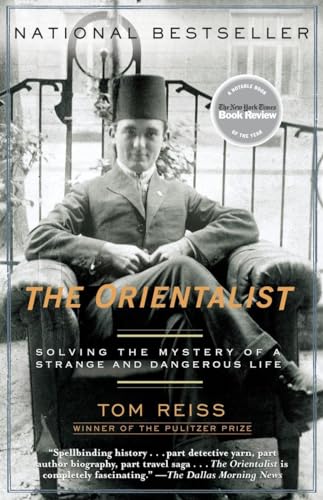
A thrilling page-turner of epic proportions, Tom Reiss’s panoramic bestseller tells the true story of a Jew who transformed himself into a Muslim prince in Nazi Germany. Lev Nussimbaum escaped the Russian Revolution in a camel caravan and, as “Essad Bey,” became a celebrated author with the enduring novel Ali and Nino as well as an adventurer, a real-life Indiana Jones with a fatal secret. Reiss pursued Lev’s story across ten countries and found himself caught up in encounters as dramatic and surreal–and sometimes as heartbreaking–as his subject’s life.
Die Inhaltsangabe kann sich auf eine andere Ausgabe dieses Titels beziehen.
Über die Autorin bzw. den Autor
Tom Reiss has written about politics and culture for The New York Times, The Wall Street Journal, The New Yorker, and elsewhere. He lives with his wife and daughters in New York City.
Von der hinteren Coverseite
Part history, part cultural biography, and part literary mystery, "The Orientalist traces the life of Lev Nussimbaum, a Jew who transformed himself into a Muslim prince and became a best-selling author in Nazi Germany.
Born in 1905 to a wealthy family in the oil-boom city of Baku, at the edge of the czarist empire, Lev escaped the Russian Revolution in a camel caravan. He found refuge in Germany, where, writing under the names Essad Bey and Kurban Said, his remarkable books about Islam, desert adventures, and global revolution, became celebrated across fascist Europe. His enduring masterpiece, "Ali and Nino-a story of love across ethnic and religious boundaries, published on the eve of the Holocaust-is still in print today.
But Lev's life grew wilder than his wildest stories. He married an international heiress who had no idea of his true identity-until she divorced him in a tabloid scandal. His closest friend in New York, George Sylvester Viereck-also a friend of both Freud's and Einstein's-was arrested as the leading Nazi agent in the United States. Lev was invited to be Mussolini's official biographer-until the Fascists discovered his "true" identity. Under house arrest in the Amalfi cliff town of Positano, Lev wrote his last book-discovered in a half a dozen notebooks never before read by anyone-helped by a mysterious half-German salon hostess, an Algerian weapons-smuggler, and the poet Ezra Pound.
Tom Reiss spent five years tracking down secret police records, love letters, diaries, and the deathbed notebooks. Beginning with a yearlong investigation for "The New Yorker, he pursued Lev's story across ten countries and found himself caught up in encounters as dramatic andsurreal, and sometimes as heartbreaking, as his subject's life. Reiss's quest for the truth buffets him from one weird character to the next: from the last heir of the Ottoman throne to a rock opera-composing baroness in an Austrian castle, to an aging starlet in a Hollywood bungalow full of cats and turtles.
As he tracks down the pieces of Lev Nussimbaum's deliberately obscured life, Reiss discovers a series of shadowy worlds-of European pan-Islamists, nihilist assassins, anti-Nazi book smugglers, Baku oil barons, Jewish Orientalists-that have also been forgotten. The result is a thoroughly unexpected picture of the twentieth century-of the origins of our ideas about race and religious self-definition, and of the roots of modern fanaticism and terrorism. Written with grace and infused with wonder, "The Orientalist is an astonishing book.
Auszug. © Genehmigter Nachdruck. Alle Rechte vorbehalten.
Introduction
On the Trail of Kurban Said
On a cold November morning in Vienna, I walked a maze of narrow streets on the way to see a man who promised to solve the mystery of Kurban Said. I was with Peter Mayer, the president of the Overlook Press, a large, rumpled figure in a black corduroy suit who wanted to publish Said’s small romantic novel Ali andNino.Mayer tended to burst into enthusiastic monologues about thebook: “You know how when you look at a Vermeer, and it’s an interior,and it’s quite quiet, yet somehow, what he does with perspective, with light, it feels much bigger–that’s this novel!” A love story set in the Caucasus on the eve of the Russian Revolution, Ali and Nino had been originally published in German in 1937 and was revived in translation in the seventies as a minor classic. But the question of the author’s identity had never been resolved. All anyone agreed on was that Kurban Said was the pen name of a writer who had probably come from Baku, an oil city in the Caucasus, and that he was either a nationalist poet who was killed in the Gulags, or the dilettante son of an oil millionaire, or a Viennese café-society writer who died in Italy after stabbing himself in the foot. In the jacket photograph of a book called Twelve Secrets of the Caucasus, the mysterious author is dressed up as a mountain warrior–wearing a fur cap, a long, flowing coat with a sewn-in bandolier, and a straight dagger at his waist. Mayer and I were on our way to a meeting with a lawyer named Heinz Barazon, who was challenging Overlook over proper author credit on the novel.
Barazon claimed to know the true identity of Kurban Said, and as the lawyer for the author’s heirs, he was insisting that it be acknowledged in the new edition of Ali and Nino or he would block publication. At the lawyer’s address, next to a shop where some old women were bent over tables with needle and thread, we were buzzed into a lobby that could have had the grime of the Anschluss on its fixtures. Mayer squeezed my arm with excitement and said, “It’s The Third Man!” Barazon’s appearance didn’t do anything to dispel the atmosphere of a Cold War thriller. He was a small man with a gravelly voice, a stooped back, and a clubfoot that made a tremendous racket as he led us down his book-lined hallway. “You have both come a long way to discover the identity of Kurban Said,” he said. “It will all soon become clear to you.” He ushered us into a room where a gaunt and beautiful blond woman with enormous glassy eyes was lying motionless on a couch. “Pardon me, this is Leela,” said Barazon. “I hope you’ll forgive me,” Leela said in a fragile, precise voice. “I must remain lying down because I’m ill. I can’t sit for long.” Barazon came directly to the point: the novel Ali and Nino was written by the Baroness Elfriede Ehrenfels von Bodmershof, the second wife of Leela’s father, Baron Omar-Rolf von Ehrenfels, and when Baroness Elfriede died, in the early 1980s, having outlived her husband, all rights to the work had passed down to Leela.
Barazon produced a thick file of documents that backed up this story: publishing contracts, legal papers, and author lists from the late thirties, stamped with Nazi eagles and swastikas. Under the entry for “Said, Kurban” in the author’s section of the 1935—39 Deutscher Gesamtkatalog–the Third Reich’s equivalent of Books in Print–it said, in no uncertain terms, “pseudonym for Ehrenfels, v. Bodmershof, Elfriede, Baroness.” The Nazi documents seemed to tell a clear story–that Baroness Elfriede had been Kurban Said–but it was one that I believed to be untrue. I had become interested in the identity of Kurban Said in the spring of 1998, when I went to Baku to write about the city’s new oil boom– virtually the first signs of life since the Russian Revolution made time stop there in 1917. Baku is the capital of Azerbaijan, a tiny country that prides itself on being the easternmost point in Europe, though most Europeans wouldn’t know it. Its proximity to Iran and the fact that the majority of its citizens are Shiite Muslims can dominate your vision of Azerbaijan until you realize that the most impressive public building in Baku is not a mosque but a copy of the grand casino at Monte Carlo. Baku is the sort of city that has been beyond rigid ideologies and religions for a thousand years. Its name is said to derive from a Persian expression, baadiyekubiden, or “blow of the winds.” Being situated at the head of a desert peninsula jutting into the sea, the city is in fact one of the windiest places on earth–one dapper ninety-seven-year-old man told me how, as a young man, he and his family had worn specially made goggles with their evening clothes to stroll along the boulevards without being blinded by the sands.
Just before I left for Baku, an Iranian friend had recommended Kurban Said’s novel Ali and Nino as a kind of introduction to the city and the Caucasus in general, saying that it would be more useful than any tourist guide. I had never heard of it, and when I tracked down a 1972 Pocket Books edition, I was a little surprised by the cover. It featured two airbrushed lovers and an endorsement from Life: “If Kurban Said can’t push Erich Segal off the bestseller list, nobody can!” But there turned out to be something of the eighteenth century about the book, as if Candide had been written with realistic characters and the intention of sweeping readers off their feet. Each scene continued only long enough to spring some miniature gear that moved the mechanism forward. The reviewer in The New York Times had written, “One feels as if one has dug up buried treasure.”The novel revolves around the love between a Muslim boy and a Christian girl and the progress of their relationship as they grow up; in the culturally tolerant world of old Azerbaijan, their courtship seems blessed, though they are constantly bickering: “ ‘Ali Khan, you are stupid. Thank God we are in Europe. If we were in Asia they would have made me wear the veil ages ago, and you couldn’t see me.’ I gave in. Baku’s undecided geographical situation allowed me to go on looking into the most beautiful eyes in the world.”
Over the course of its history, Azerbaijan had been conquered by Alexander the Great, the Mongols, the Ottomans, and the Persians. Finally, its “undecided geographical situation” was resolved when the Russians captured it in 1825. During the period of czarist expansion in the Caucasus, so vividly recounted by Lermontov, Tolstoy, and Pushkin, Europe discovered Baku and Baku discovered Europe. And everyone discovered oil. Lots of it. In Baku you did not need to drill for the stuff–it sat on the surface of the earth, in black ponds,sometimes enormous lakes–and the flow could be so strong that crude occasionally swallowed wholehouses along the Caspian shore. The walled caravan outpost soon became the center of the burgeoning global oil industry–supplying more than half the world’s crude–and the result was a fabulous nineteenth-century city built on the profits: extravagant mansions, mosques, casinos, and theaters from the period when the city was home to the Rothschilds, the Nobels, and dozens of local Muslim “oil barons,” as they were called. There was Mir Babayev, a popular singer who, after discovering oil on his land, spent the rest of his days searching out his record albums and...
„Über diesen Titel“ kann sich auf eine andere Ausgabe dieses Titels beziehen.
Suchergebnisse für The Orientalist: Solving the Mystery of a Strange and...

Beispielbild für diese ISBN
The Orientalist: Solving the Mystery of a Strange and Dangerous Life
Anbieter: World of Books (was SecondSale), Montgomery, IL, USA
Verkäuferbewertung 5 von 5 Sternen

Paperback. Zustand: Good. A thrilling page-turner of epic proportions, Tom Reiss's panoramic bestseller tells the true story of a Jew who transformed himself into a Muslim prince in Nazi Germany. Lev Nussimbaum escaped the Russian Revolution in a camel caravan and, as Essad Bey, became a celebrated author with the enduring novel Ali and Nino as well as an adventurer, a real-life Indiana Jones with a fatal secret. Reiss pursued Lev's story across ten countries and found himself caught up in encounters as dramatic and surreal-and sometimes as heartbreaking-as his subject's life. Artikel-Nr. 00094208254
Gebraucht kaufen
EUR 4,80
Versand gratis
Versand innerhalb von USA
Versand innerhalb von USA
Anzahl: 15 verfügbar
Beispielbild für diese ISBN
The Orientalist: Solving the Mystery of a Strange and Dangerous Life
Anbieter: World of Books (was SecondSale), Montgomery, IL, USA
Verkäuferbewertung 5 von 5 Sternen
Paperback. Zustand: Fair. A thrilling page-turner of epic proportions, Tom Reiss's panoramic bestseller tells the true story of a Jew who transformed himself into a Muslim prince in Nazi Germany. Lev Nussimbaum escaped the Russian Revolution in a camel caravan and, as Essad Bey, became a celebrated author with the enduring novel Ali and Nino as well as an adventurer, a real-life Indiana Jones with a fatal secret. Reiss pursued Lev's story across ten countries and found himself caught up in encounters as dramatic and surreal-and sometimes as heartbreaking-as his subject's life. Artikel-Nr. 00098247784
Gebraucht kaufen
EUR 4,80
Versand gratis
Versand innerhalb von USA
Versand innerhalb von USA
Anzahl: 4 verfügbar
Beispielbild für diese ISBN
The Orientalist: Solving the Mystery of a Strange and Dangerous Life
Verlag:
Random House Publishing Group (edition Reprint), 2006
ISBN 10: 0812972767
ISBN 13: 9780812972764
Gebraucht
Paperback
Anbieter: BooksRun, Philadelphia, PA, USA
Verkäuferbewertung 5 von 5 Sternen
Paperback. Zustand: Fair. Reprint. The item might be beaten up but readable. May contain markings or highlighting, as well as stains, bent corners, or any other major defect, but the text is not obscured in any way. Artikel-Nr. 0812972767-7-22
Gebraucht kaufen
EUR 4,82
Versand gratis
Versand innerhalb von USA
Versand innerhalb von USA
Anzahl: 1 verfügbar
Beispielbild für diese ISBN
The Orientalist: Solving the Mystery of a Strange and Dangerous Life
Verlag:
Random House Publishing Group, 2006
ISBN 10: 0812972767
ISBN 13: 9780812972764
Gebraucht
Paperback
Anbieter: ThriftBooks-Dallas, Dallas, TX, USA
Verkäuferbewertung 5 von 5 Sternen
Paperback. Zustand: Very Good. No Jacket. Former library book; May have limited writing in cover pages. Pages are unmarked. ~ ThriftBooks: Read More, Spend Less. Artikel-Nr. G0812972767I4N10
Gebraucht kaufen
EUR 5,96
Versand gratis
Versand innerhalb von USA
Versand innerhalb von USA
Anzahl: 1 verfügbar
Beispielbild für diese ISBN
The Orientalist : Solving the Mystery of a Strange and Dangerous Life
Verlag:
Random House Publishing Group, 2006
ISBN 10: 0812972767
ISBN 13: 9780812972764
Gebraucht
Softcover
Anbieter: Better World Books: West, Reno, NV, USA
Verkäuferbewertung 5 von 5 Sternen
Zustand: Good. 1 Edition. Pages intact with minimal writing/highlighting. The binding may be loose and creased. Dust jackets/supplements are not included. Stock photo provided. Product includes identifying sticker. Better World Books: Buy Books. Do Good. Artikel-Nr. 974048-75
Gebraucht kaufen
EUR 6,19
Versand gratis
Versand innerhalb von USA
Versand innerhalb von USA
Anzahl: 2 verfügbar
Beispielbild für diese ISBN
The Orientalist : Solving the Mystery of a Strange and Dangerous Life
Verlag:
Random House Publishing Group, 2006
ISBN 10: 0812972767
ISBN 13: 9780812972764
Gebraucht
Softcover
Anbieter: Better World Books, Mishawaka, IN, USA
Verkäuferbewertung 5 von 5 Sternen
Zustand: Good. 1 Edition. Pages intact with minimal writing/highlighting. The binding may be loose and creased. Dust jackets/supplements are not included. Stock photo provided. Product includes identifying sticker. Better World Books: Buy Books. Do Good. Artikel-Nr. 974048-75
Gebraucht kaufen
EUR 6,19
Versand gratis
Versand innerhalb von USA
Versand innerhalb von USA
Anzahl: 5 verfügbar
Beispielbild für diese ISBN
The Orientalist : Solving the Mystery of a Strange and Dangerous Life
Verlag:
Random House Publishing Group, 2006
ISBN 10: 0812972767
ISBN 13: 9780812972764
Gebraucht
Softcover
Anbieter: Better World Books, Mishawaka, IN, USA
Verkäuferbewertung 5 von 5 Sternen
Zustand: Very Good. 1 Edition. Pages intact with possible writing/highlighting. Binding strong with minor wear. Dust jackets/supplements may not be included. Stock photo provided. Product includes identifying sticker. Better World Books: Buy Books. Do Good. Artikel-Nr. 3934607-6
Gebraucht kaufen
EUR 6,19
Versand gratis
Versand innerhalb von USA
Versand innerhalb von USA
Anzahl: 1 verfügbar
Beispielbild für diese ISBN
The Orientalist: Solving the Mystery of a Strange and Dangerous Life
Verlag:
Random House Publishing Group, 2006
ISBN 10: 0812972767
ISBN 13: 9780812972764
Gebraucht
Softcover
Anbieter: Wonder Book, Frederick, MD, USA
Verkäuferbewertung 5 von 5 Sternen
Zustand: Good. Good condition. A copy that has been read but remains intact. May contain markings such as bookplates, stamps, limited notes and highlighting, or a few light stains. Artikel-Nr. N04P-01494
Gebraucht kaufen
EUR 6,43
Versand gratis
Versand innerhalb von USA
Versand innerhalb von USA
Anzahl: 5 verfügbar
Beispielbild für diese ISBN
The Orientalist: Solving the Mystery of a Strange and Dangerous Life
Anbieter: Magers and Quinn Booksellers, Minneapolis, MN, USA
Verkäuferbewertung 5 von 5 Sternen
paperback. Zustand: Very Good. May have light to moderate shelf wear and/or a remainder mark. Complete. Clean pages. Artikel-Nr. 235978
Gebraucht kaufen
EUR 5,96
EUR 3,56 Versand
Versand innerhalb von USA
Versand innerhalb von USA
Anzahl: 2 verfügbar
Beispielbild für diese ISBN
The Orientalist: Solving the Mystery of a Strange and Dangerous Life
Verlag:
Random House Publishing Group, 2006
ISBN 10: 0812972767
ISBN 13: 9780812972764
Gebraucht
Paperback
Anbieter: WorldofBooks, Goring-By-Sea, WS, Vereinigtes Königreich
Verkäuferbewertung 5 von 5 Sternen
Paperback. Zustand: Very Good. The book has been read, but is in excellent condition. Pages are intact and not marred by notes or highlighting. The spine remains undamaged. Artikel-Nr. GOR003129200
Gebraucht kaufen
EUR 3,40
EUR 6,62 Versand
Versand von Vereinigtes Königreich nach USA
Versand von Vereinigtes Königreich nach USA
Anzahl: 5 verfügbar