
Verwandte Artikel zu Campo Santo (Modern Library Paperbacks)
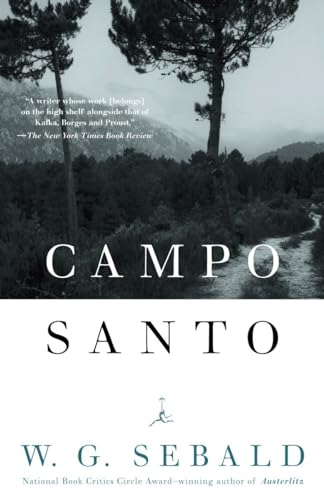
Inhaltsangabe
“W. G. Sebald exemplified the best kind of cosmopolitan literary intelligence–humane, digressive, deeply erudite, unassuming and tinged with melancholy. . . . In [Campo Santo] Sebald reveals his distinctive tone, as his winding sentences gradually mingle together curiosity and plangency, learning and self-revelation. . . . [Readers will] be rewarded with unexpected illuminations.”
–The Washington Post Book World
This final collection of essays by W. G. Sebald offers profound ruminations on many themes common to his work–the power of memory and personal history, the connections between images in the arts and life, the presence of ghosts in places and artifacts. Some of these pieces pay tribute to the Mediterranean island of Corsica, weaving elegiacally between past and present, examining, among other things, the island’s formative effect on its most famous citizen, Napoleon. In others, Sebald examines how the works of Günter Grass and Heinrich Böll reveal “the grave and lasting deformities in the emotional lives” of postwar Germans; how Kafka echoes Sebald’s own interest in spirit presences among mortal beings; and how literature can be an attempt at restitution for the injustices of the real world.
Dazzling in its erudition, accessible in its deep emotion, Campo Santo confirms Sebald’s status as one of the great modern writers who divined and expressed the invisible connections that determine our lives.
Die Inhaltsangabe kann sich auf eine andere Ausgabe dieses Titels beziehen.
Über die Autorin bzw. den Autor
W. G. SEBALD was born in Wertach im Allgäu, Germany, in 1944. He studied German language and literature in Freiburg, Switzerland, and Manchester. He taught at the University of East Anglia in Norwich, England, for thirty years, becoming professor of European literature in 1987, and from 1989 to 1994 was the first director of the British Centre for Literary Translation. His novels–The Rings of Saturn, The Emigrants, Vertigo, and Austerlitz–have won a number of international awards, including the National Book Critics Circle Award, the Los Angeles Times Book Award, the Berlin Literature Prize, and the Literatur Nord Prize. He died in December 2001. His posthumous publications include On the Natural History of Destruction and After Nature.
Translator ANTHEA BELL won the Helen and Kurt Wolff Prize for her translation of Austerlitz. She lives in Cambridge, England.
Von der hinteren Coverseite
In this final collection of sixteen essays by W. G. Sebald, one of the most elegant and incisive authors of our time, all of his trademark themes are contained-the power of memory and personal history, the connections between images in the arts and life, the presence of ghosts in places and artifacts.
Four pieces pay tribute to the Mediterranean island of Corsica, weaving elegiacally between past and present. In "A Little Excursion to Ajaccio," Sebald visits the birthplace of Napoleon and muses on the hints in his childhood home of a great man's future. Inspired by an Italian cemetery, "Campo Santo" is a reverie on death, ranging from the ambiguity of inscriptions to the size of and adornment of gravestones to the blood-soaked legend of Saint Julien.
Sebald also examines how the works of Gunter Grass and Heinrich Boll reveal "the grave and lasting deformities in the emotional lives" of postwar Germans, how Kafka echoes Sebald's own interest in spirit presences among mortal beings, and how literature can be an attempt at restitution for the injustices of the real world.
Dazzling in its erudition, accessible in its deep emotion, "Campo Santo confirms Sebald's place beside Proust and Nabokov, great writers who perceive the invisible connections that determine our lives.
"From the Hardcover edition.
Auszug. © Genehmigter Nachdruck. Alle Rechte vorbehalten.
Chapter 1
A Little Excursion to Ajaccio
In September last year, during a two-week holiday on the island of Corsica, I took a blue bus one day down the west coast to Ajaccio to spend a little time looking around the town, of which I knew nothing except that it was the birthplace of the Emperor Napoleon. It was a beautiful, sunlit day, the branches of the palms in the Place Maréchal-Foch moved gently in a breeze coming in off the sea, a snow-white cruise ship lay in the harbor like a great iceberg, and I wandered through the streets feeling carefree and at ease, now and then going into one of the dark, tunnel-like entrances of buildings to read the names of their unknown inhabitants on the metal letter boxes with a certain rapt attention, trying to imagine what it would be like to live in one of these stone citadels, occupied to my life’s end solely with the study of time past and passing. But since we can none of us really live entirely withdrawn into ourselves, and must all have some more or less significant design in view, my wishful thinking about a few last years with no duties of any kind soon gave way to a need to fill the present afternoon somehow, and so I found myself, hardly knowing how I came there, in the entrance hall of the Musée Fesch, with notebook and pencil and a ticket in my hand.
Joseph Fesch, as I later read on looking him up in my old Guide Bleu, was the son of the late second marriage of Letizia Bonaparte’s mother to a Swiss military officer in Genoese service, and was thus Napoleon’s step-uncle. At the beginning of his career in the church he held a minor ecclesiastical position in Ajaccio. After his nephew had appointed him archbishop of Lyon and envoy to the Holy See, however, he became one of the most insatiable art collectors of his day, a time when the market was positively flooded with paintings and artifacts taken from churches, monasteries, and palaces during the French Revolution, bought from émigrés, and looted in the plundering of Dutch and Italian cities.
Fesch’s aim was no less than to document the entire course of European art history in his private collection. No one knows for certain just how many pictures he actually owned, but the number is thought to be around thirty thousand. Among those that, after his death in 1838, and some devious maneuvers on the part of Joseph Bonaparte as executor of the Cardinal’s will, found their way into the museum especially built for them in Ajaccio are a Madonna by Cosimo Tura, Botticelli’s Virgin Under a Garland, Pier Francesco Cittadini’s Still Life with Turkish Carpet, Spadino’s Garden Fruits with Parrot, Titian’s Portrait of a Young Man with a Glove, and a number of other wonderful paintings.
The finest of all, it seemed to me that afternoon, was a picture by Pietro Paolini, who lived and worked in Lucca in the seventeenth century. It shows a woman of perhaps thirty against a deep black background which lightens to a very dark brown only toward the left-hand side of the painting. She has large, melancholy eyes and wears a dress the color of the night, which does not stand out from the surrounding darkness even by suggestion and is thus really invisible, and yet it is present in every fold and drape of its fabric. She wears a string of pearls around her neck. Her right arm protectively embraces her small daughter, who stands in front of her turning sideways, toward the edge of the picture, but with her grave face, upon which the tears have only just dried, turned toward the observer in a kind of silent challenge. The little girl wears a brick-red dress, and the soldier doll hardly three inches high which she is holding out to us, whether in memory of her father who has gone to war or to ward off the evil eye we may be casting on her, also wears red. I stood in front of this double portrait for a long time, seeing in it, as I thought at the time, an annulment of all the unfathomable misfortune of life.
Before leaving the museum I went down to the basement, where there is a collection of Napoleonic mementos and devotional items on display. It includes objects adorned with the head and initials of Napoleon—letter openers, seals, penknives, and boxes for tobacco and snuff—miniatures of the entire clan and most of their descendants, silhouettes and biscuit medallions, an ostrich egg painted with an Egyptian scene, brightly colored faïence plates, porcelain cups, plaster busts, alabaster figures, a bronze of Bonaparte mounted on a dromedary, and also, beneath a glass dome almost as tall as a man, a moth-eaten uniform tunic cut like a tailcoat, edged with red braid and bearing twelve brass buttons: l’habit d’un colonel des Chasseurs de la Garde, que porta Napoléon Ier (The uniform of a colonel in the Chasseurs de la Garde, worn by Napoleon I).
There are also many statuettes of the Emperor carved from soapstone and ivory and showing him in familiar poses, the tallest about ten centimeters high and each of the others smaller than the last until the smallest seems almost nothing but a white speck, perhaps representing the vanishing point of human history. One of these diminutive figures depicts Napoleon after his abdication sur le rocher de l’île de Sainte-Hélène (on the rock of the island of St. Helena). Scarcely larger than a pea, he sits in cloak and three-cornered hat astride a tiny chair set on a fragment of tuff which really does come from his place of exile, and he is gazing out into the distance with furrowed brow. He cannot have felt at ease there in the middle of the bleak Atlantic, and he must have missed the excitement of his past life, particularly as it seems that he could not really depend even on the few faithful souls who still surrounded him in his isolation.
Or so, at least, we might conclude from an article in Corse-Matin published on the day of my visit to the Musée Fesch, in which a certain Professor René Maury claimed that a study of several hairs from the Emperor’s head undertaken in the FBI laboratories established beyond any doubt que Napoléon a lentement été empoisonné à l’arsenic à Sainte-Hélène, entre 1817 et 1821, par l’un de ses compagnons d’exil, le comte de Montholon, sur l’instigation de sa femme Albine qui était devenue la maîtresse de l’empereur et s’est trouvée enceinte de lui. (“that Napoleon was slowly poisoned with arsenic on St. Helena, between 1817 and 1821, by one of his companions in exile, the comte de Montholon, at the urging of his wife, Albine, who had become the Emperor’s mistress and was pregnant by him.”) I do not really know what we should think of such stories. The Napoleonic myth has, after all, given rise to the most astonishing tales, always said to be based on incontrovertible fact. Kafka, for instance, tells us that on November 11, 1911, he attended a conférence in the Rudolfinum on the subject of La Légende de Napoléon, at which one Richepin, a sturdy man of fifty with a fine figure, his hair arranged in stiff whorls in the Daudet style and at the same time lying close to his scalp, said among other things that in the past Napoleon’s tomb used to be opened once a year so that old soldiers filing past could set eyes on their embalmed Emperor. But later the custom of the annual opening of the tomb was discontinued, because his face was becoming rather green and bloated. Richepin himself as a child, however, says Kafka, had seen the dead Emperor in the arms of his great-uncle, who had served in Africa and for whom the commandant had the tomb specially opened. Moreover, Kafka’s diary entry continues, the conférence concluded with the speaker swearing that even in a thousand years’...
„Über diesen Titel“ kann sich auf eine andere Ausgabe dieses Titels beziehen.
Suchergebnisse für Campo Santo (Modern Library Paperbacks)

Beispielbild für diese ISBN
Campo Santo
Anbieter: World of Books (was SecondSale), Montgomery, IL, USA
Verkäuferbewertung 5 von 5 Sternen

Paperback. Zustand: Good. In this final collection of sixteen essays by W. G. Sebald, one of the most elegant and incisive authors of our time, all of his trademark themes are contained-the power of memory and personal history, the connections between images in the arts and life, the presence of ghosts in places and artifacts. Four pieces pay tribute to the Mediterranean island of Corsica, weaving elegiacally between past and present. In A Little Excursion to Ajaccio, Sebald visits the birthplace of Napoleon and muses on the hints in his childhood home of a great man's future. Inspired by an Italian cemetery, Campo Santo is a reverie on death, ranging from the ambiguity of inscriptions to the size of and adornment of gravestones to the blood-soaked legend of Saint Julien. Sebald also examines how the works of Gunter Grass and Heinrich Boll reveal the grave and lasting deformities in the emotional lives of postwar Germans, how Kafka echoes Sebald's own interest in spirit presences among mortal beings, and how literature can be an attempt at restitution for the injustices of the real world. Dazzling in its erudition, accessible in its deep emotion, Campo Santo confirms Sebald's place beside Proust and Nabokov, great writers who perceive the invisible connections that determine our lives. From the Hardcover edition. Artikel-Nr. CIN0812972325G
Gebraucht kaufen
EUR 5,04
Versand gratis
Versand innerhalb von USA
Versand innerhalb von USA
Anzahl: 1 verfügbar
Beispielbild für diese ISBN
Campo Santo
Verlag:
Penguin Random House LLC (No Starch), 2006
ISBN 10: 0812972325
ISBN 13: 9780812972320
Gebraucht
Paperback
Anbieter: ThriftBooks-Atlanta, AUSTELL, GA, USA
Verkäuferbewertung 5 von 5 Sternen
Paperback. Zustand: Good. No Jacket. Pages can have notes/highlighting. Spine may show signs of wear. ~ ThriftBooks: Read More, Spend Less. Artikel-Nr. G0812972325I3N00
Gebraucht kaufen
EUR 8,70
Versand gratis
Versand innerhalb von USA
Versand innerhalb von USA
Anzahl: 1 verfügbar
Beispielbild für diese ISBN
Campo Santo (Modern Library Paperbacks)
Verlag:
Random House Publishing Group, 2006
ISBN 10: 0812972325
ISBN 13: 9780812972320
Neu
paperback
Anbieter: Roundabout Books, Greenfield, MA, USA
Verkäuferbewertung 4 von 5 Sternen

paperback. Zustand: New. Condition Notes: New from the publisher. Artikel-Nr. 1716180
Beispielbild für diese ISBN
Campo Santo (Modern Library Paperbacks)
Anbieter: Revaluation Books, Exeter, Vereinigtes Königreich
Verkäuferbewertung 5 von 5 Sternen
Paperback. Zustand: Brand New. reprint edition. 221 pages. 8.00x5.25x0.50 inches. In Stock. Artikel-Nr. x-0812972325
Neu kaufen
EUR 22,84
EUR 11,84 Versand
Versand von Vereinigtes Königreich nach USA
Versand von Vereinigtes Königreich nach USA
Anzahl: 2 verfügbar
Foto des Verkäufers
Campo Santo
Anbieter: moluna, Greven, Deutschland
Verkäuferbewertung 5 von 5 Sternen
Zustand: New. Über den AutorW. G. SEBALD was born in Wertach im Allgaeu, Germany, in 1944. He studied German language and literature in Freiburg, Switzerland, and Manchester. He taught at the University of East Anglia in Norwich, England, for thir. Artikel-Nr. 898782446
Neu kaufen
EUR 20,61
EUR 48,99 Versand
Versand von Deutschland nach USA
Versand von Deutschland nach USA
Anzahl: Mehr als 20 verfügbar