
Verwandte Artikel zu The Life of Alexander the Great (Modern Library Classics)
Inhaltsangabe
In 336 b.c. Philip of Macedonia was assassinated and his twenty-year-old son, Alexander, inherited his kingdom. Immediately quelling rebellion, Alexander extended his father’s empire through-out the Middle East and into parts of Asia, fulfilling the soothsayer Aristander’s prediction that the new king “should perform acts so important and glorious as would make the poets and musicians of future ages labour and sweat to describe and celebrate him.”
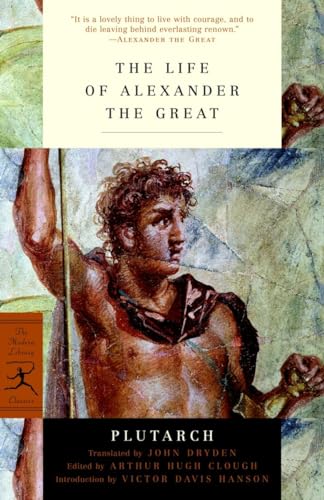
The Life of Alexander the Great is one of the first surviving attempts to memorialize the achievements of this legendary king, remembered today as the greatest military genius of all time. This exclusive Modern Library edition, excerpted from Plutarch’s Lives, is a riveting tale of honor, power, scandal, and bravery written by the most eminent biographer of the ancient world.
Die Inhaltsangabe kann sich auf eine andere Ausgabe dieses Titels beziehen.
Über die Autorin bzw. den Autor
About the Introducer
VICTOR DAVIS HANSON has written extensively on both ancient Greek and military history; his ?fteen books include The Western Way of War and Between War and Peace. He is a senior fellow at the Hoover Institution, Stanford University, and a professor of classics at California State University, Fresno.
Von der hinteren Coverseite
In 336 b.c. Philip of Macedonia was assassinated and his twenty-year-old son, Alexander, inherited his kingdom. Immediately quelling rebellion, Alexander extended his father's empire through-out the Middle East and into parts of Asia, fulfi lling the soothsayer Aristander's prediction that the new king "should perform acts so important and glorious as would make the poets and musicians of future ages labour and sweat to describe and celebrate him."
The Life of Alexander the Great is one of the fi rst surviving attempts to memorialize the achievements of this legendary king, remembered today as the greatest military genius of all time. This exclusive Modern Library edition, excerpted from Plutarch's Lives, is a riveting tale of honor, power, scandal, and bravery written by the most eminent biographer of the ancient world.
Auszug. © Genehmigter Nachdruck. Alle Rechte vorbehalten.
It being my purpose to write the lives of Alexander the king, and of Cæsar, by whom Pompey was destroyed, the multitude of their great actions affords so large a field that I were to blame if I should not by way of apology forewarn my reader that I have chosen rather to epitomise the most celebrated parts of their story, than to insist at large on every particular circumstance of it. It must be borne in mind that my design is not to write histories, but lives. And the most glorious exploits do not always furnish us with the clearest discoveries of virtue or vice in men; sometimes a matter of less moment, an expression or a jest, informs us better of their characters and inclinations, than the most famous sieges, the greatest armaments, or the bloodiest battles whatsoever. Therefore as portrait-painters are more exact in the lines and features of the face, in which the character is seen, than in the other parts of the body, so I must be allowed to give my more particular attention to the marks and indications of the souls of men, and while I endeavour by these to portray their lives, may be free to leave more weighty matters and great battles to be treated of by others.
It is agreed on by all hands, that on the father’s side, Alexander descended from Hercules by Caranus, and from Æacus by Neoptolemus on the mother’s side. His father Philip, being in Samothrace, when he was quite young, fell in love there with Olympias, in company with whom he was initiated in the religious ceremonies of the country, and her father and mother being both dead, soon after, with the consent of her brother, Arymbas, he married her. The night before the consummation of their marriage, she dreamed that a thunderbolt fell upon her body, which kindled a great fire, whose divided flames dispersed themselves all about, and then were extinguished. And Philip, some time after he was married, dreamt that he sealed up his wife’s body with a seal, whose impression, as he fancied, was the figure of a lion. Some of the diviners interpreted this as a warning to Philip to look narrowly to his wife; but Aristander of Telmessus, considering how unusual it was to seal up anything that was empty, assured him the meaning of his dream was that the queen was with child of a boy, who would one day prove as stout and courageous as a lion. Once, moreover, a serpent was found lying by Olympias as she slept, which more than anything else, it is said, abated Philip’s passion for her; and whether he feared her as an enchantress, or thought she had commerce with some god, and so looked on himself as excluded, he was ever after less fond of her conversation. Others say, that the women of this country having always been extremely addicted to the enthusiastic Orphic rites, and the wild worship of Bacchus (upon which account they were called Clodones, and Mimallones), imitated in many things the practices of the Edonian and Thracian women about Mount Hæmus, from whom the word threskeuein seems to have been derived, as a special term for superfluous and over-curious forms of adoration; and that Olympias, zealously affecting these fanatical and enthusiastic inspirations, to perform them with more barbaric dread, was wont in the dances proper to these ceremonies to have great tame serpents about her, which sometimes creeping out of the ivy in the mystic fans, sometimes winding themselves about the sacred spears, and the women’s chaplets, made a spectacle which men could not look upon without terror.
Philip, after this vision, sent Chæron of Megalopolis to consult the oracle of Apollo at Delphi, by which he was commanded to perform sacrifice, and henceforth pay particular honour, above all other gods, to Ammon; and was told he should one day lose that eye with which he presumed to peep through that chink of the door, when he saw the god, under the form of a serpent, in the company of his wife. Eratosthenes says that Olympias, when she attended Alexander on his way to the army in his first expedition, told him the secret of his birth, and bade him behave himself with courage suitable to his divine extraction. Others again affirm that she wholly disclaimed any pretensions of the kind, and was wont to say, “When will Alexander leave off slandering me to Juno?” Alexander was born the sixth of Hecatombæon, which month the Macedonians call Lous, the same day that the temple of Diana at Ephesus was burnt; which Hegesias of Magnesia makes the occasion of a conceit, frigid enough to have stopped the conflagration. The temple, he says, took fire and was burnt while its mistress was absent, assisting at the birth of Alexander. And all the Eastern soothsayers who happened to be then at Ephesus, looking upon the ruin of this temple to be the forerunner of some other calamity, ran about the town, beating their faces, and crying that this day had brought forth something that would prove fatal and destructive to all Asia.
Just after Philip had taken Potidæa, he received these three messages at one time, that Parmenio had overthrown the Illyrians in a great battle, that his race-horse had won the course at the Olympic games, and that his wife had given birth to Alexander; with which being naturally well pleased, as an addition to his satisfaction, he was assured by the diviners that a son, whose birth was accompanied with three such successes, could not fail of being invincible.
The statues that gave the best representation of Alexander’s person were those of Lysippus (by whom alone he would suffer his image to be made), those peculiarities which many of his successors afterwards and his friends used to affect to imitate, the inclination of his head a little on one side towards his left shoulder, and his melting eye, having been expressed by this artist with great exactness. But Apelles,
who drew him with thunderbolts in his hand, made his complexion browner and darker than it was naturally; for he was fair and of a light colour, passing into ruddiness in his face and upon his breast. Aristoxenus in his Memoirs tells us that a most agreeable odour exhaled from his skin, and that his breath and body all over was so fragrant as to perfume the clothes which he wore next him; the cause of which might probably be the hot and adust temperament of his body. For sweet smells, Theophrastus conceives, are produced by the concoction of moist humours by heat, which is the reason that those parts of the world which are driest and most burnt up afford spices of the best kind and in the greatest quantity; for the heat of the sun exhausts all the superfluous moisture which lies in the surface of bodies, ready to generate putrefaction. And this hot constitution, it may be, rendered Alexander so addicted to drinking, and so choleric. His temperance, as to the pleasures of the body, was apparent in him in his very childhood, as he was with much difficulty incited to them, and always used them with great moderation; though in other things he was extremely eager and vehement, and in his love of glory, and the pursuit of it, he showed a solidity of high spirit and magnanimity far above his age. For he neither sought nor valued it upon every occasion, as his father Philip did (who affected to show his eloquence almost to a degree of pedantry, and took care to have the victories of his racing chariots at the Olympic games engraven on his coin), but when he was asked by some about him, whether he would run a race in the Olympic games, as he was very swift-footed, he answered, he would, if he might have kings to run with him. Indeed, he seems in general to have looked with indifference, if not with dislike, upon the professed athletes. He often appointed prizes, for which not only tragedians and musicians, pipers and harpers, but rhapsodists also, strove to outvie one another; and delighted in all manner of hunting and cudgel-playing,...
„Über diesen Titel“ kann sich auf eine andere Ausgabe dieses Titels beziehen.
Suchergebnisse für The Life of Alexander the Great (Modern Library Classics)

Beispielbild für diese ISBN
The Life of Alexander the Great
Anbieter: ThriftBooks-Dallas, Dallas, TX, USA
Verkäuferbewertung 5 von 5 Sternen

Paperback. Zustand: Fair. No Jacket. Readable copy. Pages may have considerable notes/highlighting. ~ ThriftBooks: Read More, Spend Less. Artikel-Nr. G0812971337I5N00
Gebraucht kaufen
EUR 8,08
Versand gratis
Versand innerhalb von USA
Versand innerhalb von USA
Anzahl: 1 verfügbar
Beispielbild für diese ISBN
The Life of Alexander the Great
Anbieter: ThriftBooks-Phoenix, Phoenix, AZ, USA
Verkäuferbewertung 5 von 5 Sternen
Paperback. Zustand: Fair. No Jacket. Readable copy. Pages may have considerable notes/highlighting. ~ ThriftBooks: Read More, Spend Less. Artikel-Nr. G0812971337I5N00
Gebraucht kaufen
EUR 8,08
Versand gratis
Versand innerhalb von USA
Versand innerhalb von USA
Anzahl: 1 verfügbar
Beispielbild für diese ISBN
The Life of Alexander the Great
Anbieter: ThriftBooks-Dallas, Dallas, TX, USA
Verkäuferbewertung 5 von 5 Sternen
Paperback. Zustand: Good. No Jacket. Pages can have notes/highlighting. Spine may show signs of wear. ~ ThriftBooks: Read More, Spend Less. Artikel-Nr. G0812971337I3N00
Gebraucht kaufen
EUR 8,08
Versand gratis
Versand innerhalb von USA
Versand innerhalb von USA
Anzahl: 1 verfügbar
Beispielbild für diese ISBN
The Life of Alexander the Great
Verlag:
Random House Publishing Group, 2004
ISBN 10: 0812971337
ISBN 13: 9780812971330
Gebraucht
Softcover
Anbieter: Better World Books: West, Reno, NV, USA
Verkäuferbewertung 5 von 5 Sternen
Zustand: Very Good. Former library copy. Pages intact with possible writing/highlighting. Binding strong with minor wear. Dust jackets/supplements may not be included. Includes library markings. Stock photo provided. Product includes identifying sticker. Better World Books: Buy Books. Do Good. Artikel-Nr. 13254677-75
Gebraucht kaufen
EUR 9,77
Versand gratis
Versand innerhalb von USA
Versand innerhalb von USA
Anzahl: 1 verfügbar
Beispielbild für diese ISBN
The Life of Alexander the Grea
Anbieter: World of Books (was SecondSale), Montgomery, IL, USA
Verkäuferbewertung 5 von 5 Sternen
Zustand: Good. Item in good condition. Textbooks may not include supplemental items i.e. CDs, access codes etc. Artikel-Nr. 00109957817
Gebraucht kaufen
EUR 10,85
Versand gratis
Versand innerhalb von USA
Versand innerhalb von USA
Anzahl: 1 verfügbar
Beispielbild für diese ISBN
The Life of Alexander the Great (Modern Library Classics)
Verlag:
Modern Library, New York, 2004
ISBN 10: 0812971337
ISBN 13: 9780812971330
Gebraucht
Soft cover
Anbieter: Twice Read Books, Napa, CA, USA
Verkäuferbewertung 4 von 5 Sternen

Soft cover. Zustand: Fine. Like New. Artikel-Nr. 000402
Gebraucht kaufen
EUR 11,50
Versand gratis
Versand innerhalb von USA
Versand innerhalb von USA
Anzahl: 1 verfügbar
Beispielbild für diese ISBN
The Life of Alexander the Great (Modern Library Classics)
Anbieter: Powell's Bookstores Chicago, ABAA, Chicago, IL, USA
Verkäuferbewertung 5 von 5 Sternen
Paperback. Zustand: Used-Very Good. Modern Library Paperback Ed. Pbk. Some shelf-wear. Else clean copy. Artikel-Nr. 1821413
Gebraucht kaufen
EUR 9,33
EUR 6,47 Versand
Versand innerhalb von USA
Versand innerhalb von USA
Anzahl: 1 verfügbar
Beispielbild für diese ISBN
The Life of Alexander the Great (Modern Library Classics)
Anbieter: Revaluation Books, Exeter, Vereinigtes Königreich
Verkäuferbewertung 5 von 5 Sternen
Paperback. Zustand: Brand New. modern library paperback ed edition. 112 pages. 8.00x5.25x0.25 inches. In Stock. Artikel-Nr. __0812971337
Neu kaufen
EUR 10,11
EUR 11,66 Versand
Versand von Vereinigtes Königreich nach USA
Versand von Vereinigtes Königreich nach USA
Anzahl: 1 verfügbar
Beispielbild für diese ISBN
The Life of Alexander the Great
Anbieter: Kennys Bookstore, Olney, MD, USA
Verkäuferbewertung 5 von 5 Sternen
Zustand: New. Series: Modern Library. Num Pages: 112 pages. BIC Classification: 1QDAG; BGH; HBJD; HBLA. Category: (G) General (US: Trade); (U) Tertiary Education (US: College). Dimension: 200 x 130 x 8. Weight in Grams: 120. . 2004. Modern Library Paperback Ed. Paperback. . . . . Books ship from the US and Ireland. Artikel-Nr. V9780812971330
Neu kaufen
EUR 16,24
EUR 9,05 Versand
Versand innerhalb von USA
Versand innerhalb von USA
Anzahl: 15 verfügbar
Beispielbild für diese ISBN
The Life of Alexander the Great (Modern Library Classics)
Anbieter: Revaluation Books, Exeter, Vereinigtes Königreich
Verkäuferbewertung 5 von 5 Sternen
Paperback. Zustand: Brand New. modern library paperback ed edition. 112 pages. 8.00x5.25x0.25 inches. In Stock. Artikel-Nr. zk0812971337
Neu kaufen
EUR 18,47
EUR 11,66 Versand
Versand von Vereinigtes Königreich nach USA
Versand von Vereinigtes Königreich nach USA
Anzahl: 1 verfügbar