
Verwandte Artikel zu It Happened in Boston?: Introduction by Jonathan Lethem....
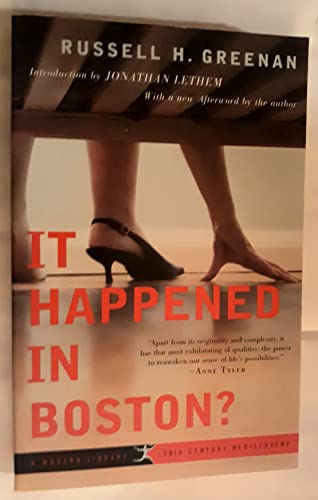
It Happened in Boston?: Introduction by Jonathan Lethem. Afterword by the author (Modern Library Classics) - Softcover
Inhaltsangabe
An obsessed, unconventional artist believes that he has received instructions from Casimir the wizard to kill seven innocent people, in a new edition of an ingenious and witty novel, first published in 1968 and out of print for fifteen years.
Die Inhaltsangabe kann sich auf eine andere Ausgabe dieses Titels beziehen.
Über die Autorin bzw. den Autor
Russell H. Greenan, on his way to becoming a novelist, grew up in the Bronx, served in the navy, sold industrial engines, and ran several curio shops in the Boston area. His thirteen novels include The Secret Life of Algernon Pendleton and The Bric-a-Brac Man.
Jonathan Lethem is the author of six novels, including Motherless Brooklyn, which won the National Book Critics Circle Award, and The Fortress of Solitude.
Von der hinteren Coverseite
First published by Random House in 1968, Russell H. Greenan's "It Happened in Boston? is the story of a brilliantly talented, unbalanced artist who strives to meet God face-to-face in order to destroy Him. It is "a magic spell of a book--phantasmagoric, lushly written, full of unforgettable characters and brilliant twists of plot," writes Jonathan Lethem in his Introduction. With a vivid depiction of the art world and a breathtaking narrative that incorporates forgery, time travel, and murder, Greenan's hilarious and disturbing debut novel--now an underground cult classic--is ripe for rediscovery.
Aus dem Klappentext
First published by Random House in 1968, Russell H. Greenan s It Happened in Boston? is the story of a brilliantly talented, unbalanced artist who strives to meet God face-to-face in order to destroy Him. It is a magic spell of a book phantasmagoric, lushly written, full of unforgettable characters and brilliant twists of plot, writes Jonathan Lethem in his Introduction. With a vivid depiction of the art world and a breathtaking narrative that incorporates forgery, time travel, and murder, Greenan s hilarious and disturbing debut novel now an underground cult classic is ripe for rediscovery.
Auszug. © Genehmigter Nachdruck. Alle Rechte vorbehalten.
From the Afterword, by Russell H. Greenan
1
It’s been thirty-five years since I completed It Happened in Boston? and in that time many people have asked me how I came to write it–a question not easily answered. Since novels have their beginnings early in the author’s life, long meandering roads are usually traveled before the finished product shows up on a bookshelf.
After the Second World War, at Long Island University in Brooklyn, I took my only course in creative writing–a lightweight subject in academia back then. Our astute teacher for that one semester, Mr. Nathan Resnick, kept his instructions simple and did not burden us with grand dicta or clever formulae. A four-hundred-word composition “about what you know” had to be turned in at every session. It would then be evaluated by the teacher privately and discussed in class at the next session.
Because what most college youth “know” is not too exciting, the result was page after page of uninspired realism. After two or three weeks of this, I broke the rules and wrote a four-
hundred-word, obviously fabricated, story–and Mr. Resnick liked it enough to have another student read it aloud to the class. Predictably, someone leaped from his chair and wailed, “That’s fiction, and you told us to write what we know.” But I defended myself by explaining that the story came from my mind, and therefore I must have known all the elements that comprised it. And how could anyone write about things he did not know? Soon thereafter the homework and the discussions became more interesting.
Of course, if a novelist writes an eight-hundred-page story about chasing a bad-tempered whale across the wide Pacific without ever having left his hometown of Lodgepole, South Dakota, the novel probably won’t turn out as true-to-life as Moby-Dick, but that doesn’t necessarily mean it will be devoid of merit. What authors put down on paper springs from their own personal experiences, from all the memories that have gathered over the years in the recesses of their minds, not to mention all the books they have read. Naipaul says that if you want to know who a writer is you don’t read his autobiography, you read his fiction. Autobiographies are full of lies, but storytelling strips you bare. A wise author will never explain his novel. He will tell you the novel explains him.
My desire to write flared up at age six or seven in the Bronx, when my older sister, Bernadette, brought novels about dogs and horses home from the Alexander Avenue branch of the New
York Public Library. Thomas Hinkle was a particular favorite of ours. They were sad stories, but with happy endings–an old plot structure still hard to improve on. To me each was an absorbing trip into an exciting world very different from my own, and I wondered how such vivid marvels could be created by mere human beings. Since then I have been consuming books at a great rate, and have never lost that sense of wonderment.
This revelation occurred in 1931. We lived in a cold-water railroad flat, 354 East 144th Street, between Willis and Third Avenue. There was no bathroom or shower–I performed my weekly ablutions in a portable washtub that held about three gallons of water–and our toilet, set in a separate alcove, had to be shared with whoever occupied the apartment next door. A cast-iron coal- or wood-burning stove heated the kitchen in the wintertime, but the other three rooms were Novaya Zemlya frigid.
Children in a family–I had three older siblings–handle poverty amazingly well, as long as they have a roof over their heads and aren’t starving. If our old oaken icebox was usually empty, my mother nevertheless always managed to put a meal on the table. Those meals improved quantitatively when the Home Relief program was established.
To a twenty-first-century American all this may sound like Gorky’s The Lower Depths, but it was actually a stimulating time and place for a kid to grow up. Next to the house next to ours there was a four-story stable, complete with a blacksmith you could watch noisily hammering red-hot horseshoes on his anvil, or nailing the shoes to the hooves of the weary old nags who were his clients. These beasts pulled the peddlers’ wagons that roamed the streets of New York, providing people with fresh fruits and vegetables–a custom that vanished during the Second World War. The wagons were stored in a big livery yard across the road. I liked that stable very much, but in the summer months horseflies were a nuisance. And the occasional dead equine, left on the street for several days before the sanitation department got around to hauling it off using a sling and a winch, could have a deleterious effect on the neighborhood air quality.
Another neat attraction loomed just beyond the stable: the Third Avenue el, which cut through the middle of the block in order to meet the Harlem River bridge to Manhattan. Because of their proximity, these trains were difficult to ignore. Aside from the loud rumble and the screech of the brakes as the cars entered the 143rd Street station–particularly harrowing at night when you were trying to sleep–the constant vibrations seemed to threaten our wood-framed house with imminent collapse.
An empty tenement around the corner gave the local kids a nice venue in which to play hide-and-seek, until one day two classmates of mine found an unfortunate man hanging from a gaslight fixture over a flight of stairs. Afterward the house was considered haunted and we never entered the place again. Littleboy’s suicide had its origin in the memory of that incident.
My father’s work picked up in 1935–he tuned pianos at the Hardman & Peck factory on West 57th Street in Manhattan–so we moved from 144th Street to 155th between Elton and Melrose, a classier neighborhood where all the apartments had steam heat, hot water, a private toilet, and real bathtubs. And the el was a block and a half away, so we barely heard it.
2
I passed blithely through the New York Public School system–PS 31, PS 38, PS 51, and Morris High–served in the Navy during the war, received a B.A. from LIU thanks to the G.I. Bill, and got a job as a parts man at a machinery distributor. When someone in their Boston office returned to the Navy for the Korean War, I eagerly accepted the company’s offer to replace him.
In 1950 Boston had the beguiling look of a European city. Its one tall building, the original John Hancock, had been constructed only a few years earlier and was something less than a skyscraper. I soon became very fond of the old Yankee town–of its Back Bay mansions, its Charles River, Public Garden, the Common, the libraries, the museums, the winding streets. Outsiders often possess an objectivity that allows them to see a place clearer than the locals do.
For a few years I was a traveling salesman in Maine, New Hampshire, and Vermont, but, ever restless, I quit the machinery company and opened an antique shop in Harvard Square, hoping to set up a business that someone else could eventually run for me. On the imagined profits from this operation I could then go to Europe and write a novel. The imagined profits remained that way, however, and my Cambridge venture failed. I opened another store called Back Bay Bric-a-Brac on Newbury Street, Boston’s art gallery district. Much of the material and atmosphere in It Happened in Boston? derives from those days, from the time I spent dealing with pickers, auctioneers, artists, restorers, and other members of the antique fraternity. But Back Bay Bric-a-Brac, despite its catchy name, did not succeed, either, and by then I was thirty-three, in debt, and married with three children. I...
„Über diesen Titel“ kann sich auf eine andere Ausgabe dieses Titels beziehen.
Suchergebnisse für It Happened in Boston?: Introduction by Jonathan Lethem....

Beispielbild für diese ISBN
It Happened in Boston?
Anbieter: World of Books (was SecondSale), Montgomery, IL, USA
Verkäuferbewertung 5 von 5 Sternen

Paperback. Zustand: Fair. Originally published in 1968 to critical acclaim, Russell H. Greenan s brilliant, audacious mystery novel It Happened in Boston? quickly became an underground sensation and has emerged over forty years later as a genuine cult classic. In this breathtakingly imaginative book now appearing in audio for the first time we enter the mind of an unnamed artist of prodigious talent and intelligence who is determined to correct the world s wrongs via a direct confrontation with the Almighty, no matter what the consequences. A spellbinding tale told by a memorably unreliable narrator, It Happened in Boston? places you inside a vivid world that brilliantly and surprisingly interweaves art, genius, love, madness, betrayal, God and murder.In 2003 IHIB? was reprinted by the Modern Library with a new introduction by celebrated writer Jonathan Lethem and an afterword by the author, both included in this audio version. Artikel-Nr. 00103730118
Gebraucht kaufen
EUR 7,44
Versand gratis
Versand innerhalb von USA
Versand innerhalb von USA
Anzahl: 1 verfügbar
Beispielbild für diese ISBN
It Happened in Boston?
Anbieter: World of Books (was SecondSale), Montgomery, IL, USA
Verkäuferbewertung 5 von 5 Sternen
Paperback. Zustand: Good. Originally published in 1968 to critical acclaim, Russell H. Greenan s brilliant, audacious mystery novel It Happened in Boston? quickly became an underground sensation and has emerged over forty years later as a genuine cult classic. In this breathtakingly imaginative book now appearing in audio for the first time we enter the mind of an unnamed artist of prodigious talent and intelligence who is determined to correct the world s wrongs via a direct confrontation with the Almighty, no matter what the consequences. A spellbinding tale told by a memorably unreliable narrator, It Happened in Boston? places you inside a vivid world that brilliantly and surprisingly interweaves art, genius, love, madness, betrayal, God and murder.In 2003 IHIB? was reprinted by the Modern Library with a new introduction by celebrated writer Jonathan Lethem and an afterword by the author, both included in this audio version. Artikel-Nr. 00110664074
Gebraucht kaufen
EUR 7,44
Versand gratis
Versand innerhalb von USA
Versand innerhalb von USA
Anzahl: 1 verfügbar
Beispielbild für diese ISBN
It Happened in Boston?
Anbieter: ThriftBooks-Dallas, Dallas, TX, USA
Verkäuferbewertung 5 von 5 Sternen
Paperback. Zustand: Fair. No Jacket. Readable copy. Pages may have considerable notes/highlighting. ~ ThriftBooks: Read More, Spend Less. Artikel-Nr. G0812970667I5N00
Gebraucht kaufen
EUR 9,14
Versand gratis
Versand innerhalb von USA
Versand innerhalb von USA
Anzahl: 1 verfügbar
Beispielbild für diese ISBN
It Happened in Boston?
Anbieter: ThriftBooks-Atlanta, AUSTELL, GA, USA
Verkäuferbewertung 5 von 5 Sternen
Paperback. Zustand: Good. No Jacket. Pages can have notes/highlighting. Spine may show signs of wear. ~ ThriftBooks: Read More, Spend Less. Artikel-Nr. G0812970667I3N00
Gebraucht kaufen
EUR 9,14
Versand gratis
Versand innerhalb von USA
Versand innerhalb von USA
Anzahl: 1 verfügbar
Beispielbild für diese ISBN
It Happened in Boston?
Anbieter: ThriftBooks-Atlanta, AUSTELL, GA, USA
Verkäuferbewertung 5 von 5 Sternen
Paperback. Zustand: Very Good. No Jacket. May have limited writing in cover pages. Pages are unmarked. ~ ThriftBooks: Read More, Spend Less. Artikel-Nr. G0812970667I4N00
Gebraucht kaufen
EUR 9,14
Versand gratis
Versand innerhalb von USA
Versand innerhalb von USA
Anzahl: 1 verfügbar
Beispielbild für diese ISBN
It Happened in Boston?
Verlag:
The Modern Library, New York, 2003
ISBN 10: 0812970667
ISBN 13: 9780812970661
Gebraucht
Softcover
Anbieter: The Haunted Bookshop, LLC, Iowa City, IA, USA
Verkäuferbewertung 5 von 5 Sternen
Softcover. Zustand: Good+. Zustand des Schutzumschlags: No Dust Jacket. Artikel-Nr. 00093247
Gebraucht kaufen
EUR 5,89
EUR 4,84 Versand
Versand innerhalb von USA
Versand innerhalb von USA
Anzahl: 1 verfügbar
Beispielbild für diese ISBN
It Happened in Boston? (20th Century Rediscoveries)
Anbieter: medimops, Berlin, Deutschland
Verkäuferbewertung 5 von 5 Sternen
Zustand: good. Befriedigend/Good: Durchschnittlich erhaltenes Buch bzw. Schutzumschlag mit Gebrauchsspuren, aber vollständigen Seiten. / Describes the average WORN book or dust jacket that has all the pages present. Artikel-Nr. M00812970667-G
Gebraucht kaufen
EUR 12,42
EUR 10,00 Versand
Versand von Deutschland nach USA
Versand von Deutschland nach USA
Anzahl: 1 verfügbar