
Verwandte Artikel zu The Prism and the Pendulum: The Ten Most Beautiful...
Inhaltsangabe
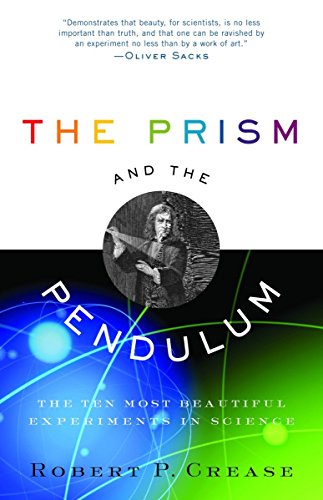
Is science beautiful? Yes, argues acclaimed philosopher and historian of science Robert P. Crease in this engaging exploration of history’s most beautiful experiments. The result is an engrossing journey through nearly 2,500 years of scientific innovation. Along the way, we encounter glimpses into the personalities and creative thinking of some of the field’s most interesting figures.
We see the first measurement of the earth’s circumference, accomplished in the third century B.C. by Eratosthenes using sticks, shadows, and simple geometry. We visit Foucault’s mesmerizing pendulum, a cannonball suspended from the dome of the Panthéon in Paris that allows us to see the rotation of the earth on its axis. We meet Galileo—the only scientist with two experiments in the top ten—brilliantly drawing on his musical training to measure the speed of falling bodies. And we travel to the quantum world, in the most beautiful experiment of all.
We also learn why these ten experiments exert such a powerful hold on our imaginations. From the ancient world to cutting-edge physics, these ten exhilarating moments reveal something fundamental about the world, pulling us out of confusion and revealing nature’s elegance. The Prism and the Pendulum brings us face-to-face with the wonder of science.
Die Inhaltsangabe kann sich auf eine andere Ausgabe dieses Titels beziehen.
Über die Autorin bzw. den Autor
Robert P. Crease is a professor in the Department of Philosophy at Stony Brook University in New York, and historian at Brookhaven National Laboratory. He writes a monthly column, “Critical Point,” for Physics World magazine. His books include Making Physics: A Biography of Brookhaven National Laboratory; The Play of Nature: Experimentation as Performance; The Second Creation: Makers of the Revolution in Twentieth-Century Physics (with Charles C. Mann); and—with Robert Serber—Peace & War: Reminiscences of a Life on the Frontiers of Science. Crease’s translations include American Philosophy of Technology: The Empirical Turn. He lectures widely, and his articles and reviews have appeared in The Atlantic Monthly, The New York Times Magazine, The Wall Street Journal, Smithsonian, and elsewhere. He lives in New York City.
Von der hinteren Coverseite
Is science beautiful? Yes, argues acclaimed philosopher and historian of science Robert P. Crease in this engaging exploration of history's most beautiful experiments. The result is an engrossing journey through nearly 2,500 years of scientific innovation. Along the way, we encounter glimpses into the personalities and creative thinking of some of the field's most interesting figures.
We see the first measurement of the earth's circumference, accomplished in the third century B.C. by Eratosthenes using sticks, shadows, and simple geometry. We visit Foucault's mesmerizing pendulum, a cannonball suspended from the dome of the Pantheon in Paris that allows us to see the rotation of the earth on its axis. We meet Galileo--the only scientist with two experiments in the top ten--brilliantly drawing on his musical training to measure the speed of falling bodies. And we travel to the quantum world, in the most beautiful experiment of all.
We also learn why these ten experiments exert such a powerful hold on our imaginations. From the ancient world to cutting-edge physics, these ten exhilarating moments reveal something fundamental about the world, pulling us out of confusion and revealing nature's elegance. "The Prism and the Pendulum brings us face-to-face with the wonder of science.
"From the Hardcover edition.
Aus dem Klappentext
Is science beautiful? Yes, argues acclaimed philosopher and historian of science Robert P. Crease in this engaging exploration of history s most beautiful experiments. The result is an engrossing journey through nearly 2,500 years of scientific innovation. Along the way, we encounter glimpses into the personalities and creative thinking of some of the field s most interesting figures.
We see the first measurement of the earth s circumference, accomplished in the third century B.C. by Eratosthenes using sticks, shadows, and simple geometry. We visit Foucault s mesmerizing pendulum, a cannonball suspended from the dome of the Panthéon in Paris that allows us to see the rotation of the earth on its axis. We meet Galileo the only scientist with two experiments in the top ten brilliantly drawing on his musical training to measure the speed of falling bodies. And we travel to the quantum world, in the most beautiful experiment of all.
We also learn why these ten experiments exert such a powerful hold on our imaginations. From the ancient world to cutting-edge physics, these ten exhilarating moments reveal something fundamental about the world, pulling us out of confusion and revealing nature s elegance. The Prism and the Pendulum brings us face-to-face with the wonder of science.
From the Hardcover edition.
Auszug. © Genehmigter Nachdruck. Alle Rechte vorbehalten.
Chapter One
MEASURING THE WORLD: Eratosthenes' Measurement of the Earth's Circumference
IN THE THIRD CENTURY B.C., A GREEK SCHOLAR NAMED Eratosthenes (ca. 276-ca. 195 b.c.) made the first known measurement of the size of the earth. His tools were simple: the shadow cast by the pointer of a sundial, plus a set of measurements and assumptions. But the measurement was so ingenious that it would be cited authoritatively for hundreds of years. It is so simple and instructive that it is reenacted annually, almost 2,500 years later, by schoolchildren all around the globe. And the principle is so elegant that grasping it all but makes you want to go measure the length of a shadow.
Eratosthenes' experiment combined two ideas of far-reaching importance. The first was to picture the cosmos as a set of objects (the earth, sun, planets, and stars) in ordinary three-dimensional space. This may seem obvious to us but was not widely believed then; it was a Greek contribution to science to insist that underneath the myriad, ever-changing motions in the world and in the night sky lay an impersonal and changeless order, a cosmic architecture that could be described and explained by geometry. The second idea was to apply ordinary measurement practices to understand the scope and dimensions of this cosmic architecture. In combining these two ideas, Eratosthenes came up with the audacious notion that the same techniques that had been developed for building houses and bridges, laying out fields and roads, and predicting floods and monsoons could provide information about the dimensions of the earth and other heavenly bodies.
Eratosthenes began by assuming that the earth was approximately round. For despite the widespread contemporary belief that Columbus set out to prove that the world was not flat, many of the ancient Greeks who had thought carefully about the cosmos had already concluded that the earth not only had to be round, but also that it must be relatively tiny in comparison with the rest of the universe. Among these scholars was Aristotle, whose book On the Heavens, written about a century before Eratosthenes, advanced several different arguments, some logical and some empirical, for why the earth had to be spherical. Aristotle pointed out, for instance, that during eclipses the shadow cast by the earth on the moon is always curved-something that would occur only if the earth were round. He also noted that travelers see different stars when going north or south (unlikely if the world is flat), that certain stars visible in Egypt and Cyprus cannot be seen in more northern lands, and that certain other stars always visible in the north rise and set in the south, as if they were seen at a distance from the surface of a round object. "This indicates not only that the earth's mass is spherical in shape," Aristotle wrote, "but also that as compared with the stars it is not of great size."
But the resourceful thinker also offered more creative arguments. From accounts by foreign travelers and military expeditions, he knew that elephants were found in distant lands both to the east (Africa) and to the west (Asia). Therefore, he said, these lands are probably joined-a clever if incorrect guess. Other Greek scholars made additional arguments for the earth's spherical shape, including the difference in the time of sunrise and sunset in different countries, and the way departing ships gradually fall out of sight from the hull upward.
None of this, though, answered a basic question: How big is this round earth? Was it even possible to know its size, without having surveyors actually pace over its entire circumference?
Until Eratosthenes, we know of only estimates of the earth's size. The earliest is by Aristotle, who wrote that "those mathematicians who try to calculate the size of the Earth's circumference arrive at the figure 400,000 stades," but he did not tell us either his sources or their reasoning. It is also impossible to convert his figure precisely to modern units. A stade, or "stadium," referred to the length of a Greek racetrack, which varied from city to city. By using a rough estimate for the stade, today's researchers have put Aristotle's figure at somewhat more than 40,000 miles (the actual number is about 24,900 miles). Archimedes, who built models of the cosmos in which the heavenly bodies revolved around one another, gave a slightly smaller estimate than Aristotle's: 300,000 stades, or more than 30,000 miles. But he, too, provided no clue to his source or reasoning.
Enter Eratosthenes. A younger contemporary of Archimedes, Eratosthenes was born in North Africa and educated in Athens. He was a polymath, expert in many areas from literary criticism and poetry to geography and mathematics. But he was not thought to have achieved the first rank in any, which led associates to give him the sarcastic nickname "Beta," the second letter of the Greek alphabet, in a joke meaning he was always second best. Despite the gibes, his brilliance was so renowned that in the middle of the third century b.c. the king of Egypt invited Eratosthenes to tutor his son, and later appointed him to head the famous library at Alexandria. This was the first and largest library of its kind, and had been established by the Ptolemys, the kings of Egypt, in the course of building up Alexandria as the cultural capital of the Greek world. The library became a meeting point for scholars around the world, and Alexandria grew into an important intellectual crossroads-it was home to Euclid and his school, for instance. At Alexandria, the librarians were able to amass a comprehensive collection of manuscripts on a wide range of subjects that anyone with the appropriate scholarly credentials could use. (The Alexandrian library was also the first one known to have arranged manuscripts by author in alphabetical order.)
Eratosthenes wrote two books on geography that were of particular importance in the ancient world. Geographica, a three-volume set, was the first to map the world using parallels (lines parallel to the equator) and meridians (longitudinal lines, which pass through both poles and a given location). His Measurement of the World contained the first known description of a way to measure the size of the earth. Unfortunately, both works have been lost, and we have to reconstruct Eratosthenes' reasoning from the remarks of other ancient authors who knew them. Fortunately, many did.
Eratosthenes began by reasoning that if the earth were a small, spherical body in a vast universe, then other parts, such as the sun, must be far away-so far away that its rays were essentially parallel no matter where they struck the earth. He also knew that as the sun crept upward in the sky, shadows grew progressively shorter-and he knew from travelers' reports that on the summer solstice in the town of Syene (modern-day Aswan), the sun stood directly overhead, and shadows would disappear around anything vertical, including columns, poles, and even gnomons, the vertical indicators or pointers in sundials, whose sole function was to cast shadows. Shadows even seemed to disappear from the town well as the light flooded it uniformly, "like a stopper fitting evenly all round to the mouth," according to one ancient source. (I exaggerate a little; the shadows did not disappear completely, but simply fell straight below objects, rather than off to the side as they usually do.)
Furthermore, Eratosthenes knew that Alexandria was north of Syene and roughly on the same meridian. And thanks to the royal surveyors, whom the Egyptian government sent to pace and remap the land each year after the seasonal flooding of the Nile, he knew that the two towns were about five thousand stades apart (the number was rounded off, so we cannot use this information to establish a precise...
„Über diesen Titel“ kann sich auf eine andere Ausgabe dieses Titels beziehen.
Suchergebnisse für The Prism and the Pendulum: The Ten Most Beautiful...

Beispielbild für diese ISBN
The Prism and the Pendulum: Th
Verlag:
Random House Trade Paperbacks, 2004
ISBN 10: 0812970624
ISBN 13: 9780812970623
Gebraucht
Softcover
Anbieter: World of Books (was SecondSale), Montgomery, IL, USA
Verkäuferbewertung 5 von 5 Sternen

Zustand: Good. Item in good condition. Textbooks may not include supplemental items i.e. CDs, access codes etc. Artikel-Nr. 00104677179
Gebraucht kaufen
EUR 4,52
Versand gratis
Versand innerhalb von USA
Versand innerhalb von USA
Anzahl: 2 verfügbar
Beispielbild für diese ISBN
The Prism and the Pendulum: The Ten Most Beautiful Experiments in Science
Verlag:
Random House Trade Paperbacks, 2004
ISBN 10: 0812970624
ISBN 13: 9780812970623
Gebraucht
Softcover
Anbieter: Wonder Book, Frederick, MD, USA
Verkäuferbewertung 5 von 5 Sternen
Zustand: Very Good. Very Good condition. A copy that may have a few cosmetic defects. May also contain light spine creasing or a few markings such as an owner's name, short gifter's inscription or light stamp. Bundled media such as CDs, DVDs, floppy disks or access codes may not be included. Artikel-Nr. P04K-00463
Gebraucht kaufen
EUR 6,43
Versand gratis
Versand innerhalb von USA
Versand innerhalb von USA
Anzahl: 1 verfügbar
Beispielbild für diese ISBN
The Prism and the Pendulum: The Ten Most Beautiful Experiments in Science
Verlag:
Random House Trade Paperbacks, 2004
ISBN 10: 0812970624
ISBN 13: 9780812970623
Gebraucht
Softcover
Anbieter: Wonder Book, Frederick, MD, USA
Verkäuferbewertung 5 von 5 Sternen
Zustand: Good. Good condition. A copy that has been read but remains intact. May contain markings such as bookplates, stamps, limited notes and highlighting, or a few light stains. Artikel-Nr. Y02H-00112
Gebraucht kaufen
EUR 6,43
Versand gratis
Versand innerhalb von USA
Versand innerhalb von USA
Anzahl: 1 verfügbar
Beispielbild für diese ISBN
The Prism and the Pendulum : The Ten Most Beautiful Experiments in Science
Verlag:
Random House Publishing Group, 2004
ISBN 10: 0812970624
ISBN 13: 9780812970623
Gebraucht
Softcover
Anbieter: Better World Books, Mishawaka, IN, USA
Verkäuferbewertung 5 von 5 Sternen
Zustand: Good. Reprint. Pages intact with minimal writing/highlighting. The binding may be loose and creased. Dust jackets/supplements are not included. Stock photo provided. Product includes identifying sticker. Better World Books: Buy Books. Do Good. Artikel-Nr. 4867059-75
Gebraucht kaufen
EUR 6,57
Versand gratis
Versand innerhalb von USA
Versand innerhalb von USA
Anzahl: 3 verfügbar
Beispielbild für diese ISBN
The Prism and the Pendulum : The Ten Most Beautiful Experiments in Science
Verlag:
Random House Publishing Group, 2004
ISBN 10: 0812970624
ISBN 13: 9780812970623
Gebraucht
Softcover
Anbieter: Better World Books, Mishawaka, IN, USA
Verkäuferbewertung 5 von 5 Sternen
Zustand: Very Good. Reprint. Former library copy. Pages intact with possible writing/highlighting. Binding strong with minor wear. Dust jackets/supplements may not be included. Includes library markings. Stock photo provided. Product includes identifying sticker. Better World Books: Buy Books. Do Good. Artikel-Nr. GRP67604554
Gebraucht kaufen
EUR 6,57
Versand gratis
Versand innerhalb von USA
Versand innerhalb von USA
Anzahl: 1 verfügbar
Beispielbild für diese ISBN
The Prism and the Pendulum : The Ten Most Beautiful Experiments in Science
Verlag:
Random House Publishing Group, 2004
ISBN 10: 0812970624
ISBN 13: 9780812970623
Gebraucht
Softcover
Anbieter: Better World Books: West, Reno, NV, USA
Verkäuferbewertung 5 von 5 Sternen
Zustand: Very Good. Reprint. Former library copy. Pages intact with possible writing/highlighting. Binding strong with minor wear. Dust jackets/supplements may not be included. Includes library markings. Stock photo provided. Product includes identifying sticker. Better World Books: Buy Books. Do Good. Artikel-Nr. GRP67604554
Gebraucht kaufen
EUR 6,57
Versand gratis
Versand innerhalb von USA
Versand innerhalb von USA
Anzahl: 1 verfügbar
Beispielbild für diese ISBN
The Prism and the Pendulum : The Ten Most Beautiful Experiments in Science
Verlag:
Random House Publishing Group, 2004
ISBN 10: 0812970624
ISBN 13: 9780812970623
Gebraucht
Softcover
Anbieter: Better World Books, Mishawaka, IN, USA
Verkäuferbewertung 5 von 5 Sternen
Zustand: Very Good. Reprint. Pages intact with possible writing/highlighting. Binding strong with minor wear. Dust jackets/supplements may not be included. Stock photo provided. Product includes identifying sticker. Better World Books: Buy Books. Do Good. Artikel-Nr. 10809269-6
Gebraucht kaufen
EUR 6,57
Versand gratis
Versand innerhalb von USA
Versand innerhalb von USA
Anzahl: 1 verfügbar
Beispielbild für diese ISBN
The Prism and the Pendulum: The Ten Most Beautiful Experiments in Science
Anbieter: ThriftBooks-Atlanta, AUSTELL, GA, USA
Verkäuferbewertung 5 von 5 Sternen
Paperback. Zustand: Fair. No Jacket. Readable copy. Pages may have considerable notes/highlighting. ~ ThriftBooks: Read More, Spend Less. Artikel-Nr. G0812970624I5N00
Gebraucht kaufen
EUR 6,87
Versand gratis
Versand innerhalb von USA
Versand innerhalb von USA
Anzahl: 1 verfügbar
Beispielbild für diese ISBN
The Prism and the Pendulum: The Ten Most Beautiful Experiments in Science
Anbieter: ThriftBooks-Dallas, Dallas, TX, USA
Verkäuferbewertung 5 von 5 Sternen
Paperback. Zustand: As New. No Jacket. Pages are clean and are not marred by notes or folds of any kind. ~ ThriftBooks: Read More, Spend Less. Artikel-Nr. G0812970624I2N00
Gebraucht kaufen
EUR 6,87
Versand gratis
Versand innerhalb von USA
Versand innerhalb von USA
Anzahl: 1 verfügbar
Beispielbild für diese ISBN
The Prism and the Pendulum: The Ten Most Beautiful Experiments in Science
Anbieter: ThriftBooks-Dallas, Dallas, TX, USA
Verkäuferbewertung 5 von 5 Sternen
Paperback. Zustand: Good. No Jacket. Pages can have notes/highlighting. Spine may show signs of wear. ~ ThriftBooks: Read More, Spend Less. Artikel-Nr. G0812970624I3N00
Gebraucht kaufen
EUR 6,87
Versand gratis
Versand innerhalb von USA
Versand innerhalb von USA
Anzahl: 1 verfügbar