
Verwandte Artikel zu Rivers Of Gold: The Rise Of The Spanish Empire, From...
Inhaltsangabe
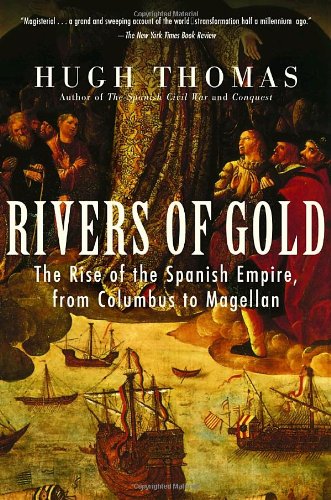
A history of Spain's first thirty years in the Americas traces Columbus's famous pioneering voyage through Magellan's first circumnavigation of the earth, in an account that offers insight into the period's political climate and profiles the era's monarchs and explorers. Reprint. 20,000 first printing.
Die Inhaltsangabe kann sich auf eine andere Ausgabe dieses Titels beziehen.
Über die Autorin bzw. den Autor
HUGH THOMAS is the author of numerous histories, including The Spanish Civil War, for which he won the Somerset Maugham Award, Conquest, and The Slave Trade. His A History of the World won him the Arts Council Prize for History. Made a Lord in 1981, Lord Thomas was educated at Queens’ College, Cambridge, and the Sorbonne.
Auszug. © Genehmigter Nachdruck. Alle Rechte vorbehalten.
Chapter 1
"This city is a wife,
whose husband is the hill"
Stay awhile here on the terrace of the Alhambra and look about you.
This city is a wife, whose husband is the hill.
Girt she is by water and by flowers
Which glisten at her throat,
Ringed with streams; and, behold the groves of trees which are the wedding guests,
Whose thirst is assuaged by the water-channels.
The Alhambra sits like a garland on Granada's brow,
On which the stars are entwined,
And the Alhambra (may God preserve it!)
Is the ruby set above that garland.
Granada is the bride whose headdress is the Alhambra
And whose jewels and adornments are its flowers.
Ibn Zamrak, c. 14501
The Spanish army and the court lay in Andalusia, at Santa Fe, a new white-painted town that King Fernando and Queen Isabel had built to serve their siege of Granada, the last Islamic city in Spain to resist the Christians. It was the autumn of 1491. Those who know the fertile plain, the vega, in which Granada stands, at that season of the year will recall the slight chill on the fine mornings, the blue sky at noon, and the sparkle from the high sierra to the south, with its near-perpetual snow.
Santa Fe had been constructed by soldiers, quickly, in eighty days, in the shape of a gridiron within a cross, four hundred paces long by three hundred broad. Coincidentally, and after Fernando's decision to build, a fire had destroyed the old Spanish camp nearby. The Queen had narrowly escaped being burned in her tent and had had to borrow clothes from a friend. Several villages had been razed by soldiers to provide material for the new town. But Santa Fe now had a mayor, a courtier who had been among the heroes of an earlier stage of the war against Granada: Francisco de Bobadilla, a comendador (commander) of the military Order of Calatrava, one of the semireligious brotherhoods that had played such a part in the Christian reconquest of Spain. Bobadilla was also maestresala (steward) of the monarchs and brother of the Queen's best friend, Beatriz de Bobadilla.3 There were now stables for a thousand horses. The intimation of permanence, combined with the speed with which Santa Fe had been built, constituted a good psychological weapon against the Muslims.
Santa Fe is still today a small, shining, white town. One can stand in the square before the church of Santa María de la Encarnación, built in the sixteenth century, and gaze, in four directions, down whitewashed streets. Gates surmounted by chapels stand at the center of each of four old external walls, which, in their gleaming paint, seem at once new and immortal. Over the entrance to the church a lance has been sculpted, accompanying the words "¡Ave María!," to recall a Christian knight, Hernán Pérez de Pulgar, "he of the doughty deeds," who, one night the previous winter, had gone to Granada by a secret tunnel in order to pin, with his dagger, a parchment bearing those same words over the entrance to the main mosque.
Pulgar's action recalled that the conflict against the Muslims in which the Christians were engaged was for many a noble war in which men wanted to be seen to be brave. Most of the aristocracy of Spain had taken part, and many were competing not only for the conquest of the Muslim city, but also for fame.
Granada, 2,500 feet above sea level, is six miles to the east of Santa Fe. From the Spanish camp, the city looked to be a congeries of palaces and small houses, provided with water from the nearby Sierra Nevada by the two rivers, the Xenil and the Darro, which were said to wed, as well as meet, just short of the city. "What has Cairo to boast of, with her Nile, when Granada has her thousand Niles?" Muslim poets asked. From tall minarets, above mosques that the Christians believed would soon be converted into churches, the muezzin called the faithful to prayer; but the Spanish monarchs, eight years before, had obtained from the tolerant Genoese Pope, Innocent VIII, the right of patronage to all the churches and convents established in conquered territory. Spanish soldiers on reconnaissance could look into the besieged city: rest their eyes on the Arch of the Ears, and on the Plaza del Arenal, not to speak of the Bibarrambla, a quarter of artisans, and a densely built residential district, El Albaicín.
The city was more like those of Muslim North Africa than of Christian Spain, as one or two experienced Spanish soldiers would have been able to recall. The beauty of Granada's blue tiles could not be seen from afar; nor could the Christians see such mottoes in Arabic as "Be not the indolent one" or "There is no conqueror but God," nor even "Blessed be He who gave to the Imam Mohammed a mansion which exceeds all others in beauty." But the rumor of the wealth in Granada was diffused in the Christian camp. Some Castilians thought that there was gold in the River Darro; while the more hardheaded Spanish commanders knew that Granada's principal product was silk, sometimes brought raw from Italy but usually deriving from the mulberries of the valley of the Alpujarras to the south, beyond the Sierra Nevada, and sold in many colors in the market of la alcaicería.
Higher up, there was the Moorish kings' lovely, rambling palace of the Alhambra, mostly built in the thirteenth and fourteenth centuries, much of the work performed by Christian slaves. Again, from the Spanish camp, one could not see the multitude of arches leading there from one magnificent room to another. But one could glimpse the strong towers and the wooden galleries that linked them. Higher still, at the end of a path bordered by myrtle and bay, there were the beautiful gardens of the Generalife, full of remarkable fruits, where splendid fountains flowed, or so the spies said.
In the town, the besiegers could observe too the strange apparel of a multitude of men and women in Muslim dress, since the latter, in burkas, appeared to be wearing shrouds, these covering not just their bodies but most of their faces. At night, they resembled ghosts. Here, too, were refugees who had fled from the Christians after earlier battles, from other cities, but also people who had refused to live as subject Muslims (mudéjares), under the peace terms offered in such places as Huéscar, Zahara, Malaga, Alcalá de los Gazules, and Antequera.
At that time, only a few of their counterparts, Christians who had survived through the generations of Mohammedan rule, mozárabes, lived in Granada; most of those who once had lived there had been deported, being perceived by the rulers as a potential military threat. There were some Jews in Granada, but their customs, like their food and official language, were largely Muslim. They fitted better into the life of the city than the Christians.
Granada was the capital of an emirate that had come into being in the thirteenth century, in the shadow of the fall of other Muslim monarchies in Córdoba, Valencia, Jaén, and Seville. The emirs were from a family, the Nasrids, which had emerged in the 1240s when a clever general from the little town of Arjona, in central Andalusia, seven miles south of Andújar, made himself a monarch, as Muhammad I. He made peace with the Christians, sent five hundred men to help King Fernando capture Seville, and paid a tribute to the Castilians. That relation continued indefinitely: Granada sent gold to Castile until 1480 in order to be allowed to continue her separate being, though whether that constituted what the Christians called "vassaldom" is open to argument.
The city under siege in 1491 was the last stronghold of a Muslim empire that had once stretched to the Pyrenees and beyond, and had included such northern...
„Über diesen Titel“ kann sich auf eine andere Ausgabe dieses Titels beziehen.
Suchergebnisse für Rivers Of Gold: The Rise Of The Spanish Empire, From...

Beispielbild für diese ISBN
Rivers of Gold: The Rise of the Spanish Empire, from Columbus to Magellan
Verlag:
Random House Trade Paperbacks, 2005
ISBN 10: 0812970551
ISBN 13: 9780812970555
Gebraucht
Paperback
Anbieter: ThriftBooks-Dallas, Dallas, TX, USA
Verkäuferbewertung 5 von 5 Sternen

Paperback. Zustand: Fair. No Jacket. Readable copy. Pages may have considerable notes/highlighting. ~ ThriftBooks: Read More, Spend Less. Artikel-Nr. G0812970551I5N00
Gebraucht kaufen
EUR 7,20
Versand gratis
Versand innerhalb von USA
Versand innerhalb von USA
Anzahl: 1 verfügbar
Beispielbild für diese ISBN
Rivers of Gold : The Rise of the Spanish Empire, from Columbus to Magellan
Verlag:
Random House Publishing Group, 2005
ISBN 10: 0812970551
ISBN 13: 9780812970555
Gebraucht
Softcover
Anbieter: Better World Books, Mishawaka, IN, USA
Verkäuferbewertung 5 von 5 Sternen
Zustand: Good. Former library copy. Pages intact with minimal writing/highlighting. The binding may be loose and creased. Dust jackets/supplements are not included. Includes library markings. Stock photo provided. Product includes identifying sticker. Better World Books: Buy Books. Do Good. Artikel-Nr. 15023778-6
Gebraucht kaufen
EUR 10,65
Versand gratis
Versand innerhalb von USA
Versand innerhalb von USA
Anzahl: 2 verfügbar
Beispielbild für diese ISBN
Rivers Of Gold The Rise Of The Spanish Empire, From Columbus To Magellan
Verlag:
Random House Trade Paperbacks, 2005
ISBN 10: 0812970551
ISBN 13: 9780812970555
Gebraucht
Paperback
Anbieter: Powell's Bookstores Chicago, ABAA, Chicago, IL, USA
Verkäuferbewertung 5 von 5 Sternen
Paperback. Zustand: Very Good. Minimal shelf wear, clean internals. Remainder mark. Artikel-Nr. 2052280
Gebraucht kaufen
EUR 14,26
EUR 4,46 Versand
Versand innerhalb von USA
Versand innerhalb von USA
Anzahl: 8 verfügbar
Foto des Verkäufers
Rivers of Gold: The Rise of the Spanish Empire, from Columbus to Magellan
Verlag:
Random House Trade, 2005
ISBN 10: 0812970551
ISBN 13: 9780812970555
Gebraucht
Trade Paperback
Erstausgabe
Anbieter: Southampton Books, Sag Harbor, NY, USA
Verkäuferbewertung 5 von 5 Sternen
Trade Paperback. Zustand: Like New. First Edition. First Edition, First Printing. Not price-clipped ($17.95 price intact). Published by Random House, 2003. Octavo. Paperback. Book is like new. 100% positive feedback. 30 day money back guarantee. NEXT DAY SHIPPING! Excellent customer service. Please email with any questions or if you would like a photo. All books packed carefully and ship with free delivery confirmation/tracking. All books come with free bookmarks. Ships from Sag Harbor, New York. Artikel-Nr. 189610
Gebraucht kaufen
EUR 18,39
EUR 4,46 Versand
Versand innerhalb von USA
Versand innerhalb von USA
Anzahl: 1 verfügbar
Foto des Verkäufers
Rivers of Gold. The Rise Of The Spanish Empire, from Columbus to Magellan.
Verlag:
Random House, New York,, 2003
ISBN 10: 0812970551
ISBN 13: 9780812970555
Gebraucht
Softcover
Anbieter: FIRENZELIBRI SRL, Reggello, FI, Italien
Verkäuferbewertung 5 von 5 Sternen
Zustand: MOLTO BUONO. New York, Random House cm.15x23, pp.696, illsutraz. e tavole bianco e nero e a colori, brossura con copertina figurata a colori. Testo in inglese. A history of Spain's first thirty years in the Americas traces Columbus's famous pioneering voyage through Magellan's first circumnavigation of the earth, in an account that offers insight into the period's political climate and profiles the era's monarchs and explorers. Artikel-Nr. 329554
Gebraucht kaufen
EUR 7,00
EUR 20,00 Versand
Versand von Italien nach USA
Versand von Italien nach USA
Anzahl: 1 verfügbar
Beispielbild für diese ISBN
Rivers of Gold: The Rise of the Spanish Empire, from Columbus to Magellan
Anbieter: Anybook.com, Lincoln, Vereinigtes Königreich
Verkäuferbewertung 5 von 5 Sternen
Zustand: Good. This is an ex-library book and may have the usual library/used-book markings inside.This book has soft covers. In good all round condition. Please note the Image in this listing is a stock photo and may not match the covers of the actual item,900grams, ISBN:9780812970555. Artikel-Nr. 7859479
Gebraucht kaufen
EUR 14,52
EUR 15,38 Versand
Versand von Vereinigtes Königreich nach USA
Versand von Vereinigtes Königreich nach USA
Anzahl: 1 verfügbar
Foto des Verkäufers
Rivers of Gold: The Rise of the Spanish Empire, from Columbus to Magellan
Verlag:
Random House Trade Paperbacks, 2005
ISBN 10: 0812970551
ISBN 13: 9780812970555
Gebraucht
Soft cover
Anbieter: TASALCO Books & Maps, Coburg North, VIC, Australien
Verkäuferbewertung 5 von 5 Sternen
Soft cover. Zustand: As New. Condition: As New. Volume 1 in a triologly of books on Spain, the Americas & the Habsburgs. Am selling all 3, buy them all & combine postage? Artikel-Nr. ABE-1786357321145
Gebraucht kaufen
EUR 23,69
EUR 37,50 Versand
Versand von Australien nach USA
Versand von Australien nach USA
Anzahl: 1 verfügbar
Beispielbild für diese ISBN
Rivers Of Gold: The Rise Of The Spanish Empire, From Columbus To Magellan
Anbieter: Revaluation Books, Exeter, Vereinigtes Königreich
Verkäuferbewertung 5 von 5 Sternen
Paperback. Zustand: Brand New. reprint edition. 696 pages. 8.25x5.75x1.50 inches. In Stock. Artikel-Nr. 0812970551
Neu kaufen
EUR 63,52
EUR 14,75 Versand
Versand von Vereinigtes Königreich nach USA
Versand von Vereinigtes Königreich nach USA
Anzahl: 1 verfügbar