
Verwandte Artikel zu The Lost Girl: A Novel (Modern Library Classics)
Inhaltsangabe
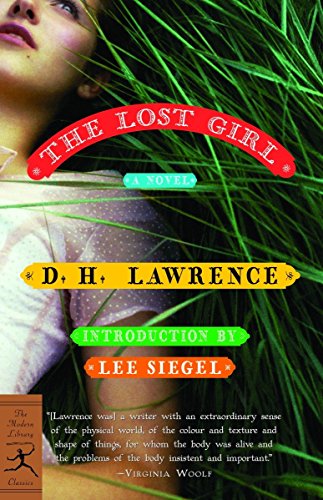
The Lost Girl, D. H. Lawrence’s forgotten novel, is a passionate tale of longing and sexual defiance, of devastation and destitution.
Alvina Houghton, the daughter of a widowed Midlands draper, comes of age just as her father’s business is failing. In a desperate attempt to regain his fortune and secure his daughter’s proper upbringing, James Houghton buys a theater. Among the traveling performers he employs is Ciccio, a sensual Italian who immediately captures Alvina’s attention. Fleeing with him to Naples, she leaves her safe world behind and enters one of sexual awakening, desire, and fleeting freedom.
Die Inhaltsangabe kann sich auf eine andere Ausgabe dieses Titels beziehen.
Über die Autorin bzw. den Autor
Lee Siegel is a critic and essayist living in New York City, whose writing about literature, art, politics, film, and television has appeared in Harper's, The New Republic, Time, The Atlantic Monthly, and The New Yorker, among other publications. He received the 2002 National Magazine Award for Reviews and Criticism.
Von der hinteren Coverseite
"The Lost Girl, D. H. Lawrence's forgotten novel, is a passionate tale of longing and sexual defiance, of devastation and destitution.
Alvina Houghton, the daughter of a widowed Midlands draper, comes of age just as her father's business is failing. In a desperate attempt to regain his fortune and secure his daughter's proper upbringing, James Houghton buys a theater. Among the traveling performers he employs is Ciccio, a sensual Italian who immediately captures Alvina's attention. Fleeing with him to Naples, she leaves her safe world behind and enters one of sexual awakening, desire, and fleeting freedom.
Aus dem Klappentext
The Lost Girl, D. H. Lawrences forgotten novel, is a passionate tale of longing and sexual defiance, of devastation and destitution.
Alvina Houghton, the daughter of a widowed Midlands draper, comes of age just as her fathers business is failing. In a desperate attempt to regain his fortune and secure his daughters proper upbringing, James Houghton buys a theater. Among the traveling performers he employs is Ciccio, a sensual Italian who immediately captures Alvinas attention. Fleeing with him to Naples, she leaves her safe world behind and enters one of sexual awakening, desire, and fleeting freedom.
Auszug. © Genehmigter Nachdruck. Alle Rechte vorbehalten.
CHAPTER I
The Decline of Manchester House
Take a mining townlet like Woodhouse, with a population of ten thousand people, and three generations behind it. This space of three generations argues a certain well-established society. The old “County”1 has fled from the sight of so much disembowelled coal, to flourish on mineral rights in regions still idyllic. Remains one great and inaccessible magnate, the local coal owner: three generations old, and clambering on the bottom step of the “County,” kicking off the mass below. Rule him out.
A well established society in Woodhouse, full of fine shades, ranging from the dark of coal-dust to grit of stone-mason and sawdust of timber-merchant, through the lustre of lard and butter and meat, to the perfume of the chemist and the disinfectant of the doctor, on to the serene gold-tarnish of bank-managers, cashiers for the firm, clergymen and such-like, as far as the automobile refulgence of the general-manager of all the collieries. Here the ne plus ultra. The general manager lives in the shrubberied seclusion of the so-called Manor. The genuine Hall, abandoned by the “County,” has been taken over as offices by the firm.
Here we are then: a vast substratum of colliers; a thick sprinkling of tradespeople intermingled with small employers of labour and diversified by elementary schoolmasters and nonconformist clergy; a higher layer of bank-managers, rich millers and well-to-do ironmasters, episcopal clergy and the managers of collieries, then the rich and sticky cherry of the local coal-owner glistening over all.
Such the complicated social system of a small industrial town in the Midlands of England, in this year of grace 1920. But let us go back a little. Such it was in the last calm year of plenty, 1913.
A calm year of plenty. But one chronic and dreary malady: that of the odd women.2 Why, in the name of all prosperity, should every class but the lowest in such a society hang overburdened with Dead Sea fruit of odd women, unmarried, unmarriageable women, called old maids? Why is it that every tradesman, every school-master, every bank-manager, and every clergyman produces one, two, three or more old maids? Do the middle-classes, particularly the lower middle-classes, give birth to more girls than boys? Or do the lower middle-class men assiduously climb up or down, in marriage, thus leaving their true partners stranded? Or are middle-class women very squeamish in their choice of husbands?
However it be, it is a tragedy. Or perhaps it is not.
Perhaps these unmarried women of the middle-classes are the famous sexless-workers of our ant-industrial society, of which we hear so much. Perhaps all they lack is an occupation: in short, a job. But perhaps we might hear their own opinion, before we lay the law down.
In Woodhouse, there was a terrible crop of old maids among the “nobs,” the tradespeople and the clergy. The whole town of women, colliers’ wives and all, held its breath as it saw a chance of one of these daughters of comfort and woe getting off. They flocked to the well-to-do weddings with an intoxication of relief. For let class-jealousy be what it may, a woman hates to see another woman left stalely on the shelf, without a chance. They all wanted the middle-class girls to find husbands. Every one wanted it, including the girls themselves. Hence the dismalness.
Now James Houghton3 had only one child: his daughter Alvina.4 Surely Alvina Houghton——
But let us retreat to the early eighties, when Alvina was a baby: or even further back, to the palmy days of James Houghton. In his palmy days, James Houghton was crême de la crême of Woodhouse society. The house of Houghton had always been well-to-do: tradespeople, we must admit; but after a few generations of affluence, tradespeople acquire a distinct cachet. Now James Houghton, at the age of twenty-eight, inherited a splendid business in Manchester goods,5 in Woodhouse. He was a tall, thin, elegant young man with side-whiskers, genuinely refined, somewhat in the Bulwer style.6 He had a taste for elegant conversation and elegant literature and elegant Christianity: a tall, thin, brittle young man, rather fluttering in his manner, full of facile ideas, and with a beautiful speaking voice: most beautiful. Withal, of course, a tradesman. He courted a small, dark woman, older than himself, daughter of a Derbyshire squire. He expected to get at least ten thousand pounds with her. In which he was disappointed, for he got only eight hundred. Being of a romantic-commercial nature, he never forgave her, but always treated her with the most elegant courtesy. To see him peel and prepare an apple for her was an exquisite sight. But that peeled and quartered apple was her portion. This elegant Adam of commerce gave Eve her own back, nicely cored, and had no more to do with her. Meanwhile Alvina was born.
Before all this, however, before his marriage, James Houghton had built Manchester House. It was a vast square building—vast, that is, for Woodhouse—standing on the main street and highroad of the small but growing town. The lower front consisted of two fine shops, one for Manchester goods, one for silk and woollens. This was James Hough- ton’s commercial poem.
For James Houghton was a dreamer, and something of a poet: commercial, be it understood. He liked the novels of George Macdonald,7 and the fantasies of that author, extremely. He wove one continual fantasy for himself, a fantasy of commerce. He dreamed of silks and poplins, luscious in texture and of unforeseen exquisiteness: he dreamed of carriages of the “County” arrested before his windows, of exquisite women ruffling charmed, entranced to his counter. And charming, entrancing, he served them his lovely fabrics, which only he and they could sufficiently appreciate. His fame spread, until Alexandra, Princess of Wales, and Elizabeth, Empress of Austria,8 the two best-dressed women in Europe, floated down from heaven to the shop in Woodhouse, and sallied forth to show what could be done by purchasing from James Houghton.
We cannot say why James Houghton failed to become the Liberty or the Snelgrove of his day.9 Perhaps he had too much imagination. Be that as it may, in those early days when he brought his wife to her new home, his window on the Manchester side was a foam and a mayblossom of muslins and prints, his window on the London side was an autumn evening of silks and rich fabrics. What wife could fail to be dazzled! But she, poor darling, from her stone hall in stony Derbyshire, was a little bit repulsed by the man’s dancing in front of his stock, like David before the ark.
The home to which he brought her was a monument. In the great bedroom over the shop he had his furniture built: built of solid mahogany: oh too, too solid. No doubt he hopped or skipped himself with satisfaction into the monstrous matrimonial bed: it could only be mounted by means of a stool and chair. But the poor, secluded little woman, older than he, must have climbed up with a heavy heart, to lie and face the gloomy Bastille of mahogany, the great cupboard opposite, or to turn wearily sideways to the great cheval mirror, which performed a perpetual and hideous bow before her grace. Such furniture! It could never be removed from the room.
The little child was born in the second year. And then James Houghton decamped to a small, half-furnished bedroom at the other end of the house, where he slept on a rough board and played the anchorite for the rest of his days. His wife was left alone with her baby and the built-in furniture. She developed heart disease, as a result of nervous repressions.
But like a butterfly James fluttered over his fabrics. He was a tyrant to his shop-girls. No French marquis in a...
„Über diesen Titel“ kann sich auf eine andere Ausgabe dieses Titels beziehen.
Suchergebnisse für The Lost Girl: A Novel (Modern Library Classics)

Beispielbild für diese ISBN
The Lost Girl: A Novel (Modern Library Classics)
Verlag:
Random House Publishing Group (edition ), 2003
ISBN 10: 0812969979
ISBN 13: 9780812969979
Gebraucht
Paperback
Anbieter: BooksRun, Philadelphia, PA, USA
Verkäuferbewertung 5 von 5 Sternen

Paperback. Zustand: Fair. The item might be beaten up but readable. May contain markings or highlighting, as well as stains, bent corners, or any other major defect, but the text is not obscured in any way. Artikel-Nr. 0812969979-7-1
Gebraucht kaufen
EUR 5,33
Versand gratis
Versand innerhalb von USA
Versand innerhalb von USA
Anzahl: 1 verfügbar
Beispielbild für diese ISBN
The Lost Girl
Anbieter: ThriftBooks-Atlanta, AUSTELL, GA, USA
Verkäuferbewertung 5 von 5 Sternen
Paperback. Zustand: Very Good. No Jacket. May have limited writing in cover pages. Pages are unmarked. ~ ThriftBooks: Read More, Spend Less. Artikel-Nr. G0812969979I4N00
Gebraucht kaufen
EUR 6,45
Versand gratis
Versand innerhalb von USA
Versand innerhalb von USA
Anzahl: 1 verfügbar
Beispielbild für diese ISBN
The Lost Girl
Verlag:
Penguin Random House LLC (No Starch), 2003
ISBN 10: 0812969979
ISBN 13: 9780812969979
Gebraucht
Paperback
Anbieter: ThriftBooks-Atlanta, AUSTELL, GA, USA
Verkäuferbewertung 5 von 5 Sternen
Paperback. Zustand: Fair. No Jacket. Readable copy. Pages may have considerable notes/highlighting. ~ ThriftBooks: Read More, Spend Less. Artikel-Nr. G0812969979I5N00
Gebraucht kaufen
EUR 6,45
Versand gratis
Versand innerhalb von USA
Versand innerhalb von USA
Anzahl: 1 verfügbar
Beispielbild für diese ISBN
The Lost Girl : A Novel
Verlag:
Random House Publishing Group, 2003
ISBN 10: 0812969979
ISBN 13: 9780812969979
Gebraucht
Softcover
Anbieter: Better World Books, Mishawaka, IN, USA
Verkäuferbewertung 5 von 5 Sternen
Zustand: Fine. Reprint. Used book that is in almost brand-new condition. May contain a remainder mark. Better World Books: Buy Books. Do Good. Artikel-Nr. 57970875-6
Gebraucht kaufen
EUR 7,18
Versand gratis
Versand innerhalb von USA
Versand innerhalb von USA
Anzahl: 1 verfügbar
Beispielbild für diese ISBN
The Lost Girl : A Novel
Verlag:
Random House Publishing Group, 2003
ISBN 10: 0812969979
ISBN 13: 9780812969979
Gebraucht
Softcover
Anbieter: Better World Books, Mishawaka, IN, USA
Verkäuferbewertung 5 von 5 Sternen
Zustand: Good. Reprint. Former library copy. Pages intact with minimal writing/highlighting. The binding may be loose and creased. Dust jackets/supplements are not included. Includes library markings. Stock photo provided. Product includes identifying sticker. Better World Books: Buy Books. Do Good. Artikel-Nr. 4921800-75
Gebraucht kaufen
EUR 7,18
Versand gratis
Versand innerhalb von USA
Versand innerhalb von USA
Anzahl: 1 verfügbar
Beispielbild für diese ISBN
The Lost Girl (Modern Library) (Modern Library Classics): A Novel
Anbieter: AwesomeBooks, Wallingford, Vereinigtes Königreich
Verkäuferbewertung 5 von 5 Sternen
Paperback. Zustand: Very Good. The Lost Girl (Modern Library) (Modern Library Classics): A Novel This book is in very good condition and will be shipped within 24 hours of ordering. The cover may have some limited signs of wear but the pages are clean, intact and the spine remains undamaged. This book has clearly been well maintained and looked after thus far. Money back guarantee if you are not satisfied. See all our books here, order more than 1 book and get discounted shipping. Artikel-Nr. 7719-9780812969979
Gebraucht kaufen
EUR 4,81
EUR 4,83 Versand
Versand von Vereinigtes Königreich nach USA
Versand von Vereinigtes Königreich nach USA
Anzahl: 2 verfügbar
Beispielbild für diese ISBN
The Lost Girl: A Novel (Modern Library Classics)
Verlag:
Random House USA Inc, United States, 2003
ISBN 10: 0812969979
ISBN 13: 9780812969979
Gebraucht
Paperback
Anbieter: WorldofBooks, Goring-By-Sea, WS, Vereinigtes Königreich
Verkäuferbewertung 5 von 5 Sternen
Paperback. Zustand: Very Good. The book has been read, but is in excellent condition. Pages are intact and not marred by notes or highlighting. The spine remains undamaged. Artikel-Nr. GOR002890242
Gebraucht kaufen
EUR 3,38
EUR 6,57 Versand
Versand von Vereinigtes Königreich nach USA
Versand von Vereinigtes Königreich nach USA
Anzahl: 1 verfügbar
Beispielbild für diese ISBN
The Lost Girl : A Novel
Verlag:
Random House Publishing Group, 2003
ISBN 10: 0812969979
ISBN 13: 9780812969979
Gebraucht
Softcover
Anbieter: Better World Books Ltd, Dunfermline, Vereinigtes Königreich
Verkäuferbewertung 5 von 5 Sternen
Zustand: Very Good. Reprint. Former library copy. Pages intact with possible writing/highlighting. Binding strong with minor wear. Dust jackets/supplements may not be included. Includes library markings. Stock photo provided. Product includes identifying sticker. Better World Books: Buy Books. Do Good. Artikel-Nr. GRP81245334
Gebraucht kaufen
EUR 5,70
EUR 5,87 Versand
Versand von Vereinigtes Königreich nach USA
Versand von Vereinigtes Königreich nach USA
Anzahl: 1 verfügbar
Beispielbild für diese ISBN
The Lost Girl (Modern Library) (Modern Library Classics): A Novel
Anbieter: Bahamut Media, Reading, Vereinigtes Königreich
Verkäuferbewertung 4 von 5 Sternen

Paperback. Zustand: Very Good. This book is in very good condition and will be shipped within 24 hours of ordering. The cover may have some limited signs of wear but the pages are clean, intact and the spine remains undamaged. This book has clearly been well maintained and looked after thus far. Money back guarantee if you are not satisfied. See all our books here, order more than 1 book and get discounted shipping. Artikel-Nr. 6545-9780812969979
Gebraucht kaufen
EUR 5,17
EUR 8,19 Versand
Versand von Vereinigtes Königreich nach USA
Versand von Vereinigtes Königreich nach USA
Anzahl: 2 verfügbar
Beispielbild für diese ISBN
The Lost Girl: A Novel (Modern Library Classics)
Anbieter: Powell's Bookstores Chicago, ABAA, Chicago, IL, USA
Verkäuferbewertung 5 von 5 Sternen
Paperback. Zustand: Used-Very Good. Pap. Minor shelf wear. Artikel-Nr. 1892602
Gebraucht kaufen
EUR 9,62
EUR 4,45 Versand
Versand innerhalb von USA
Versand innerhalb von USA
Anzahl: 1 verfügbar