
Verwandte Artikel zu General George Washington: A Military Life
Inhaltsangabe
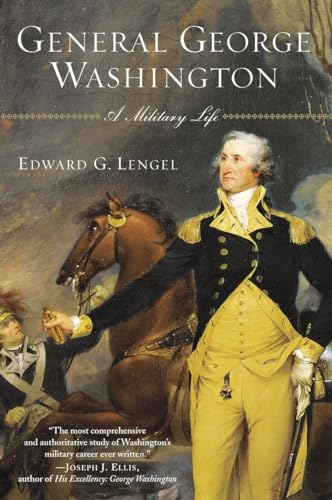
“The most comprehensive and authoritative study of Washington’s military career ever written.”
–Joseph J. Ellis, author of His Excellency: George Washington
Based largely on George Washington’s personal papers, this engrossing book paints a vivid, factual portrait of Washington the soldier. An expert in military history, Edward Lengel demonstrates that the “secret” to Washington’s excellence lay in his completeness, in how he united the military, political, and personal skills necessary to lead a nation in war and peace. Despite being an “imperfect commander”–and at times even a tactically suspect one–Washington nevertheless possessed the requisite combination of vision, integrity, talents, and good fortune to lead America to victory in its war for independence. At once informative and engaging, and filled with some eye-opening revelations about Washington, the American Revolution, and the very nature of military command, General George Washington is a book that reintroduces readers to a figure many think they already know.
“The book’s balanced assessment of Washington is satisfying and thought-provoking. Lengel gives us a believable Washington . . . the most admired man of his generation by far.”
–The Washington Post Book World
“A compelling picture of a man who was ‘the archetypal American soldier’ . . . The sum of his parts was the greatness of Washington.”
–The Boston Globe
“[An] excellent book . . . fresh insights . . . If you have room on your bookshelf for only one book on the Revolution, this may be it.”
–The Washington Times
Die Inhaltsangabe kann sich auf eine andere Ausgabe dieses Titels beziehen.
Über die Autorin bzw. den Autor
EDWARD LENGEL is associate professor of history at the University of Virginia and associate editor of The Papers of George Washington. A specialist in military history, he is the author of World War I Memories and The Irish Through British Eyes.
Von der hinteren Coverseite
Much has been written in the past two centuries about George Washington the statesman and "father of his country." Less often discussed is Washington's military career, including his exploits as a young officer and his performance as the Revolutionary War commander in chief. Now, in a revealing work of historical biography, Edward Lengel has written the definitive account of George Washington the soldier.
Based largely on Washington's personal papers, this engrossing book paints a vivid, factual portrait of a man to whom lore and legend so tenaciously cling. To Lengel, Washington was the imperfect commander. Washington possessed no great tactical ingenuity, and his acknowledged "brilliance in retreat" only demonstrates the role luck plays in the fortunes of all great men. He was not an enlisted man's leader; he made a point of never mingling with his troops. He was not an especially creative military thinker; he fought largely by the book.
He was not a professional, but a citizen soldier, who, at a time when warfare demanded that armies maneuver efficiently in precise formation, had little practical training handling men in combat. Yet despite his flaws, Washington was a remarkable figure, a true man of the moment, a leader who possessed a clear strategic, national, and continental vision, and who inspired complete loyalty from his fellow revolutionaries, officers, and enlisted men. America could never have won freedom without him.
A trained surveyor, Washington mastered topography and used his superior knowledge of battlegrounds to maximum effect. He appreciated the importance of good allies in times of crisis, and understood well the benefits of coordination of ground andnaval forces. Like the American nation itself, he was a whole that was greater than the sum of its parts-a remarkable everyman whose acts determined the course of history. Lengel argues that Washington's excellence was in his completeness, in how he united the military, political, and personal skills necessary to lead a nation in war and peace.
At once informative and engaging, and filled with some eye-opening revelations about Washington, the war for American independence, and the very nature of military command, General George Washington is a book that reintroduces readers to a figure many think they already know.
Auszug. © Genehmigter Nachdruck. Alle Rechte vorbehalten.
1
YOUNG FRONTIERSMAN
May 1741 – February 1753 At the end of May 1741, a young American officer stood sweltering on the sun-baked deck of a warship off the coast of Jamaica. Transports full of red-coated soldiers surrounded him, clogging the horizon with wooden hulls, masts, and sails that announced the presence of a British expeditionary army. As a captain in the provincial infantry, he occupied only a small corner of that army, and counted for little; but as an American he felt proud to participate in Great Britain’s glorious military tradition. Or at least he had at first. Now all reason for pride had gone. The army was dying. It had won no laurels, just a watery shroud. Most of the men had perished in the last four months, and disease stalked every survivor. As the American captain watched, daily burials at sea became feasts for frenzied sharks. He had no reason to think that he would not end the same way. Officers enjoyed no immunity to tropical disease or ignominious burial. Like all soldiers, Captain Lawrence Washington found refuge in thoughts of home. He came from Fredericksburg, Virginia, over a thousand miles away. He had not been there in over a year. Letters took weeks to travel each way, and often never arrived at all. Still, writing to his loved ones could make them seem closer, so retreating from the sun to his cabin or a shady place on deck, he turned from the horrors surrounding him, took up a pen, and wrote a letter to his father.
Lawrence Washington wrote as a recent eyewitness to the most important battle of the War of Jenkins’ Ear, and as a participant in its miserable aftermath. Named after the alleged mutilation of English sailor Robert Jenkins, the conflict had started in the summer of 1739 as a minor colonial fray between Great Britain and Spain. The bloodletting centered in the Caribbean, where the British sought to strangle Spain’s communications with the gold and silver mines of South America by snatching some of her outposts. Victors of the war’s early encounters, the British expected to make short work of the decrepit Spanish empire by capturing the important port of Cartagena off the northeast coast of South America. After this, with the Spanish reeling, they expected to move on to seize the even more important settlement of Havana on the island of Cuba. As plans for its Caribbean offensive jelled in 1739, the British government announced its intention to form an American regiment to serve as part of an amphibious army of six marine regiments and other regular units. Virginia, whose governor was appointed to command the regiment, provided the largest number of volunteers when recruitment began in the spring of 1740. The common Virginians made unimpressive soldiers—a British observer called them “Blacksmiths, Tailors, Barbers, Shoemakers, and all the Banditry the colonies afford”—but their officers were privileged, cultured, and generally intelligent young men, anxious to earn good reputations in battle. Sons of the Old Dominion had besieged colonial officials with requests for commissions, and Lawrence Washington was one of the many who lobbied fiercely for the four captaincies available from his colony. Thanks to his family’s influence and his own considerable personal charm, he received the highest-ranking spot.
The newly appointed Captain Washington followed the American Regiment to Jamaica near the end of 1740. At first, his soldiers showed little promise. Like the British redcoats, the American enlisted men came from the scum of society; and the Virginians stood out even in such rough company. Among them were vagrants, loafers, cutpurses, and former convicts. Soldiering did not come naturally to them, as Lawrence and his fellow officers swiftly discovered. They looked bad, too. Only about one in every six of the scrawny, ill-fed men possessed a uniform. British Brigadier General Thomas Wentworth reviewed the Americans on Jamaica in January 1741 and shook his head at the spectacle they presented. Yet there was some innate quality in the common soldiers that he liked. Under proper leadership and discipline, he decided, they might eventually prove useful. For American officers, on the other hand, he expressed complete and unreserved contempt. Branding them naïve and stupid, and certain that they would falter in combat, he attempted to replace them with British regulars. But by then the scruffy American enlisted soldiers had bonded with their young officers, and they bluntly refused to serve under anyone else. Irritated, Wentworth relented, but he privately resolved to keep all of the Americans on shipboard during the approaching campaign. It was inconceivable to him that the redcoats might need their provincial allies’ support. Wentworth commanded the land element of the expeditionary force of 8,000 British regulars and 3,000 Americans that left Jamaica in February 1741. The fleet carrying his troops sailed under Admiral Edward Vernon, a fifty-five-year-old, ill-tempered naval commander known in the fleet as “Grog” because of his grogram cloak. Sailors also applied this nickname to the watered-down rum that he forced upon them. But the ribbing was good- natured. Vernon’s capture of Porto Bello on the Panamanian isthmus in November 1739 had made him a popular hero. Capturing Cartagena would add to his reputation and clear the way for other conquests in the Caribbean. The fleet dropped anchor off Cartagena in early March 1741, and the redcoats quickly debarked, eager to fight. Yet their enthusiasm availed little in the ensuing six weeks as the expedition foundered and disintegrated. The British easily invested the port, but instead of storming its fortifications, Vernon and Wentworth quarreled over the plan of attack.
Finally, after weeks of dithering that left the troops gravely weakened by dysentery and malaria, the British launched a large-scale assault on April 9th. Their officers bungled the advance, and the well-entrenched Spanish refused to budge. Nearly 700 redcoats fell slain without penetrating the enemy entrenchments. The siege then stalled while the British returned to the ships where their American allies had spent the last month languishing in stifling heat. Though spared the horrors of battle, the colonials had not been able to avoid the equally appalling threats of heatstroke, fever, and disease. British surgeons and their assistants—among them a young writer named Tobias Smollett—struggled to care for the sick and wounded, and as soldiers perished in increasing numbers, discipline collapsed. Officers gave up on their duties and avoided their haggard men. The living casually dumped the bodies of dead comrades overboard, strewing the waters of Cartagena with bloated corpses. The trail of bodies led all the way to Jamaica, where the fleet arrived several weeks after abandoning its siege. But that island offered little relief, and the fever epidemic continued unabated. The army’s effective strength rapidly fell to fewer than 2,000 British and just over 1,000 Americans. Captain Lawrence Washington, by some miracle still alive and apparently healthy despite the carnage surrounding him, had the Cartagena fiasco fresh in his mind as he wrote to his father from on board the British warship in May 1741. The crisis continued as he wrote, and the expeditionary force still wasted away. Total disintegration was near. Yet he knew the keen anticipation with which his news-starved family would read his letter. His father would seek war news as well as hints on the state of trade and commerce in the Caribbean. His mother would want to know about Lawrence’s health, and to hear about the fates of other friends and relations. And nine-year-old George, Lawrence’s half brother, would look for descriptions of the roar of the cannon or the sight of infantry boldly...
„Über diesen Titel“ kann sich auf eine andere Ausgabe dieses Titels beziehen.
Suchergebnisse für General George Washington: A Military Life

Beispielbild für diese ISBN
General George Washington: A Military Life
Anbieter: World of Books (was SecondSale), Montgomery, IL, USA
Verkäuferbewertung 5 von 5 Sternen

Paperback. Zustand: Good. The most comprehensive and authoritative study of Washington's military career ever written.-Joseph J. Ellis, author of His Excellency: George Washington Based largely on George Washington's personal papers, this engrossing book paints a vivid, factual portrait of Washington the soldier. An expert in military history, Edward Lengel demonstrates that the secret to Washington's excellence lay in his completeness, in how he united the military, political, and personal skills necessary to lead a nation in war and peace. Despite being an imperfect commander-and at times even a tactically suspect one-Washington nevertheless possessed the requisite combination of vision, integrity, talents, and good fortune to lead America to victory in its war for independence. At once informative and engaging, and filled with some eye-opening revelations about Washington, the American Revolution, and the very nature of military command, General George Washington is a book that reintroduces readers to a figure many think they already know. The book's balanced assessment of Washington is satisfying and thought-provoking. Lengel gives us a believable Washington . . . the most admired man of his generation by far.-The Washington Post Book World A compelling picture of a man who was 'the archetypal American soldier' . . . The sum of his parts was the greatness of Washington.-The Boston Globe An] excellent book . . . fresh insights . . . If you have room on your bookshelf for only one book on the Revolution, this may be it.-The Washington Times. Artikel-Nr. 00102581038
Gebraucht kaufen
EUR 9,10
Versand gratis
Versand innerhalb von USA
Versand innerhalb von USA
Anzahl: 1 verfügbar
Beispielbild für diese ISBN
General George Washington: A Military Life
Anbieter: ThriftBooks-Dallas, Dallas, TX, USA
Verkäuferbewertung 5 von 5 Sternen
Paperback. Zustand: Fair. No Jacket. Readable copy. Pages may have considerable notes/highlighting. ~ ThriftBooks: Read More, Spend Less. Artikel-Nr. G0812969502I5N00
Gebraucht kaufen
EUR 12,76
Versand gratis
Versand innerhalb von USA
Versand innerhalb von USA
Anzahl: 1 verfügbar
Foto des Verkäufers
General George Washington
Verlag:
Random House Publishing Group, 2007
ISBN 10: 0812969502
ISBN 13: 9780812969504
Gebraucht
Softcover
Anbieter: Hamelyn, Madrid, M, Spanien
Verkäuferbewertung 5 von 5 Sternen
Zustand: As New. : Descubre la vida militar de George Washington en esta biografía exhaustiva de Edward G. Lengel. Basado en los documentos personales de Washington, el libro ofrece una visión detallada de su carrera militar, desde sus primeros años como oficial hasta su papel como comandante en jefe durante la Guerra de la Independencia. Lengel presenta a Washington como un líder imperfecto pero notable, cuya visión estratégica y lealtad inspiraron a sus compatriotas a luchar por la libertad. Con revelaciones sobre la guerra y el mando militar, este libro es una reintroducción a una figura histórica clave. EAN: 9780812969504 Tipo: Libros Categoría: Historia Título: General George Washington Autor: Edward G. Lengel Editorial: Random House Publishing Group Idioma: en Páginas: 512 Formato: tapa blanda. Artikel-Nr. Happ-2024-10-04-8d83277d
Gebraucht kaufen
EUR 6,05
EUR 11,99 Versand
Versand von Spanien nach USA
Versand von Spanien nach USA
Anzahl: 1 verfügbar
Beispielbild für diese ISBN
General George Washington: A Military Life
Anbieter: Revaluation Books, Exeter, Vereinigtes Königreich
Verkäuferbewertung 5 von 5 Sternen
Paperback. Zustand: Brand New. reprint edition. 450 pages. 9.25x6.10x1.00 inches. In Stock. Artikel-Nr. x-0812969502
Neu kaufen
EUR 30,88
EUR 11,84 Versand
Versand von Vereinigtes Königreich nach USA
Versand von Vereinigtes Königreich nach USA
Anzahl: 2 verfügbar
Beispielbild für diese ISBN
General George Washington: A Military Life
Anbieter: Majestic Books, Hounslow, Vereinigtes Königreich
Verkäuferbewertung 4 von 5 Sternen

Zustand: New. pp. 516. Artikel-Nr. 7939708
Neu kaufen
EUR 45,89
EUR 7,69 Versand
Versand von Vereinigtes Königreich nach USA
Versand von Vereinigtes Königreich nach USA
Anzahl: 1 verfügbar