
Verwandte Artikel zu All's Well That Ends Well (The RSC Shakespeare)
Inhaltsangabe
“A young man married is a man that’s marr’d.”
—All’s Well That Ends Well
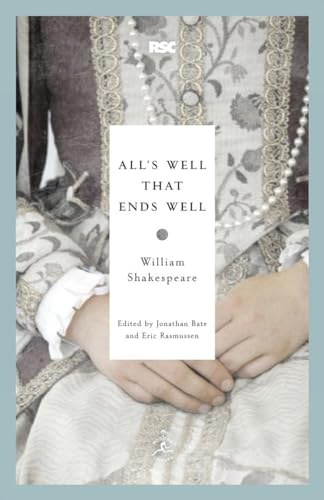
Eminent Shakespearean scholars Jonathan Bate and Eric Rasmussen provide a fresh new edition of this classic play about gender, desire, and sexual love.
THIS VOLUME ALSO INCLUDES MORE THAN A HUNDRED PAGES OF EXCLUSIVE FEATURES:
• an original Introduction to All’s Well That Ends Well
• incisive scene-by-scene synopsis and analysis with vital facts about the work
• commentary on past and current productions based on interviews with leading directors, actors, and designers
• photographs of key RSC productions
• an overview of Shakespeare’s theatrical career and chronology of his plays
Ideal for students, theater professionals, and general readers, these modern and accessible editions from the Royal Shakespeare Company set a new standard in Shakespearean literature for the twenty-first century.
Die Inhaltsangabe kann sich auf eine andere Ausgabe dieses Titels beziehen.
Über die Autorin bzw. den Autor
William Shakespeare (1564–1616) was a poet, playwright, and actor who is widely regarded as one of the most influential writers in the history of the English language. Often referred to as the Bard of Avon, Shakespeare's vast body of work includes comedic, tragic, and historical plays; poems; and 154 sonnets. His dramatic works have been translated into every major language and are performed more often than those of any other playwright.
Jonathan Bate is a professor of Shakespeare and Renaissance literature at the University of Warwick. Widely known as a critic, award-winning biographer, and broadcaster, Bate is the author of several books on Shakespeare. He is also the principal editor of the Modern Library’s and Royal Shakespeare Company’s highly acclaimed William Shakespeare: Complete Works.
Eric Rasmussen, a professor of English at the University of Nevada, is one of today's leading textual experts on Shakespeare.
Auszug. © Genehmigter Nachdruck. Alle Rechte vorbehalten.
All's Well That Ends Well
By William ShakespeareModern Library
Copyright © 2011 William ShakespeareAll right reserved.
ISBN: 9780812969375
Act 1 Scene 1 running scene 1
Enter young Bertram, [the] Count of Rossillion, his mother [the Countess], and Helena, Lord Lafew, all in black
COUNTESS In delivering my son from me, I bury a second husband.
BERTRAM And I in going, madam, weep o'er my father's death anew; but I must attend his majesty's command, to whom I am now in ward, evermore in subjection.
LAFEW You shall find of the king a husband, madam, you, sir, a father. He that so generally is at all times good must of necessity hold his virtue to you, whose worthiness would stir it up where it wanted rather than lack it where there is such abundance.
COUNTESS What hope is there of his majesty's amendment?
LAFEW He hath abandoned his physicians, madam, under whose practices he hath persecuted time with hope, and finds no other advantage in the process but only the losing of hope by time.
COUNTESS This young gentlewoman had a father - O, that 'had'! How sad a passage 'tis! - whose skill was almost as great as his honesty, had it stretched so far, would have made nature immortal, and death should have play for lack of work. Would for the king's sake he were living! I think it would be the death of the king's disease.
LAFEW How called you the man you speak of, madam?
COUNTESS He was famous, sir, in his profession, and it was his great right to be so: Gerard de Narbon.
LAFEW He was excellent indeed, madam. The king very lately spoke of him admiringly and mourningly: he was skilful enough to have lived still, if knowledge could be set up against mortality.
BERTRAM What is it, my good lord, the king languishes of?
LAFEW A fistula, my lord.
BERTRAM I heard not of it before.
LAFEW I would it were not notorious. Was this gentlewoman the daughter of Gerard de Narbon?
COUNTESS His sole child, my lord, and bequeathed to my overlooking. I have those hopes of her good that her education promises her dispositions she inherits, which makes fair gifts fairer. For where an unclean mind carries virtuous qualities, there commendations go with pity, they are virtues and traitors too. In her they are the better for their simpleness; she derives her honesty and achieves her goodness.
LAFEW Your commendations, madam, get from her tears.
COUNTESS 'Tis the best brine a maiden can season her praise in. The remembrance of her father never approaches her heart but the tyranny of her sorrows takes all livelihood from her cheek. No more of this, Helena. Go to, no more, lest it be rather thought you affect a sorrow than to have.
HELEN I do affect a sorrow indeed, but I have it too.
LAFEW Moderate lamentation is the right of the dead, excessive grief the enemy to the living.
COUNTESS If the living be enemy to the grief, the excess makes it soon mortal.
BERTRAM Madam, I desire your holy wishes.
LAFEW How understand we that?
COUNTESS Be thou blest, Bertram, and succeed thy father
In manners as in shape. Thy blood and virtue
Contend for empire in thee, and thy goodness
Share with thy birthright. Love all, trust a few,
Do wrong to none. Be able for thine enemy
Rather in power than use, and keep thy friend
Under thy own life's key. Be checked for silence,
But never taxed for speech. What heaven more will,
That thee may furnish and my prayers pluck down,
Fall on thy head! Farewell.- My lord, To Lafew
'Tis an unseasoned courtier. Good my lord,
Advise him.
LAFEW He cannot want the best
That shall attend his love.
COUNTESS Heaven bless him.- Farewell, Bertram. [Exit]
BERTRAM The best wishes that can be forged in your To Helen
thoughts be servants to you! Be comfortable to my mother, your mistress, and make much of her.
LAFEW Farewell, pretty lady. You must hold the credit of your father. [Exeunt Bertram and Lafew]
HELEN O, were that all! I think not on my father,
And these great tears grace his remembrance more
Than those I shed for him. What was he like?
I have forgot him. My imagination
Carries no favour in't but Bertram's.
I am undone. There is no living, none,
If Bertram be away. 'Twere all one
That I should love a bright particular star
And think to wed it, he is so above me.
In his bright radiance and collateral light
Must I be comforted, not in his sphere;
Th'ambition in my love thus plagues itself:
The hind that would be mated by the lion
Must die for love. 'Twas pretty, though a plague,
To see him every hour, to sit and draw
His archèd brows, his hawking eye, his curls
In our heart's table - heart too capable
Of every line and trick of his sweet favour:
But now he's gone, and my idolatrous fancy
Must sanctify his relics. Who comes here?
Enter Parolles
One that goes with him: I love him for his sake, Aside
And yet I know him a notorious liar,
Think him a great way fool, solely a coward.
Yet these fixed evils sit so fit in him
That they take place when virtue's steely bones
Looks bleak i'th'cold wind. Withal, full oft we see
Cold wisdom waiting on superfluous folly.
PAROLLES Save you, fair queen!
HELEN And you, monarch!
PAROLLES No.
HELEN And no.
PAROLLES Are you meditating on virginity?
HELEN Ay. You have some stain of soldier in you. Let me ask you a question. Man is enemy to virginity: how may we barricado it against him?
PAROLLES Keep him out.
HELEN But he assails, and our virginity, though valiant, in the defence yet is weak. Unfold to us some warlike resistance.
PAROLLES There is none. Man setting down before you will undermine you and blow you up.
HELEN Bless our poor virginity from underminers and blowers up! Is there no military policy how virgins might blow up men?
PAROLLES Virginity being blown down, man will quicklier be blown up. Marry, in blowing him down again, with the breach yourselves made, you lose your city. It is not politic in the commonwealth of nature to preserve virginity. Loss of virginity is rational increase, and there was never virgin got till virginity was first lost. That you were made of is mettle to make virgins. Virginity by being once lost may be ten times found. By being ever kept, it is ever lost. 'Tis too cold a companion. Away with't!
HELEN I will stand for't a little, though therefore I die a virgin.
PAROLLES There's little can be said in't, 'tis against the rule of nature. To speak on the part of virginity is to accuse your mothers, which is most infallible disobedience. He that hangs himself is a virgin: virginity murders itself and should be buried in highways out of all sanctified limit, as a desperate offendress against nature. Virginity breeds mites, much like a cheese, consumes itself to the very paring, and so dies with feeding his own stomach. Besides, virginity is peevish, proud, idle, made of self-love, which is the most inhibited sin in the canon. Keep it not, you cannot choose but lose by't. Out with't! Within ten year it will make itself two, which is a goodly increase, and the principal itself not much the worse. Away with't!
HELEN How might one do, sir, to lose it to her own liking?
PAROLLES Let me see. Marry, ill, to like him that ne'er it likes. 'Tis a commodity will lose the gloss with lying: the...
„Über diesen Titel“ kann sich auf eine andere Ausgabe dieses Titels beziehen.
Suchergebnisse für All's Well That Ends Well (The RSC Shakespeare)

Beispielbild für diese ISBN
All's Well That Ends Well
Verlag:
Random House Publishing Group, 2011
ISBN 10: 0812969375
ISBN 13: 9780812969375
Gebraucht
Softcover
Anbieter: Better World Books: West, Reno, NV, USA
Verkäuferbewertung 5 von 5 Sternen

Zustand: Very Good. Elibron Classics series. Former library copy. Pages intact with possible writing/highlighting. Binding strong with minor wear. Dust jackets/supplements may not be included. Includes library markings. Stock photo provided. Product includes identifying sticker. Better World Books: Buy Books. Do Good. Artikel-Nr. 10318223-6
Gebraucht kaufen
EUR 6,41
Versand gratis
Versand innerhalb von USA
Versand innerhalb von USA
Anzahl: 1 verfügbar
Beispielbild für diese ISBN
All's Well That Ends Well
Verlag:
Random House Publishing Group, 2011
ISBN 10: 0812969375
ISBN 13: 9780812969375
Gebraucht
Softcover
Anbieter: Better World Books, Mishawaka, IN, USA
Verkäuferbewertung 5 von 5 Sternen
Zustand: Very Good. Elibron Classics series. Former library copy. Pages intact with possible writing/highlighting. Binding strong with minor wear. Dust jackets/supplements may not be included. Includes library markings. Stock photo provided. Product includes identifying sticker. Better World Books: Buy Books. Do Good. Artikel-Nr. 10318223-6
Gebraucht kaufen
EUR 6,41
Versand gratis
Versand innerhalb von USA
Versand innerhalb von USA
Anzahl: 1 verfügbar
Beispielbild für diese ISBN
All's Well That Ends Well
Verlag:
Random House Publishing Group, 2011
ISBN 10: 0812969375
ISBN 13: 9780812969375
Gebraucht
Softcover
Anbieter: Better World Books Ltd, Dunfermline, Vereinigtes Königreich
Verkäuferbewertung 5 von 5 Sternen
Zustand: Very Good. Elibron Classics series. Former library copy. Pages intact with possible writing/highlighting. Binding strong with minor wear. Dust jackets/supplements may not be included. Includes library markings. Stock photo provided. Product includes identifying sticker. Better World Books: Buy Books. Do Good. Artikel-Nr. 10318223-6
Gebraucht kaufen
EUR 10,37
EUR 5,83 Versand
Versand von Vereinigtes Königreich nach USA
Versand von Vereinigtes Königreich nach USA
Anzahl: 1 verfügbar
Beispielbild für diese ISBN
All's Well That Ends Well
Anbieter: Revaluation Books, Exeter, Vereinigtes Königreich
Verkäuferbewertung 5 von 5 Sternen
Paperback. Zustand: Brand New. elibron classics series edition. 224 pages. 8.00x5.00x0.50 inches. In Stock. Artikel-Nr. x-0812969375
Neu kaufen
EUR 14,72
EUR 11,66 Versand
Versand von Vereinigtes Königreich nach USA
Versand von Vereinigtes Königreich nach USA
Anzahl: 2 verfügbar
Foto des Verkäufers
All's Well That Ends Well
Verlag:
Penguin Random House LLC Sep 2011, 2011
ISBN 10: 0812969375
ISBN 13: 9780812969375
Neu
Taschenbuch
Anbieter: AHA-BUCH GmbH, Einbeck, Deutschland
Verkäuferbewertung 5 von 5 Sternen
Taschenbuch. Zustand: Neu. Neuware - 'A young man married is a man that's marr'd.'--All's Well That Ends Well >THIS VOLUME ALSO INCLUDES MORE THAN A HUNDRED PAGES OF EXCLUSIVE FEATURES: - an original Introduction to All's Well That Ends Well- incisive scene-by-scene synopsis and analysis with vital facts about the work- commentary on past and current productions based on interviews with leading directors, actors, and designers- photographs of key RSC productions>Ideal for students, theater professionals, and general readers, these modern and accessible editions from the Royal Shakespeare Company set a new standard in Shakespearean literature for the twenty-first century. Artikel-Nr. 9780812969375
Neu kaufen
EUR 24,62
EUR 30,50 Versand
Versand von Deutschland nach USA
Versand von Deutschland nach USA
Anzahl: 2 verfügbar
Foto des Verkäufers
All\ s Well That Ends Well
Anbieter: moluna, Greven, Deutschland
Verkäuferbewertung 5 von 5 Sternen
Zustand: New. Klappentextrnrn A young man married is a man that s marr d. --All s Well That Ends Well Eminent Shakespearean scholars Jonathan Bate and Eric Rasmussen provide a fresh new edition of this classic play about gender, desire, and sexual l. Artikel-Nr. 898782312
Neu kaufen
EUR 15,07
EUR 48,99 Versand
Versand von Deutschland nach USA
Versand von Deutschland nach USA
Anzahl: Mehr als 20 verfügbar