
Verwandte Artikel zu Measure for Measure (The RSC Shakespeare)
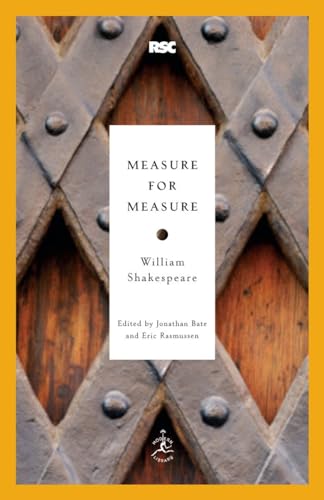
Inhaltsangabe
Eminent Shakespearean scholars Jonathan Bate and Eric Rasmussen provide a fresh new edition of this powerful play that explores sexual hypocrisy and questions morality at all levels of society. This volume also includes more than a hundred pages of exclusive features, including:
• an original Introduction to Measure for Measure
• incisive scene-by-scene synopsis and analysis with vital facts about the work
• commentary on past and current productions based on interviews with leading directors, actors, and designers
• photographs of key RSC productions
• an overview of Shakespeare’s theatrical career and chronology of his plays
Ideal for students, theater professionals, and general readers, these modern and accessible editions from the Royal Shakespeare Company set a new standard in Shakespearean literature for the twenty-first century.
Die Inhaltsangabe kann sich auf eine andere Ausgabe dieses Titels beziehen.
Über die Autorin bzw. den Autor
William Shakespeare was born in Stratford-upon-Avon in April 1564, and his birth is traditionally celebrated on April 23. The facts of his life, known from surviving documents, are sparse. He was one of eight children born to John Shakespeare, a merchant of some standing in his community. William probably went to the King’s New School in Stratford, but he had no university education. In November 1582, at the age of eighteen, he married Anne Hathaway, eight years his senior, who was pregnant with their first child, Susanna. She was born on May 26, 1583. Twins, a boy, Hamnet ( who would die at age eleven), and a girl, Judith, were born in 1585. By 1592 Shakespeare had gone to London working as an actor and already known as a playwright. A rival dramatist, Robert Greene, referred to him as “an upstart crow, beautified with our feathers.” Shakespeare became a principal shareholder and playwright of the successful acting troupe, the Lord Chamberlain’s Men (later under James I, called the King’ s Men). In 1599 the Lord Chamberlain’s Men built and occupied the Globe Theater in Southwark near the Thames River. Here many of Shakespeare’s plays were performed by the most famous actors of his time, including Richard Burbage, Will Kempe, and Robert Armin. In addition to his 37 plays, Shakespeare had a hand in others, including Sir Thomas More and The Two Noble Kinsmen, and he wrote poems, including Venus and Adonis and The Rape of Lucrece. His 154 sonnets were published, probably without his authorization, in 1609. In 1611 or 1612 he gave up his lodgings in London and devoted more and more time to retirement in Stratford, though he continued writing such plays as The Tempest and Henry VII until about 1613. He died on April 23 1616, and was buried in Holy Trinity Church, Stratford. No collected edition of his plays was published during his life-time, but in 1623 two members of his acting company, John Heminges and Henry Condell, put together the great collection now called the First Folio.
Auszug. © Genehmigter Nachdruck. Alle Rechte vorbehalten.
Act 1 Scene 1 running scene 1
Enter Duke, Escalus, Lords [and Attendants]
DUKE Escalus.
ESCALUS My lord.
DUKE Of government the properties to unfold
Would seem in me t'affect speech and discourse,
Since I am put to know that your own science
Exceeds, in that, the lists of all advice
My strength can give you. Then no more remains
But that to your sufficiency as your worth is able,
And let them work. The nature of our people,
Our city's institutions, and the terms
For common justice, you're as pregnant in
As art and practice hath enrichèd any
That we remember. There is our commission, Hands him a paper
From which we would not have you warp. Call hither,
I say, bid come before us Angelo. [Exit an Attendant]
What figure of us think you he will bear?
For you must know, we have with special soul
Elected him our absence to supply;
Lent him our terror, dressed him with our love,
And given his deputation all the organs
Of our own power. What think you of it?
ESCALUS If any in Vienna be of worth
To undergo such ample grace and honour,
It is Lord Angelo.
DUKE Look where he comes.
Enter Angelo
ANGELO Always obedient to your grace's will,
I come to know your pleasure.
DUKE Angelo,
There is a kind of character in thy life
That to th'observer doth thy history
Fully unfold. Thyself and thy belongings
Are not thine own so proper as to waste
Thyself upon thy virtues, they on thee.
Heaven doth with us as we with torches do,
Not light them for themselves: for if our virtues
Did not go forth of us, 'twere all alike
As if we had them not. Spirits are not finely touched
But to fine issues, nor nature never lends
The smallest scruple of her excellence
But, like a thrifty goddess, she determines
Herself the glory of a creditor,
Both thanks and use. But I do bend my speech
To one that can my part in him advertise.
Hold therefore, Angelo.
In our remove be thou at full ourself:
Mortality and mercy in Vienna
Live in thy tongue and heart. Old Escalus,
Though first in question, is thy secondary.
Take thy commission. Offers a paper
ANGELO Now, good my lord,
Let there be some more test made of my mettle,
Before so noble and so great a figure
Be stamped upon it.
DUKE No more evasion.
We have with a leavened and preparèd choice
Proceeded to you: therefore take your honours. Angelo takes
Our haste from hence is of so quick condition paper
That it prefers itself and leaves unquestioned
Matters of needful value. We shall write to you,
As time and our concernings shall importune,
How it goes with us, and do look to know
What doth befall you here. So, fare you well:
To th'hopeful execution do I leave you
Of your commissions.
ANGELO Yet give leave, my lord,
That we may bring you something on the way.
DUKE My haste may not admit it,
Nor need you, on mine honour, have to do
With any scruple. Your scope is as mine own,
So to enforce or qualify the laws
As to your soul seems good. Give me your hand,
I'll privily away. I love the people,
But do not like to stage me to their eyes:
Though it do well, I do not relish well
Their loud applause and aves vehement,
Nor do I think the man of safe discretion
That does affect it. Once more, fare you well.
ANGELO The heavens give safety to your purposes!
ESCALUS Lead forth and bring you back in happiness!
DUKE I thank you. Fare you well. Exit
ESCALUS I shall desire you, sir, to give me leave
To have free speech with you; and it concerns me
To look into the bottom of my place.
A power I have, but of what strength and nature
I am not yet instructed.
ANGELO 'Tis so with me. Let us withdraw together,
And we may soon our satisfaction have
Touching that point.
ESCALUS I'll wait upon your honour. Exeunt
Act 1 Scene 2 running scene 2
Enter Lucio and two other Gentlemen
LUCIO If the duke with the other dukes come not to composition with the King of Hungary, why then all the dukes fall upon the king.
FIRST GENTLEMAN Heaven grant us its peace, but not the King of Hungary's!
SECOND GENTLEMAN Amen.
LUCIO Thou concludest like the sanctimonious pirate, that went to sea with the Ten Commandments, but scraped one out of the table.
SECOND GENTLEMAN 'Thou shalt not steal'?
LUCIO Ay, that he razed.
FIRST GENTLEMAN Why, 'twas a commandment to command the captain and all the rest from their functions: they put forth to steal. There's not a soldier of us all that, in the thanksgiving before meat, do relish the petition well that prays for peace.
SECOND GENTLEMAN I never heard any soldier dislike it.
LUCIO I believe thee; for I think thou never wast where grace was said.
SECOND GENTLEMAN No? A dozen times at least.
FIRST GENTLEMAN What, in metre?
LUCIO In any proportion or in any language.
FIRST GENTLEMAN I think, or in any religion.
LUCIO Ay, why not? Grace is grace, despite of all controversy: as for example, thou thyself art a wicked villain, despite of all grace.
FIRST GENTLEMAN Well, there went but a pair of shears between us.
LUCIO I grant, as there may between the lists and the velvet. Thou art the list.
FIRST GENTLEMAN And thou the velvet. Thou art good velvet; thou'rt a three-piled piece, I warrant thee. I had as lief be a list of an English kersey as be piled, as thou art piled, for a French velvet. Do I speak feelingly now?
LUCIO I think thou dost, and indeed, with most painful feeling of thy speech. I will, out of thine own confession, learn to begin thy health, but, whilst I live, forget to drink after thee.
FIRST GENTLEMAN I think I have done myself wrong, have I not?
SECOND GENTLEMAN Yes, that thou hast, whether thou art tainted or free.
Enter Bawd [Mistress Overdone]
LUCIO Behold, behold, where Madam Mitigation comes! I have purchased as many diseases under her roof as come to-
SECOND GENTLEMAN To what, I pray?
LUCIO Judge.
SECOND GENTLEMAN To three thousand dolours a year.
FIRST GENTLEMAN Ay, and more.
LUCIO A French crown more.
FIRST GENTLEMAN Thou art always figuring diseases in me, but thou art full of error, I am sound.
LUCIO Nay, not as one would say, healthy: but so sound as things that are hollow; thy bones are hollow, impiety has made a feast of thee.
FIRST GENTLEMAN How now! Which of your To Mistress Overdone
hips has the most profound sciatica?
MISTRESS OVERDONE Well, well. There's one yonder arrested and carried to prison was worth five thousand of you all.
SECOND GENTLEMAN Who's that, I pray thee?
MISTRESS OVERDONE Marry, sir, that's Claudio, Signior Claudio.
FIRST GENTLEMAN Claudio to prison? 'Tis not so.
MISTRESS OVERDONE Nay, but I know 'tis so. I saw him arrested, saw him carried away, and, which is more, within these three days his head to be chopped off.
LUCIO But, after all this fooling, I would not have it so. Art thou sure of this?
MISTRESS OVERDONE I am too sure of it. And it is for getting Madam Julietta with child.
LUCIO Believe me, this may be: he promised to meet me two hours since, and he was ever precise in promise-keeping.
SECOND GENTLEMAN Besides, you know, it draws something near to the speech we had to such a purpose.
FIRST GENTLEMAN But most of all agreeing with the proclamation.
LUCIO...
„Über diesen Titel“ kann sich auf eine andere Ausgabe dieses Titels beziehen.
Suchergebnisse für Measure for Measure (The RSC Shakespeare)

Beispielbild für diese ISBN
Measure for Measure
Verlag:
Random House Publishing Group, 2010
ISBN 10: 0812969286
ISBN 13: 9780812969283
Gebraucht
Softcover
Anbieter: Better World Books, Mishawaka, IN, USA
Verkäuferbewertung 5 von 5 Sternen

Zustand: Very Good. Former library copy. Pages intact with possible writing/highlighting. Binding strong with minor wear. Dust jackets/supplements may not be included. Includes library markings. Stock photo provided. Product includes identifying sticker. Better World Books: Buy Books. Do Good. Artikel-Nr. GRP102397377
Gebraucht kaufen
EUR 6,05
Versand gratis
Versand innerhalb von USA
Versand innerhalb von USA
Anzahl: 1 verfügbar
Beispielbild für diese ISBN
Measure for Measure
Verlag:
Random House Publishing Group, 2010
ISBN 10: 0812969286
ISBN 13: 9780812969283
Gebraucht
Softcover
Anbieter: Better World Books, Mishawaka, IN, USA
Verkäuferbewertung 5 von 5 Sternen
Zustand: Very Good. Pages intact with possible writing/highlighting. Binding strong with minor wear. Dust jackets/supplements may not be included. Stock photo provided. Product includes identifying sticker. Better World Books: Buy Books. Do Good. Artikel-Nr. 7651973-6
Gebraucht kaufen
EUR 6,05
Versand gratis
Versand innerhalb von USA
Versand innerhalb von USA
Anzahl: 1 verfügbar
Beispielbild für diese ISBN
Measure for Measure
Verlag:
Random House Publishing Group, 2010
ISBN 10: 0812969286
ISBN 13: 9780812969283
Gebraucht
Softcover
Anbieter: Better World Books Ltd, Dunfermline, Vereinigtes Königreich
Verkäuferbewertung 5 von 5 Sternen
Zustand: Very Good. Former library copy. Pages intact with possible writing/highlighting. Binding strong with minor wear. Dust jackets/supplements may not be included. Includes library markings. Stock photo provided. Product includes identifying sticker. Better World Books: Buy Books. Do Good. Artikel-Nr. GRP102397377
Gebraucht kaufen
EUR 6,11
EUR 5,83 Versand
Versand von Vereinigtes Königreich nach USA
Versand von Vereinigtes Königreich nach USA
Anzahl: 1 verfügbar
Beispielbild für diese ISBN
Measure for Measure
Anbieter: Revaluation Books, Exeter, Vereinigtes Königreich
Verkäuferbewertung 5 von 5 Sternen
Paperback. Zustand: Brand New. reprint edition. 187 pages. 8.00x5.25x0.75 inches. In Stock. Artikel-Nr. x-0812969286
Neu kaufen
EUR 16,84
EUR 11,66 Versand
Versand von Vereinigtes Königreich nach USA
Versand von Vereinigtes Königreich nach USA
Anzahl: 2 verfügbar
Beispielbild für diese ISBN
Measure for Measure
Anbieter: Majestic Books, Hounslow, Vereinigtes Königreich
Verkäuferbewertung 4 von 5 Sternen

Zustand: New. pp. xxv + 187 Illus. Artikel-Nr. 7939589
Neu kaufen
EUR 26,01
EUR 7,58 Versand
Versand von Vereinigtes Königreich nach USA
Versand von Vereinigtes Königreich nach USA
Anzahl: 1 verfügbar
Foto des Verkäufers
Measure for Measure
Verlag:
Penguin Random House LLC Sep 2010, 2010
ISBN 10: 0812969286
ISBN 13: 9780812969283
Neu
Taschenbuch
Anbieter: AHA-BUCH GmbH, Einbeck, Deutschland
Verkäuferbewertung 5 von 5 Sternen
Taschenbuch. Zustand: Neu. Neuware - Eminent Shakespearean scholars Jonathan Bate and Eric Rasmussen provide a fresh new edition of this powerful play that explores sexual hypocrisy and questions morality at all levels of society. This volume also includes more than a hundred pages of exclusive features, including: - an original Introduction to Measure for Measure- incisive scene-by-scene synopsis and analysis with vital facts about the work- commentary on past and current productions based on interviews with leading directors, actors, and designers- photographs of key RSC productions>Ideal for students, theater professionals, and general readers, these modern and accessible editions from the Royal Shakespeare Company set a new standard in Shakespearean literature for the twenty-first century. Artikel-Nr. 9780812969283
Neu kaufen
EUR 27,35
EUR 30,50 Versand
Versand von Deutschland nach USA
Versand von Deutschland nach USA
Anzahl: 2 verfügbar
Foto des Verkäufers
Measure for Measure
Anbieter: moluna, Greven, Deutschland
Verkäuferbewertung 5 von 5 Sternen
Zustand: New. Über den AutorWilliam Shakespeare was born in Stratford-upon-Avon in April 1564, and his birth is traditionally celebrated on April 23. The facts of his life, known from surviving documents, are sparse. He was one of eight children . Artikel-Nr. 898782303
Neu kaufen
EUR 16,52
EUR 48,99 Versand
Versand von Deutschland nach USA
Versand von Deutschland nach USA
Anzahl: Mehr als 20 verfügbar