
Verwandte Artikel zu Apollo's Angels: A History of Ballet
Inhaltsangabe
NEW YORK TIMES BESTSELLER • NAMED ONE OF THE BEST BOOKS OF THE YEAR BY THE NEW YORK TIMES BOOK REVIEW, LOS ANGELES TIMES, SAN FRANCISCO CHRONICLE, AND PUBLISHERS WEEKLY
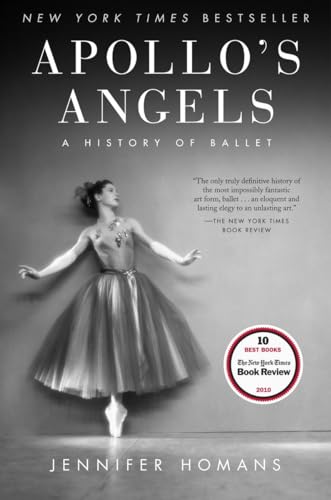
For more than four hundred years, the art of ballet has stood at the center of Western civilization. Its traditions serve as a record of our past. Lavishly illustrated and beautifully told, Apollo’s Angels—the first cultural history of ballet ever written—is a groundbreaking work. From ballet’s origins in the Renaissance and the codification of its basic steps and positions under France’s Louis XIV (himself an avid dancer), the art form wound its way through the courts of Europe, from Paris and Milan to Vienna and St. Petersburg. In the twentieth century, émigré dancers taught their art to a generation in the United States and in Western Europe, setting off a new and radical transformation of dance. Jennifer Homans, a historian, critic, and former professional ballerina, wields a knowledge of dance born of dedicated practice. Her admiration and love for the ballet, as Entertainment Weekly notes, brings “a dancer’s grace and sure-footed agility to the page.”
Die Inhaltsangabe kann sich auf eine andere Ausgabe dieses Titels beziehen.
Über die Autorin bzw. den Autor
Jennifer Homans was a professional dancer trained at the North Carolina School of the Arts, American Ballet Theatre, and The School of American Ballet. She performed with the Chicago Lyric Opera Ballet, the San Francisco Ballet, and Pacific Northwest Ballet. Currently the dance critic for The New Republic, she has written for The New York Times, the International Herald Tribune, The New York Review of Books, and The Australian. She earned her B.A. at Columbia University and her Ph.D. in modern European history at New York University, where she is a Distinguished Scholar in Residence.
Auszug. © Genehmigter Nachdruck. Alle Rechte vorbehalten.
Chapter 1
Kings of Dance
Music and Dancing, not only give great pleasure but have the honour of depending on Mathematics, for they consist in number and in measure. And to this must be added Painting and Perspective and the use of very elaborate Machines, all of which are necessary for the ornament of Theatres at Ballets and at Comedies. Therefore, whatever the old doctors may say, to employ oneself at all this is to be a Philosopher and a Mathematician.
-Charles Sorel
According to Aristotle, ballet expresses the actions of men, their customs and their passions. -Claude-François Ménestrier
The king's grandeur and majesty derive from the fact that in his presence his subjects are unequal. . . . Without gradation, inequality, and difference, order is impossible. -Le Duc de Saint- Simon
It is to this noble subordination that we owe the art of seemliness, the elegance of custom, the exquisite good manners with which this magnificent age [of Louis XIV] is imprinted. -Charles-Maurice de Talleyrand
WHEN THE FRENCH king Henri II wedded the Florentine Catherine de Medici in 1533, French and Italian culture came into close and formal alliance, and it is here that the history of ballet begins. The French court had long reveled in tournaments, jousting, and masquerades, but even these impressive and lavish entertainments fell short of those traditionally mounted by the princes and nobility of Milan, Venice, and Florence: flaming torch dances, elaborate horse ballets with hundreds of mounted cavaliers arranged in symbolic formations, and masked interludes with heroic, allegorical, and exotic themes.
The ballet master Guglielmo Ebreo, writing in Milan in 1463, for example, described festivities that included fireworks, tightrope walkers, conjurers, and banquets with up to twenty courses served on solid gold platters with peacocks wandering on the tables. On another occasion, in 1490, Leonardo da Vinci helped to stage Festa de paradiso in Milan, featuring the Seven Planets along with Mercury, the three Graces, the seven Virtues, nymphs, and the god Apollo. The Italians also performed simple but elegant social dances known as balli and balletti, which consisted of graceful, rhythmic walking steps danced at formal balls and ceremonies, or on occasion stylized pantomime performances: the French called them ballets.1
Catherine (who was only fourteen when she married) dominated the French court for many years after Henri's death in 1559, bringing her Italianate taste to bear on French courtiers-and kings. Her sons, the French kings Charles IX and Henri III, carried the tradition forward: they admired the floats, chariots, and parades of allegorical performances they saw in Milan and Naples, and shared their mother's keen interest in ceremonial and theatrical events. In their hands, even strictly Catholic processionals could morph into colorful masquerades, and both monarchs were known to promenade through the streets at night dressed en travesti, adorned with gold and silver veils and Venetian masks, accompanied by courtiers in similar attire. Chivalric themes enacted with dancing, singing, and demonstrations of equestrian skill made for impressive theatrical collages, such as the joust held at Fontainebleau in 1564, which included a full-scale reenactment of a castle siege and battles between demons, giants, and dwarfs on behalf of six beautiful nymphs in captivity.
These festivities, so seemingly gay in their extravagances, were not mere frivolous diversions. Sixteenth-century France was beset with intractable and savage civil and religious conflicts: the French kings, drawing on a deep tradition of Italian Renaissance thought and princely patronage of the arts, thought of spectacle as a way to soothe passions and calm sectarian violence. Catherine herself was no saint of tolerance, as her role in the murder of Huguenots in Paris during the St. Bartholomew's Day massacre in 1572 proved. But the brutality of this event should not blind us to the fact that she, her sons, and many others also genuinely hoped that theatrical events might be an important political tool, assuaging tensions and pacifying warring parties.
It was in this spirit that Charles IX established in 1570 the Académie de Poésie et de Musique, modeled after the famous Renaissance Florentine Platonic Academy and drawing its members from a circle of distinguished French poets, including Jean-Antoine de Baïf, Jean Dorat, and Pierre de Ronsard.* Profoundly influenced by Neoplatonism, these poets believed that hidden beneath the shattered and chaotic surface of political life lay a divine harmony and order- a web of rational and mathematical relations that demonstrated the natural laws of the universe and the mystical power of God. Melding their own deeply religious beliefs with the Platonic notion of a secret and ideal realm more real than their own perceived world, they sought to remake the Christian church-not through the old practices of Catholic liturgy but through theater and art, and above all through the classical forms of pagan antiquity. Working with players, poets, and musicians, these men hoped to create a new kind of spectacle in which the rigorous rhythms of classical Greek verse would harmonize dance, music, and language into a measured whole. Number, proportion, and design, they felt, could elucidate the occult order of the universe, thus revealing God.
A powerful alloy of mystical theology, recondite magic, and classical rigor, the new Academy represented a distinct form of idealism: music and art could summon men to their highest capacities and goals. The key lay in turning spirituality and learning to concrete theatrical effect. And so the Academy proposed an encyclopedic course of inquiry, including natural philosophy, languages, mathematics, music, painting, and the military arts. The focus, as one adherent later explained, was to perfect man "both in mind and body." Music-"the beautiful part of mathematics"-held a special place, with its celestial harmonies, Pythagorean logic, and penetrating emotional intensity seen as an unmatched suasion. "Songs," it was said (following Plato), "are the spells for souls." Or, as the statutes of the Academy put it, a
bit more dryly, "where music is disordered, there morals are also depraved, and where it is well ordered, there men are well disciplined morally."2
So it was with dance. Indeed, the Academicians saw in ballet a chance to take man's troublesome passions and physical desires and redirect them toward a transcendent love of God. The body had long been seen as pulling man down, sacrificing his higher spiritual powers to material needs. On the Great Chain of Being, ranking all living things from the lowliest vegetative and material creatures up to the angels who occupied the highest rungs near God, man was consigned to the middle rungs: suspended perilously between beasts and angels, his highest spiritual aspirations were forever constrained by his earthly ties and gross bodily functions.
But if he danced, so the men of the Academy believed, man might break some of these earthly ties and raise himself up, closer to the angels. The movements of the body, disciplined with poetic rhythm and meter and brought into accord with musical and mathematical principles, could tune him to celestial harmonies. Pontus de Tyard, a poet involved with the Academy, wrote of the logic justifying such claims in characteristically humanist terms: "The spread of the two arms and the extreme opening of the legs correspond to the height of the man: as does the length of the head multiplied eight or nine or ten times, according to different statues." It was this sense of perfect mathematical proportion that led the Abbé Mersenne, in a moment of high inspiration in 1636, to refer to "the author of the Universe" as "the...
„Über diesen Titel“ kann sich auf eine andere Ausgabe dieses Titels beziehen.
Suchergebnisse für Apollo's Angels: A History of Ballet

Beispielbild für diese ISBN
Apollo's Angels: A History of Ballet
Anbieter: World of Books (was SecondSale), Montgomery, IL, USA
Verkäuferbewertung 5 von 5 Sternen

Paperback. Zustand: Good. NEW YORK TIMES BESTSELLER * NAMED ONE OF THE BEST BOOKS OF THE YEAR BY THE NEW YORK TIMES BOOK REVIEW, LOS ANGELES TIMES, SAN FRANCISCO CHRONICLE, AND PUBLISHERS WEEKLY For more than four hundred years, the art of ballet has stood at the center of Western civilization. Its traditions serve as a record of our past. Lavishly illustrated and beautifully told, Apollo's Angels--the first cultural history of ballet ever written--is a groundbreaking work. From ballet's origins in the Renaissance and the codification of its basic steps and positions under France's Louis XIV (himself an avid dancer), the art form wound its way through the courts of Europe, from Paris and Milan to Vienna and St. Petersburg. In the twentieth century, émigré dancers taught their art to a generation in the United States and in Western Europe, setting off a new and radical transformation of dance. Jennifer Homans, a historian, critic, and former professional ballerina, wields a knowledge of dance born of dedicated practice. Her admiration and love for the ballet, as Entertainment Weekly notes, brings "a dancer's grace and sure-footed agility to the page.". Artikel-Nr. 00106105325
Gebraucht kaufen
EUR 4,57
Versand gratis
Versand innerhalb von USA
Versand innerhalb von USA
Anzahl: 11 verfügbar
Beispielbild für diese ISBN
Apollo's Angels: A History of Ballet
Anbieter: World of Books (was SecondSale), Montgomery, IL, USA
Verkäuferbewertung 5 von 5 Sternen
Paperback. Zustand: Fair. NEW YORK TIMES BESTSELLER * NAMED ONE OF THE BEST BOOKS OF THE YEAR BY THE NEW YORK TIMES BOOK REVIEW, LOS ANGELES TIMES, SAN FRANCISCO CHRONICLE, AND PUBLISHERS WEEKLY For more than four hundred years, the art of ballet has stood at the center of Western civilization. Its traditions serve as a record of our past. Lavishly illustrated and beautifully told, Apollo's Angels--the first cultural history of ballet ever written--is a groundbreaking work. From ballet's origins in the Renaissance and the codification of its basic steps and positions under France's Louis XIV (himself an avid dancer), the art form wound its way through the courts of Europe, from Paris and Milan to Vienna and St. Petersburg. In the twentieth century, émigré dancers taught their art to a generation in the United States and in Western Europe, setting off a new and radical transformation of dance. Jennifer Homans, a historian, critic, and former professional ballerina, wields a knowledge of dance born of dedicated practice. Her admiration and love for the ballet, as Entertainment Weekly notes, brings "a dancer's grace and sure-footed agility to the page.". Artikel-Nr. 00090825454
Gebraucht kaufen
EUR 4,57
Versand gratis
Versand innerhalb von USA
Versand innerhalb von USA
Anzahl: 2 verfügbar
Beispielbild für diese ISBN
Apollo's Angels: A History of Ballet
Verlag:
Random House Trade Paperbacks (edition ), 2011
ISBN 10: 0812968743
ISBN 13: 9780812968743
Gebraucht
Paperback
Anbieter: BooksRun, Philadelphia, PA, USA
Verkäuferbewertung 5 von 5 Sternen
Paperback. Zustand: Fair. The item might be beaten up but readable. May contain markings or highlighting, as well as stains, bent corners, or any other major defect, but the text is not obscured in any way. Artikel-Nr. 0812968743-7-1-13
Gebraucht kaufen
EUR 6,10
Versand gratis
Versand innerhalb von USA
Versand innerhalb von USA
Anzahl: 1 verfügbar
Beispielbild für diese ISBN
Apollo's Angels: A History of Ballet
Verlag:
Random House Trade Paperbacks (edition ), 2011
ISBN 10: 0812968743
ISBN 13: 9780812968743
Gebraucht
Paperback
Anbieter: BooksRun, Philadelphia, PA, USA
Verkäuferbewertung 5 von 5 Sternen
Paperback. Zustand: Fair. The item might be beaten up but readable. May contain markings or highlighting, as well as stains, bent corners, or any other major defect, but the text is not obscured in any way. Artikel-Nr. 0812968743-7-1
Gebraucht kaufen
EUR 6,16
Versand gratis
Versand innerhalb von USA
Versand innerhalb von USA
Anzahl: 1 verfügbar
Beispielbild für diese ISBN
Apollo's Angels: A History of Ballet
Verlag:
Random House Trade Paperbacks, 2011
ISBN 10: 0812968743
ISBN 13: 9780812968743
Gebraucht
Softcover
Anbieter: Wonder Book, Frederick, MD, USA
Verkäuferbewertung 5 von 5 Sternen
Zustand: Good. Good condition. A copy that has been read but remains intact. May contain markings such as bookplates, stamps, limited notes and highlighting, or a few light stains. Artikel-Nr. J06M-01525
Gebraucht kaufen
EUR 6,43
Versand gratis
Versand innerhalb von USA
Versand innerhalb von USA
Anzahl: 1 verfügbar
Beispielbild für diese ISBN
Apollo's Angels : A History of Ballet
Verlag:
Random House Publishing Group, 2011
ISBN 10: 0812968743
ISBN 13: 9780812968743
Gebraucht
Softcover
Anbieter: Better World Books: West, Reno, NV, USA
Verkäuferbewertung 5 von 5 Sternen
Zustand: Good. Pages intact with minimal writing/highlighting. The binding may be loose and creased. Dust jackets/supplements are not included. Stock photo provided. Product includes identifying sticker. Better World Books: Buy Books. Do Good. Artikel-Nr. 4717645-6
Gebraucht kaufen
EUR 6,51
Versand gratis
Versand innerhalb von USA
Versand innerhalb von USA
Anzahl: 1 verfügbar
Beispielbild für diese ISBN
Apollo's Angels : A History of Ballet
Verlag:
Random House Publishing Group, 2011
ISBN 10: 0812968743
ISBN 13: 9780812968743
Gebraucht
Softcover
Anbieter: Better World Books: West, Reno, NV, USA
Verkäuferbewertung 5 von 5 Sternen
Zustand: Very Good. Pages intact with possible writing/highlighting. Binding strong with minor wear. Dust jackets/supplements may not be included. Stock photo provided. Product includes identifying sticker. Better World Books: Buy Books. Do Good. Artikel-Nr. 4023241-6
Gebraucht kaufen
EUR 6,51
Versand gratis
Versand innerhalb von USA
Versand innerhalb von USA
Anzahl: 1 verfügbar
Beispielbild für diese ISBN
Apollo's Angels: A History of Ballet
Anbieter: ThriftBooks-Reno, Reno, NV, USA
Verkäuferbewertung 5 von 5 Sternen
Paperback. Zustand: Fair. No Jacket. Readable copy. Pages may have considerable notes/highlighting. ~ ThriftBooks: Read More, Spend Less. Artikel-Nr. G0812968743I5N00
Gebraucht kaufen
EUR 6,99
Versand gratis
Versand innerhalb von USA
Versand innerhalb von USA
Anzahl: 4 verfügbar
Beispielbild für diese ISBN
Apollo's Angels: A History of Ballet
Anbieter: ThriftBooks-Phoenix, Phoenix, AZ, USA
Verkäuferbewertung 5 von 5 Sternen
Paperback. Zustand: Fair. No Jacket. Readable copy. Pages may have considerable notes/highlighting. ~ ThriftBooks: Read More, Spend Less. Artikel-Nr. G0812968743I5N00
Gebraucht kaufen
EUR 6,99
Versand gratis
Versand innerhalb von USA
Versand innerhalb von USA
Anzahl: 3 verfügbar
Beispielbild für diese ISBN
Apollo's Angels: A History of Ballet
Anbieter: ThriftBooks-Atlanta, AUSTELL, GA, USA
Verkäuferbewertung 5 von 5 Sternen
Paperback. Zustand: Fair. No Jacket. Readable copy. Pages may have considerable notes/highlighting. ~ ThriftBooks: Read More, Spend Less. Artikel-Nr. G0812968743I5N00
Gebraucht kaufen
EUR 7,01
Versand gratis
Versand innerhalb von USA
Versand innerhalb von USA
Anzahl: 4 verfügbar