
Verwandte Artikel zu Communism: A History (Modern Library Chronicles, Band...
Communism: A History (Modern Library Chronicles, Band 7) - Softcover
Buch 7 von 33: Modern Library Chronicles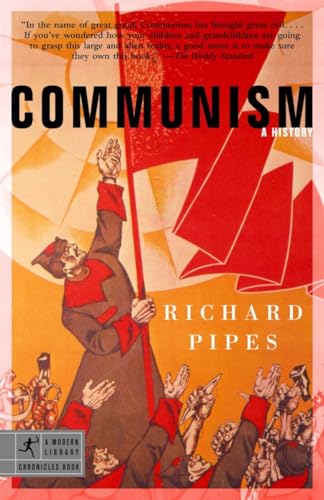
Inhaltsangabe
With astonishing authority and clarity, Richard Pipes has fused a lifetime’s scholarship into a single focused history of Communism, from its hopeful birth as a theory to its miserable death as a practice. At its heart, the book is a history of the Soviet Union, the most comprehensive reorganization of human society ever attempted by a nation-state. This is the story of how the agitation of Karl Marx and Friedrich Engels, two mid-nineteenth-century European thinkers and writers, led to a great and terrible world religion that brought down a mighty empire, consumed the world in conflict, and left in its wake a devastation whose full costs can only now be tabulated.
Die Inhaltsangabe kann sich auf eine andere Ausgabe dieses Titels beziehen.
Über die Autorin bzw. den Autor
Richard Pipes, Baird Professor of History, Emeritus, at Harvard University, is the author of numerous books and essays, including The Russian Revolution, Russia Under the Bolshevik Regime, and Property and Freedom. In 1981–82 he served as the Director of East European and Soviet Affairs on the National Security Council, and in 1992 he was an expert witness in the Russian Constitutional Court’s trial against the Communist Party of the Soviet Union. He lives in Cambridge, Massachusetts, and Chesham, New Hampshire.
Von der hinteren Coverseite
With astonishing authority and clarity, Richard Pipes has fused a lifetime's scholarship into a single focused history of Communism, from its hopeful birth as a theory to its miserable death as a practice. At its heart, the book is a history of the Soviet Union, the most comprehensive reorganization of human society ever attempted by a nation-state. This is the story of how the agitation of Karl Marx and Friedrich Engels, two mid-nineteenth-century European thinkers and writers, led to a great and terrible world religion that brought down a mighty empire, consumed the world in conflict, and left in its wake a devastation whose full costs can only now be tabulated.
Auszug. © Genehmigter Nachdruck. Alle Rechte vorbehalten.
1.
Communist Theory and Program
The idea of a classless, fully egalitarian society first emerged in classical Greece. Ancient Greece happened to have been the first country in the world to recognize private property in land and to treat land as a commodity, and hence it was the first to confront the social inequalities that result from ownership. Hesiod, a contemporary of Homer (seventh century b.c.), in the poem Works and Days extolled a mythical “Golden Age” when people were not driven by the “shameful lust for gain,” when there was an abundance of goods for all to share and mankind lived in perpetual peace. The theme of the Golden Age resounded in the writings of the Roman poets Virgil and Ovid; Ovid spoke of the time when the world knew nothing of “boundary posts and fences.”
The ideal acquired its earliest theoretical formulation in the writings of Plato. In the Republic, speaking through Socrates, Plato saw the root of discord and wars in belongings:
Such differences commonly originate in a disagreement about the use of the terms “mine” and “not mine,” “his” and “not his.” . . . And is not that the best-ordered State in which the greatest number of persons apply the terms “mine” and “not mine” in the same way to the same thing?
In The Laws, Plato envisioned not only a society in which people shared all worldly possessions, as well as their wives and children, but one in which the private and individual is altogether banished from life, and things which are by nature private, such as eyes and ears and hands, have become common, and in some way see and hear and act in common, and all men express praise and blame and feel joy and sorrow on the same occasions.
Aristotle, Plato’s pupil, questioned whether such a communist utopia would bring about social peace, on the grounds that people who hold things in common are more prone to quarrel than those who hold them in private ownership. Furthermore, he argued, the root of social discord lies not in material belongings but in the yearning for them: “it is not possession but the desires of mankind which require to be equalized.”
There exists a widespread but false notion that socialism and communism are merely up-to-date, secular versions of Christianity. As the nineteenth-century Russian philosopher Vladimir Soloviev has pointed out, the difference is that whereas Jesus urged his followers to give up their own possessions, the socialists and communists want to give away the possessions of others. Moreover, Jesus never insisted on penury; he merely counseled it as easing the way to salvation. Saint Paul’s well-known saying about money is usually misquoted: he said not that “money is the root of all evil” but that “love of money” is—in other words, greed. Saint Augustine asked rhetorically, “Is gold not good?” and answered, “Yes, it is good. But the evil use good gold for evil, and the good use good gold for good.”
The fathers of the church and later Catholic theologians took a pragmatic view of ownership. According to Saint Augustine, a propertyless world was possible only in paradise—that “Golden Age” which mankind had lost because of original sin. Given human imperfection, property is moral if used wisely and employed for charitable purposes. The Catholic Church not only did not preach poverty but disowned and sometimes persecuted those who did. The founders of Protestantism, notably Calvin, viewed wealth as a positive good and a sign of divine grace.
But the notion of the Golden Age never disappeared from European consciousness. The early maritime explorers ventured on their journeys inspired not merely by the quest for Eldorado and other mythical places in which gold was reputed to be as plentiful as dust but also by the desire to find the islands of terrestrial paradise, legends of which circu- lated in medieval Europe. And when they first landed in the Americas and saw naked Indians, they were convinced they had found them: for was not lack of shame the very mark of life before the Fall? If the natives, indeed, lived in paradise this meant also that they knew nothing of property. Columbus on his return reported that the aborigines were “guileless” and “never refuse[d] anything which they possess, if it be asked of them; on the contrary, they invite anyone to share it.” He was uncertain whether or not they knew private property, but noted, “In that which one had, all took a share, especially of eatable things.”
These naive first impressions soon yielded to more realistic appraisals of American Indians, but not before giving rise to a utopian literature that has ever since become a permanent feature of Western thought.* Thomas More’s archetypal Utopia, described in the book of that name he published in 1516, was, some scholars believe, inspired by the travel accounts of Columbus and other early explorers. Far from the happy place that the modern usage of the adjective utopian conveys, it was an austere and regimented community where
* Because the vision of a propertyless society is central to virtually all utopias, it could emerge only in societies in which private property was prevalent: this, until recent times, meant, in effect, Europe and regions populated by Europeans. all citizens dressed alike and lived in identical houses, where no one could travel without permission, and where private discussion of public affairs carried the death penalty. Money was abolished; gold and silver served to make chamber pots. The common theme of subsequent utopias was, as in More’s, both the absence of private wealth and the coercion of individuals by the community at large: utopia both in theory and practice signifies the individual’s subservience to authority, which compels him to do what he is disinclined to do of his own free will.
It needs to be stated at this point that the ideal of a propertyless Golden Age is a myth—the fruit of longing rather than memory—because historians, archaeologists, and anthropologists concur that there never was a time or place when all productive assets were collectively owned. All living creatures, from the most primitive to the most advanced, in order to survive must enjoy assured access to food and, to secure such access, claim ownership of territory. During the aeons before humans settled down to pursue agriculture, when they lived primarily by hunting and gathering, kinship groups asserted exclusive access to their area, expelling or killing trespassers. Property claims intensified after transition to agriculture some ten thousand years ago, because cultivation of the soil is arduous work and its fruits take time to mature.
In the oldest civilizations, dating back five thousand years—pharaonic Egypt and Mesopotamia—agricultural land belonged to palaces and temples. Ancient Israel is the first country where we possess firm evidence of private land ownership. The Lord in the Hebrew Bible casts a curse on anyone who tampers with boundary stones (“Cursed be he that removeth his neighbor’s landmark,” Deuteronomy 27:17), and several biblical books tell of families as well as individuals holding land and pasture in private possession. But land ownership in ancient Israel was hedged by many religious and clan restrictions. It is in classical Greece that from the earliest times agricultural land was privately held. In other words, there is no evidence that at any time, even in the most remote past, there existed societies that knew no “boundary posts and fences” or ignored “mine” and “thine.”
A critical contribution to socialist and communist...
„Über diesen Titel“ kann sich auf eine andere Ausgabe dieses Titels beziehen.
Suchergebnisse für Communism: A History (Modern Library Chronicles, Band...

Beispielbild für diese ISBN
Communism: A History
Anbieter: World of Books (was SecondSale), Montgomery, IL, USA
Verkäuferbewertung 5 von 5 Sternen

Paperback. Zustand: Good. With astonishing authority and clarity, Richard Pipes has fused a lifetime s scholarship into a single focused history of Communism, from its hopeful birth as a theory to its miserable death as a practice. At its heart, the book is a history of the Soviet Union, the most comprehensive reorganization of human society ever attempted by a nation-state. This is the story of how the agitation of Karl Marx and Friedrich Engels, two mid-nineteenth-century European thinkers and writers, led to a great and terrible world religion that brought down a mighty empire, consumed the world in conflict, and left in its wake a devastation whose full costs can only now be tabulated. Artikel-Nr. 00106906067
Gebraucht kaufen
EUR 6,09
Versand gratis
Versand innerhalb von USA
Versand innerhalb von USA
Anzahl: 2 verfügbar
Foto des Verkäufers
Communism: A History (Modern Library Chronicles)
Anbieter: Dream Books Co., Denver, CO, USA
Verkäuferbewertung 5 von 5 Sternen
Zustand: good. Gently used with minimal wear on the corners and cover. A few pages may contain light highlighting or writing, but the text remains fully legible. Dust jacket may be missing, and supplemental materials like CDs or codes may not be included. May be ex-library with library markings. Ships promptly! Artikel-Nr. DBV.0812968646.G
Gebraucht kaufen
EUR 6,10
Versand gratis
Versand innerhalb von USA
Versand innerhalb von USA
Anzahl: 1 verfügbar
Beispielbild für diese ISBN
Communism : A History
Verlag:
Random House Publishing Group, 2003
ISBN 10: 0812968646
ISBN 13: 9780812968644
Gebraucht
Softcover
Anbieter: Better World Books: West, Reno, NV, USA
Verkäuferbewertung 5 von 5 Sternen
Zustand: Good. Pages intact with minimal writing/highlighting. The binding may be loose and creased. Dust jackets/supplements are not included. Stock photo provided. Product includes identifying sticker. Better World Books: Buy Books. Do Good. Artikel-Nr. 5847107-6
Gebraucht kaufen
EUR 7,13
Versand gratis
Versand innerhalb von USA
Versand innerhalb von USA
Anzahl: 1 verfügbar
Beispielbild für diese ISBN
Communism : A History
Verlag:
Random House Publishing Group, 2003
ISBN 10: 0812968646
ISBN 13: 9780812968644
Gebraucht
Softcover
Anbieter: Better World Books, Mishawaka, IN, USA
Verkäuferbewertung 5 von 5 Sternen
Zustand: Good. Former library copy. Pages intact with minimal writing/highlighting. The binding may be loose and creased. Dust jackets/supplements are not included. Includes library markings. Stock photo provided. Product includes identifying sticker. Better World Books: Buy Books. Do Good. Artikel-Nr. 4972356-75
Gebraucht kaufen
EUR 7,16
Versand gratis
Versand innerhalb von USA
Versand innerhalb von USA
Anzahl: 1 verfügbar
Beispielbild für diese ISBN
Communism : A History
Verlag:
Random House Publishing Group, 2003
ISBN 10: 0812968646
ISBN 13: 9780812968644
Gebraucht
Softcover
Anbieter: Better World Books Ltd, Dunfermline, Vereinigtes Königreich
Verkäuferbewertung 5 von 5 Sternen
Zustand: Good. Pages intact with minimal writing/highlighting. The binding may be loose and creased. Dust jackets/supplements are not included. Stock photo provided. Product includes identifying sticker. Better World Books: Buy Books. Do Good. Artikel-Nr. 5847107-6
Gebraucht kaufen
EUR 6,25
EUR 5,86 Versand
Versand von Vereinigtes Königreich nach USA
Versand von Vereinigtes Königreich nach USA
Anzahl: 1 verfügbar
Beispielbild für diese ISBN
Communism: A History
Anbieter: Browse Awhile Books, Tipp City, OH, USA
Verkäuferbewertung 5 von 5 Sternen
Soft cover. Zustand: Near Fine. Artikel-Nr. 1154349
Gebraucht kaufen
EUR 8,18
EUR 6,18 Versand
Versand innerhalb von USA
Versand innerhalb von USA
Anzahl: 1 verfügbar
Beispielbild für diese ISBN
Communism: A History (Modern Library Chronicles)
Anbieter: Majestic Books, Hounslow, Vereinigtes Königreich
Verkäuferbewertung 4 von 5 Sternen

Zustand: New. Artikel-Nr. 7939635
Neu kaufen
EUR 15,22
EUR 7,61 Versand
Versand von Vereinigtes Königreich nach USA
Versand von Vereinigtes Königreich nach USA
Anzahl: 1 verfügbar
Beispielbild für diese ISBN
Communism: A History
Anbieter: Revaluation Books, Exeter, Vereinigtes Königreich
Verkäuferbewertung 5 von 5 Sternen
Paperback. Zustand: Brand New. reprint edition. 192 pages. 9.50x5.00x0.50 inches. In Stock. Artikel-Nr. __0812968646
Neu kaufen
EUR 20,53
EUR 11,71 Versand
Versand von Vereinigtes Königreich nach USA
Versand von Vereinigtes Königreich nach USA
Anzahl: 1 verfügbar
Foto des Verkäufers
Communism: A History (Modern Library Chronicles)
Verlag:
Modern Library 05.08.2003., 2003
ISBN 10: 0812968646
ISBN 13: 9780812968644
Gebraucht
Softcover
Anbieter: bookmarathon, Emmendingen, BW, Deutschland
Verkäuferbewertung 5 von 5 Sternen
Zustand: Gut. 9. Auflage. 192 Seiten Leichte Lese- und Lagerspuren! Ex-Libris-Stempel auf dem Vorsatz. Sie erhalten eine Rechnung mit der darin ausgewiesenen MwSt. Sprache: Englisch Gewicht in Gramm: 158 13,1 x 1,0 x 20,3 cm, Taschenbuch. Artikel-Nr. 13429
Gebraucht kaufen
EUR 14,99
EUR 28,00 Versand
Versand von Deutschland nach USA
Versand von Deutschland nach USA
Anzahl: 1 verfügbar