
Verwandte Artikel zu Hitler and the Holocaust (Modern Library Chronicles,...
Hitler and the Holocaust (Modern Library Chronicles, Band 8) - Softcover
Buch 8 von 33: Modern Library Chronicles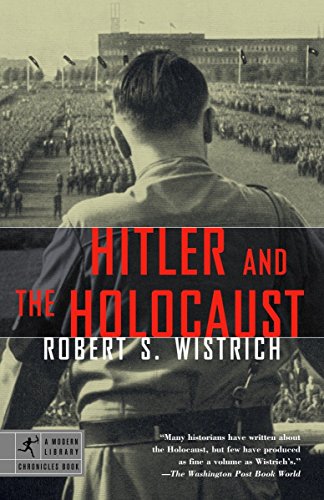
Inhaltsangabe
Hitler and the Holocaust is the product of a lifetime’s work by one of the world’s foremost authorities on the history of anti-Semitism and modern Jewry. Robert S. Wistrich examines Europe’s long history of violence against its Jewish populations, looks at the forces that shaped Hitler’s belief in a “satanic Jewish power” that must be eradicated, and discusses the process by which Hitler gained power and finalized his plans for mass genocide. He concludes by addressing the abiding legacy of the Holocaust and the lessons that can be drawn from it. Combining a comprehensive picture of one of the most cataclysmic periods in recent history with contemporary scholarly developments and fresh historical inquiry, Hitler and the Holocaust is an indelible contribution to the literature of history.
Die Inhaltsangabe kann sich auf eine andere Ausgabe dieses Titels beziehen.
Über die Autorin bzw. den Autor
Robert S. Wistrich is professor of modern European history at the Hebrew University of Jerusalem and head of its International Center for the Study of Antisemitism. He is the author and editor of twenty-two books, several of which have won international awards, including Antisemitism: The Longest Hatred.
Von der hinteren Coverseite
Hitler and the Holocaust is the product of a lifetime's work by one of the world's foremost authorities on the history of anti-Semitism and modern Jewry. Robert S. Wistrich examines Europe's long history of violence against its Jewish populations, looks at the forces that shaped Hitler's belief in a "satanic Jewish power" that must be eradicated, and discusses the process by which Hitler gained power and finalized his plans for mass genocide. He concludes by addressing the abiding legacy of the Holocaust and the lessons that can be drawn from it. Combining a comprehensive picture of one of the most cataclysmic periods in recent history with contemporary scholarly developments and fresh historical inquiry, Hitler and the Holocaust is an indelible contribution to the literature of history.
Auszug. © Genehmigter Nachdruck. Alle Rechte vorbehalten.
Anti-Semitism and the Jews
"After Satan Christians have no greater enemies than the Jews. . . . They pray many times each day that God may destroy us through pestilence, famine and war, aye, that all beings and creatures may rise up with them against the Christians."
-Abraham a Sancta Clara Viennese Catholic preacher (1683)
"I hold the Jewish race to be the born enemy of pure humanity and everything noble in it. It is certain that it is running us Germans into the ground, and I am perhaps the last German who knows how to hold himself upright in the face of Judaism, which already rules everything."
-Richard Wagner (1881)
"Jewry is one of the great negative principles of world history and thus can only be understood as a parasite within the opposing positive principle. As little as Judas Iscariot with his thirty silver coins . . . can be understood without the Lord whose community he sneeringly betrayed . . . that night side of history called Jewry cannot be understood without being positioned in the totality of the historical process where God and Satan, Creation and Destruction confront each other in an eternal struggle."
-Walter Frank, “German Science in Its Struggle against World Jewry,” German radio broadcast, 11 and 13 January 1939
Throughout recorded time, there have been countless massacres, some on religious grounds, others for political or territorial reasons. Native peoples have been exterminated in colonial wars. Millions of Africans were sold into slavery. The colonization of North America, Australia, Africa, and other parts of the globe by expanding Western societies involved constant displacement, despoliation, and sometimes even the genocide of indigenous populations in the name of empire, plunder, and “progress.” The Turkish massacre of more than a million Armenians during the First World War marked a new scale of brutality. However, if the number of victims alone were to be our point of departure, then we should look to those unfortunate Soviet citizens who were shot, starved, or worked to death in the gulags of Stalinist Russia as “enemies of the people,” in the name of Marxist ideology. The victims of this “autogenocide,” which a totalitarian regime inflicted on its own subjects, may have numbered as many as twenty million. (While staggeringly high, this was a much lower percentage of all Soviet citizens than the one third of all Jewish people in the world who were killed by the Nazis.) No less horrifying were the events in Maoist China (the full story has yet to be told) and, on a smaller scale, in Communist Cambodia during the 1970s. The slaughter in Rwanda and “ethnic cleansing” in the former Yugoslavia in the 1990s demonstrate that the genocidal chapter in human history is far from over.
Even during the Second World War, several genocides occurred, though of different magnitudes. Approximately three million Polish Gentiles fell victim to the Nazis, as did a similar number of Russian POWs who were starved to death by the Germans. Both groups were used as guinea pigs at Auschwitz-Birkenau before the gassing of Jews began. The German war in the east involved much more than exterminating the Jews: it was initially conceived of as part of a larger design for a radical racial restructuring in which Poles, Russians, and Ukrainians would be expropriated, deported, or killed. Gypsies, too, were earmarked for destruction; between 250,000 and half a million Gypsies were sent to their deaths between 1939 and 1945, coterminous with the Jewish Holocaust. Gypsies (Roma and Sinti) did not, of course, hold the same place either in Christian consciousness or in the Nazi worldview as did Jews or Judaism, but prejudice and hostility toward their nomadic way of life was nonetheless widespread and in some ways comparable to the perception of Jews as alien to Christian Europe.
The Nazis were particularly hostile toward the Gypsies as an “antisocial” element and as “people of different blood” who fell under the Nuremberg race laws of 1935. (Heinrich Himmler’s decree of December 1937 permitted their arrest on the extremely elastic grounds of asocial behavior, even without the commission of any criminal act.) As early as 1936, some groups of Gypsies were sent to the Dachau concentration camp. Further legislation in 1938 to deal with the “Gypsy plague” aimed at a strict separation between “pure” (Sinti and Lalleri) and “mixed blood” Gypsies, as well as between Germans and Gypsies. According to the Nazi Office for Racial Hygiene and Population Biology, more than 90 percent of the German Gypsies were defined as non-Aryan “mixed bloods,” the favored government policy toward which was sterilization. During the war, Nazi policy became even more radical, and in the fall of 1941, five thousand Austrian Gypsies were deported to the Lódz ghetto. Then, in early 1942, some Gypsies were murdered along with Jews in the Chelmno death camp. Gypsies started arriving in Auschwitz-Birkenau on 26 February 1943; a great many died from hunger, disease, and “medical experiments.” In 1944, women and children were gassed. In the Baltic states and the Soviet Union, Gypsies were murdered by the Einsatzgruppen; in Yugoslavia, they were killed by the Paveli´c regime; in Hungary, they were persecuted and rounded up by Arrow Cross fascists. In France, they were interned and later sent to camps in Germany. Two thirds of the Polish Gypsies died under Nazi occupation.
The Nazis regarded “the fight against the Gypsy Menace” after 1935 as “a matter of race” and insisted on the need to “separate once and for all the Gypsy race (Zigeunertum) from the German nation (Volkstum),” to prevent the danger of miscegenation. In that respect, there was an ideological link between the murder of Jews and Gypsies in the Nazi vision of radical ethnic cleansing or “purification” of the Volksge- meinschaft (people’s community). Indeed, the settlement of the “Gypsy question” was conceived from the outset in the framework of “knowledge stemming from ethnological research” under the jurisdiction of Heinrich Himmler as Reichsführer SS and chief of the German police. The fate of the Gypsies, as Himmler made clear in September 1942, was not a matter for the law or the courts, any more than was that of the Jews. Hence, they were totally at the mercy of the police and the SS and were liable to be thrown at any time into concentration camps. The accusations against them of hereditary racial inferiority, economic parasitism, or sexual “immorality,” all of which were seen as threatening to the general German population, overlapped with the demagoguery of anti-Semitism. The Gypsies, however, were deemed a “social menace,” not a total and universal enemy like the Jews, engaged in a universal conspiracy against Germany and the “Aryan” world. The “Gypsy question” had, for example, only marginal importance in the Nazi political agenda, and Hitler himself referred publicly to Gypsies on only two occasions, in stark contrast to his relentless obsession with the Jews. Moreover, those Gypsies who were considered “racially pure” were never regarded as a danger to the German people and were even thought of as having noble blood. Thus, the horrible crime against the Gypsies as a social group did not aim in principle at their total annihilation.
The Jewish Holocaust was unprecedented—as compared to other genocides—because it was the planned, deliberate policy decision of a powerful state that mobilized its resources to destroy the entire Jewish people. In this diabolical aim, the Germans were almost successful...
„Über diesen Titel“ kann sich auf eine andere Ausgabe dieses Titels beziehen.
Suchergebnisse für Hitler and the Holocaust (Modern Library Chronicles,...

Beispielbild für diese ISBN
Hitler and the Holocaust (Modern Library Chronicles)
Verlag:
Random House Publishing Group (edition Reprint), 2003
ISBN 10: 0812968638
ISBN 13: 9780812968637
Gebraucht
Paperback
Anbieter: BooksRun, Philadelphia, PA, USA
Verkäuferbewertung 5 von 5 Sternen

Paperback. Zustand: Very Good. Reprint. It's a well-cared-for item that has seen limited use. The item may show minor signs of wear. All the text is legible, with all pages included. It may have slight markings and/or highlighting. Artikel-Nr. 0812968638-11-1
Gebraucht kaufen
EUR 4,49
Versand gratis
Versand innerhalb von USA
Versand innerhalb von USA
Anzahl: 1 verfügbar
Beispielbild für diese ISBN
Hitler and the Holocaust (Modern Library Chronicles)
Verlag:
Random House Publishing Group, 2003
ISBN 10: 0812968638
ISBN 13: 9780812968637
Gebraucht
Softcover
Anbieter: Wonder Book, Frederick, MD, USA
Verkäuferbewertung 5 von 5 Sternen
Zustand: Good. Good condition. A copy that has been read but remains intact. May contain markings such as bookplates, stamps, limited notes and highlighting, or a few light stains. Artikel-Nr. V09A-04396
Gebraucht kaufen
EUR 6,27
Versand gratis
Versand innerhalb von USA
Versand innerhalb von USA
Anzahl: 1 verfügbar
Beispielbild für diese ISBN
Hitler and the Holocaust (Modern Library Chronicles)
Verlag:
Random House Publishing Group, 2003
ISBN 10: 0812968638
ISBN 13: 9780812968637
Gebraucht
paperback
Anbieter: Books From California, Simi Valley, CA, USA
Verkäuferbewertung 4 von 5 Sternen

paperback. Zustand: Very Good. Artikel-Nr. mon0004177948
Gebraucht kaufen
EUR 5,09
EUR 4,34 Versand
Versand innerhalb von USA
Versand innerhalb von USA
Anzahl: 1 verfügbar
Beispielbild für diese ISBN
Hitler and the Holocaust (Modern Library Chronicles)
Anbieter: Revaluation Books, Exeter, Vereinigtes Königreich
Verkäuferbewertung 5 von 5 Sternen
Paperback. Zustand: Brand New. reprint edition. 320 pages. 9.75x5.00x0.75 inches. In Stock. Artikel-Nr. x-0812968638
Neu kaufen
EUR 24,14
EUR 11,66 Versand
Versand von Vereinigtes Königreich nach USA
Versand von Vereinigtes Königreich nach USA
Anzahl: 2 verfügbar
Beispielbild für diese ISBN
Hitler and the Holocaust: 8 (Modern Library Chronicles)
Anbieter: Majestic Books, Hounslow, Vereinigtes Königreich
Verkäuferbewertung 4 von 5 Sternen
Zustand: New. pp. 320. Artikel-Nr. 7939632
Neu kaufen
EUR 34,83
EUR 7,58 Versand
Versand von Vereinigtes Königreich nach USA
Versand von Vereinigtes Königreich nach USA
Anzahl: 1 verfügbar