
Verwandte Artikel zu Evolution: The Remarkable History of a Scientific Theory...
Evolution: The Remarkable History of a Scientific Theory (Modern Library Chronicles, Band 17) - Softcover
Buch 17 von 33: Modern Library Chronicles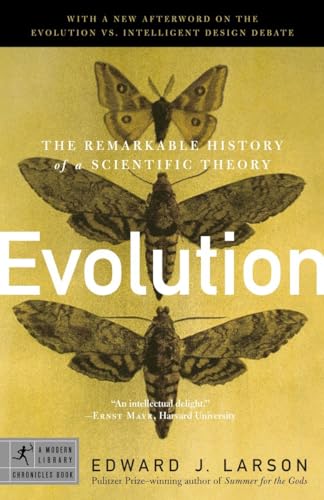
Inhaltsangabe
“I often said before starting, that I had no doubt I should frequently repent of the whole undertaking.” So wrote Charles Darwin aboard The Beagle, bound for the Galapagos Islands and what would arguably become the greatest and most controversial discovery in scientific history. But the theory of evolution did not spring full-blown from the head of Darwin. Since the dawn of humanity, priests, philosophers, and scientists have debated the origin and development of life on earth, and with modern science, that debate shifted into high gear.
In this lively, deeply erudite work, Pulitzer Prize–winning science historian Edward J. Larson takes us on a guided tour of Darwin’s “dangerous idea,” from its theoretical antecedents in the early nineteenth century to the brilliant breakthroughs of Darwin and Wallace, to Watson and Crick’s stunning discovery of the DNA double helix, and to the triumphant neo-Darwinian synthesis and rising sociobiology today.
Along the way, Larson expertly places the scientific upheaval of evolution in cultural perspective: the social and philosophical earthquake that was the French Revolution; the development, in England, of a laissez-faire capitalism in tune with a Darwinian ethos of “survival of the fittest”; the emergence of Social Darwinism and the dark science of eugenics against a backdrop of industrial revolution; the American Christian backlash against evolutionism that culminated in the famous Scopes trial; and on to today’s world, where religious fundamentalists litigate for the right to teach “creation science” alongside evolution in U.S. public schools, even as the theory itself continues to evolve in new and surprising directions.
Throughout, Larson trains his spotlight on the lives and careers of the scientists, explorers, and eccentrics whose collaborations and competitions have driven the theory of evolution forward. Here are portraits of Cuvier, Lamarck, Darwin, Wallace, Haeckel, Galton, Huxley, Mendel, Morgan, Fisher, Dobzhansky, Watson and Crick, W. D. Hamilton, E. O. Wilson, and many others. Celebrated as one of mankind’s crowning scientific achievements and reviled as a threat to our deepest values, the theory of evolution has utterly transformed our view of life, religion, origins, and the theory itself, and remains controversial, especially in the United States (where 90% of adults do not subscribe to the full Darwinian vision). Replete with fresh material and new insights, Evolution will educate and inform while taking readers on a fascinating journey of discovery.
Die Inhaltsangabe kann sich auf eine andere Ausgabe dieses Titels beziehen.
Über die Autorin bzw. den Autor
EDWARD J. LARSON is Russell Professor of History and Talmadge Professor of Law at the University of Georgia. He is the recipient of multiple awards for teaching and writing, including the 1998 Pulitzer Prize in History for his book, Summer for the Gods: The Scopes Trial and America’s Continuing Debate Over Science and Religion. His most recent book is Evolution’s Workshop: God and Science on the Galapagos Islands. His articles have appeared in dozens of journals including The Atlantic Monthly, Nature, The Nation, and Scientific American.
Auszug. © Genehmigter Nachdruck. Alle Rechte vorbehalten.
CHAPTER 1
Bursting the Limits of Time
Georges Cuvier had a large head-a famously large head-and an ego more than sufficient to swell even it. From his position atop the French scientific establishment during the first third of the nineteenth century, he accumulated high academic posts and official honors like some favored children collect toys: never enough and all kept in play. For his contributions to laying the foundations of modern biology, Cuvier willingly suffered comparisons to Aristotle, the acknowledged founder of the science. As a naturalist, Cuvier fancied himself "the French Newton"-bringing order to the life sciences much as Isaac Newton brought order to the physical sciences. Cuvier's rigorous empirical methods opened windows into the earth's biological history that would lead others to a vision of organic evolution he steadfastly refused to see. More than any other naturalist, he so greatly influenced the style and substance of nineteenth-century biology that the history of the modern scientific theory of evolution rightly begins with him-its staunchest foe.
Born in 1769 into an educated, bourgeois family in the Protestant, French-speaking portion of the independent French-German duchy of Württemberg, Cuvier was trained at a regional academy to serve in the duke's government. Pushed by his mother to excel academically, Cuvier's formal education included a solid introduction to natural history, a traditional subject encompassing such modern fields as biology, geology, oceanography, mineralogy, and paleontology. This subject became his passion. In 1788, with no government position open to him at home, Cuvier accepted employment as a private tutor for a French noble family in Normandy. There, as a sideline, he immersed himself in the study of marine invertebrates. From the relative safety of rural Normandy, Cuvier witnessed the French Revolution that began, from his perspective, with high hopes in 1789 but turned terribly ugly during the early 1790s. Becoming a citizen of France in 1793, when the French government annexed his homeland, Cuvier accepted a post in the revolutionary administration of Normandy even as he turned viscerally against the central regime's Terror and focused his own attentions on zoological fieldwork. In 1795, when a moderate republican government took power in Paris and promised to rebuild the central scientific establishment decapitated during the Terror, Cuvier moved to the capital in search of a career in science. There were plenty of openings for a naturalist of his obvious brilliance and driving ambition. Cuvier gained an assistantship at the renowned Museum of Natural History, and never looked back. His subsequent rise was meteoric. The study of natural history would never be the same.
Cuvier concentrated his scientific research on the burgeoning field of comparative anatomy; he was convinced that the internal structure of an animal revealed its function and therefore its true nature. In biology as in all else, form followed function for Cuvier. His research profited greatly from his position at the world's premier natural-history museum-an institution that rapidly became ever more comprehensive in its zoological holdings as Napoleon's armies plundered the collections of Europe and sent home live, preserved, and fossilized specimens from as far afield as Russia and Egypt. Ultimately, Cuvier proposed that there are four (but only four) basic anatomical types (he called them "embranchements") of animals: vertebrates (with backbones), molluscs (with shells), articulates (such as insects), and radiates (such as starfish). "Lesser divisions," he wrote, "are only modifications superficially founded on development or on the addition of certain parts, but which in no way change the essence of the plan."1 This view, built solidly on anatomical analysis and still reflected (with modifications) in modern taxonomy, shattered the hierarchical concept dating from Aristotle of a single great chain of beings rising in fine gradations from the simplest living form to humans at the top. The idea within biology of giving an anthropomorphic order to all living things gave way to studying them on their own terms.
Cuvier was the first naturalist to have at his disposal a suitably complete collection of the world's mammals-past and present-to make definitive distinctions among them. He made the most of this advantage, hoarding it to himself, his collaborators, and his protegés. In 1796, for example, he announced that, based on his anatomical comparisons of actual specimens, the elephants of India and Africa constituted two distinct species, and that both of them differed from the elephant-like mammoth found only in fossil remains. The positive identification of other living and extinct mammals followed one after another in rapid succession. To account for so many extinct species, as early as 1796 Cuvier announced "the existence of a world previous to ours, destroyed by some kind of catastrophe."2
Before Cuvier, European naturalists typically held that no species-all of them perfect in their original creation-ever died out. Fossils had no fundamental significance: Such things were simply sports of nature or remnants of some still-living species. Overturning this view, Cuvier ultimately concluded that all fossilized animals differed in kind from modern ones and that no modern species existed in truly fossil form. He boldly claimed the power "to burst the limits of time, and, by some observations [of fossils], to recover the history of the world, and the succession of events that preceded the birth of the human species."3
Suddenly, life had a history different from the present, and fossil fragments revealed it. "As a new species of antiquarian," Cuvier explained, "I have had . . . to reconstruct the ancient beings to which these fragments belonged; to reproduce them in their proportions and characters; and finally to compare them to those that live today."4 The modern science of paleontology was born in Cuvier's laboratory. Because of his conviction that the form of any animal precisely served its functional needs, Cuvier confidently assumed that trained researchers could, in principle, reconstruct its entire structure from any one of its functional parts. Paleontologists could do for extinct animals what comparative anatomists did for living ones-definitively identify them. Doing so for all of the earth's past and present species became Cuvier's goal for science-and he himself would launch the effort, doing his own best work with fishes and four-footed mammals.
A compulsive worker, stern and impatient, Cuvier never doubted his own ability as a science researcher, educator, and administrator. He mastered the treacherous shoals of French academic politics just as ably as he mastered comparative anatomy. Even as he climbed the professional ladder within the Museum of Natural History, Cuvier gained leadership posts at the National Institute and the University of France-giving him unparalleled influence over patronage within the country's highly centralized science establishment. Napoleon named Cuvier to the Council of State in 1813, and he deftly kept his seat (and steadily expanded his portfolio) under three succeeding monarchs. Remarkably, even though every ruler he served was forcibly driven from office at least once, Cuvier held each of his official posts for life and died peacefully in his bed in 1832.
Napoleon ennobled him as a chevalier; Louis XVIII promoted him to the rank of baron; under Charles X, he became a grand officer of the Legion of Honor; Louis-Philippe made him a peer of France. "Cuvier was short and during the Revolution was thin," one biographer wryly noted. "He became stouter during the Empire; and he grew enormously fat after the...
„Über diesen Titel“ kann sich auf eine andere Ausgabe dieses Titels beziehen.
Suchergebnisse für Evolution: The Remarkable History of a Scientific Theory...

Beispielbild für diese ISBN
Evolution: The Remarkable History of a Scientific Theory (Modern Library Chronicles)
Verlag:
Random House Publishing Group, 2006
ISBN 10: 0812968492
ISBN 13: 9780812968491
Gebraucht
Softcover
Anbieter: World of Books (was SecondSale), Montgomery, IL, USA
Verkäuferbewertung 5 von 5 Sternen

Zustand: Acceptable. Item in acceptable condition! Textbooks may not include supplemental items i.e. CDs, access codes etc. Artikel-Nr. 00100617713
Gebraucht kaufen
EUR 3,72
Versand gratis
Versand innerhalb von USA
Versand innerhalb von USA
Anzahl: 1 verfügbar
Beispielbild für diese ISBN
Evolution: The Remarkable History of a Scientific Theory (Modern Library Chronicles)
Verlag:
Random House Publishing Group, 2006
ISBN 10: 0812968492
ISBN 13: 9780812968491
Gebraucht
Softcover
Anbieter: World of Books (was SecondSale), Montgomery, IL, USA
Verkäuferbewertung 5 von 5 Sternen
Zustand: Good. Item in good condition. Textbooks may not include supplemental items i.e. CDs, access codes etc. Artikel-Nr. 00105261921
Gebraucht kaufen
EUR 3,72
Versand gratis
Versand innerhalb von USA
Versand innerhalb von USA
Anzahl: 1 verfügbar
Beispielbild für diese ISBN
Evolution: The Remarkable History of a Scientific Theory (Modern Library Chronicles)
Verlag:
Random House Publishing Group (edition Reprint), 2006
ISBN 10: 0812968492
ISBN 13: 9780812968491
Gebraucht
Paperback
Anbieter: BooksRun, Philadelphia, PA, USA
Verkäuferbewertung 5 von 5 Sternen
Paperback. Zustand: Very Good. Reprint. It's a well-cared-for item that has seen limited use. The item may show minor signs of wear. All the text is legible, with all pages included. It may have slight markings and/or highlighting. Artikel-Nr. 0812968492-11-6
Gebraucht kaufen
EUR 4,91
Versand gratis
Versand innerhalb von USA
Versand innerhalb von USA
Anzahl: 1 verfügbar
Beispielbild für diese ISBN
Evolution: The Remarkable History of a Scientific Theory
Verlag:
Random House Publishing Group, 2006
ISBN 10: 0812968492
ISBN 13: 9780812968491
Gebraucht
Paperback
Anbieter: ThriftBooks-Atlanta, AUSTELL, GA, USA
Verkäuferbewertung 5 von 5 Sternen
Paperback. Zustand: Good. No Jacket. Pages can have notes/highlighting. Spine may show signs of wear. ~ ThriftBooks: Read More, Spend Less. Artikel-Nr. G0812968492I3N00
Gebraucht kaufen
EUR 5,75
Versand gratis
Versand innerhalb von USA
Versand innerhalb von USA
Anzahl: 1 verfügbar
Beispielbild für diese ISBN
Evolution: The Remarkable History of a Scientific Theory
Verlag:
Random House Publishing Group, 2006
ISBN 10: 0812968492
ISBN 13: 9780812968491
Gebraucht
Paperback
Anbieter: ThriftBooks-Phoenix, Phoenix, AZ, USA
Verkäuferbewertung 5 von 5 Sternen
Paperback. Zustand: Good. No Jacket. Pages can have notes/highlighting. Spine may show signs of wear. ~ ThriftBooks: Read More, Spend Less. Artikel-Nr. G0812968492I3N00
Gebraucht kaufen
EUR 5,75
Versand gratis
Versand innerhalb von USA
Versand innerhalb von USA
Anzahl: 1 verfügbar
Beispielbild für diese ISBN
Evolution: The Remarkable History of a Scientific Theory
Verlag:
Random House Publishing Group, 2006
ISBN 10: 0812968492
ISBN 13: 9780812968491
Gebraucht
Paperback
Anbieter: ThriftBooks-Dallas, Dallas, TX, USA
Verkäuferbewertung 5 von 5 Sternen
Paperback. Zustand: Good. No Jacket. Pages can have notes/highlighting. Spine may show signs of wear. ~ ThriftBooks: Read More, Spend Less. Artikel-Nr. G0812968492I3N00
Gebraucht kaufen
EUR 5,75
Versand gratis
Versand innerhalb von USA
Versand innerhalb von USA
Anzahl: 1 verfügbar
Beispielbild für diese ISBN
Evolution: The Remarkable History of a Scientific Theory
Verlag:
Random House Publishing Group, 2006
ISBN 10: 0812968492
ISBN 13: 9780812968491
Gebraucht
Paperback
Anbieter: ThriftBooks-Dallas, Dallas, TX, USA
Verkäuferbewertung 5 von 5 Sternen
Paperback. Zustand: Fair. No Jacket. Readable copy. Pages may have considerable notes/highlighting. ~ ThriftBooks: Read More, Spend Less. Artikel-Nr. G0812968492I5N00
Gebraucht kaufen
EUR 5,75
Versand gratis
Versand innerhalb von USA
Versand innerhalb von USA
Anzahl: 1 verfügbar
Beispielbild für diese ISBN
Evolution: The Remarkable History of a Scientific Theory (Modern Library Chronicles)
Verlag:
Random House Publishing Group, 2006
ISBN 10: 0812968492
ISBN 13: 9780812968491
Gebraucht
Softcover
Anbieter: Wonder Book, Frederick, MD, USA
Verkäuferbewertung 5 von 5 Sternen
Zustand: Good. Good condition. A copy that has been read but remains intact. May contain markings such as bookplates, stamps, limited notes and highlighting, or a few light stains. Artikel-Nr. H10K-00999
Gebraucht kaufen
EUR 6,20
Versand gratis
Versand innerhalb von USA
Versand innerhalb von USA
Anzahl: 1 verfügbar
Beispielbild für diese ISBN
Evolution: The Remarkable History of a Scientific Theory (Modern Library Chronicles)
Verlag:
Random House Publishing Group, 2006
ISBN 10: 0812968492
ISBN 13: 9780812968491
Gebraucht
Softcover
Anbieter: Wonder Book, Frederick, MD, USA
Verkäuferbewertung 5 von 5 Sternen
Zustand: Good. Good condition. A copy that has been read but remains intact. May contain markings such as bookplates, stamps, limited notes and highlighting, or a few light stains. Bundled media such as CDs, DVDs, floppy disks or access codes may not be included. Artikel-Nr. P03C-01644
Gebraucht kaufen
EUR 6,20
Versand gratis
Versand innerhalb von USA
Versand innerhalb von USA
Anzahl: 1 verfügbar
Beispielbild für diese ISBN
Evolution : The Remarkable History of a Scientific Theory
Verlag:
Random House Publishing Group, 2006
ISBN 10: 0812968492
ISBN 13: 9780812968491
Gebraucht
Softcover
Anbieter: Better World Books: West, Reno, NV, USA
Verkäuferbewertung 5 von 5 Sternen
Zustand: Good. 1 Edition. Pages intact with minimal writing/highlighting. The binding may be loose and creased. Dust jackets/supplements are not included. Stock photo provided. Product includes identifying sticker. Better World Books: Buy Books. Do Good. Artikel-Nr. 973313-6
Gebraucht kaufen
EUR 6,96
Versand gratis
Versand innerhalb von USA
Versand innerhalb von USA
Anzahl: 1 verfügbar