
Verwandte Artikel zu Leading Up: How to Lead Your Boss So You Both Win
Inhaltsangabe
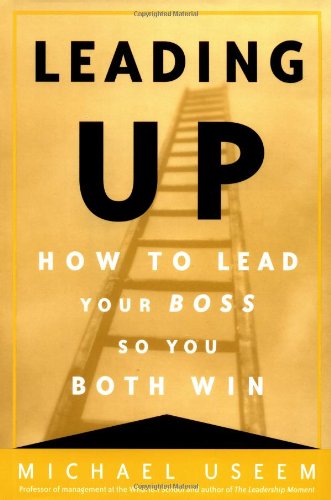
The author shares the secret to "leading up" or gently moving a superior to work at his or her own potential. 25,000 first printing.
Die Inhaltsangabe kann sich auf eine andere Ausgabe dieses Titels beziehen.
Über die Autorin bzw. den Autor
MICHAEL USEEM is a professor of management and the director of the Center for Leadership and Change Management at the Wharton School of the University of Pennsylvania. His previous book, The Leadership Moment: Nine True Stories of Triumph and Disaster and Their Lessons for Us All, offers compelling accounts of leadership when it really counted.
Aus dem Klappentext
tories show that Leaders today aren t just bosses, they re self-starters who take charge even when they haven t been given a charge. Upward leaders get results by helping their superiors lead. They make sure that good ideas don t die on the vine because a boss s understanding doesn t reach down deep enough into the organization. Upward leadership assures that advice arrives from all points on the corporate compass, not just from the top down. And it applies at every level: Even CEOs need to learn about leading up because they ultimately answer to their boards.
In Leading Up, Michael Useem offers instructive accounts of this vital and unexplored facet of leadership. Drawing on the extraordinary experiences of real people, Useem shows us what happens when those not in charge rise to the challenge, and also what happens when those who should step forward fail to do so:
* Civil War generals openly disrespected and frequently misinf
Auszug. © Genehmigter Nachdruck. Alle Rechte vorbehalten.
Chapter 1
Informing Your Commander
General Robert E. Lee Informed His Commander in Chief, but Generals Joseph E. Johnston and George B. McClellan Did Not, and Their Causes Paid Dearly
The American Civil War brought to the fore hundreds of military officers whose battlefield decisions have shaped our history. Some proved adept in commanding troops, other proved disastrous. Some worked exceedingly well with their superiors, others just the opposite.
Those dexterous -- or disastrous -- at leading up could be found on both the Union and Confederate sides of the battlefields. In this resource, neither side dominated, and both sides discovered that its supply often spelled the difference between triumph and disaster. Nowhere is this more evident than in the contrasting styles of three of the great generals of the Civil War: George B. McClellan, Joseph E. Johnston, and Robert E. Lee.
By spring of 1862, a year after Confederate rebels fired on Federal troops at Fort Sumter, South Carolina, a Union army under McClellan's command was on the offensive. With more than 120,000 troops and enormous siege guns, McClellan sent his force up a Virginia peninsula toward the Confederate capital of Richmond. His strategy was simple: destroy the defending army, capture the Confederate leadership, end the war.
Though attacking to restore the Union, George McClellan treated its commander in chief with thinly veiled disdain. In the general's view, Abraham Lincoln was uncouth, uncivilized, and untutored in battlefield affairs. McClellan would insulate his strategy against meddling from the president by resisting policy directives, inflating enemy threats, and withholding battlefield reports. For his part, Lincoln was less interested in personalities than results, but without orders honored, numbers trusted, or intelligence delivered, how could he render McClellan the support he requested?
Meanwhile, as McClellan launched his vast and unprecedented military campaign against Richmond, the Confederacy assigned its premier commander, Joseph E. Johnston, the imperative of defending the capital. Like McClellan, Johnston was supremely confident in his own generalship and brooked no advice from political superiors. To ensure that little advice was received, he kept the Confederacy's supreme commander, President Jefferson Davis, in the dark.
But President Davis had been a military commander in his own right. A graduate of West Point and a veteran of the Mexican War, he had served as chairman of the U.S. Senate's military affairs committee and as U.S. secretary of war. He expected his commanders to welcome his advice, but he also appreciated that he could render real counsel only if his commanders informed him of what they were facing in the field and what they were intending to do about it.
When a shell fragment felled Johnston on May 31, 1862, President Davis replaced him with his own aide, Robert E. Lee. General Lee continued his own well-established practice of informing and consulting with the president. The result was Davis's unswerving support for Lee. Lee received the men and materiel he required, and within days he had stopped the Union advance on Richmond that General McClellan had been unable to sustain and General Johnston unable to reverse.
By aggressively keeping his president in the picture, Lee acquired what he needed from his superior for both to win. McClellan and Johnston had not -- and they did not. As we will see in this chapter, the disparity between the upward incapacity of generals McClellan and Johnston (on opposing sides of the war) and the upward facility of General Lee could not have been greater, nor more momentous for the course of the war. Lee's exceptional ability to work with those above gave an enormous advantage to the secessionist cause in the weeks that followed. History offers few starker contrasts of upward leadership performed so differently to such great consequence, nor few clearer examples of the difference that appreciating and informing your superior can make-for you, your superior, and your mutual cause.
Setting the Stage:
Early Battles in the Civil War
Newly elected president Abraham Lincoln had warned in his inaugural address on March 4, 1861, that a "disruption of the Federal Union, heretofore only menaced, is now formidably attempted" but that the rush to "secession is the essence of anarchy." He appealed to the "mystic chords of memory, stretching from every battlefield and patriot grave to every living heart and hearthstone." He asked that we heed the "better angels of our nature."
Lincoln's words fell on deaf ears. South Carolina, Mississippi, and five other states had already declared their exit from the Union. On April 10, 1861, Brigadier General Pierre G. T. Beauregard, commander of provisional Confederate forces, demanded the surrender of the Federal garrison of Fort Sumter in the harbor of Charleston, South Carolina. The demand refused, he opened fire on the fortress and forced its surrender on April 13 without a casualty suffered on either side. Virginia announced its exit from the Union on April 17. The first land battle of the Civil War came six weeks later when a Union brigade surprised and routed a small Confederate force at Philippi, Virginia (now West Virginia). The human toll: 26 Rebel casualties and 4 Federal losses.
The first large-scale engagement of the Civil War erupted on July 21 when Confederate generals Johnston and Beauregard confronted and defeated Union General Irvin McDowell's Army of Northeastern Virginia in a battle along Bull Run near Manassas, Virginia, just twenty-five miles southwest of Washington, D.C. The engagement brutally dispelled any notion on either side that the secession would be quickly secured or crushed. Southern forces suffered 1,750 casualties, Northern forces 2,950.
In the wake of the Federal defeat at Manassas, President Lincoln on July 27 appointed George McClellan commander of the Army of the Potomac, the Union's largest and most potent fighting machine. His immediate job was to protect Washington from further attack by General Johnston, whose Confederate forces had dug in after the battle just twenty miles from the capital. Neither general, though, was yet primed to strike a decisive blow against the other-or even start a fight. As summer turned to fall, the opposing forces recruited, regrouped, and reviewed their options, but neither moved to battle. By the end of 1861, the two sides' combined losses would not total a fraction of those cut down in a single day's fighting at Antietam, Maryland, less than a year later.
In March of 1862, the standoff in northern Virginia came to an end. After rancorous debate in the White House and War Department, the Union settled on an aggressive strategy of grand attack, with George McClellan targeting the biggest prize of all, the Confederate capital. Since little remained secret in a conflict where both sides compiled a steady flow of information from newspaper reporters, amateur observers, and professional spies, the Confederacy withdrew Johnston's forces from its offensive position near Washington to a defensive posture around Richmond.
As the great confrontation took form, the combat fate of each side -- and the eventual fate of the rebellion and the republic -- depended on Johnston's and McClellan's strategic theories with respect to each other's army, on their field equipment and military discipline, on their intelligence networks, and in part on dumb luck. But it also depended in no small part on the two commanders' relations with their superiors.
In both cases, the relations were lethally impaired by the flawed behavior of the two generals themselves. Historians have judged their failings harshly. President Davis "had come to view"...
„Über diesen Titel“ kann sich auf eine andere Ausgabe dieses Titels beziehen.
Suchergebnisse für Leading Up: How to Lead Your Boss So You Both Win

Beispielbild für diese ISBN
Leading Up: How to Lead Your Boss So You Both Win
Anbieter: World of Books (was SecondSale), Montgomery, IL, USA
Verkäuferbewertung 5 von 5 Sternen

Zustand: Good. Item in good condition. Textbooks may not include supplemental items i.e. CDs, access codes etc. Artikel-Nr. 00109720396
Gebraucht kaufen
EUR 5,42
Versand gratis
Versand innerhalb von USA
Versand innerhalb von USA
Anzahl: 2 verfügbar
Beispielbild für diese ISBN
Leading Up: How to Lead Your Boss So You Both Win
Anbieter: ThriftBooks-Atlanta, AUSTELL, GA, USA
Verkäuferbewertung 5 von 5 Sternen
Hardcover. Zustand: Very Good. No Jacket. May have limited writing in cover pages. Pages are unmarked. ~ ThriftBooks: Read More, Spend Less. Artikel-Nr. G0812933109I4N00
Gebraucht kaufen
EUR 6,03
Versand gratis
Versand innerhalb von USA
Versand innerhalb von USA
Anzahl: 1 verfügbar
Beispielbild für diese ISBN
Leading Up: How to Lead Your Boss So You Both Win
Anbieter: ThriftBooks-Atlanta, AUSTELL, GA, USA
Verkäuferbewertung 5 von 5 Sternen
Hardcover. Zustand: Good. No Jacket. Pages can have notes/highlighting. Spine may show signs of wear. ~ ThriftBooks: Read More, Spend Less. Artikel-Nr. G0812933109I3N00
Gebraucht kaufen
EUR 6,03
Versand gratis
Versand innerhalb von USA
Versand innerhalb von USA
Anzahl: 1 verfügbar
Beispielbild für diese ISBN
Leading Up: How to Lead Your Boss So You Both Win
Anbieter: ThriftBooks-Dallas, Dallas, TX, USA
Verkäuferbewertung 5 von 5 Sternen
Hardcover. Zustand: Very Good. No Jacket. May have limited writing in cover pages. Pages are unmarked. ~ ThriftBooks: Read More, Spend Less. Artikel-Nr. G0812933109I4N00
Gebraucht kaufen
EUR 6,03
Versand gratis
Versand innerhalb von USA
Versand innerhalb von USA
Anzahl: 1 verfügbar
Beispielbild für diese ISBN
Leading Up: How to Lead Your Boss So You Both Win
Anbieter: ThriftBooks-Reno, Reno, NV, USA
Verkäuferbewertung 5 von 5 Sternen
Hardcover. Zustand: Very Good. No Jacket. May have limited writing in cover pages. Pages are unmarked. ~ ThriftBooks: Read More, Spend Less. Artikel-Nr. G0812933109I4N00
Gebraucht kaufen
EUR 6,03
Versand gratis
Versand innerhalb von USA
Versand innerhalb von USA
Anzahl: 1 verfügbar
Beispielbild für diese ISBN
Leading Up : How to Lead Your Boss So You Both Win
Verlag:
Penguin Random House South Africa, 2001
ISBN 10: 0812933109
ISBN 13: 9780812933109
Gebraucht
Hardcover
Erstausgabe
Anbieter: Better World Books, Mishawaka, IN, USA
Verkäuferbewertung 5 von 5 Sternen
Zustand: Very Good. 1st. Former library copy. Pages intact with possible writing/highlighting. Binding strong with minor wear. Dust jackets/supplements may not be included. Includes library markings. Stock photo provided. Product includes identifying sticker. Better World Books: Buy Books. Do Good. Artikel-Nr. 5446537-6
Gebraucht kaufen
EUR 6,25
Versand gratis
Versand innerhalb von USA
Versand innerhalb von USA
Anzahl: 2 verfügbar
Beispielbild für diese ISBN
Leading Up : How to Lead Your Boss So You Both Win
Verlag:
Penguin Random House South Africa, 2001
ISBN 10: 0812933109
ISBN 13: 9780812933109
Gebraucht
Hardcover
Erstausgabe
Anbieter: Better World Books, Mishawaka, IN, USA
Verkäuferbewertung 5 von 5 Sternen
Zustand: Very Good. 1st. Pages intact with possible writing/highlighting. Binding strong with minor wear. Dust jackets/supplements may not be included. Stock photo provided. Product includes identifying sticker. Better World Books: Buy Books. Do Good. Artikel-Nr. 4333639-6
Gebraucht kaufen
EUR 6,25
Versand gratis
Versand innerhalb von USA
Versand innerhalb von USA
Anzahl: 1 verfügbar
Beispielbild für diese ISBN
Leading Up: How to Lead Your Boss So You Both Win
Anbieter: Wonder Book, Frederick, MD, USA
Verkäuferbewertung 5 von 5 Sternen
Zustand: Good. Good condition. Good dust jacket. With remainder mark. A copy that has been read but remains intact. May contain markings such as bookplates, stamps, limited notes and highlighting, or a few light stains. Artikel-Nr. E15N-02169
Gebraucht kaufen
EUR 6,32
Versand gratis
Versand innerhalb von USA
Versand innerhalb von USA
Anzahl: 1 verfügbar
Beispielbild für diese ISBN
Leading up: How to Lead Your Boss So You Both Win
Anbieter: AwesomeBooks, Wallingford, Vereinigtes Königreich
Verkäuferbewertung 5 von 5 Sternen
Hardcover. Zustand: Very Good. Leading up: How to Lead Your Boss So You Both Win This book is in very good condition and will be shipped within 24 hours of ordering. The cover may have some limited signs of wear but the pages are clean, intact and the spine remains undamaged. This book has clearly been well maintained and looked after thus far. Money back guarantee if you are not satisfied. See all our books here, order more than 1 book and get discounted shipping. Artikel-Nr. 7719-9780812933109
Gebraucht kaufen
EUR 4,50
EUR 4,79 Versand
Versand von Vereinigtes Königreich nach USA
Versand von Vereinigtes Königreich nach USA
Anzahl: 2 verfügbar
Foto des Verkäufers
Leading Up: How to Lead Your Boss So You Both Win
Anbieter: WeBuyBooks, Rossendale, LANCS, Vereinigtes Königreich
Verkäuferbewertung 5 von 5 Sternen
hardcover. Zustand: Very Good. Most items will be dispatched the same or the next working day. A copy that has been read, but is in excellent condition. Pages are intact and not marred by notes or highlighting. The spine remains undamaged. Artikel-Nr. rev8876065473
Gebraucht kaufen
EUR 2,41
EUR 7,71 Versand
Versand von Vereinigtes Königreich nach USA
Versand von Vereinigtes Königreich nach USA
Anzahl: 1 verfügbar