
Verwandte Artikel zu The Hard Road to the Softer Side: Lessons from the...
Inhaltsangabe
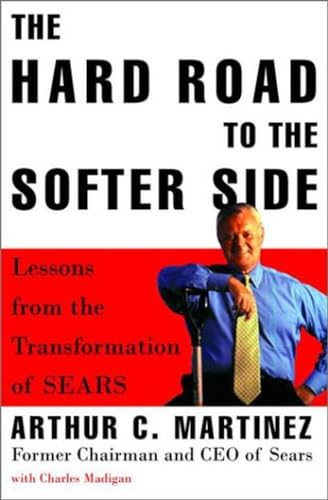
The former CEO of Sears describes his career and the transformation of the company from a troubled, confused corporation with a Soviet-style bureaucracy faced with huge losses in 1992, to its 1997 battle with aggressive new competitors and the ethics of new business, to its current status as a healthy company dealing with the new economy. 35,000 first printing.
Die Inhaltsangabe kann sich auf eine andere Ausgabe dieses Titels beziehen.
Über die Autorin bzw. den Autor
Arthur C. Martinez was chairman and CEO of Sears, Roebuck and Company from 1995 to 2000 and chairman and CEO of its retail arm, Sears Merchandise Group from 1992 to 1995. Prior to Sears, he was vice chairman at Saks Fifth Avenue, where he worked in various senior positions for 12 years. <br><br>Charles Madigan is the Sunday perspective editor of the <i>Chicago Tribune</i> and a <i>Tribune</i> senior writer. He is also coauthor of the business bestseller <b>Dangerous Company</b>, and he collaborated on <b>Lessons from the Heart of American Business</b> by Gerald Greenwald, former chairman and CEO of United Airlines.
Aus dem Klappentext
er part of a century, Sears, Roebuck and Company touched the lives of almost everyone in America. A stunning tale of marketing and savvy, the company started selling watches and quickly became an essential source of goods for the American home. Sears brought the Christmas dreams of distant children to life; introduced the American homemaker to a collection of appliances that stripped much of the drudgery from daily living; and put solid, dependable tools in the hands of strong, eager men. At the same time, it forged a solid relationship with its customers, earning that most valuable business asset of them all: loyalty.<br><br>And then, when it could least afford to, Sears lost its way. It gradually forgot about its customers. It no longer understood (or cared) who its competitors were. It shifted its focus inward, to the interests and needs of its huge bureaucracy, all at the expense of the customers who found themselves in declining, dismal stores. The greatest retailer in world history had bec
Auszug. © Genehmigter Nachdruck. Alle Rechte vorbehalten.
Chapter 1
Sears' History:
The Bad and the Brilliant
In the life of every individual and in the life of every corporation there is a defining moment. The thinking, the abstraction of planning, melts away, the fog lifts, the air clarifies, and under a bright sun and fresh sky, what must be done takes on a stunning, undeniable shape. It is rare that an event of that nature would happen in the life of a corporation and in the life of an individual at the same time.
My moment, and Sears' moment, too, came on a company jet with a handful of Sears executives heading home from a trip to Mexico to review the company's business there. It was early December 1992. I had been on the Sears team for only three months. I had been brought in to revive the Sears retail business, its merchandising group, and potentially to run the whole company. (I'll tell you later about the unusual journey that carried me to Sears, a trip that led some to conclude I had lost my mind.)
My first weeks on the job had been real eye-openers.
I dove deep into this treasure of a company and found layer upon layer of trouble, a hemorrhaging of red ink, indecision about what to do, and an almost palpable anxiety.
My most formidable adversary, and ultimately my strongest ally, would be culture, a century of culture and the mammoth bureaucracy it had created. Bureaucracy was so deeply developed and planted at Sears that it seemed for all the world as though the place had been designed by one of those obsessive Soviet functionaries at mid-century. At the same time, a lot of it took on the earmarks of the classic Potemkin village, with fresh paint and flowers on the outside masking an operation that was close to collapse. The enemy, I knew from the outset, was us. The challenge would be to find what was solid, dependable, even brilliant inside of this company and use it to create an entirely new Sears.
That had been my message and my mantra since the day I arrived at Sears: Cultural transformation must always be at the top of the agenda at Sears. The reason for that was the same on the day I left as it was on the day I first walked in.
Sears was in love with its past and entrapped by it at the same time.
Trapped in the Amber of Its Own History
These kinds of things happen to institutions all the time. They keep playing out yesterday's agenda without recognizing that the world has changed and that it continues to change every minute of every day. They ride their old horses onto a modern battlefield, then puzzle about why they are losing a war to an enemy who has tanks and machine guns.
The great irony was that Sears had been a model for change from the very beginning, from its huge catalog operation to its shift to retail stores, a wrenching struggle that transformed the nature of the company, and the nature of the American retailing industry at the same time. Even as I was leaving in the fall of 2000, Sears was embarking on another in its long string of adventures, this time moving onto the Internet, finding a new way to reach customers and meet their needs.
At the same time, the company I walked into in 1992 was becoming the poster child of the business stagnation movement. It was as though Sears had forgotten the strongest parts of its own history, the most important lessons it had learned in decades of serving the American consumer.
Sears' roots were more than a century deep. The company had earned a strong and important place in American history. It could not be viewed as just another big business slipping off track, or as an ailing dinosaur waiting for time to bleach it into whitened bones. If the company died, a big piece of history would die with it, along with the dreams of thousands upon thousands of customers, employees, and investors everywhere.
I was the outsider on that flight from Mexico, but I was beginning to know what had gone wrong, and I had a strong sense of where we had to go to fix it. It was going to be a tough, long march, a struggle to save the part of Sears history that was golden and shed the parts that were locking the company in a bad place. This would be a battle with a vast bureaucracy and a deep, troubled culture and everything that entails. I am not a shy man, but I knew the scope of the challenge I was facing. No one had ever revived a retailing business of this size-or, for that matter, just about any other business of this size.
Resistance to Change
I didn't know then that I would have to face that challenge twice during my eight years at Sears, that the same demons that caused problems for Sears the first time around were waiting on the sidelines, even as we were racking up strong numbers and basking in the glory of a successful transformation.
The basking, I came to understand, was one of the problems at Sears. There was, and there remained, a strong institutional tendency to sit back and conclude that all the problems were solved, that the retailing heroes had fixed it once and for all.
That was never the case. Sears was an institution that needed to be pushed, prodded, or shaken at least once a day. The story was in the numbers.
In 1992, Sears had sales of more than $50 billion in some 800 stores and 2,000 other locations around the nation. It was an insurance company, a real estate company, a banker, an investment company. It wound up losing $3.9 billion in that awful year.
It was a humbling experience, but, apparently, not humbling enough. Even that level of loss was not enough to shake the company to its foundation and force it onto a different track.
Ed Brennan, chief executive officer at the time and a Searsman to his very soul, the last in a long line of Searsmen in his family, was on the jet, along with a few other Sears veterans and financial people who had been wrestling with the company's problems for years. Sears was lost in the sea of the marketplace, clinging to its remarkable history the way a shipwrecked sailor clings to the one piece of oak that keeps him from drowning. The customers who had made Sears a marketplace legend were abandoning us. The stores were in bad shape, capital starved and looking it.
Our competitors were coming from all sides. Home Depot and Wal-Mart were gobbling up market share. In malls all over America, many of them there because Sears put them there by deciding on its location a long time ago, competitors large and small were stealing our customers. They were offering state-of-the-art retailing to enlivened shoppers who had found so many new places to spend money that we simply weren't competing anymore.
We had made embarrassing mistakes. We were struggling with the fallout of an auto store fraud scandal on the West Coast. A whole decade of internal tinkering had failed to address the company's problems in the marketplace. The institution was turning almost completely inward, focusing on itself instead of its customers and its competition, a problem I would struggle with for eight years. My challenge was to take that declining retail business and revive it: to find out what was wrong, find a new customer, and strengthen what Sears had to sell to bring the place into the black again.
That flight from Mexico was all about the kinds of changes that had to happen if we were to save Sears from its competitors and, in a very real way, to save it from itself. That was one of the deepest problems at Sears, a culture that simply would not change, that kept looking to the past for solutions to problems that were brand new. As the outsider, I had very bad news to deliver. I had looked at the Sears universe from every conceivable angle, and what I had concluded was that there was trouble at its heart. We had to invent a new Sears that would compete with the best, that would draw back its customers, enliven its employees,...
„Über diesen Titel“ kann sich auf eine andere Ausgabe dieses Titels beziehen.
Suchergebnisse für The Hard Road to the Softer Side: Lessons from the...

Beispielbild für diese ISBN
The Hard Road to the Softer Side : Lessons from the Transformation of Sears
Verlag:
Crown Publishing Group, The, 2001
ISBN 10: 0812929608
ISBN 13: 9780812929607
Gebraucht
Hardcover
Erstausgabe
Anbieter: Better World Books, Mishawaka, IN, USA
Verkäuferbewertung 5 von 5 Sternen

Zustand: Good. 1st. Pages intact with minimal writing/highlighting. The binding may be loose and creased. Dust jackets/supplements are not included. Stock photo provided. Product includes identifying sticker. Better World Books: Buy Books. Do Good. Artikel-Nr. 4293389-6
Gebraucht kaufen
EUR 9,15
Versand gratis
Versand innerhalb von USA
Versand innerhalb von USA
Anzahl: 1 verfügbar
Beispielbild für diese ISBN
The Hard Road to the Softer Side: Lessons from the Transformation of SEARS
Anbieter: ThriftBooks-Atlanta, AUSTELL, GA, USA
Verkäuferbewertung 5 von 5 Sternen
Hardcover. Zustand: Fair. No Jacket. Missing dust jacket; Readable copy. Pages may have considerable notes/highlighting. ~ ThriftBooks: Read More, Spend Less. Artikel-Nr. G0812929608I5N01
Gebraucht kaufen
EUR 9,15
Versand gratis
Versand innerhalb von USA
Versand innerhalb von USA
Anzahl: 1 verfügbar